
How do you start an indoor herb garden? Pick easy herbs such as basil, chives, mint and parsley, plant each in its own draining pot of light potting mix, and give them a south-facing window or a full-spectrum grow light 6–12 inches (15–30 cm) above the leaves for 12–16 hours a day. Water when the mix starts to dry.
Key takeaway: Light is the main limit for an indoor herb garden. Iowa State Extension says most herbs want about eight hours of direct light indoors, so a sunny window or a simple LED setup on a timer makes the biggest difference. Light feeding and regular snipping keep plants compact.
| Indoor herb garden factor | Target | Source |
|---|---|---|
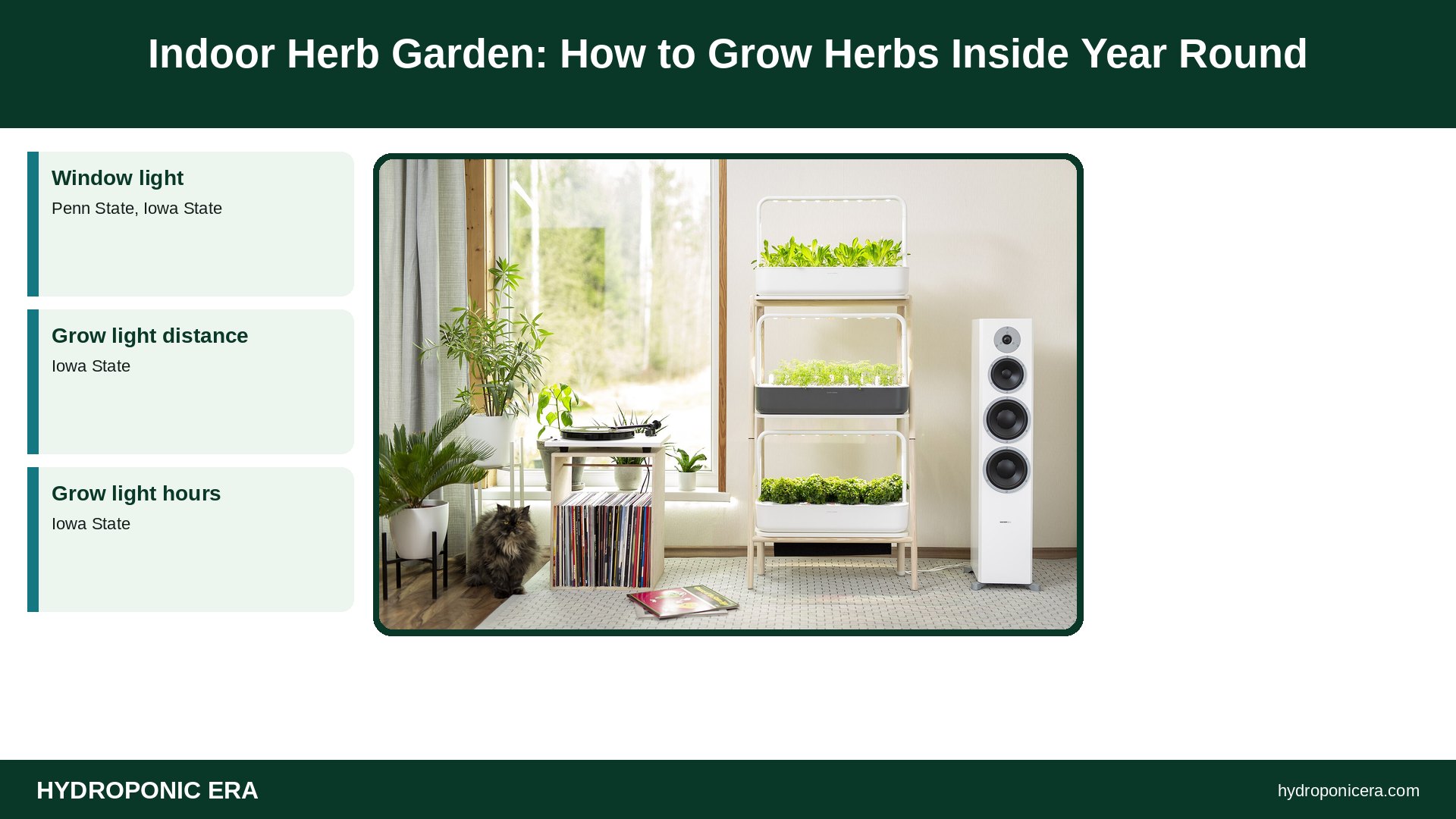
| Window light | South window; 6–8+ hours direct sun | Penn State, Iowa State |
| Grow light distance | 6–12 inches (15–30 cm) above leaves | Iowa State |
| Grow light hours | 12–16 hours a day on a timer | Iowa State |
| Day / night temperature | 65–70°F (18–21°C) / 55–60°F (13–16°C) | Penn State |
| Potting mix | 2 parts soilless mix : 1 part perlite | UMD |
| Fertilizer | Quarter- to half-strength, spring to summer | Iowa State |
Which Herbs Grow Best in an Indoor Herb Garden?
The easiest herbs for an indoor herb garden are parsley, mint, chives, basil, oregano, cilantro and thyme, according to Iowa State Extension, because they tolerate the lower light, low humidity and cooler air found in homes. Rosemary, sage, lemon balm, marjoram, chervil and bay laurel can work too, but they need more light and often attract pests such as spider mites indoors.
| Herb group | Examples | Light need indoors |
|---|---|---|
| Easiest starters | Parsley, mint, chives, basil | Bright window or grow light |
| Tolerate lower light | Lemon balm, chives, cilantro (2–6 hours direct sun) | East or west window |
| Need full sun | Bay, rosemary, thyme | South window or close LED |
| Avoid indoors | Horseradish, fennel, lovage (large roots) | Better outdoors |
Penn State Extension adds that tarragon is toxic to dogs and cats, so skip it in homes with pets. For soil-free options, see our list of the best herbs for hydroponics.
How Much Light Does an Indoor Herb Garden Need?
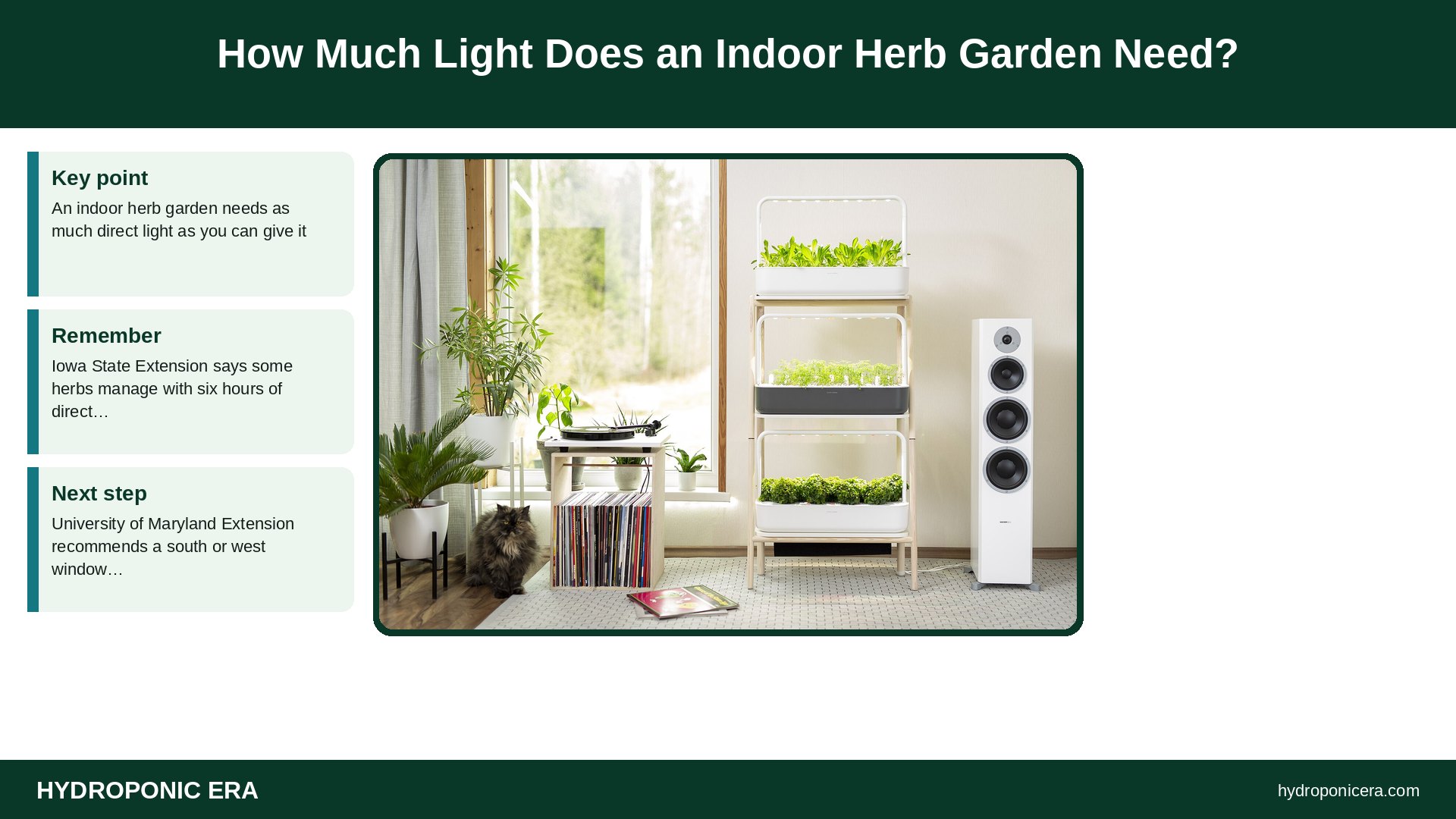
An indoor herb garden needs as much direct light as you can give it. Iowa State Extension says some herbs manage with six hours of direct light, but most want eight or more. University of Maryland Extension recommends a south or west window with at least five hours of sun, and grow lights for 14–16 hours a day in winter.
Herbs short on light turn thin and spindly, with small leaves and weaker aroma, Penn State warns. Rotate windowsill pots often so every side gets light.
What Grow Light Setup Works for an Indoor Herb Garden?
A simple full-spectrum LED setup on a timer works well for an indoor herb garden. Iowa State Extension says setups range from a compact bulb in a task lamp for a few pots to a plug-in 4-foot (1.2 m) LED shop light for a larger collection. Hang lights 6–12 inches (15–30 cm) above the leaves and run them 12–16 hours a day.
- Choose full-spectrum, high-output fixtures, as Iowa State suggests.
- Set the height so the light sits 6–12 inches (15–30 cm) above the tallest leaves.
- Plug into a timer for 12–16 hours on and a dark period every night.
- Raise the light as plants grow, keeping the same gap.
- Group herbs by light need so sun lovers sit in the brightest center.
For exact distances by growth stage, see our light distance and hanging height guide. A tiered rack like our seed starting shelf with grow lights also suits herbs.
What Pots and Soil Should an Indoor Herb Garden Use?
Use pots with drainage holes and a light, fast-draining mix. UMD Extension suggests two parts soilless potting mix to one part perlite. Iowa State recommends clay or terracotta because the porous walls dry faster, and warns that oversized pots stay wet too long. Grow each herb in its own container, since one pot rarely suits several species.
Penn State adds that herbs with taproots, such as borage, need deep pots, while trailing herbs can go in hanging baskets.
How Often Should You Water and Feed an Indoor Herb Garden?
Water when the mix starts to dry, and feed lightly. Iowa State Extension says most herbs do not tolerate wet soil, so let the surface dry between waterings. UMD notes bay, marjoram, oregano, sage and thyme should dry out more between drinks. Use room-temperature water.
| Task | Guideline | Source |
|---|---|---|
| Watering | When the mix starts to dry; never soggy | Penn State, Iowa State |
| Fertilizer strength | Quarter or half strength | Iowa State |
| Fertilizer timing | Early spring through summer; skip winter | Iowa State |
| Low-dose schedule | Water-soluble feed about every 2 weeks | Penn State |
Penn State cautions that feeding too often can weaken aroma and taste, and that some organic fertilizers smell fishy indoors.
What Temperature and Humidity Do Indoor Herbs Like?
Indoor herbs like 65–70°F (18–21°C) by day and 55–60°F (13–16°C) at night, according to Penn State Extension. Basil cannot survive below 50°F (10°C), so keep it off cold winter windowsills. Group pots or set them on a tray of moist pebbles to raise humidity in heated homes, and run a fan if air turns stuffy.
UMD adds: keep herbs away from drafts and dry heat vents.
How Do You Harvest an Indoor Herb Garden Without Killing It?
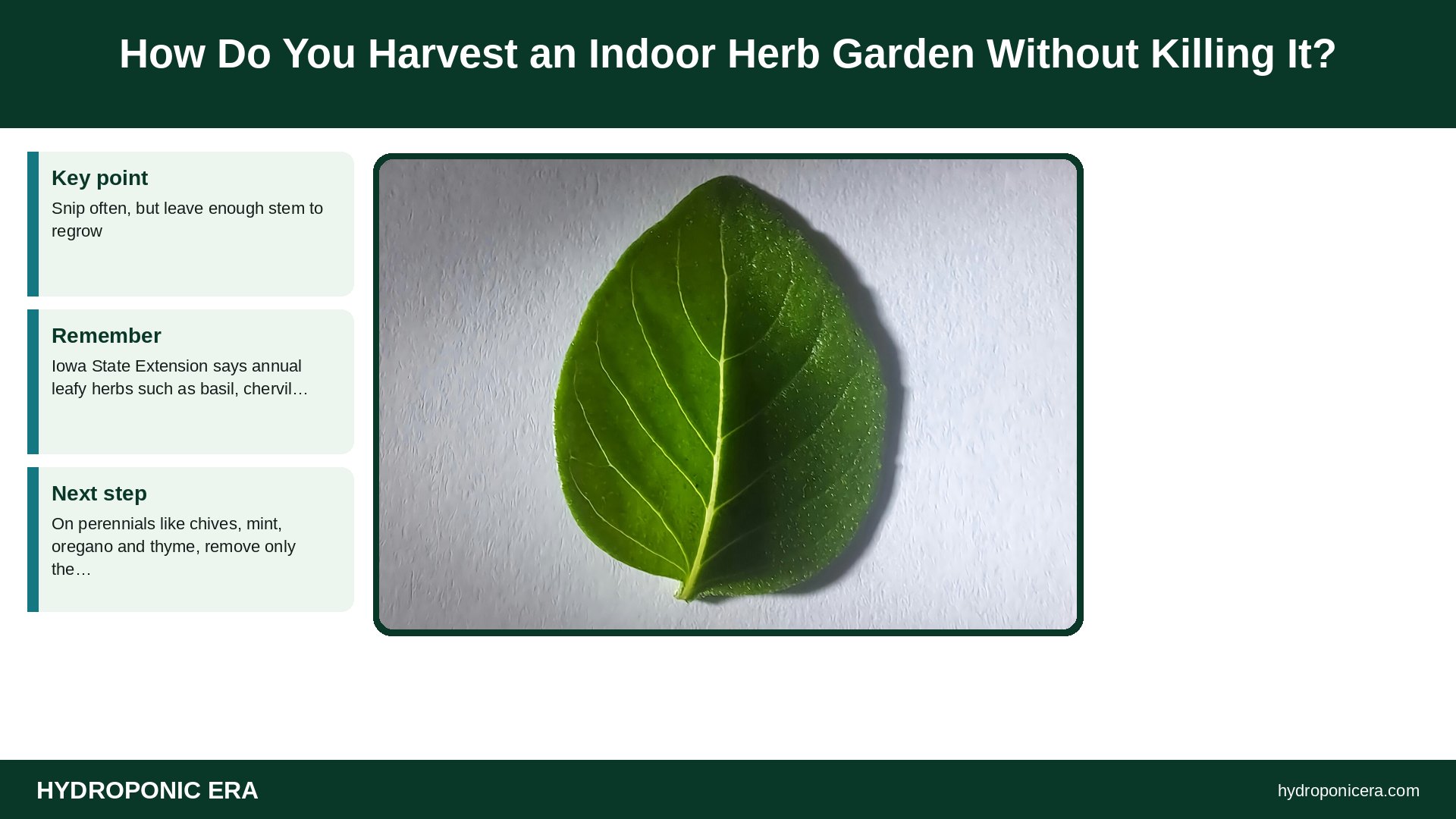
Snip often, but leave enough stem to regrow. Iowa State Extension says annual leafy herbs such as basil, chervil and parsley can be cut back hard, just above a leaf pair, leaving about 4–6 inches (10–15 cm) of stem. On perennials like chives, mint, oregano and thyme, remove only the top one-third.
After several harvests, replace old annual plants with new seedlings. Our guides to growing basil hydroponically and mint hydroponically cover pinching in more detail.
How Do You Control Pests in an Indoor Herb Garden?
- Fungus gnats: Penn State suggests yellow sticky traps and better watering habits. See fungus gnats in hydroponics.
- Aphids: trim off infested stems and bag them in the trash.
- Spider mites: watch rosemary and sage closely, Iowa State warns.
- Sprays: Penn State notes neem or Bt products are for extreme cases only, following the label, since you eat the leaves. Always wash herbs before cooking.
Do Indoor Herbs Taste as Strong as Outdoor Herbs?
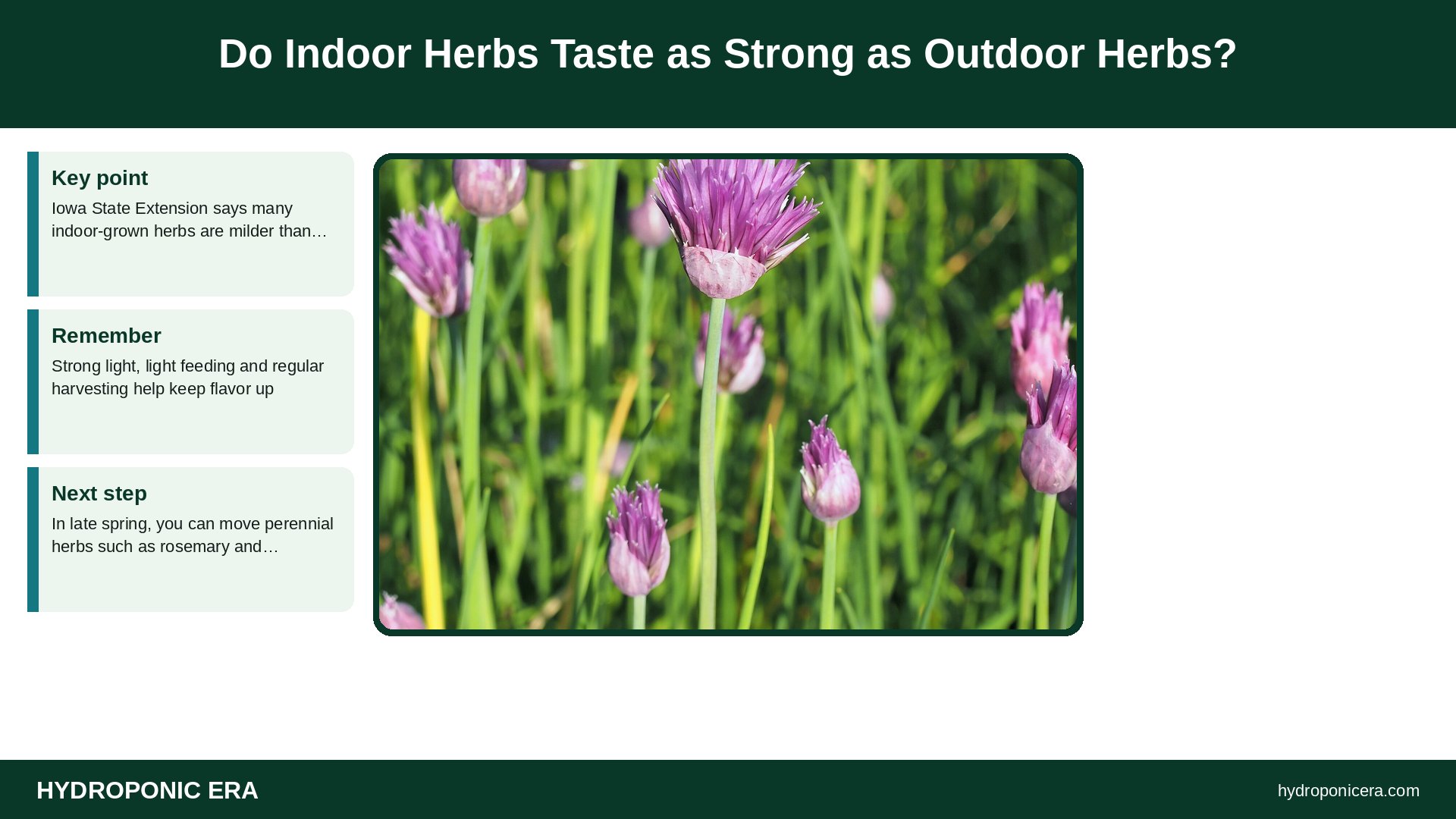
Often not quite. Iowa State Extension says many indoor-grown herbs are milder than outdoor herbs, though basil still tastes like basil. Strong light, light feeding and regular harvesting help keep flavor up. In late spring, you can move perennial herbs such as rosemary and marjoram outdoors, acclimating them slowly to sun and wind, as Penn State advises.
FAQs
Can I grow herbs in a north window?
Rarely well. Add a grow light, since most herbs want 6–8+ hours of direct light.
Can I plant several herbs in one pot?
Iowa State advises one herb per pot, since needs differ.
When should I repot?
When roots grow through the drainage hole, ideally in early spring, Penn State says.
Why are my herbs leggy?
Too little light. Move them closer to a window or lower the grow light.
Can I grow herbs indoors without soil?
Yes. Basil, mint and parsley grow well in small hydroponic systems.
Sources
- Iowa State University Extension — Growing Herbs Indoors
- Iowa State University Extension — How can I provide more light for my herbs indoors?
- Penn State Extension — Growing Herbs Indoors
- University of Maryland Extension — Growing Herbs in Containers and Indoors
- Photo credits (Wikimedia Commons, edited with titles): Click & Grow Smart Garden 27 by Janar Raidla (CC BY-SA 4.0); Click & Grow Smart Garden 27 by Janar Raidla (CC BY-SA 4.0); Ocimum Basilicum leaf lighted by the left by BernaBotto (CC BY-SA 4.0); Allium schoenoprasum Szczypiorek 2019-05-17 01 by Agnieszka Kwiecień, Nova (CC BY-SA 4.0); Petroselinum crispum 2011 by 4028mdk09 (CC BY-SA 3.0)