
How do you grow lilaeopsis in an aquarium? Plant small clumps, about 1/8 of a pot each, a few centimeters apart in an open, brightly lit foreground. Tropica says a lawn effect 1.6 to 2.8 inches (4 to 7 cm) tall only forms under high light. Dennerle lists 64 to 79°F (18 to 26°C), pH 6 to 8 and slow, steady growth.
Key takeaway: Lilaeopsis brasiliensis is a grass-like foreground plant from South America in the carrot family (Apiaceae). It spreads by runners into a short lawn. Tropica rates its light and CO2 needs as low but says the lawn effect needs high light; Dennerle lists high light, 10–20 mg/L CO2, 64–79°F (18–26°C) and pH 6–8. Expect slow growth and trim it like a lawn.
| Fact | What sources report | Source |
|---|---|---|
| Family and origin | Apiaceae; South America | Dennerle, Tropica |
| Growth form | Spreads by runners (stolons) | Tropica, Dennerle |
| Height | 1.2–2+ in (3–5+ cm) after two months; up to 3 in (8 cm) | Tropica, Dennerle |
| Light | Low rating, but lawn needs high light (Tropica); high (Dennerle) | Tropica, Dennerle |
| CO2 | Low (Tropica); 10–20 mg/L (Dennerle) | Tropica, Dennerle |
| Water | 64–79°F (18–26°C); pH 6–8; very soft to hard | Dennerle |
| Salt | Tolerates low salt in brackish tanks | Tropica |
What Is Lilaeopsis?
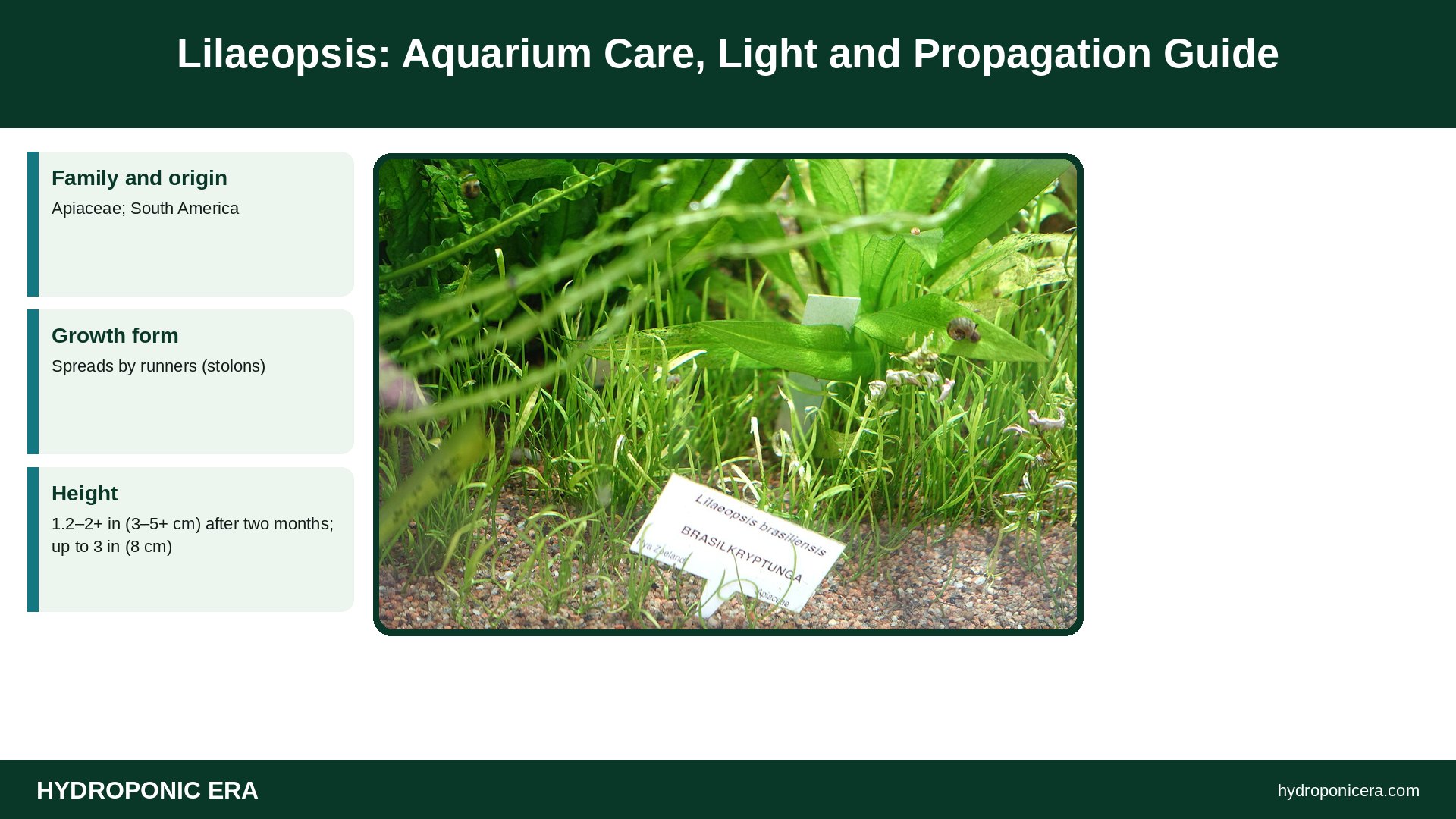
Lilaeopsis is a genus of small, grass-like plants, and the one usually sold for aquariums is Lilaeopsis brasiliensis. Dennerle places it in the carrot family (Apiaceae) and says it colonizes riverbanks and marshes in South America at elevations over 3,300 feet (1,000 m). Its look resembles dwarf sagittaria, so it is sometimes called “false tenellus.”
Each plant has flat, spoon-tipped leaves on runners that creep through the substrate. Tropica calls it a stolon plant that can grow very compact. Another species, Lilaeopsis novae-zelandiae from New Zealand, is also sold in the hobby; check the label, since growth and leaf shape differ.
- Use: foreground lawn or edge planting.
- Also grows: in garden ponds and lightly brackish tanks, per Tropica.
- Similar carpets: Monte Carlo and Hydrocotyle tripartita.
How Do You Plant Lilaeopsis in an Aquarium?
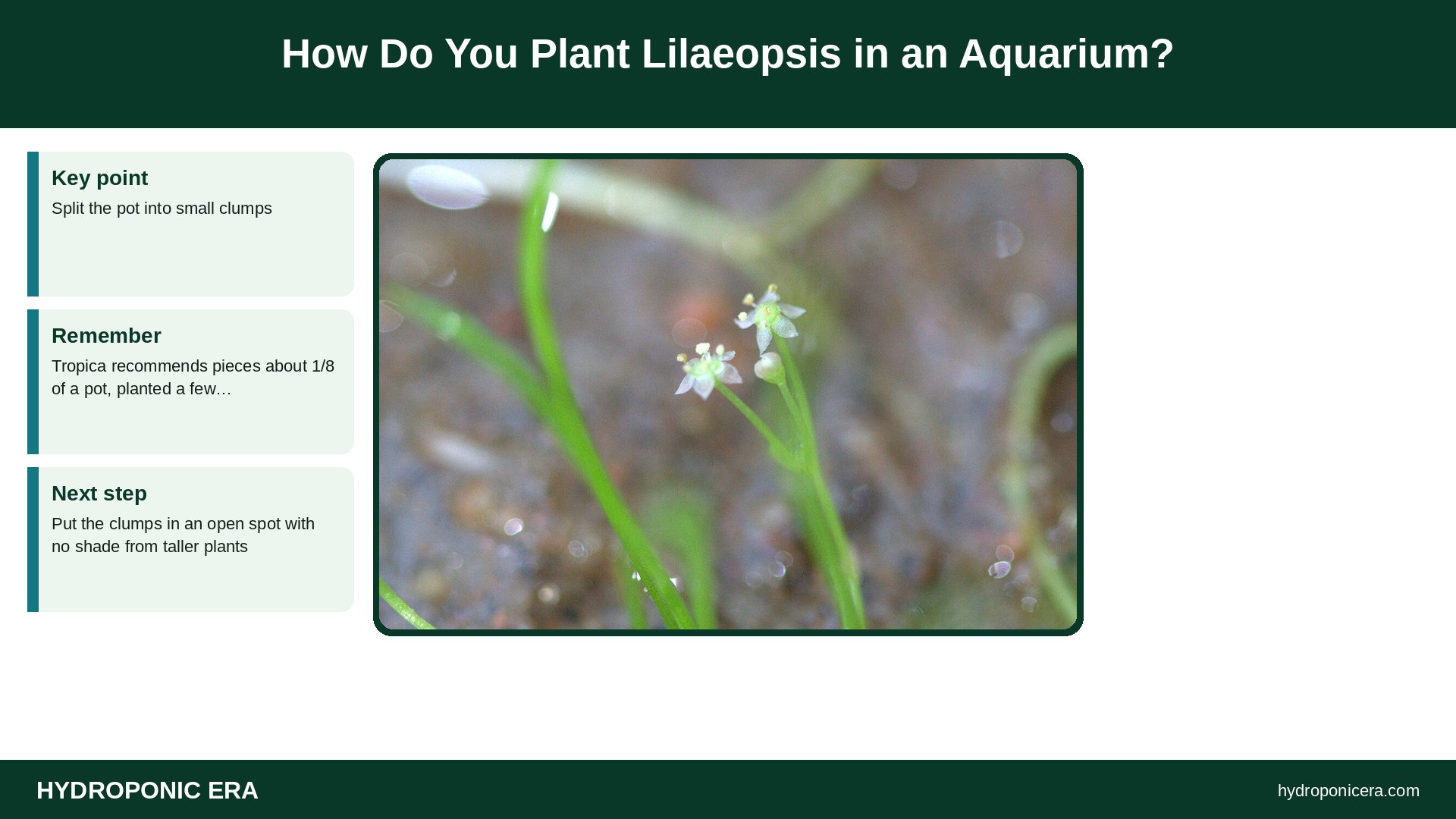
Split the pot into small clumps. Tropica recommends pieces about 1/8 of a pot, planted a few centimeters apart so they grow together faster. Put the clumps in an open spot with no shade from taller plants. Use a fine substrate so the runners can spread easily.
- Remove the pot and rock wool gently.
- Divide the clump into 8 small pieces.
- Plant each piece about 1 inch (2.5 cm) apart with tweezers.
- Keep tall plants out of the light path.
- Run lights 7 to 8 hours a day at first to limit algae.
What Light, CO2 and Fertilizer Does Lilaeopsis Need?
Strong light gives the best lawn. Tropica rates light and CO2 as low, but adds that the compact lawn effect is only reached at high light intensity. Dennerle lists high light with 10 to 20 mg/L CO2. Low light keeps the plant alive but taller and sparse.
- Light: medium to high over the foreground.
- CO2: helpful; see aquarium CO2 for plants.
- Root feed: runners spread faster in rich soil or with root tabs.
- Liquid feed: light weekly dosing of aquarium plant fertilizer.
What Water Parameters Does Lilaeopsis Like?
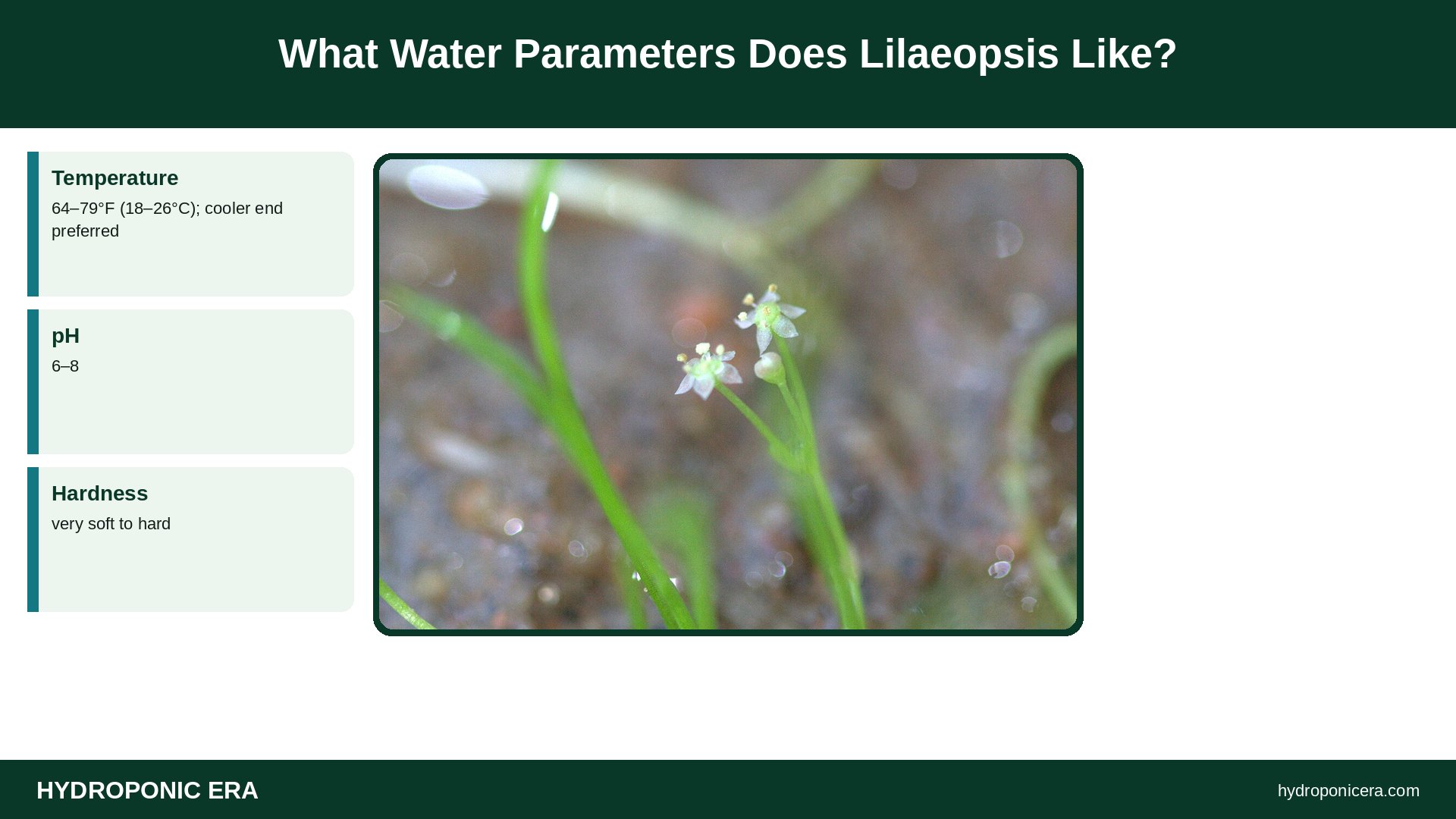
Dennerle lists 64 to 79°F (18 to 26°C), pH 6 to 8 and very soft to hard water, and says it prefers fairly cool temperatures. It grows in soft or hard water alike. Tropica adds that it tolerates low salt levels in brackish aquariums, which few carpet plants do.
- Temperature: 64–79°F (18–26°C); cooler end preferred.
- pH: 6–8.
- Hardness: very soft to hard.
How Do You Trim and Propagate Lilaeopsis?
Mow it. Dennerle says radical pruning, as with a lawn, encourages compact growth, and lists runners and division for propagation. Cut the leaves low with curved scissors once the lawn gets taller than you want. To spread it, lift a section with runners and replant it in a bare area.
- Trim leaves down to about 0.5–1 inch (1.3–2.5 cm).
- Siphon out loose clippings.
- Cut runners with a few plantlets and replant them.
- Repeat every few weeks once the lawn fills in.
Why Is Lilaeopsis Melting or Not Growing?
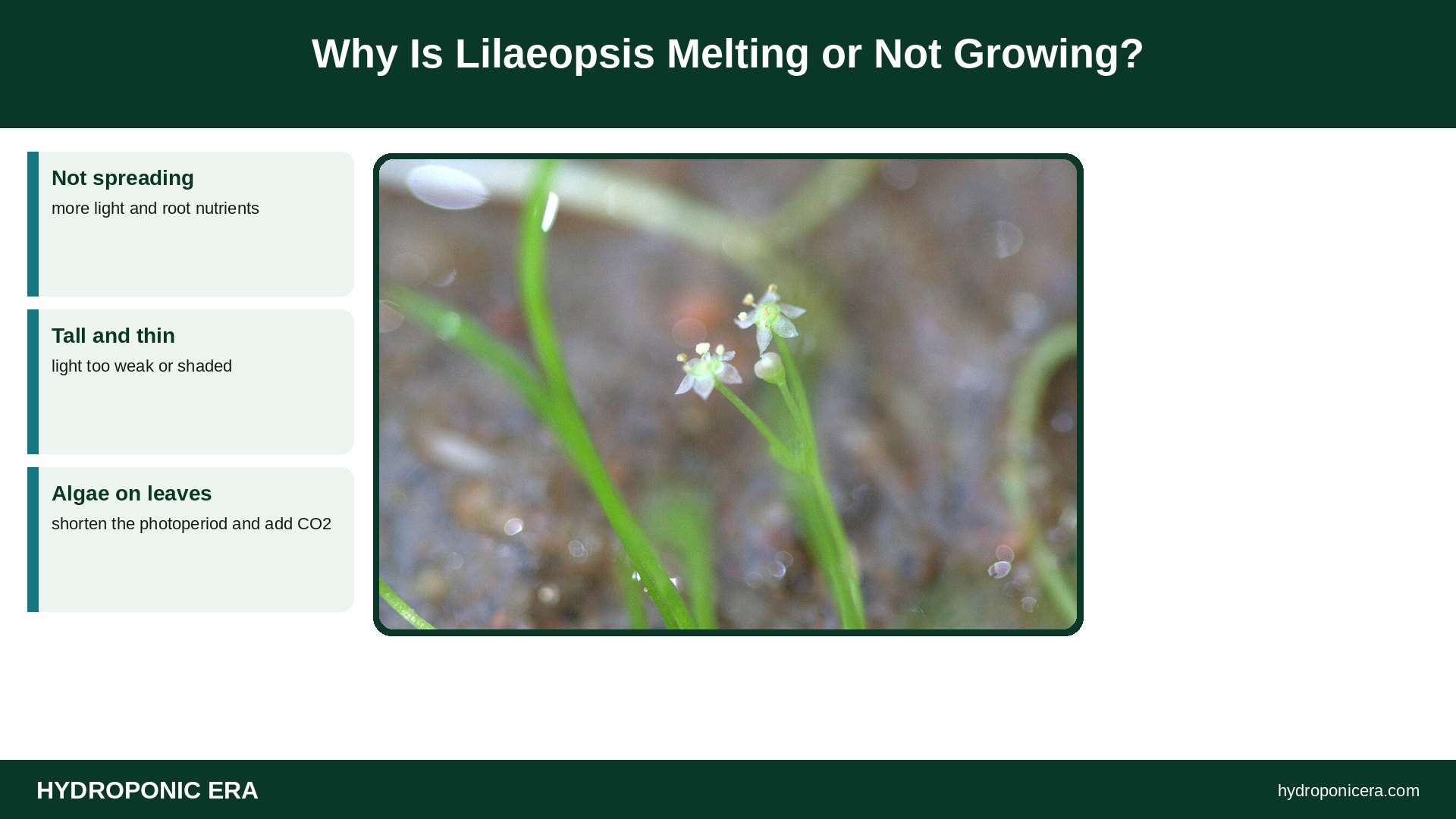
Slow growth is normal. Tropica rates it slow and Dennerle says it grows extremely slowly, even though its profile says moderate. Real problems are shading, low light and algae coating the leaves. Melting soon after planting usually affects old emersed leaves; new submerged leaves follow.
- Not spreading: more light and root nutrients.
- Tall and thin: light too weak or shaded.
- Algae on leaves: shorten the photoperiod and add CO2.
- Melting: trim dead leaves and wait for new growth.
FAQ About Lilaeopsis
Is lilaeopsis a carpet plant?
Yes; it spreads by runners into a short lawn under high light.
Does this carpet plant need CO2?
No, but Dennerle lists 10–20 mg/L for best growth.
How tall does this plant get?
About 1.2–3 inches (3–8 cm).
Can it grow in brackish water?
Tropica says it tolerates low salt levels.
Why is my lawn growing so slowly?
It is naturally slow; add light and nutrients.
How do you propagate it?
Divide the clumps or replant runners.
Sources
- Tropica Aquarium Plants — L. brasiliensis plant info/18808)
- Dennerle Plants — L. brasiliensis plant profile/27890)
- Photo credits (Wikimedia Commons, edited with titles): Lilaeopsis brasiliensis – Victoriahuset, Bergianska trädgården – Stockholm, Sweden – DSC00261 by Daderot (CC0); Lilaeopsis brasiliensis flower (1) by Averater (CC BY-SA 3.0)