
How do you care for dwarf sagittaria? Dwarf sagittaria (Sagittaria subulata) is an undemanding carpet plant that spreads by short runners. Tropica rates it low light and medium CO2 and suggests spacing plantlets 0.8–1.6 in (2–4 cm) apart. Trim tall leaves, since older plants can suddenly reach 20 in (50 cm).
Key takeaway: Dwarf sagittaria is one of the easiest grassy carpets for low-tech tanks. Plant it in the foreground, feed the roots, and keep light moderate. Tropica notes it may grow tall with age but often stays low again if moved. In the wild it is a native awl-leaf arrowhead of tidal marshes, per UF/IFAS.
| Need | Detail | Source |
|---|---|---|
| Position | Foreground carpet | Tropica |
| Height | 2–12 in (5–30 cm); can reach 20 in (50 cm) | Tropica |
| Spacing | 0.8–1.6 in (2–4 cm) apart | Tropica |
| Light | Low to moderate | Tropica |
| CO2 | Medium; ‘Needle Leaf’ needs no added CO2 | Tropica |
| Spread | Runners (stolons) | Tropica |
What Is Dwarf Sagittaria?
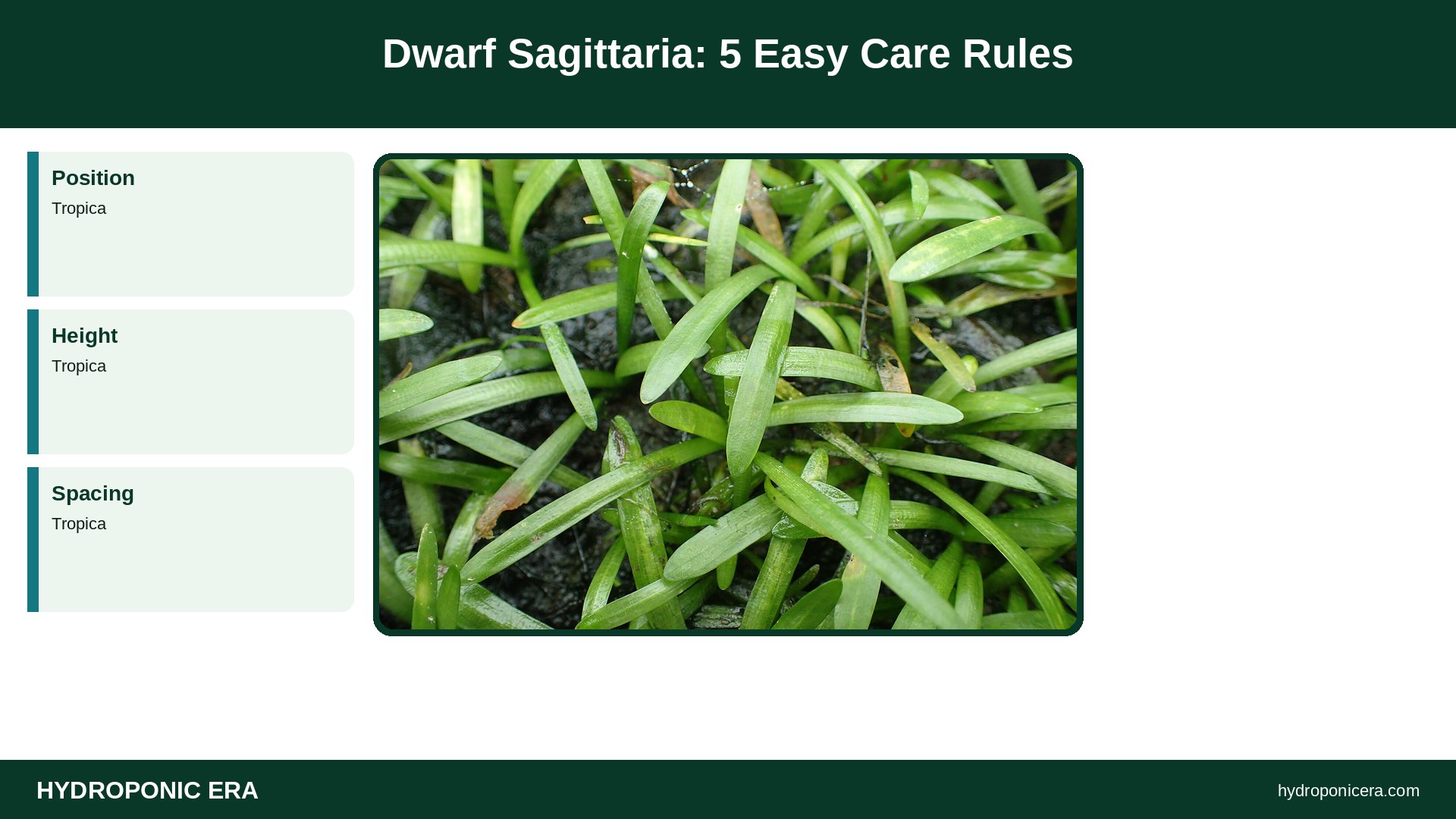
Dwarf sagittaria is a grass-like rosette plant in the arrowhead genus. Tropica describes Sagittaria subulata as an ideal, undemanding foreground plant whose short runners form a compact group. UF/IFAS calls the species awl-leaf arrowhead and says it occurs in tidal marshes from Florida’s northern counties south to the central peninsula, almost always in natural wetlands.
Do not confuse it with Sagittaria sagittifolia, an Old World arrowhead that appears on the USDA APHIS Federal Noxious Weed List. Sagittaria subulata itself is not on that list, but always check state rules before releasing any aquarium plant outdoors, and never dump trimmings into ponds or streams.
How Do You Plant Dwarf Sagittaria?
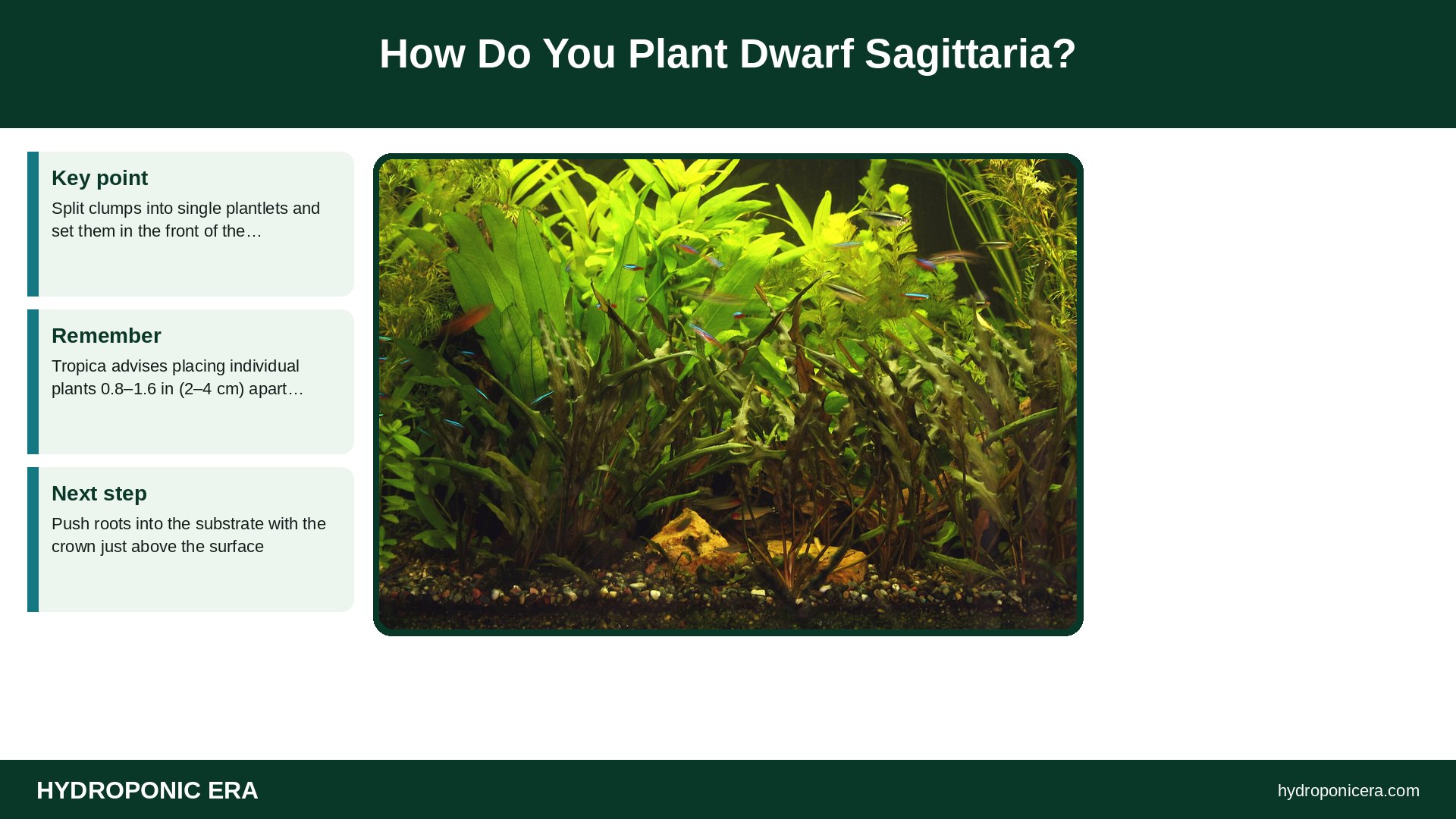
Split clumps into single plantlets and set them in the front of the tank. Tropica advises placing individual plants 0.8–1.6 in (2–4 cm) apart so the runners fill in quickly. Push roots into the substrate with the crown just above the surface. Aquarium Science suggests roughly one plant every 3 in (7.5 cm) across a planted tank.
- Rinse plants and remove rock wool from the roots.
- Separate the clump into small plantlets.
- Plant each with tweezers 0.8–1.6 in (2–4 cm) apart.
- Add a root tab near the group once it settles.
How Much Light and CO2 Does Dwarf Sagittaria Need?
Modest light is enough. Tropica rates the plant low light demand and medium CO2 need, which it defines as 6–14 mg/L. Its narrow ‘Needle Leaf’ form thrives in moderate light without extra CO2 and may develop subtle orange hues under intense light.
- Learn CO2 basics in our CO2 enrichment guide.
- Pick a fixture with our grow light for aquarium guide.
- Aquarium Science warns strong aeration strips CO2 that plants feed on.
Why Is My Dwarf Sagittaria Growing Tall?
Height changes with age and conditions. Tropica warns that in certain conditions older plants suddenly grow to 20 in (50 cm), but if moved into the background they may become low again. Trim or relocate tall plants and let new runners replace them.
Tropica’s ‘Needle Leaf’ type naturally grows slender leaves 6–12 in (15–30 cm) long, so it suits backgrounds instead.
How Does Dwarf Sagittaria Spread?
It spreads by runners. Tropica lists it as a stolon plant and says the ‘Needle Leaf’ form spreads effortlessly via runners, so propagation is simply trimming and replanting daughter plants. In the aquarium, Tropica notes it sometimes sends a long flower stem to the surface, opening small white flowers just above the water.
- Wait until runners root and show three or four leaves.
- Snip the runner between mother and daughter plant.
- Replant daughters in bare patches or another tank.
- Bag spare plants in the trash rather than flushing or dumping them.
Is Dwarf Sagittaria Right for a Beginner Tank?
Yes, in a plant-focused tank. Aquarium Science warns plants are not as easy as often claimed and lists four guidelines: light stocking of fish under 2 in (5 cm), CO2 above 10 ppm in the morning, a plant every 3 in (7.5 cm), and little surface movement with no air stones. Dwarf sagittaria fits that low-tech plan.
| Guideline | Why it matters | Source |
|---|---|---|
| Few small fish | Less waste and aeration need | Aquarium Science |
| CO2 above 10 ppm | Plants feed on CO2 | Aquarium Science |
| Dense planting | Plants outcompete algae | Aquarium Science |
| No air stones | Aeration strips CO2 | Aquarium Science |
Aquarium Science explains the conflict plainly: moderate numbers of larger fish need strong aeration, but aeration removes the carbon dioxide plants feed on.
How Do You Feed Dwarf Sagittaria?
Feed it through the roots and water column. As a rooted rosette, it benefits from a nutrient-rich substrate or root tabs, plus a light liquid fertilizer in planted tanks. Aquarium Science advises light fish stocking in planted tanks, with fish under 2 in (5 cm), so plants are not overwhelmed by waste and aeration demands.
- Our fertilizer for plants in water guide explains nutrient basics.
- Pair it with slow rhizome plants like Anubias in the midground.
- Aquarium Science also suggests CO2 above 10 ppm first thing in the morning for planted tanks.
Is dwarf sagittaria good for beginners?
Yes. Tropica calls it undemanding with low light demand.
How fast does dwarf sagittaria carpet?
It spreads by short runners; spacing plants 0.8–1.6 in (2–4 cm) apart speeds coverage.
Does dwarf sagittaria need CO2?
Tropica rates its need as medium; the ‘Needle Leaf’ form needs no added CO2.
Where does dwarf sagittaria grow wild?
UF/IFAS records it in tidal marshes in northern and central Florida.
Why are my sagittaria leaves tall?
Tropica says older plants may suddenly reach 20 in (50 cm); trim or move them.
Sources
- Tropica Aquarium Plants. Sagittaria subulata/4530).
- Tropica Aquarium Plants. Sagittaria subulata ‘Needle Leaf’/30440).
- University of Florida IFAS. Sagittaria subulata, awl-leaf arrowhead.
- Aquarium Science. Plants and the New Hobbyist.
- USDA APHIS. Federal Noxious Weed List.
- Photo credits (Wikimedia Commons, edited with titles): Sagittaria subulata kz01 by Krzysztof Ziarnek, Kenraiz (CC BY-SA 4.0); Planted Tank 03 – Flickr – The Wandering Angel by The Wandering Angel from Makati City, Philippines (CC BY 2.0); Glow light tetra by Jim Zamichieli (CC BY-SA 3.0); Anubias barteri var. nana by Abhik.Mazumdar.73 (CC BY 4.0)