
What is magnesium nitrate used for in hydroponics? Magnesium nitrate supplies magnesium and nitrate nitrogen without adding sulfur. A common greenhouse grade, Haifa Magnisal, is 11-0-0 with 9% Mg. Use it for Mg that can share a stock tank with calcium nitrate; Epsom salt cannot. About 444 mg per liter gives 40 ppm Mg.
Key takeaway: This fully soluble salt is a staple in nutrient recipes. It is the swap that lets Cal-Mag products and A-tank mixes carry magnesium alongside calcium.
| Property | Magnesium nitrate | Magnesium sulfate (Epsom salt) |
|---|---|---|
| Typical label analysis | 11% N (all nitrate), 9% Mg | 9.7% Mg, 13% S |
| Adds sulfur? | No | Yes |
| Mixes with calcium nitrate in concentrate? | Yes; Cal-Mag mixes rely on this | No, forms calcium sulfate |
| Usual stock tank | A tank with calcium nitrate | B tank |
| Amount for 40 ppm Mg | About 444 mg/L | About 412 mg/L |
What Is Magnesium Nitrate Fertilizer?
Magnesium nitrate is a water-soluble salt that delivers two nutrients at once: magnesium and nitrate nitrogen. The Haifa Magnisal label lists 11% total nitrogen, all as nitrate, and 9% magnesium, derived from the nitrate salt. Other brands can differ slightly, so always read your own bag before you run any numbers.
Magnesium sits at the center of the chlorophyll molecule, UF/IFAS explains, so a steady supply keeps leaves green.
Why Use Magnesium Nitrate Instead of Epsom Salt?
The key reason is compatibility. University of Kentucky greenhouse specialists call mixing Epsom salt with calcium nitrate the most common mistake, because calcium and sulfate precipitate. They note this is why Cal-Mag formulas swap magnesium sulfate for magnesium nitrate, so Cal-Mag products supply no sulfur. Magnesium nitrate can therefore sit beside calcium nitrate.
Epsom salt is still cheaper and adds useful sulfur. Compare both in our Epsom salt guide.
How Much Magnesium Nitrate Do You Add per Gallon?
Use the e-GRO method from Cornell: divide your ppm target by the percent of the element. For 40 ppm Mg with a 9% Mg product, 40 ÷ 0.09 = 444 mg per liter. That is about 1.68 g per gallon (3.785 L), or roughly 5.9 oz (168 g) per 100 gallons (378.5 L). It also adds about 49 ppm nitrogen.
- Read the label percent of Mg and N.
- Pick a Mg target and subtract Mg already in your water.
- Divide the target ppm by the Mg percent (as a decimal) to get mg/L.
- Multiply by 3.785 for mg per gallon, then convert to grams.
- Multiply mg/L by the N percent to see how much nitrogen you added.
- Lower your other nitrate sources to keep total N on target.
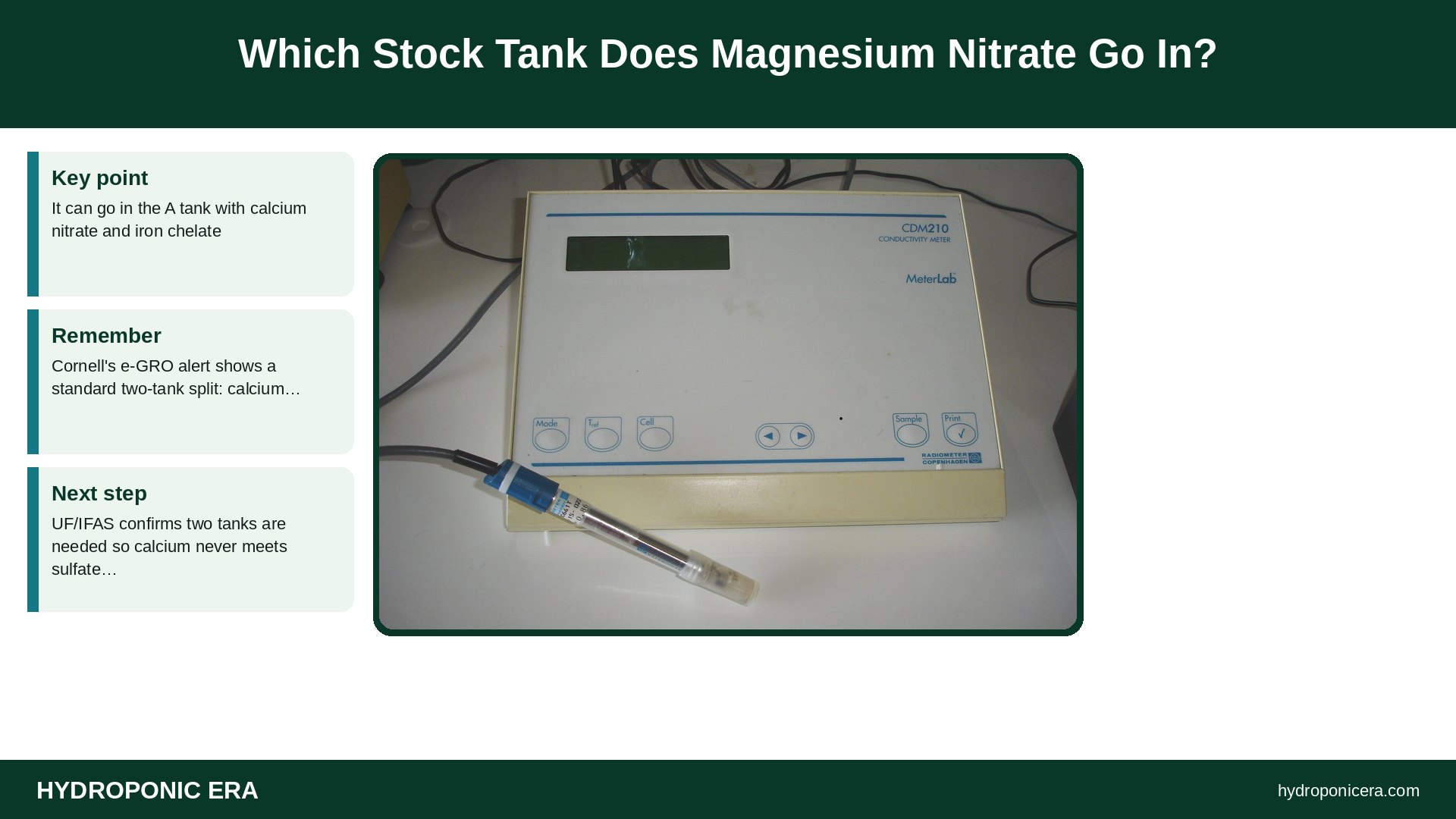
Which Stock Tank Does Magnesium Nitrate Go In?
It can go in the A tank with calcium nitrate and iron chelate. Cornell’s e-GRO alert shows a standard two-tank split: calcium nitrate, half the potassium nitrate and iron chelate in Tank A; sulfates and phosphates in Tank B. UF/IFAS confirms two tanks are needed so calcium never meets sulfate or phosphate in concentrate.
Learn the full split in our stock tanks vs mixing per reservoir guide.
How Do You Know Plants Need More Magnesium?
Look at the lower leaves. UF/IFAS says magnesium is mobile, so deficiency appears first on older leaves as interveinal yellowing that can turn to dead patches; tomatoes may show mild purpling. Normal leaves hold 0.2–0.8% Mg. Too much potassium, calcium or ammonium can also cause it by competing with Mg uptake.
- Check that your formula includes Mg at all.
- Review whether K or Ca levels are very high.
- Test your water; UF notes most Florida wells hold only a few ppm Mg.
- Compare symptoms in our calcium and magnesium deficiency guide.
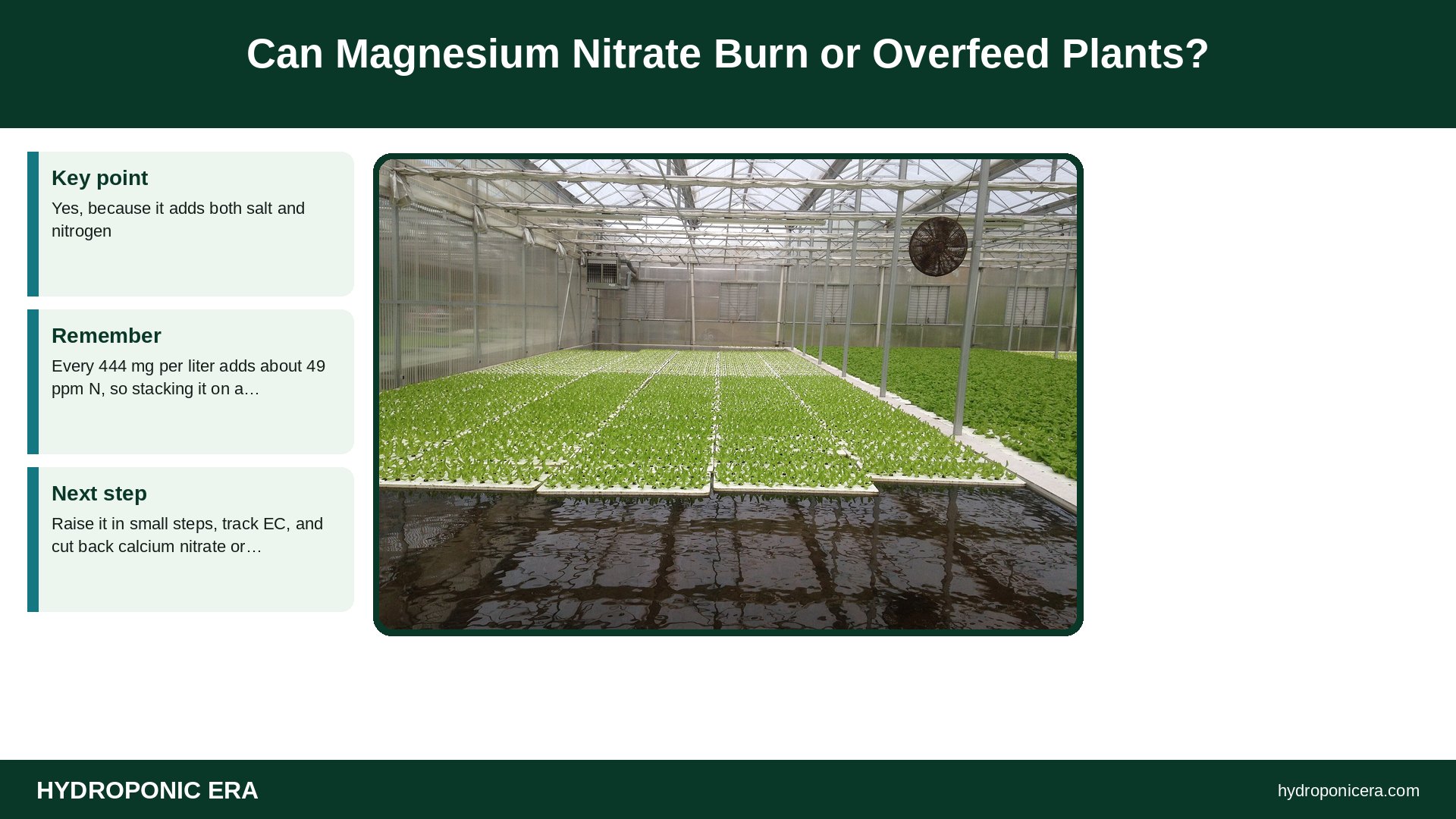
Can Magnesium Nitrate Burn or Overfeed Plants?
Yes, because it adds both salt and nitrogen. Every 444 mg per liter adds about 49 ppm N, so stacking it on a full-strength base nutrient can push nitrogen and EC too high. Raise it in small steps, track EC, and cut back calcium nitrate or potassium nitrate slightly to keep the overall nitrogen level where your crop needs it.
Our hydroponic PPM chart helps you keep totals in range.
How Do You Test a New Mg Recipe Safely?
Run a jar test before you commit a new recipe. University of Kentucky specialists suggest mixing your planned stock in a clear 1-quart (0.95 L) jar, capping it and letting it stand for 12–24 hours. Then look for cloudiness, solids or settling. If anything forms, split those salts into separate A and B tanks.
See the right order in our nutrient mixing order guide.
FAQ About Magnesium Nitrate
Is magnesium nitrate the same as Cal-Mag?
No. Cal-Mag products often use it as their Mg source, plus calcium.
Does it add sulfur?
No. Use Epsom salt or potassium sulfate if you need sulfur.
Can it share a tank with calcium nitrate?
Yes. They are commonly paired in the A tank; confirm with a jar test.
How much product gives 40 ppm Mg?
About 444 mg per liter for a 9% Mg product.
Is it an organic fertilizer?
No. It is a mineral salt fertilizer.
Sources
- Cornell University e-GRO — Fertilizer Calculation Basics for Hydroponics (PDF)
- University of Kentucky Greenhouse Horticulture — Jar Test: Determining Fertilizer Solubility and Compatibility (PDF)
- UF/IFAS — Fertilizer Management for Greenhouse Vegetables (HS787/CV265)
- Haifa Group — Magnisal 11-0-0 guaranteed analysis label (PDF)
- Photo credits (Wikimedia Commons, edited with titles): 20160617-AMS-LSC-9000 (61-sec.) (27334710733) by U.S. Department of Agriculture (Public domain); Epsomite by WTucker (talk) (CC BY-SA 3.0); Electrical conductivity meter by Nuno Nogueira (Nmnogueira) (CC BY-SA 2.5); Deep water culture by ArcadiYay (CC BY-SA 4.0)