
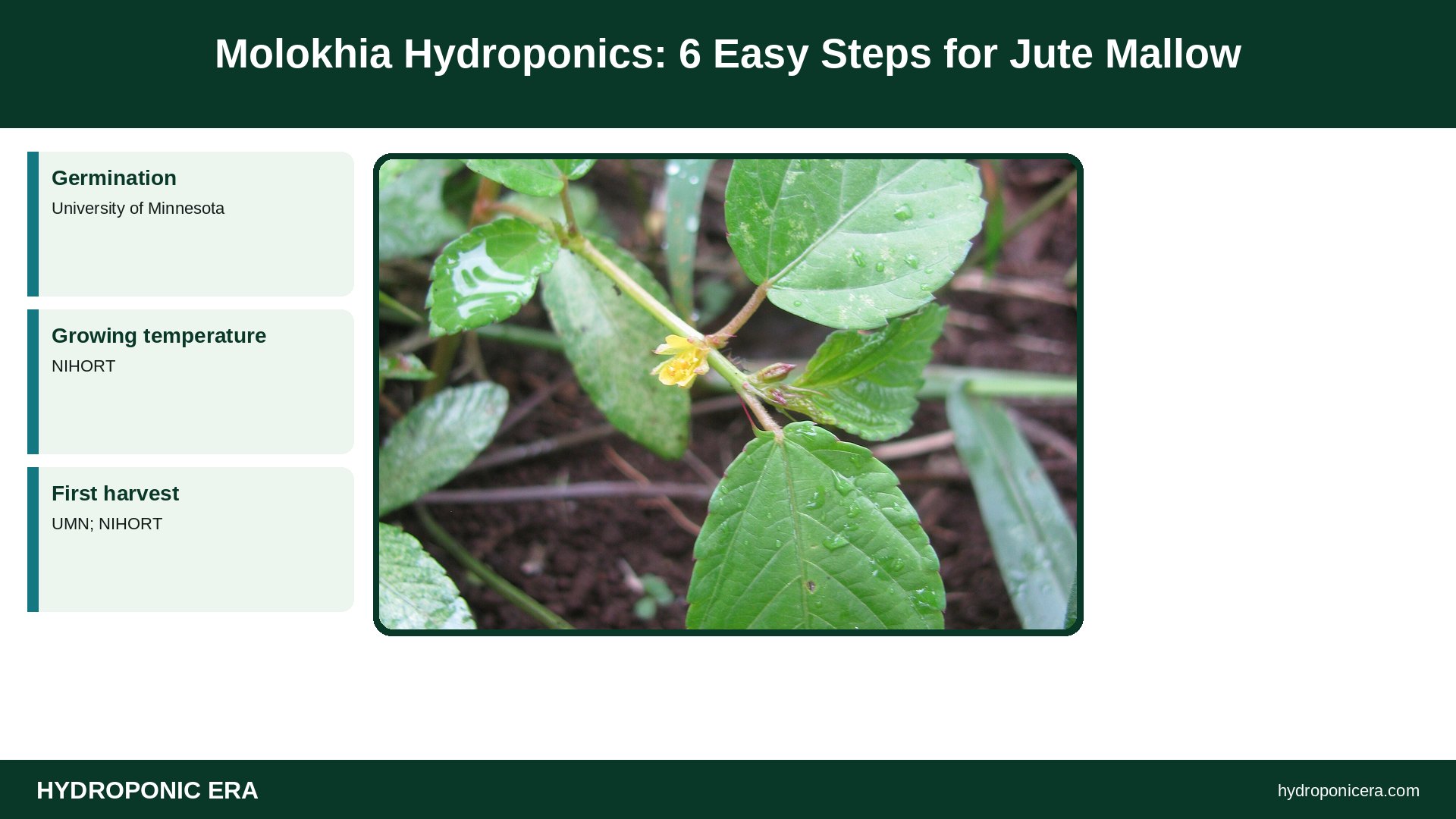
Can you grow molokhia hydroponically? Yes. Molokhia hydroponics works well because jute mallow is a fast, heat-loving leafy green that regrows after cutting. The University of Minnesota says leaves can be harvested from 40 days, then every 2–3 weeks. Nigeria’s horticulture institute (NIHORT) gives an optimum of 77–90°F (25–32°C). Give it warmth, strong light and long days to keep it leafy.
Key takeaway: Molokhia (Corchorus olitorius) is the opposite of lettuce: it loves heat. Germinate it warm, grow it at 77–90°F (25–32°C) under long days, cut shoots at 8–12 inches (20–30 cm), and keep cutting every two to three weeks.
| Factor | Target | Source |
|---|---|---|
| Germination | About 65°F (18°C) minimum root-zone warmth | University of Minnesota |
| Growing temperature | 77–90°F (25–32°C) | NIHORT |
| First harvest | From 40 days; NIHORT gives 4–6 weeks after planting | UMN; NIHORT |
| Cutting height | Shoots 8–12 in (20–30 cm) long | NIHORT |
| Repeat harvests | Every 2–3 weeks, 2–8 cuttings | UMN; NIHORT |
| Day length | Longer days favor leafy growth | NIHORT |
What Is Molokhia?
Molokhia is the leaf of jute mallow, Corchorus olitorius, eaten as a vegetable across North Africa, the Middle East and West Africa. The University of Minnesota lists other names including Egyptian spinach, ewedu, bush okra and Jew’s mallow. The same genus is a major fiber crop, but leaf types are grown for tender shoots.
The leaves turn slippery when cooked, much like okra, and are used to make thick soups and sauces. UMN notes that in parts of Africa the leaves are boiled into a sticky soup served with fufu. If you enjoy mucilaginous greens, also see our guide to growing okra hydroponically.
What Conditions Does Molokhia Hydroponics Need?
Molokhia hydroponics needs heat, bright light and a well-fed, aerated root zone. NIHORT gives an optimal growing temperature of 77–90°F (25–32°C), and UMN lists full sun and fertile conditions. Indoors, that means warm air, strong LEDs and a complete nutrient solution, with the reservoir kept oxygenated so warm water does not starve the roots. Our hydroponic lettuce EC guide explains how to read and adjust EC.
- Air temperature: 77–90°F (25–32°C), per NIHORT.
- Light: full sun outdoors, so give strong grow lights indoors.
- Nutrients: a complete vegetative formula; start near the 1.2–1.8 mS/cm range UF/IFAS gives for leafy lettuce and raise it if leaves pale.
- pH: around 5.8–6.5, the usual soilless range for leafy crops.
- Oxygen: warm water holds less oxygen, so run an air stone continuously.
Why Does Day Length Matter for Molokhia?
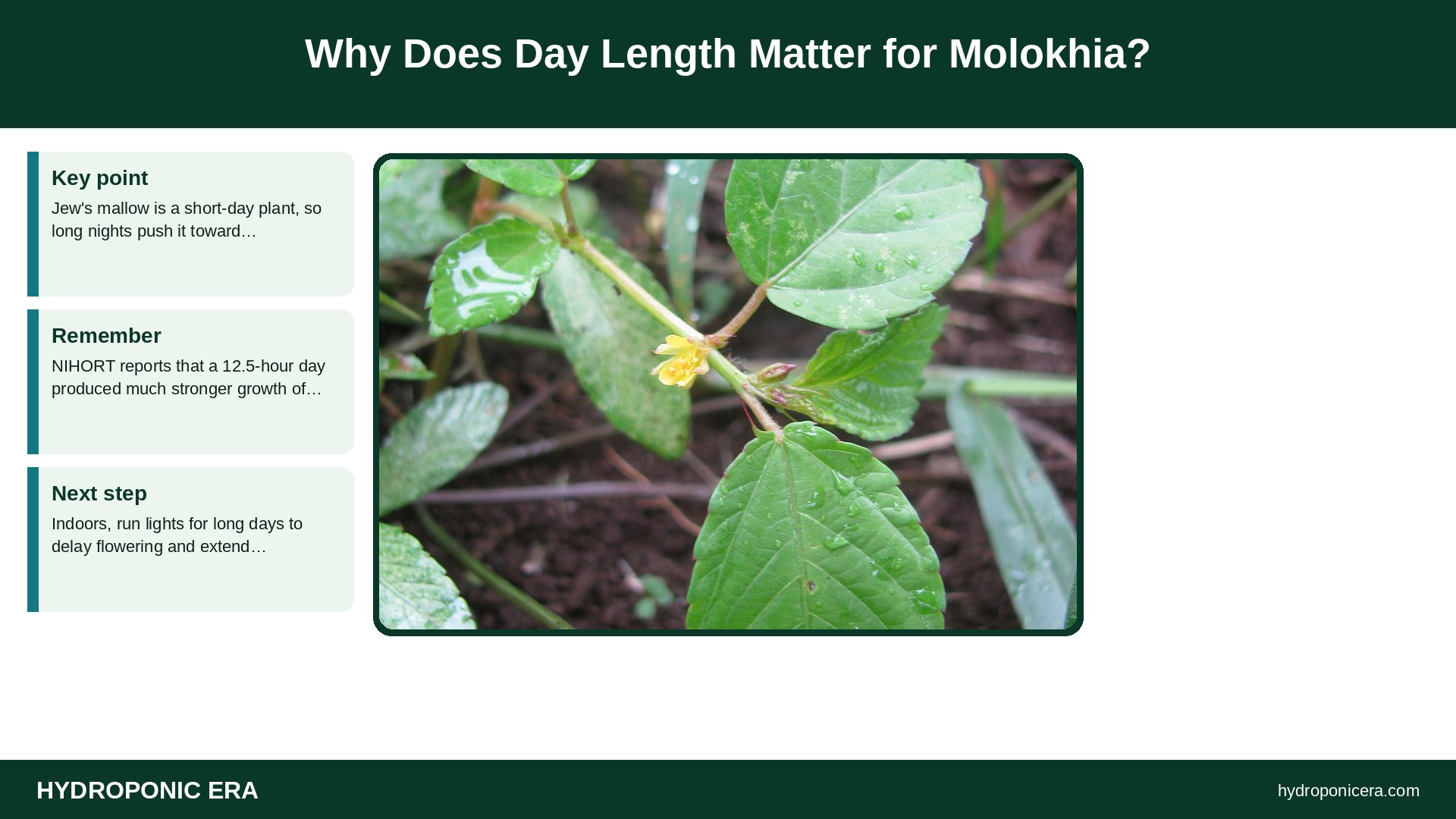
Jew’s mallow is a short-day plant, so long nights push it toward flowering while long days keep it leafy. NIHORT reports that a 12.5-hour day produced much stronger growth of roots, stems and leaves than an 11.5-hour day. Indoors, run lights for long days to delay flowering and extend harvests.
In molokhia hydroponics, long days are easy to give. This is also why UMN notes that in Minnesota many trialed varieties do not flower before frost. For a leaf crop that is an advantage. If you want seed, you need to shorten the day later in the plant’s life.
How Do You Start Seeds for Molokhia Hydroponics?
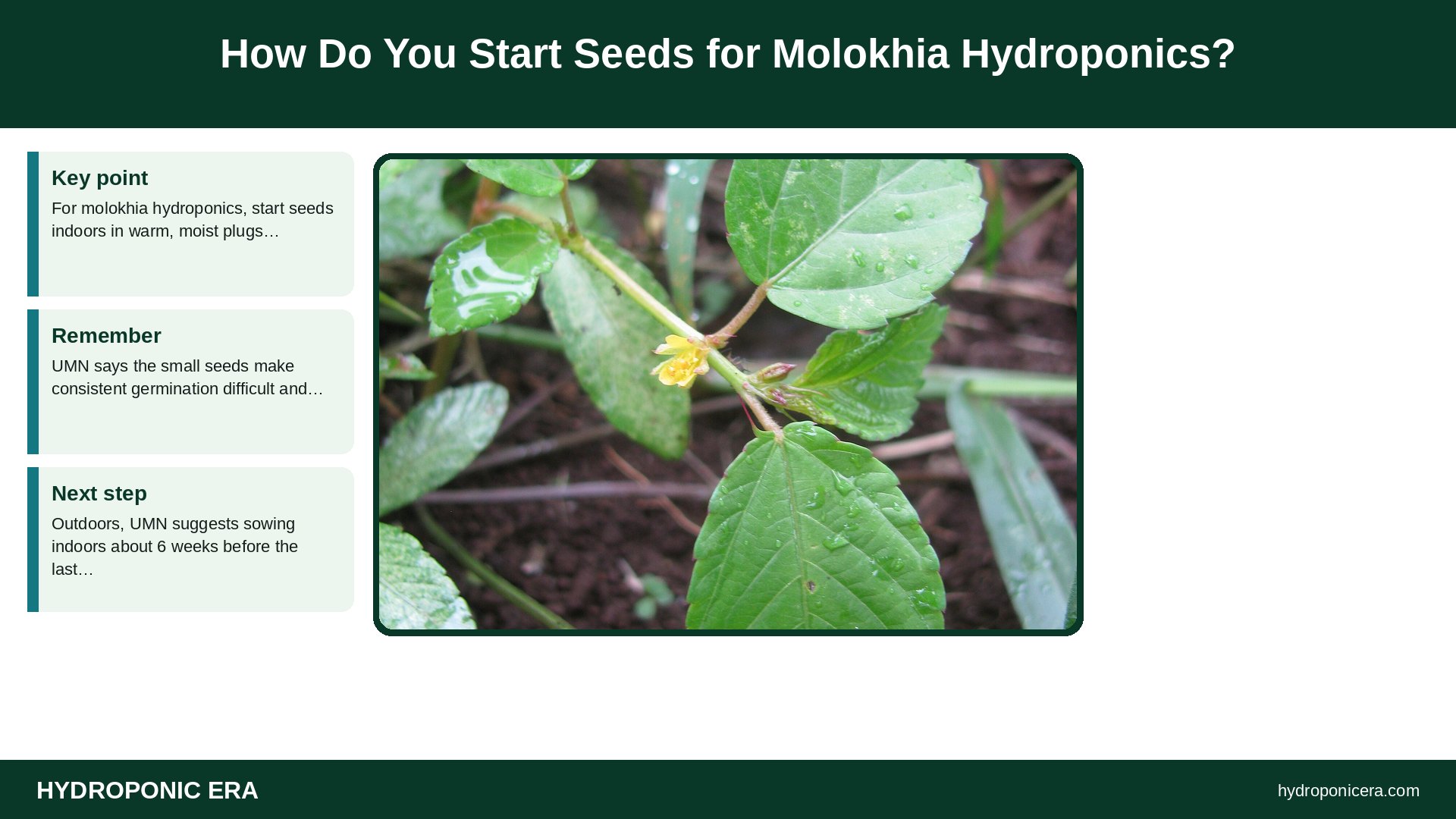
For molokhia hydroponics, start seeds indoors in warm, moist plugs, then transplant. UMN says the small seeds make consistent germination difficult and recommends starting indoors or using seed tape, with soil temperature of at least 65°F (18°C). Outdoors, UMN suggests sowing indoors about 6 weeks before the last frost.
- Pre-soak rockwool or coco plugs in pH-adjusted water.
- Sow several small seeds per plug, since germination can be uneven.
- Keep plugs warm, ideally well above 65°F (18°C), with a heat mat if needed.
- Thin to the strongest seedling once true leaves appear.
- Transplant into deep water culture or a Dutch bucket when roots show.
Because the seed is so small, cover it only lightly and keep the plug surface evenly moist until seedlings appear.
How Do You Harvest Molokhia?
In molokhia hydroponics, harvest by cutting shoots once they reach 8–12 inches (20–30 cm). NIHORT says the first cut comes 4–6 weeks after planting and that cutting stimulates side shoots, with further cuts every 2–3 weeks for 2 to 8 harvests. UMN gives the first harvest at about 40 days, then every 2–3 weeks.
| Harvest step | What to do | Why |
|---|---|---|
| First cut | Shoots 8–12 in (20–30 cm) long | Triggers branching |
| Repeat cuts | Every 2–3 weeks | Keeps leaves young |
| Remove flowers | Pinch buds | Keeps the plant leafy |
| Storage | Keep leaves moist and cool | NIHORT says they do not keep long |
NIHORT notes that the leaves cannot be kept long and are usually sold on harvest day, kept wet. Pick only what you need, or strip the leaves and freeze them, a common way to store molokhia.
Which System Is Best for Molokhia Hydroponics?
Deep water culture and Dutch buckets suit molokhia hydroponics best because the plants grow into bushy, multi-stemmed shrubs that need room and support. A single plant can be grown in a 5-gallon (19 L) bucket. NFT is less suitable for full-size plants but can work for young shoots harvested early.
- Deep water culture: simple and fast, with a strong air pump.
- Dutch bucket: good for long-season, branching plants.
- Kratky: possible, but warm water and a long harvest window make it riskier.
To build a simple single-plant system, see our 5-gallon bucket DWC guide.
What Problems Affect Molokhia Hydroponics?
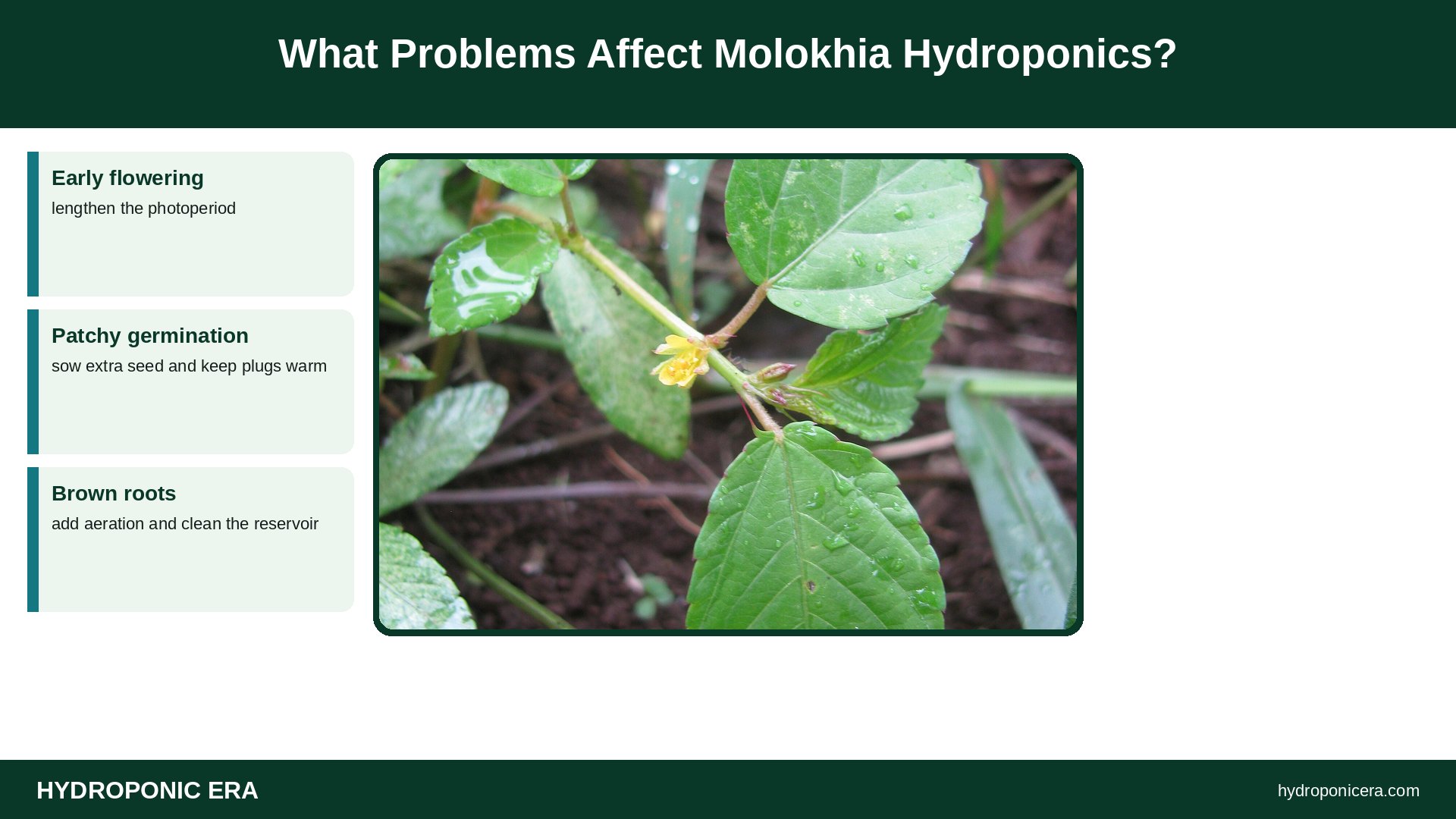
The main problems are early flowering under short days, poor germination, root rot in warm, low-oxygen water and spider mites in hot, dry rooms. NIHORT also warns about root-knot nematodes in soil, which hydroponics avoids. Keep days long, aerate the solution and check leaf undersides weekly for mites.
- Early flowering: lengthen the photoperiod.
- Patchy germination: sow extra seed and keep plugs warm.
- Brown roots: add aeration and clean the reservoir.
- Speckled leaves: check for spider mites.
FAQ About Molokhia Hydroponics
Is molokhia the same as jute?
Yes, it is jute mallow, the same genus grown for jute fiber, but leaf types are used for food.
Does molokhia hydroponics work indoors in winter?
Yes, if you provide warmth and long days under grow lights.
How often can I harvest molokhia?
Every 2–3 weeks, according to UMN and NIHORT.
Why is my molokhia flowering early?
Short days trigger flowering in this short-day plant.
Is molokhia slimy?
Yes, the leaves become mucilaginous when cooked, which thickens soups.
Sources
- University of Minnesota CPBT — Jute Mallow crop profile
- National Horticultural Research Institute (NIHORT), Nigeria — Corchorus Production Guide
- UF/IFAS Extension — Hydroponic Lettuce Production (HS1422)
- Photo credits (Wikimedia Commons, edited with titles): Starr-130221-1613-Corchorus olitorius-leaves and flower-Waihee-Maui (25179550776) by Forest and Kim Starr (CC BY 3.0 us)