
What is monopotassium phosphate used for in hydroponics? Monopotassium phosphate (MKP, 0-52-34) is a nitrogen-free, water-soluble fertilizer that supplies phosphorus and potassium. Growers add it to nutrient solutions to raise P and K for fruiting crops, but never alone. Keep it in a separate stock from calcium and magnesium to avoid precipitation.
Key takeaway: Monopotassium phosphate supplies about 52% P2O5 and 34% K2O with no nitrogen. Use it as a supplement to a complete nutrient program, dissolve it before adding other salts, keep it apart from calcium stock, and check pH and EC after each addition.
| Property | Value | What it means |
|---|---|---|
| Analysis | 0-52-34 (N-P2O5-K2O) | No nitrogen, high phosphate and potassium |
| Elemental phosphorus | About 22.7% P | 52% P2O5 x 0.44 |
| Elemental potassium | About 28.2% K | 34% K2O x 0.83 |
| Solubility use | Dissolve fully in water | Use hydroponic or fertilizer grade |
| Compatibility | Keep apart from calcium stock | Calcium phosphate can precipitate |

What Is Monopotassium Phosphate?
Monopotassium phosphate, also called MKP or potassium dihydrogen phosphate, is a soluble salt with an analysis of 0-52-34. It supplies phosphorus and potassium without nitrogen. Because it dissolves cleanly, it is used in fertigation and hydroponics. The University of Missouri and UF/IFAS describe it as a common soluble source of phosphorus and potassium.
It is a supplement, not a complete fertilizer. Plants still need nitrogen, calcium, magnesium and micronutrients. For the basics of building a recipe, see one-part vs two-part vs three-part nutrients.
When Should You Use Monopotassium Phosphate?
Use monopotassium phosphate when your feed lacks phosphorus or potassium, or when fruiting crops need more of both. Test first. Many complete nutrients already contain enough, and adding more can upset the balance. Look for signs described in our phosphorus deficiency and potassium deficiency guides.
- Fruiting crops: tomatoes, peppers and strawberries often take more P and K.
- Custom recipes: MKP supplies P and K in a build-your-own formula.
- Deficiency correction: only after you confirm the problem.
Do not add it to a healthy solution out of habit. Excess phosphate and potassium can interfere with calcium, magnesium and iron uptake.

How Do You Dose Monopotassium Phosphate?
Start with a small dose and calculate what it adds. One gram of MKP per liter (3.8 g per US gallon) supplies about 227 mg/L of phosphorus and 282 mg/L of potassium by calculation, plus a rise in EC. Add it in small steps, mix fully and test EC and pH before adding more.
- Check your current nutrient analysis for P and K.
- Weigh a small amount of MKP, and dissolve it in a separate cup of water.
- Add it to the reservoir while stirring, after the calcium-containing part is already diluted.
- Measure EC and pH, and adjust pH if needed.
- Record the dose and watch plants for a week before changing again.
Use the weights as a guide and follow your recipe or calculator. Our EC and TDS guide shows how to confirm solution strength.
How Do You Mix Monopotassium Phosphate Without Precipitation?
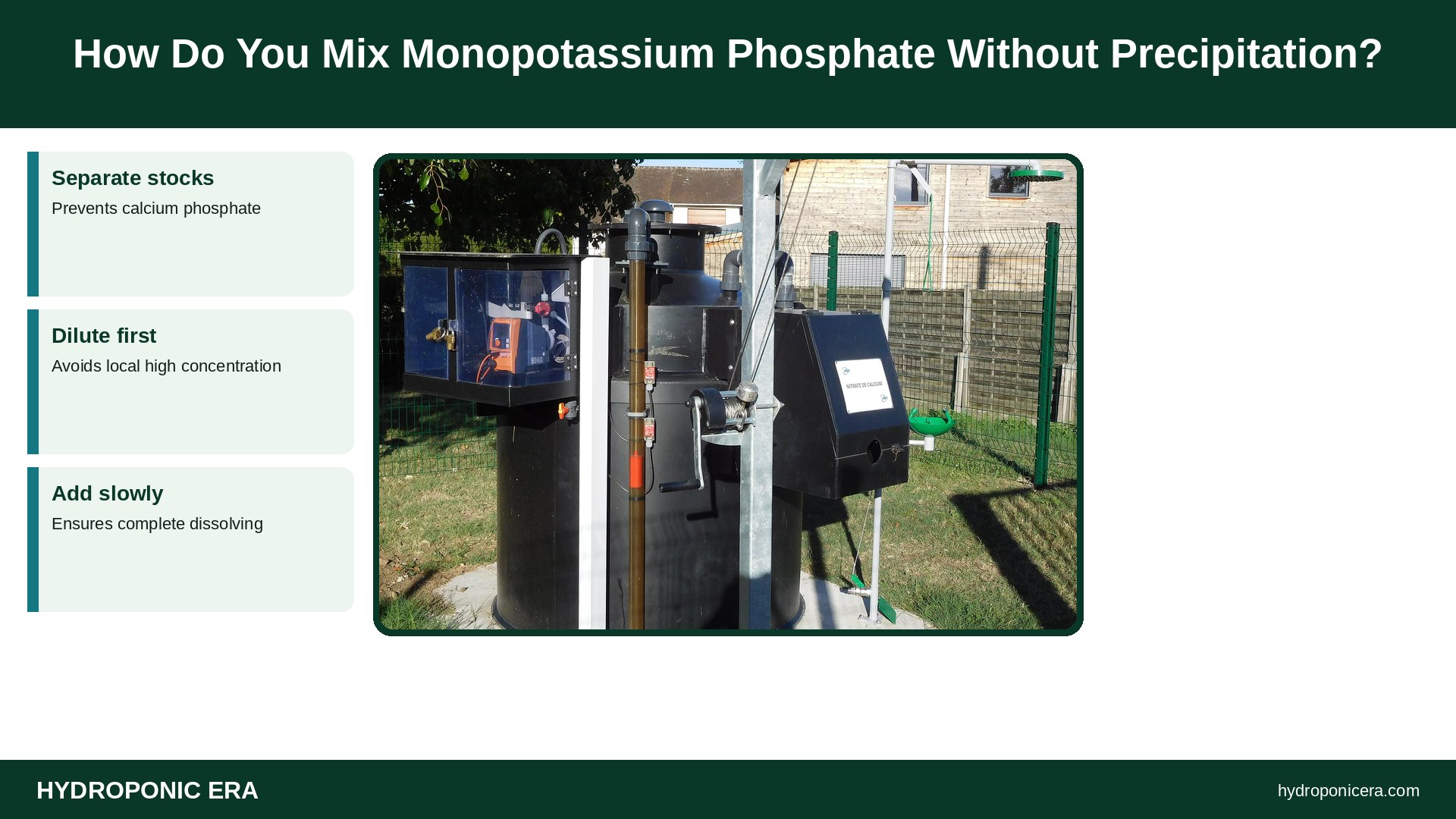
Keep monopotassium phosphate in a separate concentrate from calcium and sulfate-rich stocks, and dilute before combining. Mixing phosphate with calcium at high concentration forms insoluble calcium phosphate that settles and clogs. See nutrient mixing order and calcium nitrate in hydroponics for sequence guidance.
| Step | Do this | Why |
|---|---|---|
| Separate stocks | A: calcium nitrate, B: MKP and other salts | Prevents calcium phosphate |
| Dilute first | Add each part to plenty of water | Avoids local high concentration |
| Add slowly | Stir between additions | Ensures complete dissolving |
| Check pH | Adjust after mixing | MKP is acidic and lowers pH |
How Does Monopotassium Phosphate Affect pH?
Monopotassium phosphate is slightly acidic and tends to lower solution pH, so you may need less pH-down. Most hydroponic crops grow best at pH 5.6–6.0, a range shared by University of Missouri and UF/IFAS guidance. Measure after dissolving and adjust gradually, since pH can drift as plants take up nutrients.
If pH keeps moving, review your water’s alkalinity and your feed. Our guide to controlling pH in hydroponics explains the corrections in order.
What Are the Risks of Using Too Much Monopotassium Phosphate?
Too much monopotassium phosphate can raise EC, lock out calcium, magnesium and micronutrients, and cause leaf spotting or stunting. Phosphate also feeds algae in open reservoirs. Overfeeding is easier with a pure salt than with a balanced fertilizer, so measure, record and change one thing at a time.
How Do You Convert P2O5 and K2O to Real Nutrient Numbers?
Fertilizer labels list phosphate as P2O5 and potassium as K2O, not as the elements. To get elemental phosphorus multiply P2O5 by 0.44, and for elemental potassium multiply K2O by 0.83. Monopotassium phosphate at 52% P2O5 and 34% K2O therefore holds roughly 22.7% phosphorus and 28.2% potassium by weight.
A worked example: 1 gram in 1 liter gives 1,000 mg of salt, so phosphorus is about 0.227 x 1,000 = 227 mg/L and potassium about 0.282 x 1,000 = 282 mg/L. These are the calculated additions, so subtract what your base nutrient already supplies. Treat any recipe from a book or website as a starting point, then confirm with EC and plant response.
How Does It Compare With Other Phosphorus and Potassium Sources?
| Source | Supplies | Note |
|---|---|---|
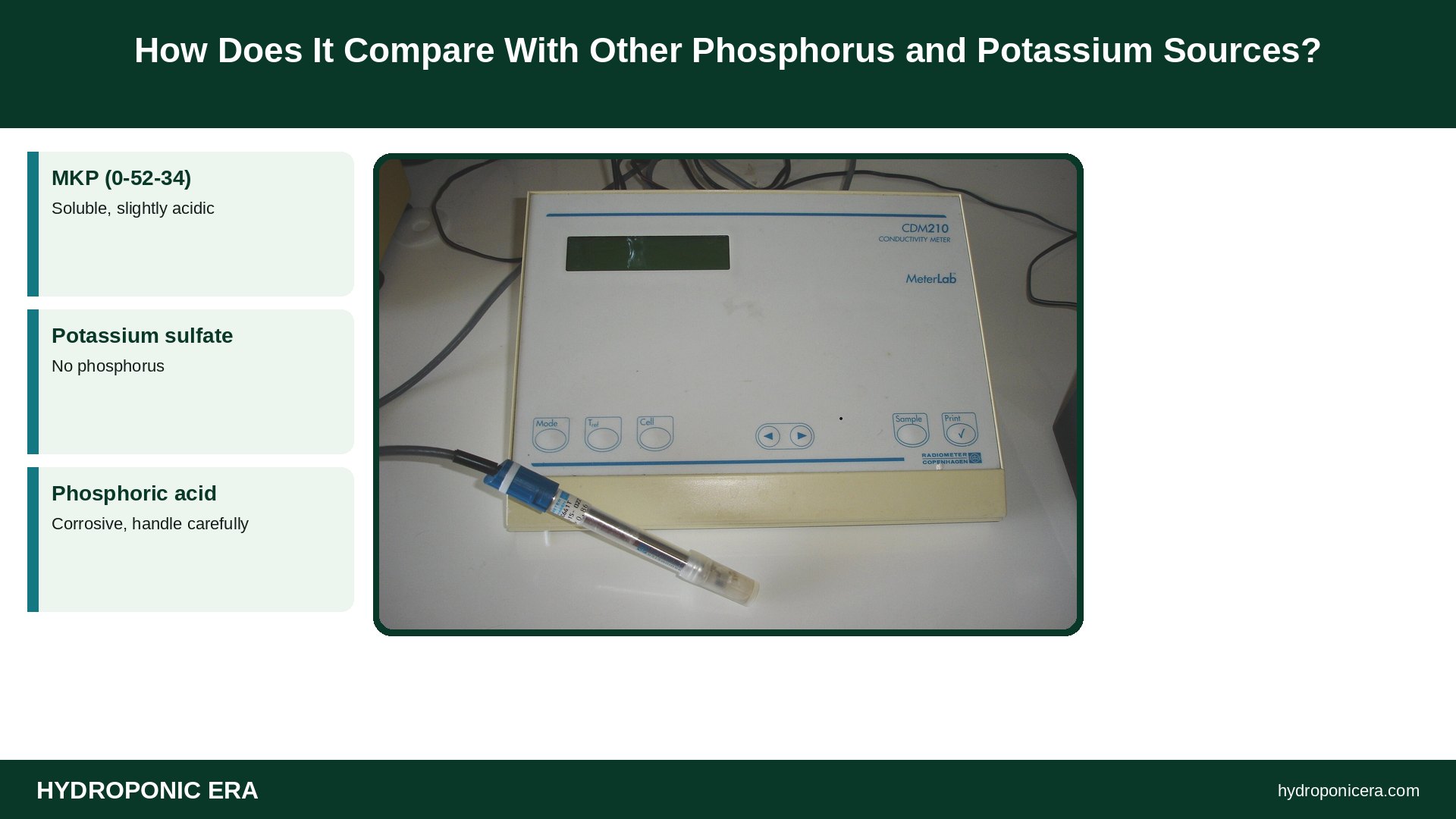
| MKP (0-52-34) | P and K, no nitrogen | Soluble, slightly acidic |
| Potassium sulfate | K and sulfur | No phosphorus |
| Phosphoric acid | P, lowers pH | Corrosive, handle carefully |
| Complete bloom nutrients | P, K and other nutrients | Easier for beginners |
For most home growers, a complete nutrient with a bloom formula is easier and safer than mixing pure salts. Monopotassium phosphate makes sense when you build your own recipe or need to correct a verified shortfall in P and K only.
Store the dry salt in a sealed, labeled container in a cool, dry place, because it absorbs moisture and clumps. Wear gloves and eye protection when handling any fertilizer, and keep it away from children and pets. Weigh with a scale that reads to at least 0.1 gram, since small doses make large differences in a few liters of water.
FAQ About Monopotassium Phosphate
What is MKP 0-52-34?
It is monopotassium phosphate, with about 52% P2O5 and 34% K2O and no nitrogen.
Can I use MKP alone as fertilizer?
No. It lacks nitrogen, calcium, magnesium and micronutrients.
Can I mix MKP with calcium nitrate?
Not as concentrates. Keep separate stocks and dilute before mixing.
Does MKP change pH?
It tends to lower pH slightly, so test after adding it.
Is MKP the same as potassium phosphate in other grades?
Check the label, and use a soluble fertilizer or hydroponic grade.
Sources
- University of Missouri Extension — Hydroponic nutrient solutions (G6984)
- UF/IFAS EDIS — Hydroponic nutrient management (CV265)
- Penn State Extension — Hydroponic systems: using the two basic equations to calculate a nutrient solution recipe
- Photo credits (Wikimedia Commons, edited with titles): Monopotassium phosphate Créer le cristal by Marie-Lan Taÿ Pamart (CC BY 4.0); Glaubersalz by Alphawikipo (Public domain); Calcium nitrate, waste water treatment by Cjp24 (CC BY-SA 4.0); Electrical conductivity meter by Nuno Nogueira (Nmnogueira) (CC BY-SA 2.5)