
Is softened water for plants a good idea? Softened water for plants is not recommended, because a softener swaps calcium and magnesium for sodium. UMass guidance lists 0–20 ppm sodium as the target for irrigation water and under 50 ppm as acceptable. Hard water is usually better than softened water for plants, and rain or RO water is better still.
Key takeaway: Softened water for plants adds sodium while removing the calcium and magnesium plants need. Sodium can block calcium uptake, raise salt levels and burn leaf edges, and it builds up in recirculating systems. Test the water, use an unsoftened tap, rainwater or reverse osmosis water, or blend carefully.
| Water source | Sodium risk | Better choice? |
|---|---|---|
| Softened water | High, from ion exchange | Avoid for plants and hydroponics |
| Hard, unsoftened tap | Usually low sodium | Fine if EC and pH are managed |
| Rainwater | Very low | Good, collect clean |
| Reverse osmosis water | Very low | Excellent base, add Ca and Mg |
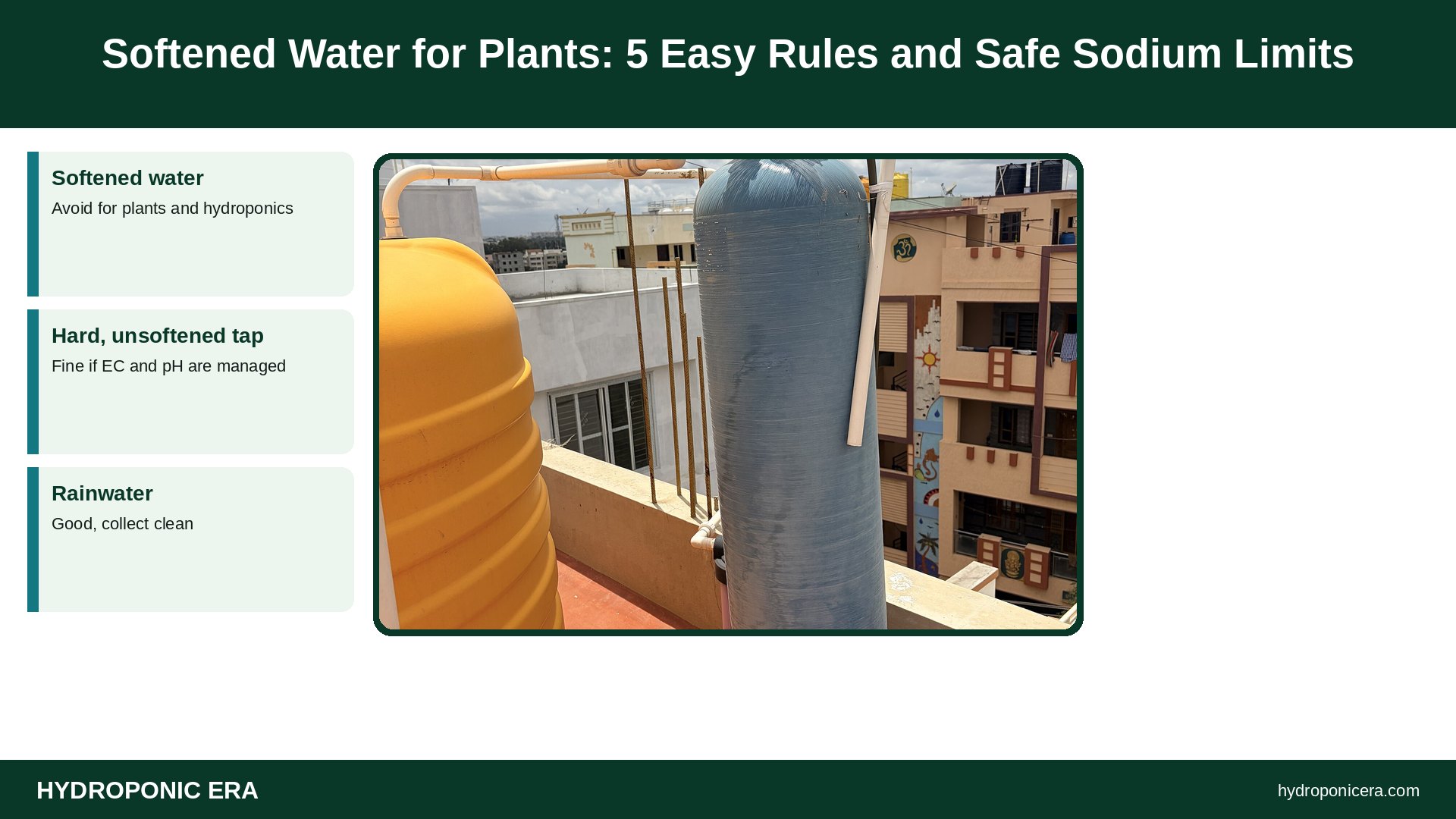
What Is Softened Water?
Softened water for plants starts as hard water that has passed through an ion-exchange softener. The resin traps calcium and magnesium ions and releases sodium in exchange, so hardness drops but sodium rises. This protects pipes and appliances, which is why homes use softeners, but it makes the water less suitable for watering plants.
The sodium in softened water for plants depends on how hard the water was. By the ion-exchange math, each 1 mg/L of hardness removed adds about 0.46 mg/L of sodium, so water with 200 mg/L hardness ends up around 90 mg/L sodium. Compare that with the limits in the next section.
How Much Sodium Is Too Much for Plants?
UMass Extension lists a target of 0–20 ppm sodium and chloride in irrigation water for greenhouse crops, with under 50 ppm sodium and under 140 ppm chloride as acceptable. Softened water for plants can easily exceed this, especially from hard sources. Sodium also blocks calcium uptake, so excess sodium can cause deficiency even when calcium is present.
| Measure | Target | Acceptable (UMass) |
|---|---|---|
| Sodium | 0–20 ppm | Under 50 ppm |
| Chloride | 0–20 ppm | Under 140 ppm |
| EC | 0.2–0.8 mS/cm | Up to 1.5 mS/cm |
UMass also notes that if the sodium adsorption ratio is below 2 and sodium is under 40 ppm, sodium should not limit calcium and magnesium. High sodium and chloride can cause leaf burn, reduced growth and more disease.
Is Softened Water for Plants Ever Safe?
Softened water for plants is risky because sodium displaces calcium and magnesium in the root zone, adds to total salts, and can burn leaf margins. It also removes the very minerals that hard water supplied. In a recirculating system, plants take up water faster than sodium, so sodium builds up in the reservoir over time.
- Sodium buildup: it concentrates as plants use water.
- Calcium and magnesium loss: the softener removes both.
- Salt stress: higher EC without useful nutrients.
- Leaf burn: sodium and chloride damage leaf edges.
Our guide to sodium buildup in recirculating hydroponics explains how to spot and manage it.
What Should You Use Instead of Softened Water for Plants?
Instead, use unsoftened tap water, rainwater or reverse osmosis water. Most homes can bypass the softener with an outdoor spigot or a separate cold tap that does not run through the softener. Hard water is usually fine for plants if you track pH and EC, and rain or RO water gives you full control.
- Find a tap that is not connected to the softener, such as an outdoor spigot or a bypass.
- Test pH and EC, and compare with your target.
- If the water is very hard, blend with rainwater or RO water.
- Add calcium and magnesium back if you use pure RO water, as explained in cal-mag.
- Keep notes and retest after seasonal changes.
Can You Use Softened Water for Plants in Emergencies?
For a short time, a few waterings of softened water will not kill most plants, especially in a pot that drains well. Flush the pot with clean water now and then to wash out sodium. Avoid using it on sensitive plants, seedlings or hydroponic systems, where sodium builds up fast and cannot leach away.
Bottled drinking water, rainwater and condensate from an air conditioner are possible fallbacks, but check each for contaminants. Our guide to rainwater for hydroponics covers collection, and chlorine and chloramine covers common tap water questions.
How Do You Test Softened Water for Plants?
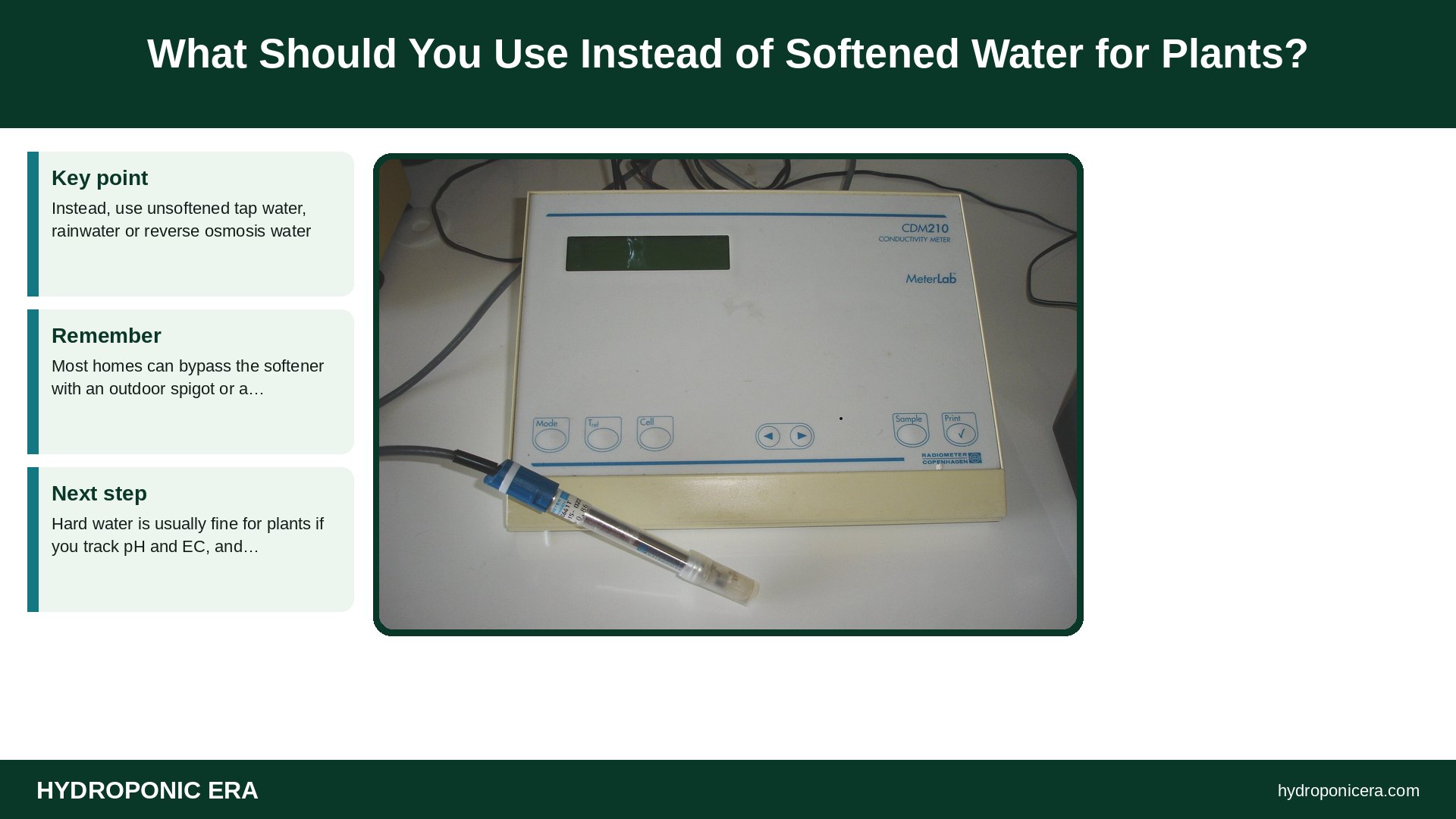
To test softened water for plants, check sodium and chloride with a lab or a home water test that reports them, and check EC, pH and hardness with a meter or test kit. UMass recommends repeating tests every week or two when you suspect a problem. A cheap TDS meter alone cannot tell sodium from calcium, so read the full report.
Use EC and TDS readings as a trend tool only. If EC rises over several fills with no matching fertilizer, suspect salts such as sodium.
How Do You Bypass a Water Softener for Garden Use?
Most homes have an outdoor spigot or a cold kitchen tap plumbed ahead of the softener, which delivers hard but sodium-free water. If yours is softened everywhere, a plumber can add a bypass valve or a separate line for irrigation. Collecting rainwater in a clean barrel is a simple, low-cost alternative, and it also helps flush salts from container soil.
Pots can also be flushed. Pour clean water through the container until a good amount drains out, which carries salts away. Empty the saucer so roots do not sit in the runoff. Repeat every few weeks if you have no choice but to use salty water, and watch for white crusts on the soil surface or pot rim, which signal salt buildup.
FAQ About Softened Water for Plants
Can I water houseplants with softened tap water?
Avoid it. Use unsoftened tap, rain or RO water, since sodium harms roots and blocks calcium.
Is softened water for plants okay in hydroponics?
No. Sodium accumulates in the reservoir and can cause deficiency and burn.
Does a water filter remove sodium?
Most carbon filters do not. Reverse osmosis does reduce sodium.
Is hard water better than softened water for plants?
Usually yes, if the water is not extremely hard and pH is managed.
How can I tell if softened water for plants is hurting them?
Look for leaf-edge burn and stunting, and test the water for sodium and chloride.
Sources
- UMass CAFE — Water quality for crop production
- UMass CAFE — Water analysis: target and acceptable ranges
- University of Arkansas Extension — Irrigation water for greenhouses and nurseries (FSA6061)
- Photo credits (Wikimedia Commons, edited with titles): Water softener by రవిచంద్ర (CC BY-SA 4.0); A boy taking a glass of water from a tap Wellcome L0060803 by Unknown (CC BY 4.0); Electrical conductivity meter by Nuno Nogueira (Nmnogueira) (CC BY-SA 2.5); Calcium nitrate, waste water treatment by Cjp24 (CC BY-SA 4.0)