
How do you grow mustard sprouts? Soak about 3 tablespoons of non-mucilaginous mustard seed, such as oriental mustard, in cool water for 4–6 hours. Drain, then rinse and drain every 8–12 hours in a jar or sprouter. Mustard sprouts are ready in about 3–6 days, when leaves open and green. Remove hulls and refrigerate.
Key takeaway: Mustard sprouts grow fast and taste spicy, a lot like horseradish. The main tricks are picking a mustard seed that can sprout in a jar, draining very thoroughly, loosening the clump at each rinse and removing the hulls before storage.
| Mustard sprouts step | Guideline | Source |
|---|---|---|
| Seed | Non-mucilaginous type (oriental mustard), sold for sprouting | Sprout People, UC ANR |
| Amount | 3 Tbsp per sprouter or quart jar | Sprout People |
| Soak | 4–6 hours, cool water | Sprout People |
| Rinse | Every 8–12 hours (2–3 times a day) | Sprout People, USask |
| Harvest | 3–6 days; leaves open and green | Sprout People |
| Yield | About 5 parts sprouts per 1 part seed by weight | Sprout People |
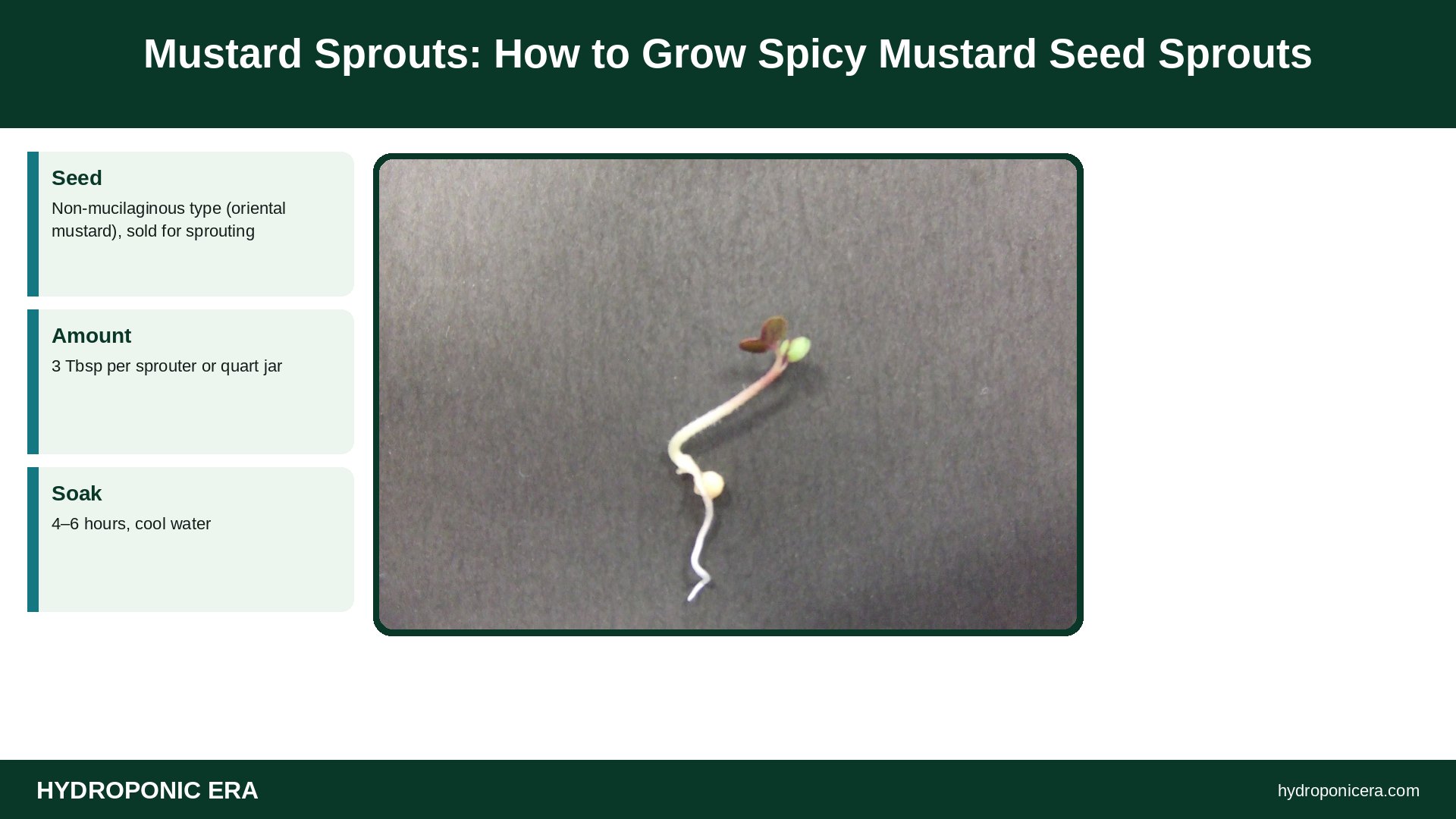
What Are Mustard Sprouts?
Mustard sprouts are mustard seeds germinated for a few days and eaten whole, with tiny leaves, stems and roots. They belong to the brassica family with broccoli and radish. Sprout People describes the flavor as much like horseradish. NC State Extension, University of Vermont Extension and the University of Saskatchewan all list mustard among good home sprouting seeds.
Which Mustard Seed Works for Sprouting?
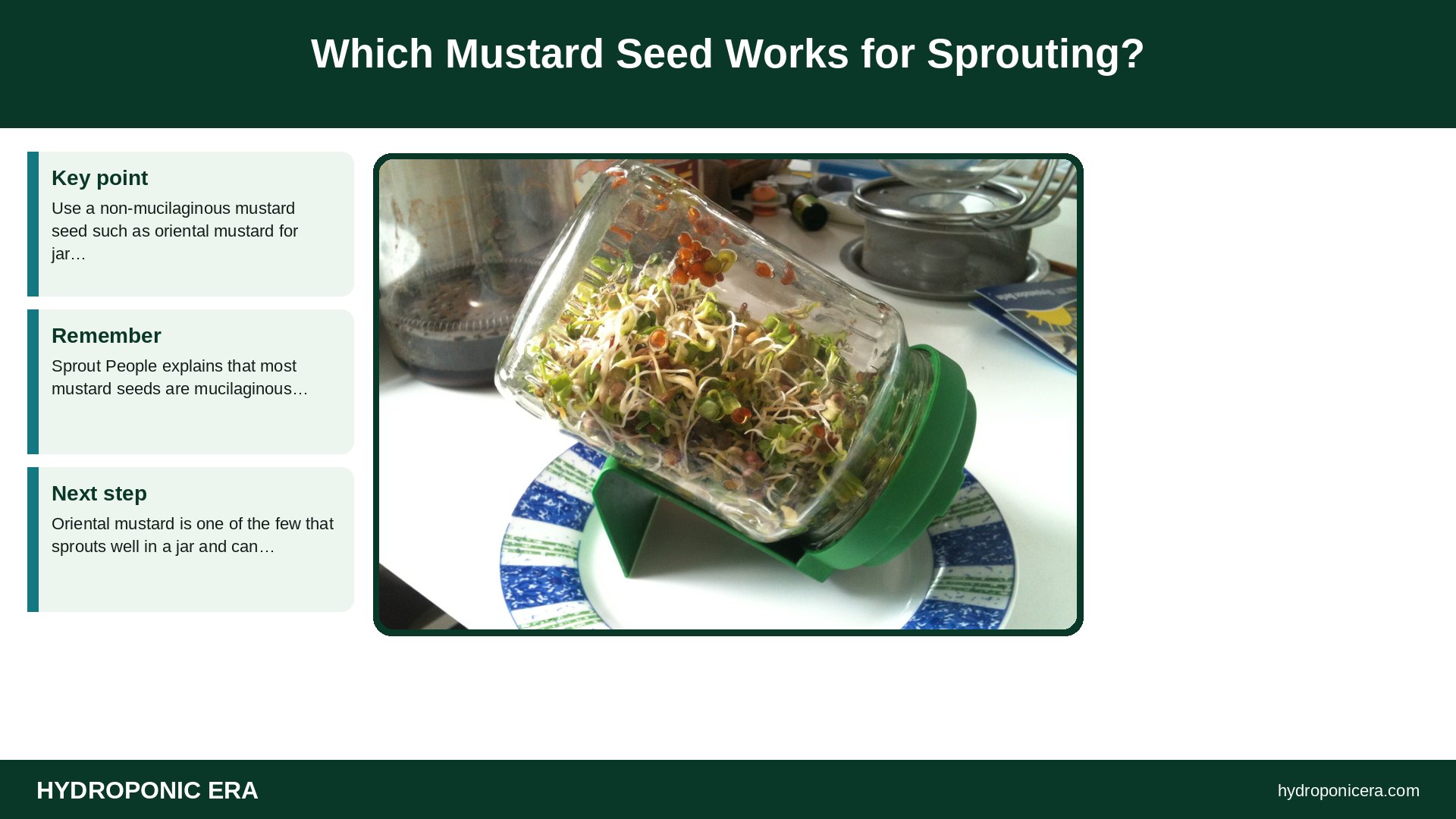
Use a non-mucilaginous mustard seed such as oriental mustard for jar sprouts. Sprout People explains that most mustard seeds are mucilaginous, forming a gel when wet, and those must be grown as microgreens on a tray instead. Oriental mustard is one of the few that sprouts well in a jar and can also grow as microgreens.
Buy seed sold for sprouting, not garden packets. Virginia Tech Extension warns that garden seed is often treated with pesticides, and UC ANR recommends certified pathogen-free seed.
How Do You Grow Mustard Sprouts Step by Step?
- Sanitize the jar and lid with diluted bleach, then rinse, as UC ANR describes.
- Add 3 tablespoons of seed to the sprouter.
- Soak 4–6 hours in cool water, then drain. Sprout People says never soak again.
- Rinse and drain every 8–12 hours with cool water.
- Loosen the clump. Brassica sprouts mat together, so fill with water and stir gently with a fork before draining.
- Drain very thoroughly each time; leftover water invites spoilage.
- Remove hulls from about day 3 by letting them float and skimming them off.
- Give indirect light once leaves form so they green; never direct sun, per USask.
- Harvest on day 5 or 6, when most leaves are open and green.
New to sprouting? Read how to grow sprouts in a jar.
How Long Do Mustard Sprouts Take to Grow?
They take about 3–6 days from dry seed. Sprout People lists a 3–6 day harvest and suggests tasting them at each rinse to find the stage you like best. Warmer rooms speed growth; NC State Extension gives 70–80°F (21–27°C) as a good sprouting range.
| Day | What you see | Task |
|---|---|---|
| 0 | Dry seed | Soak 4–6 hours |
| 1–2 | Tiny white roots | Rinse, drain, loosen |
| 3–4 | Yellow hulls among sprouts | Start removing hulls |
| 5–6 | Open green leaves | De-hull, dry, refrigerate |
Why Do You Need to De-Hull Mustard Sprouts?
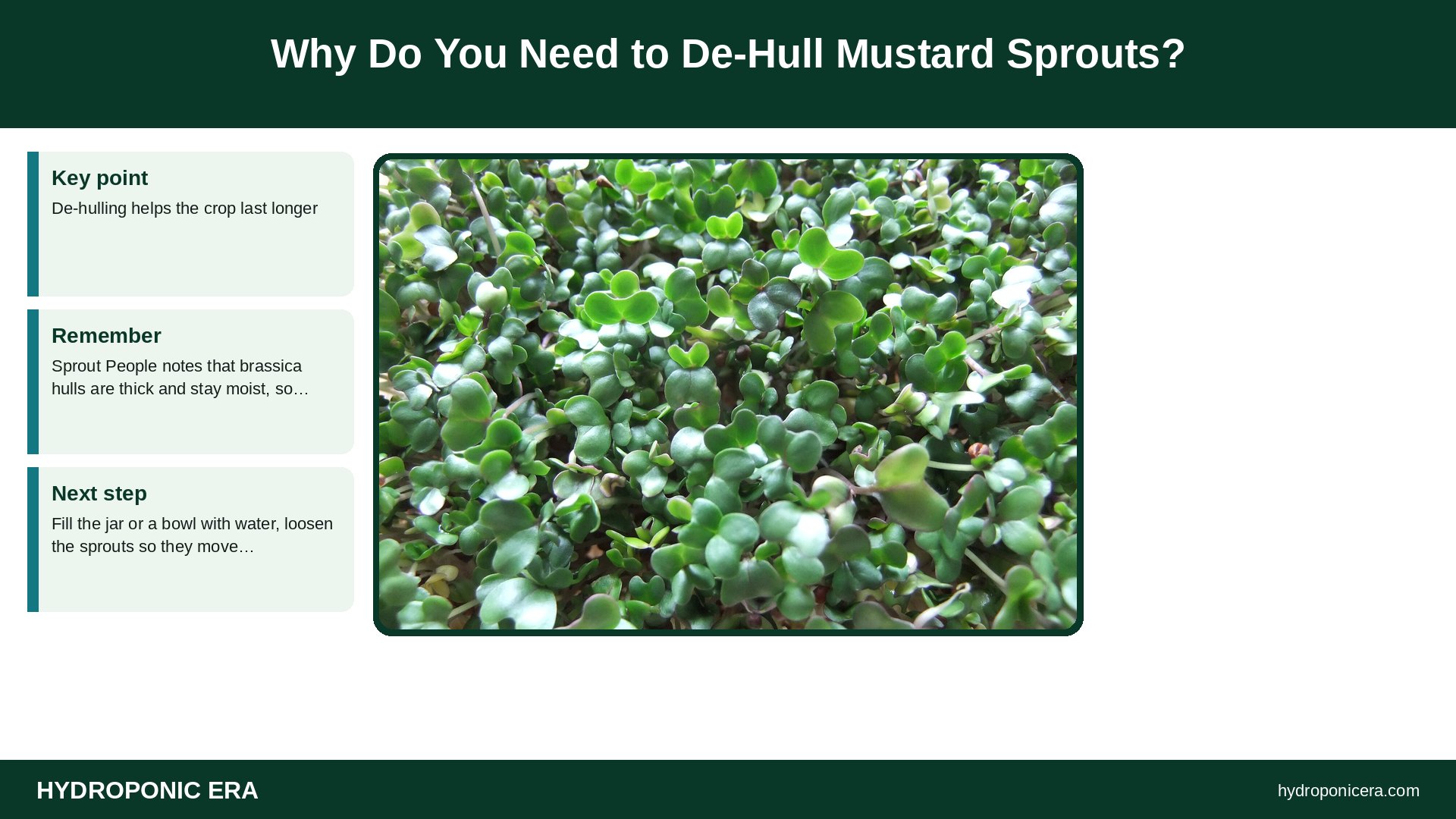
De-hulling helps the crop last longer. Sprout People notes that brassica hulls are thick and stay moist, so removing them is key if you want to store the crop for more than a few days. Fill the jar or a bowl with water, loosen the sprouts so they move freely, let hulls float to the top, and scoop them off. Repeat a few times, then drain well.
Can You Sprout Mustard Without a Jar?
Yes. Virginia Tech Extension describes the simplest method: spread seeds thinly between two damp paper towels and add water whenever the towels start to dry. It needs almost no equipment, but Virginia Tech warns that sprouted seeds can stick to the towels or mold if left too long, so harvest promptly. A tiered sprouter or a shallow tray with a mesh bottom also works well, because brassica seeds spread out and drain better than in a crowded jar.
How Do You Use Mustard Sprouts?
Use them where you want a peppery kick. Virginia Tech Extension suggests sprouts in sandwiches, soups, omelets, casseroles and stir-fries. A small handful brightens avocado toast, egg salad, noodle bowls or tacos. Their heat is strongest raw; brief cooking softens it and lowers food-safety risk.
Are Mustard Sprouts Safe to Eat Raw?
Like all raw sprouts, these carry a food-safety risk. The FDA explains that warm, humid sprouting conditions let bacteria multiply from seed, even in clean home setups, and advises children, older adults, pregnant people and people with weakened immune systems to avoid raw or lightly cooked sprouts.
- Heat-treat seed: UC ANR describes 5 minutes in 3% hydrogen peroxide at 140°F (60°C), then a 1-minute rinse.
- Skim floating seeds and debris, which UC ANR ties to most contamination.
- Cook sprouts to 165°F (74°C) for higher-risk eaters.
How Do You Store Mustard Sprouts?
Let de-hulled sprouts dry on the surface for a few hours, then refrigerate in a sealed container. Virginia Tech Extension says small-seeded sprouts keep fairly well for a week or more. NC State suggests 38–50°F (3–10°C). Discard any that smell off or turn slimy.
Mustard Sprouts vs Mustard Microgreens: What Is the Difference?
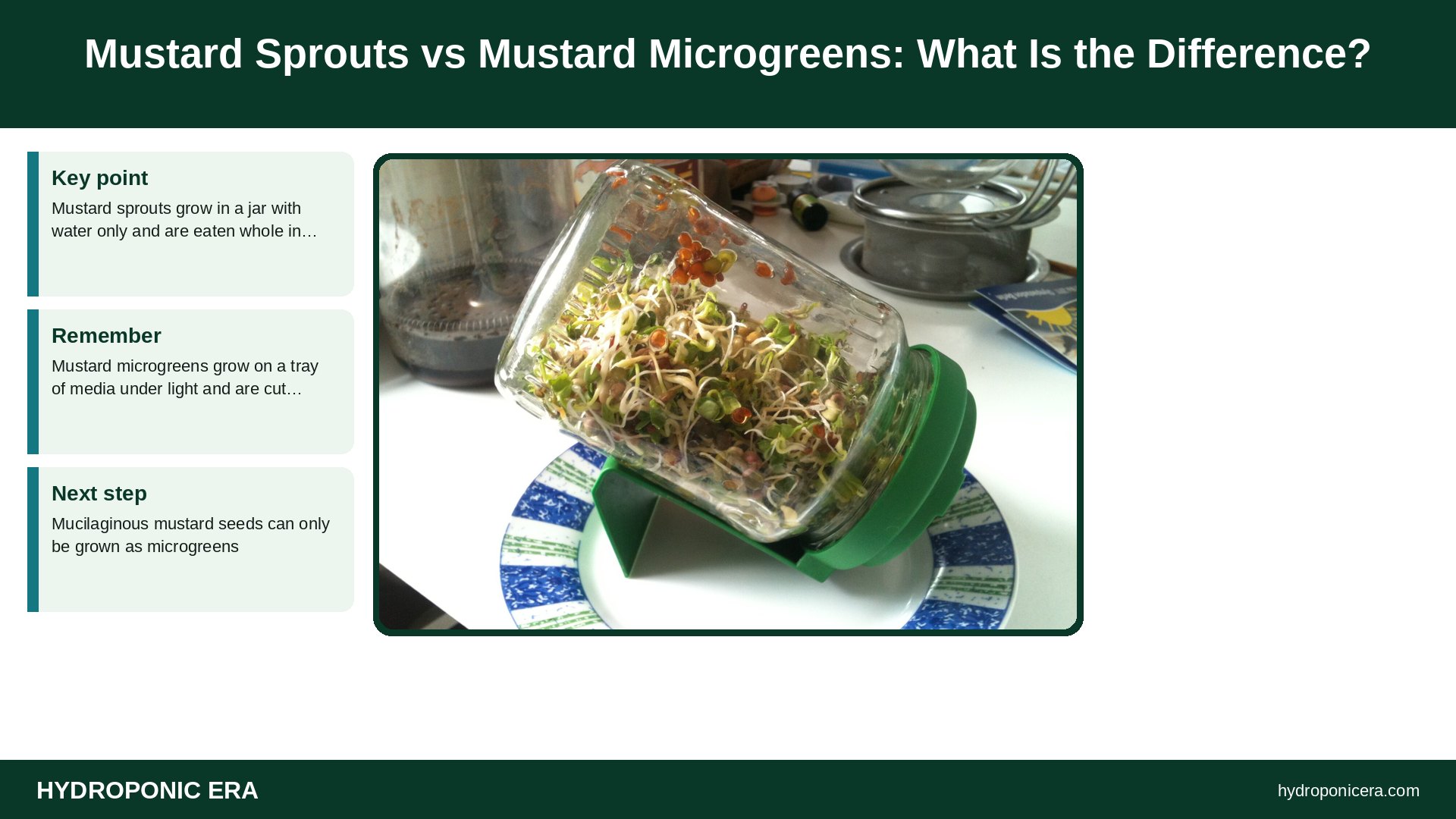
Mustard sprouts grow in a jar with water only and are eaten whole in under a week. Mustard microgreens grow on a tray of media under light and are cut above the root, usually a little later. Mucilaginous mustard seeds can only be grown as microgreens. See our hydroponic microgreens guide, or grow full-size plants with hydroponic mustard greens.
Why Are My Mustard Sprouts Moldy or Clumped?
- Fuzzy white roots: often harmless root hairs that vanish after rinsing; true mold smells musty and stays.
- Sour smell: poor draining; drain more thoroughly.
- Gel-like seed mass: a mucilaginous seed; grow it as microgreens.
- Tight mat: loosen with a fork at each rinse.
FAQs
Are mustard sprouts spicy?
Yes. Sprout People compares the taste to horseradish.
Why are my seeds not sprouting?
Old seed, chlorinated water or a cold room can slow germination; NC State notes chlorine can cause poor sprouting.
Can I mix mustard with other seeds?
Yes, with seeds that sprout at a similar speed, like radish or broccoli.
Do they need light?
Only at the end to green the leaves.
How much do 3 tablespoons make?
Sprout People lists about a 5:1 yield by weight.
Can I cook them?
Yes. A quick stir-fry lowers food-safety risk.
Sources
- Sprout People — Mustard Sprouts growing guide
- UC ANR — Growing Seed Sprouts at Home (Publication 8151)
- U.S. FDA — Selecting and Serving Produce Safely
- NC State Extension — Bean Sprouts and Other Vegetable Seed Sprouts
- Virginia Cooperative Extension — Sprouting Seeds for Food
- University of Saskatchewan — Sprouts
- Photo credits (Wikimedia Commons, edited with titles): Mustard seedling by Tess Watson from Edinburgh, Scotland, UK (CC BY 2.0); Growing bean sprouts by User:tlcoles (CC BY-SA 3.0); Broccoli sprouts by Julie Gibbons (CC BY 2.0); Growing bean sprouts by User:tlcoles (CC BY-SA 3.0); Radish sprouts (1 etap) by MOs810 (CC BY-SA 3.0)