
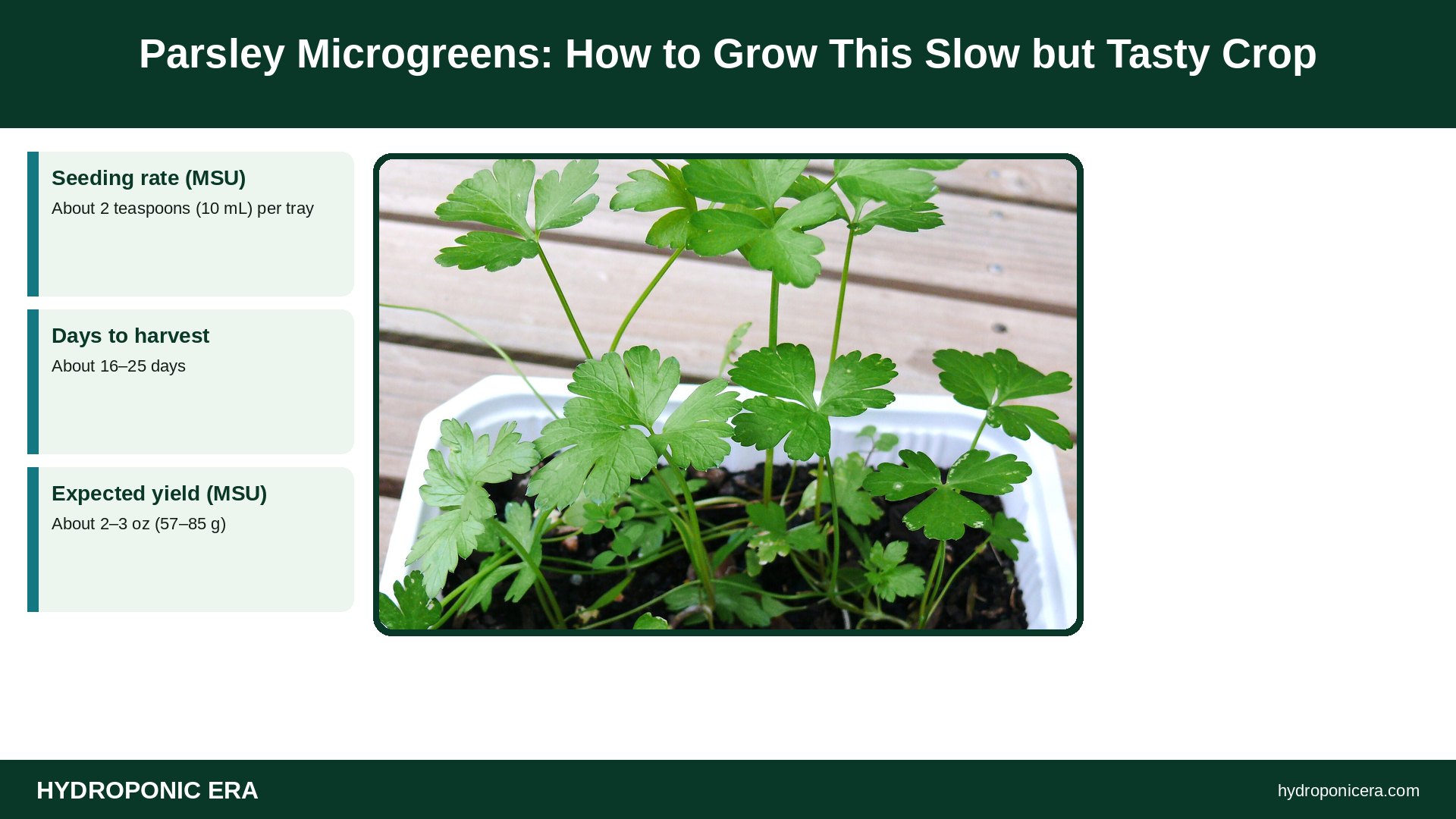
How do you grow parsley microgreens? Parsley microgreens are slow but easy. Sow about 2 teaspoons (10 mL) of seed on moist mix in a tray, keep it covered and dark until sprouts appear, then give strong light. Mississippi State University Extension lists parsley in the 16–25 day group, with an expected yield of about 2–3 oz (57–85 g) per tray.
Key takeaway: Parsley germinates slowly and unevenly, so patience and steady moisture matter. Soak seeds overnight, bottom water to keep leaves dry, and harvest when the first true leaves appear. Flat-leaf and curly types both work.
| Factor | Target |
|---|---|
| Seeding rate (MSU) | About 2 teaspoons (10 mL) per tray |
| Days to harvest | About 16–25 days |
| Expected yield (MSU) | About 2–3 oz (57–85 g) |
| Flavor | Mild parsley |
| Pre-soak | Overnight, 8–12 hours |
Why Grow Parsley Microgreens?
Parsley microgreens give a mild, fresh herb flavor in a small space. Mississippi State University Extension describes them as having intricate lobed leaves and a mild parsley flavor. They suit salads, eggs, soups and garnishes, and you can grow them on a windowsill or under a small light all year.
They are slower than radish or broccoli, so many growers plant them alongside faster crops. Our hydroponic microgreens guide covers the basics for all types.
How Do You Grow Parsley Microgreens Step by Step?
To grow parsley microgreens, soak seeds overnight, spread them evenly on a pre-moistened peat-based mix or grow mat, mist, and cover the tray to keep it dark and humid. After sprouts appear, remove the cover, place the tray in bright light, and bottom water as needed until harvest.
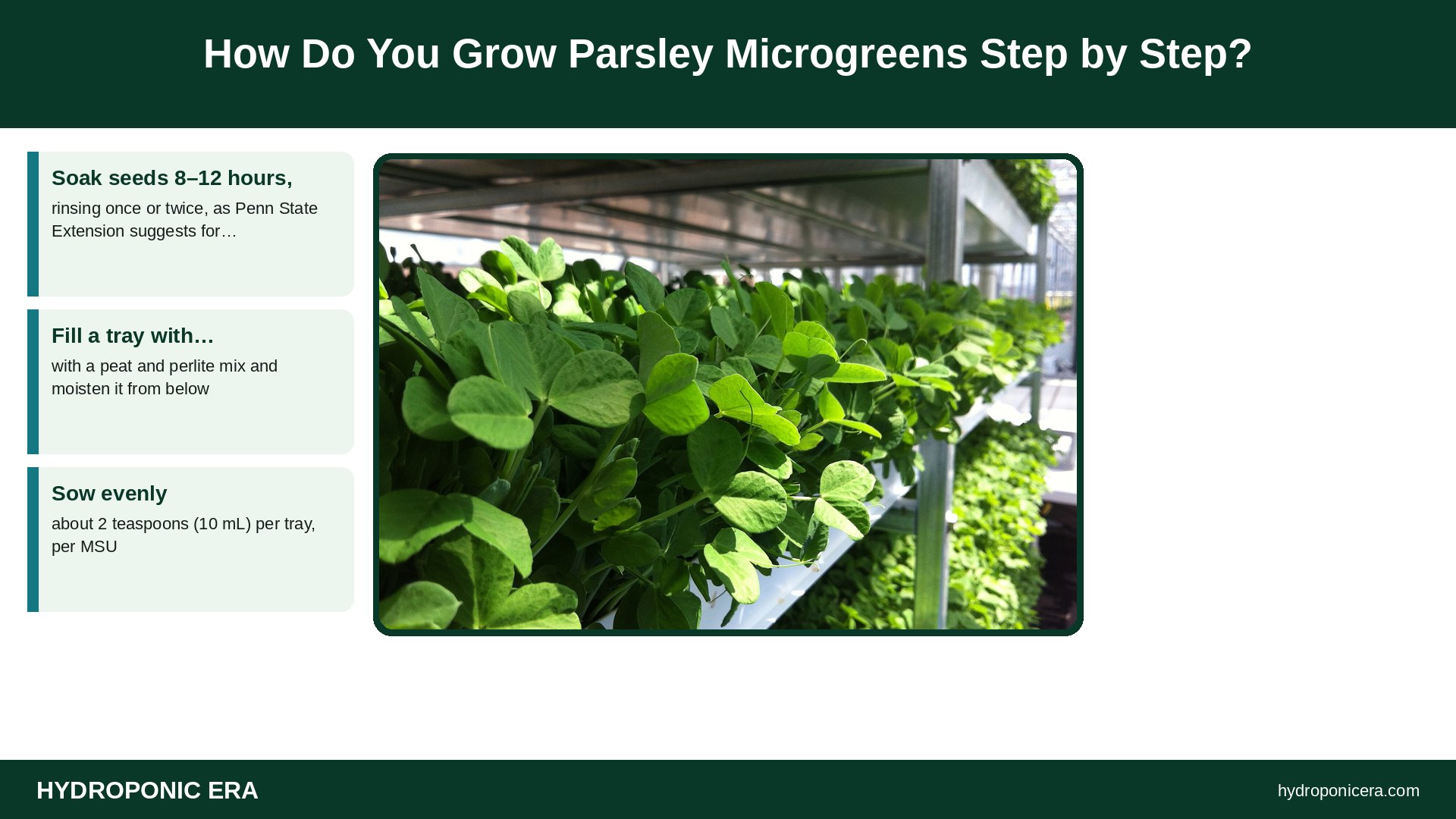
- Soak seeds 8–12 hours, rinsing once or twice, as Penn State Extension suggests for hard-coated seeds.
- Fill a tray with drainage holes with a peat and perlite mix and moisten it from below.
- Sow evenly: about 2 teaspoons (10 mL) per tray, per MSU.
- Mist and cover with a dome or another tray to block light.
- Keep warm and moist until most seeds sprout.
- Uncover and give light from a south window or grow light.
- Bottom water to keep leaves dry and reduce mold.
- Harvest with clean scissors just above the media.
How Long Do Parsley Microgreens Take to Grow?
Parsley microgreens usually take about 16–25 days from sowing to harvest, according to the Mississippi State University Extension growth groups. That puts parsley with beets, carrots, cilantro and basil in the slow group, compared with 7–10 days for pea shoots and radish. Germination itself can be slow and uneven.
| Speed group (MSU) | Examples |
|---|---|
| 7–10 days | Pea shoots, radish |
| 10–15 days | Mustard, kale, red cabbage, arugula |
| 16–25 days | Parsley, beets, carrots, cilantro, basil |
Seed priming can even out germination. MSU suggests mixing small seeds with damp vermiculite in a closed container for a couple of days until roots begin to show, then spreading the mix on the tray.
How Much Light Does Parsley Need as a Microgreen?
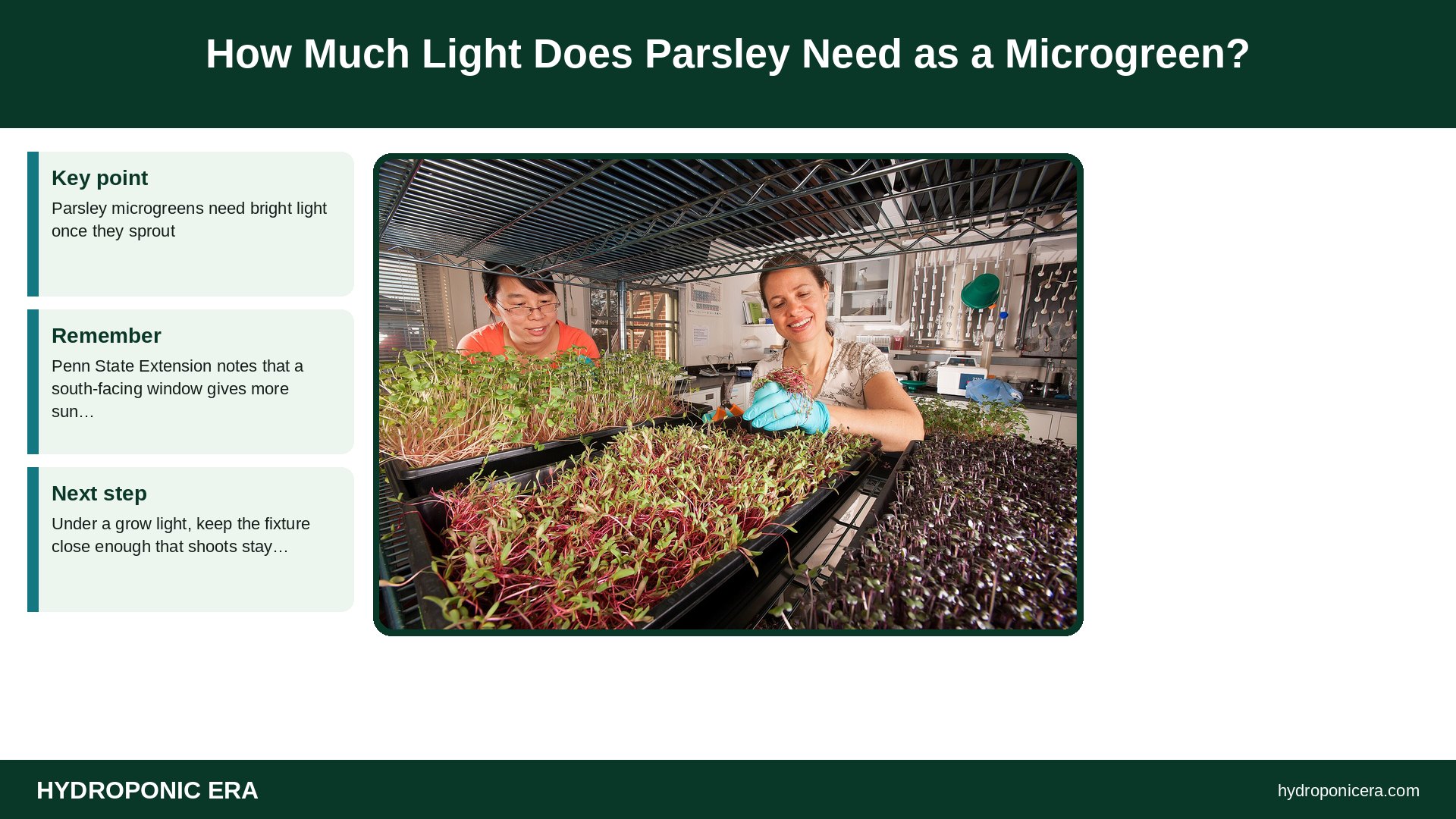
Parsley microgreens need bright light once they sprout. Penn State Extension notes that a south-facing window gives more sun than a north one and that seedlings lean toward light when it is limited. Under a grow light, keep the fixture close enough that shoots stay compact and green rather than tall and pale.
Turn trays daily on a windowsill. Our guide to the seed starting shelf with grow lights shows a simple indoor setup.
How Should You Water the Trays?
Water parsley microgreens from the bottom. Mississippi State Extension says bottom watering is effective, especially on a kitchen windowsill, and Penn State recommends it to limit contact between water and the greens. Set the tray in a second tray of water for a few minutes, then drain the extra so the mix is moist, not soggy.
- Before sprouting: mist the surface to keep seeds moist.
- After sprouting: bottom water only when the mix starts to dry.
- Airflow: a small fan or open window helps prevent mold.
When and How Do You Harvest Parsley Microgreens?
Harvest parsley microgreens when the cotyledons are fully open and the first true leaves, with their lobed parsley shape, begin to show. Cut just above the media with a clean, sharp knife or scissors. Penn State notes that washing shortens shelf life, so store unwashed in the refrigerator and rinse right before eating.
Harvesting is a one-cut process for most microgreens, so plant new trays every week or two for a steady supply. See our hydroponic parsley guide if you want full-size plants.
What Problems Slow Growth?
The main problems with parsley microgreens are slow, patchy germination, mold, and leggy growth. Old seed and dry spells during germination cause gaps. Overwatering and still air invite mold. Low light makes stems stretch and flop. Fresh seed, steady moisture, airflow and strong light solve most issues.
| Problem | Likely cause | Fix |
|---|---|---|
| Patchy sprouts | Old seed, dry spells | Fresh seed, pre-soak, keep covered |
| Fuzzy mold | Too wet, poor airflow | Bottom water less, add a fan |
| Tall, pale stems | Low light | Move closer to light |
White fuzzy root hairs near the base are normal and not mold; they disappear when misted.
How Do You Use and Store Parsley Microgreens?
Use parsley microgreens anywhere you would use chopped parsley: on eggs, soups, grain bowls, fish, salads and sandwiches. Add them at the end of cooking so the tiny leaves stay fresh and green. Their flavor is milder than mature parsley, so you can use a generous handful without overpowering a dish.
For storage, Penn State suggests bagging unwashed microgreens and keeping them cold, then washing right before use, because washing shortens shelf life. Line a container with a dry paper towel to absorb extra moisture. Microgreens are eaten raw, so clean trays, clean water and good hand hygiene matter; see Penn State’s guide to microgreen food safety.
Which Parsley Varieties Work Best?
Both flat-leaf (Italian) and curly parsley make good microgreens. Flat-leaf types tend to have a slightly stronger flavor, while curly types look frilly once true leaves appear. Buy untreated seed sold for sprouting or microgreens, and buy in bulk; MSU notes that small garden packets are not economical for microgreen trays.
FAQ About Parsley Microgreens
Flat-leaf or curly parsley for microgreens?
Both work. Taste is similar at this stage.
Does parsley regrow after cutting?
Usually not well; sow a new tray.
Can I grow them hydroponically?
Yes, on hemp or coconut mats with water or a weak nutrient solution.
Why is parsley so slow to germinate?
Parsley seed is naturally slow to sprout. Soaking and priming help.
How long do they keep?
Several days unwashed in the fridge.
Sources
- Mississippi State University Extension — Microgreen Varieties for the Mississippi Gardener (P2884)
- Mississippi State University Extension — Growing Microgreens for the Mississippi Gardener
- Penn State Extension — A Step-By-Step Guide for Growing Microgreens at Home
- Photo credits (Wikimedia Commons, edited with titles): Parsley; Petroselinum sativum by PARDC (CC BY-SA 3.0); Lufa Farms Microgreens in Trays by Lufa Farms (CC BY-SA 2.0); Liping Kou observes microgreens by Peggy Greb (Public domain); Fleece lined greenhouse potting tray and seed pots – Flickr – peganum by peganum from Small Dole, England (CC BY-SA 2.0)