
Can you root Persian shield cuttings in water? Yes. University of Wisconsin–Madison Extension says basal or softwood tip cuttings of Persian shield root readily in water or any moist growing medium, with no rooting hormone needed. Take 3 to 6 inch (8 to 15 cm) tips with several nodes in spring or summer, or in late summer to overwinter indoors, and use non-flowering stems.
Key takeaway: Persian shield cuttings are one of the easiest ways to keep this tender plant from year to year. UW–Madison says basal or softwood tip cuttings root readily in water or moist media without hormone, and that cuttings taken in late summer or early fall can be rooted indoors to overwinter. Avoid flowering stems: once spikes form, UW–Madison says the stems can no longer be used for propagation.
| Fact | What sources report | Source |
|---|---|---|
| Scientific name | Strobilanthes dyerianus (syn. S. auriculata var. dyeriana) | UW–Madison, NC State |
| Native range | Myanmar (NC State: Myanmar to Thailand) | UW–Madison, NC State |
| Cutting type | Basal or softwood tip cuttings | UW–Madison |
| Rooting | Roots readily in water or moist medium, no hormone | UW–Madison |
| Best timing | Early spring–summer; late summer–fall to overwinter | UW–Madison |
| Hardiness | Zone 10a (root hardy to about 8a); perennial in 8b+ per NC State | UW–Madison, NC State |
| Leaf color | Best in hot, humid conditions | UW–Madison |

What Is Persian Shield?
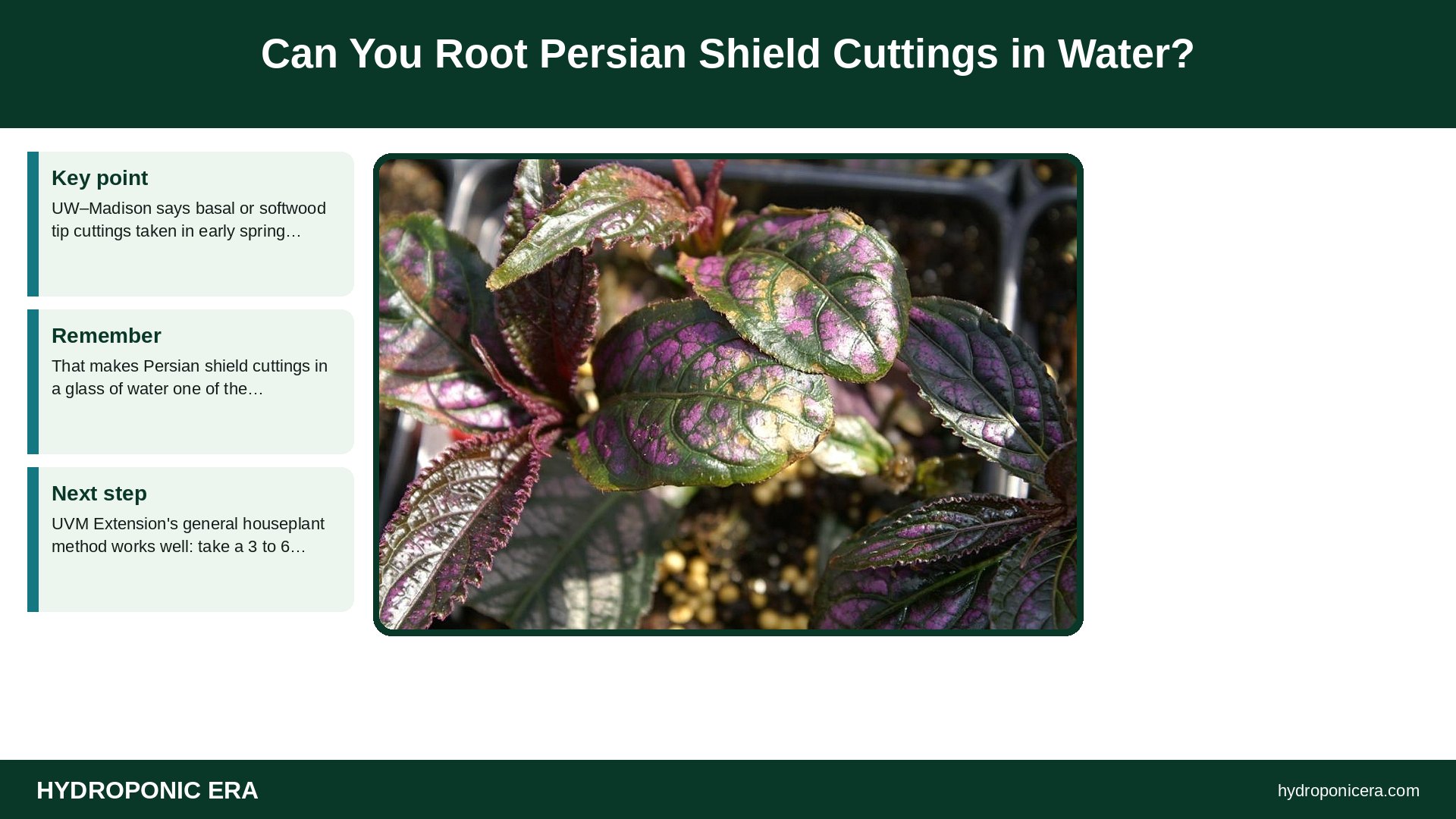
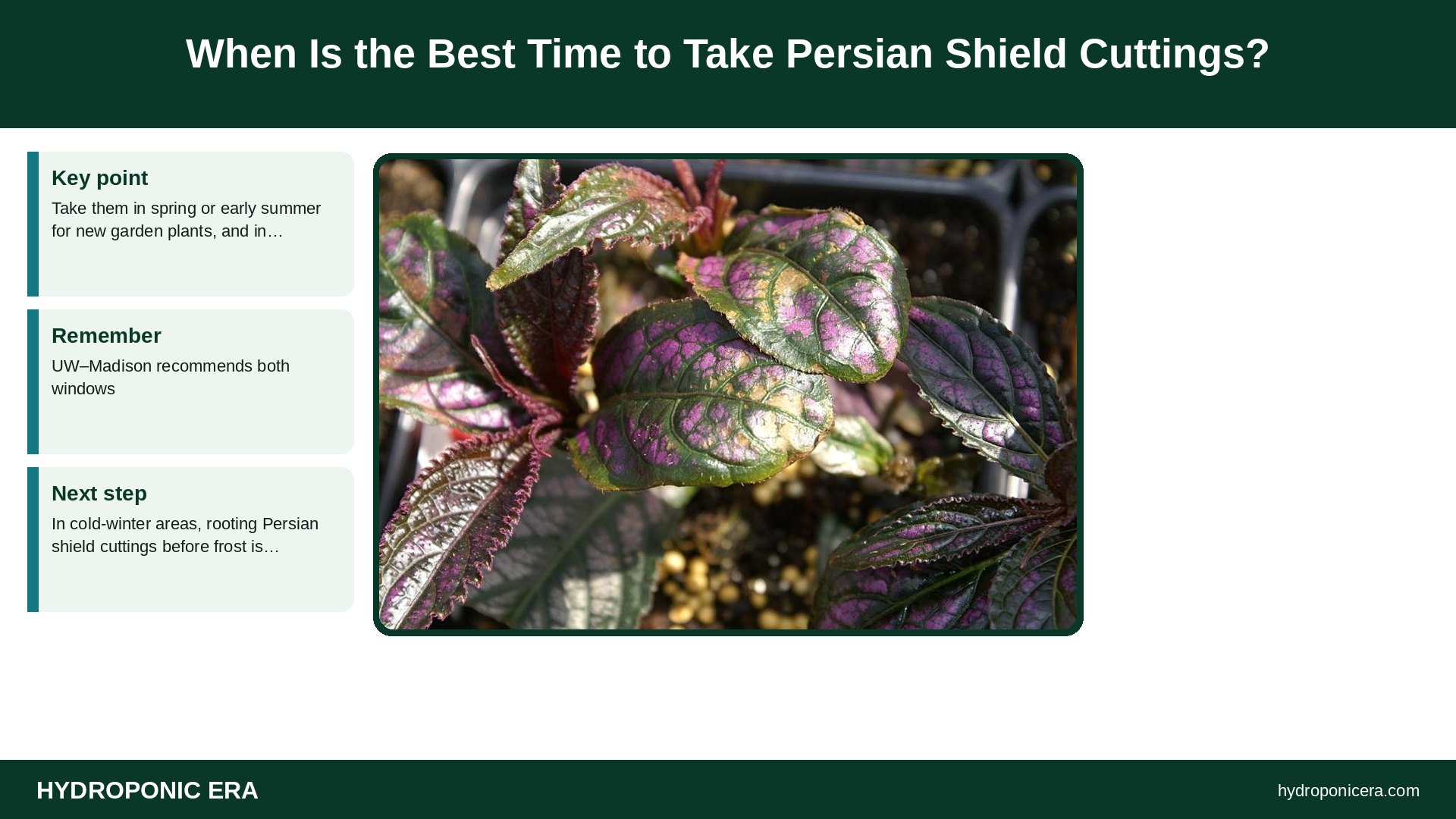
Persian shield is Strobilanthes dyerianus, an evergreen subshrub in the acanthus family (Acanthaceae). UW–Madison Extension says it is native to Myanmar and has been grown since Victorian times for its iridescent purple and silver foliage. NC State lists it as Strobilanthes auriculata var. dyeriana, native from Myanmar to Thailand.
It is hardy only to zone 10a, though possibly root hardy to zone 8a, so most US gardeners grow it as an annual or houseplant. Leaves reach 6 to 8 inches (15 to 20 cm) long and color best in heat. UW–Madison adds that older plants get woody and lose color, so it is best to take cuttings every year for fresh plants.
- Look: purple leaves with a metallic silver sheen.
- Size: up to 5 feet (1.5 m) tall in the ground, smaller in pots.
- Why propagate: young plants have the brightest leaves.
Can You Root Persian Shield Cuttings in Water?
Yes. UW–Madison says basal or softwood tip cuttings taken in early spring or summer root readily in water or any moist growing medium, without rooting hormone. That makes Persian shield cuttings in a glass of water one of the simplest ways to save a plant before frost, as long as each cutting has healthy nodes.
UVM Extension’s general houseplant method works well: take a 3 to 6 inch (8 to 15 cm) cutting from the tip of a healthy stem with several leaf nodes. New roots form at the nodes, where the leaves join the stem.
- Choose a soft, green, non-flowering shoot.
- Cut 3–6 inches (8–15 cm) long, just below a node.
- Remove the lower leaves so no foliage sits in water.
- Cut large upper leaves in half to reduce water loss.
- Stand the stems in a clean jar of room-temperature water.
- Place in bright, indirect light and change the water every few days.
Which Stems Make the Best Persian Shield Cuttings?
Use young, soft, non-flowering stems. UW–Madison explains that once the plant produces flower spikes, floral buds arise from every node and the stems can no longer be used for propagation, and plants do not easily revert to leafy growth. Basal shoots and soft tips root faster than old, woody stems, which also carry duller leaves.
- Best: soft green tips or basal shoots.
- Avoid: stems with flower spikes or buds.
- Avoid: woody, bare lower stems.
- Tip: water the parent plant the day before cutting.
How Long Do Persian Shield Cuttings Take to Root?
UW–Madison says the cuttings root readily but gives no exact timeline. In warm rooms of about 70 to 80°F (21 to 27°C) with bright light, soft Persian shield cuttings commonly show roots within about two to three weeks. Cool temperatures slow rooting, which fits UW–Madison’s note that the plant languishes when the weather is cool.
Wait for roots about 1 to 2 inches (2.5 to 5 cm) long before you move them. If leaves wilt at first, keep the jar out of direct sun and mist the leaves; they usually perk up once roots form.
- Warmth: the most important factor for fast roots.
- Light: bright but indirect while rooting.
- Water: replace it every 3–4 days.
When Is the Best Time to Take Persian Shield Cuttings?
Take them in spring or early summer for new garden plants, and in late summer or early fall to overwinter. UW–Madison recommends both windows. In cold-winter areas, rooting Persian shield cuttings before frost is easier than digging and moving a large plant, which UW–Madison says may drop all its leaves indoors before regrowing in spring.
If you do dig up the parent, do it well before frost and give it moderate light indoors, as UW–Madison advises. Many gardeners do both: root a few jars of cuttings as backup and pot up the main plant.
How Do You Move Rooted Persian Shield Cuttings Into Soil or Hydroponics?
Once roots reach 1 to 2 inches (2.5 to 5 cm), pot each cutting in a rich, well-drained mix and keep it moist. UW–Madison recommends soil rich in organic matter, good drainage, steady moisture and monthly feeding. Rooted Persian shield cuttings can also go into a small hydroponic or semi-hydro pot of clay pebbles with a weak nutrient solution.
- Use a 4 inch (10 cm) pot with drainage holes.
- Set the roots in gently; do not wind them.
- Water well, then keep it in bright shade for a week.
- Pinch the tip after new growth starts to make it bushy.
Outdoors, UW–Madison says to grow it in full sun in northern areas and in partial shade in southern states. Space plants 18 to 24 inches (45 to 60 cm) apart.
What Problems Affect Persian Shield Cuttings?
The main problems are rot, wilting and indoor pests. Persian shield cuttings rot if leaves sit underwater or the water goes stale, and they wilt when large leaves lose water faster than the stem can supply it. UW–Madison notes that indoors, plants may get spider mites, aphids or mealybugs, so inspect the parent plant before you cut.
- Black, soft base: cut above the rot and re-root.
- Wilting: halve big leaves and shade the jar.
- No roots after a month: move to a warmer spot.
- Tiny webs or speckles: check for spider mites.
Similar water-rooting methods work for coleus in water, salvia cuttings and impatiens cuttings in water.

FAQ About Persian Shield Cuttings
Do Persian shield cuttings need rooting hormone?
No; UW–Madison says they root readily without it.
Can you root Persian shield in soil instead of water?
Yes, any moist growing medium works.
Why won’t my Persian shield cutting root?
It may be too cool, woody or taken from a flowering stem.
Can you overwinter Persian shield from cuttings?
Yes; take cuttings in late summer or early fall.
How long should a Persian shield cutting be?
About 3 to 6 inches (8 to 15 cm) with several nodes.
Is Persian shield a perennial?
Only in warm zones; NC State lists 8b and warmer.
Sources
- University of Wisconsin–Madison Extension — Persian Shield, Strobilanthes dyerianus
- NC State Extension Plant Toolbox — Strobilanthes auriculata var. dyeriana
- University of Vermont Extension — More, Please: Propagating Houseplants
- Photo credits (Wikimedia Commons, edited with titles): Persian Shield (Strobilanthes dyerianus) by Mokkie (CC BY-SA 4.0); Strobilanthes dyerianus 5zz by Photo by David J. Stang (CC BY-SA 4.0)