
How do you grow bucephalandra in an aquarium? Attach bucephalandra to rock or driftwood instead of burying its rhizome, and give it medium to low light. Dennerle lists 68 to 82°F (20 to 28°C), pH 5 to 8, soft to moderately hard water and optional CO2 up to 20 mg/L. It grows slowly, so be patient and keep algae in check.
Key takeaway: Bucephalandra is a genus of slow-growing aroids endemic to Borneo. A 2025 Reinwardtia synthesis counts 32 species, 26 of them in Indonesian Borneo, and describes the genus as rheophytes, plants that grow on rocks in fast streams. In the aquarium, tie or glue the rhizome to hardscape, use medium to low light, keep water at 68–82°F (20–28°C) and propagate by cutting the rhizome.
| Fact | What sources report | Source |
|---|---|---|
| Family and origin | Araceae; endemic to Borneo | Reinwardtia, Dennerle |
| Species | 32 species, 26 found in Kalimantan | Reinwardtia (2025) |
| Habitat | Rheophyte on rocks near streams and cascades | Reinwardtia, Dennerle |
| Light | Medium–low | Dennerle |
| Temperature | 68–82°F (20–28°C) | Dennerle |
| pH and hardness | pH 5–8; soft to moderate | Dennerle |
| CO2 and growth | 0–20 mg/L; slow; height up to about 3 in (8 cm) | Dennerle |
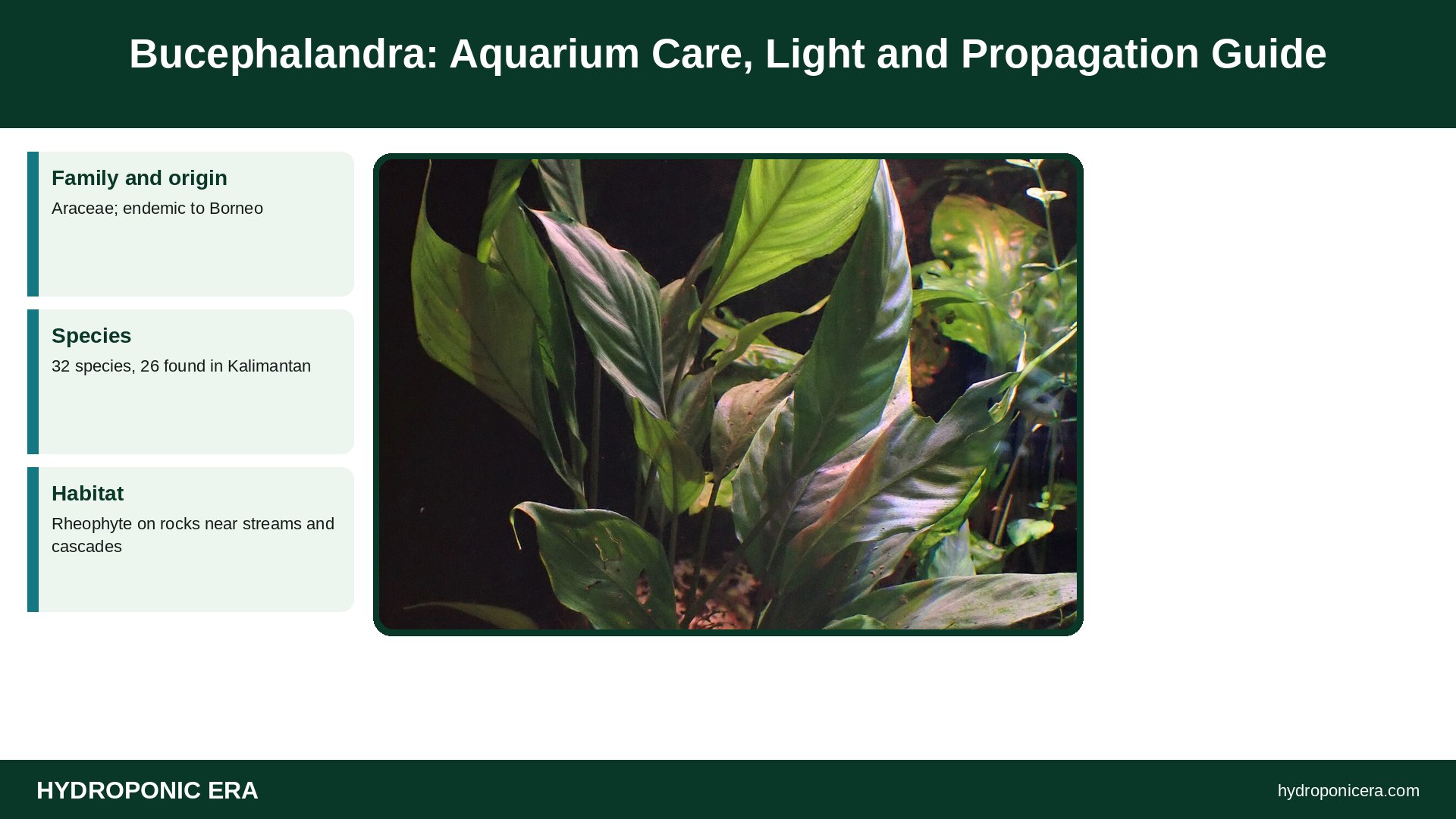
What Is Bucephalandra?
Bucephalandra is a genus in the aroid family, Araceae, found only on the island of Borneo. A 2025 synthesis in the journal Reinwardtia by Yuzammi and colleagues at Indonesia’s national research agency describes it as an endemic rheophyte genus, with 26 of its 32 species found in Kalimantan, the Indonesian part of the island.
Rheophytes grow on rocks in and beside fast-flowing streams. Dennerle explains that these plants grow on rocks near streams and cascades, which is why they should be attached to wood or stone in the aquarium. Hobby names such as ‘Wavy Green’, ‘Brownie’ or ‘Kedagang’ are trade labels, and many are not yet tied to a described species.
- Leaves: small, thick, often with blue or green sheen.
- Growth: a creeping rhizome like anubias.
- Best for: nano tanks, aquascapes and shrimp tanks.
How Do You Grow Bucephalandra in an Aquarium?
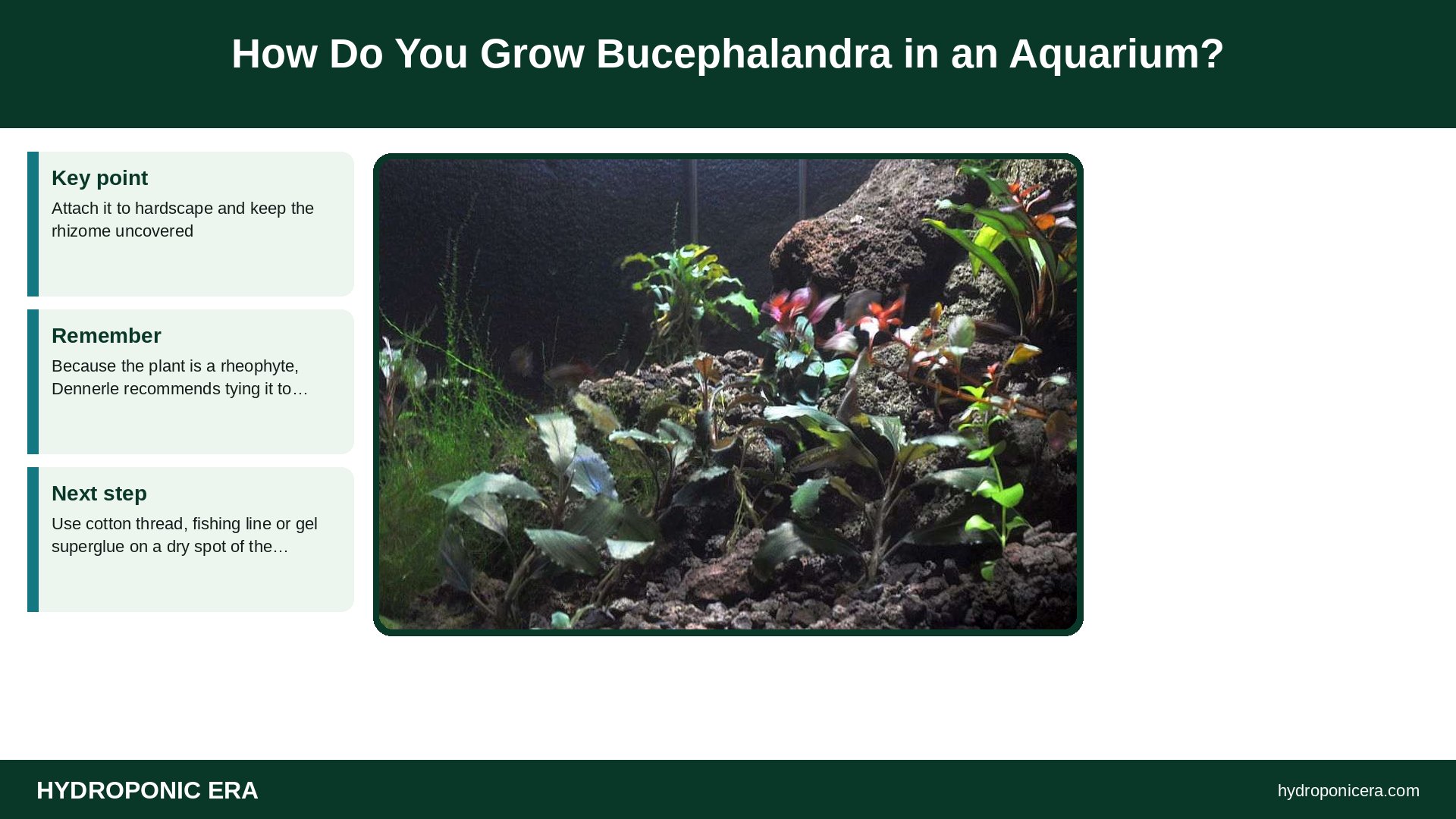
Attach it to hardscape and keep the rhizome uncovered. Because the plant is a rheophyte, Dennerle recommends tying it to root wood or stones rather than planting it in substrate. Use cotton thread, fishing line or gel superglue on a dry spot of the rock. Roots will grip the surface over several weeks.
- Rinse the plant and remove rock wool or gel from the roots.
- Choose a gap in rock or wood where the rhizome can sit snugly.
- Tie it in place or add a dot of gel superglue to the rhizome base.
- Keep the rhizome above the substrate in gentle flow.
- Leave it alone for a few weeks while roots attach.
You can wedge the roots lightly into gravel, but never bury the rhizome itself. A buried rhizome is a common cause of rot in rhizome plants such as Java fern.
What Light Does Bucephalandra Need?
Medium to low light is enough. Dennerle lists its light demand as medium to low, and its slow growth means strong light mainly feeds algae on the leaves. Place it in partial shade under taller plants or on lower rocks, and run lights about 6 to 8 hours a day.
Some growers report stronger blue or red tones under brighter light, but leaf color also depends on the variety. If you see green spots or fuzz on old leaves, reduce light or shade the plant before changing anything else. Our black beard algae guide helps with stubborn growth.
Does Bucephalandra Need CO2 and Fertilizer?
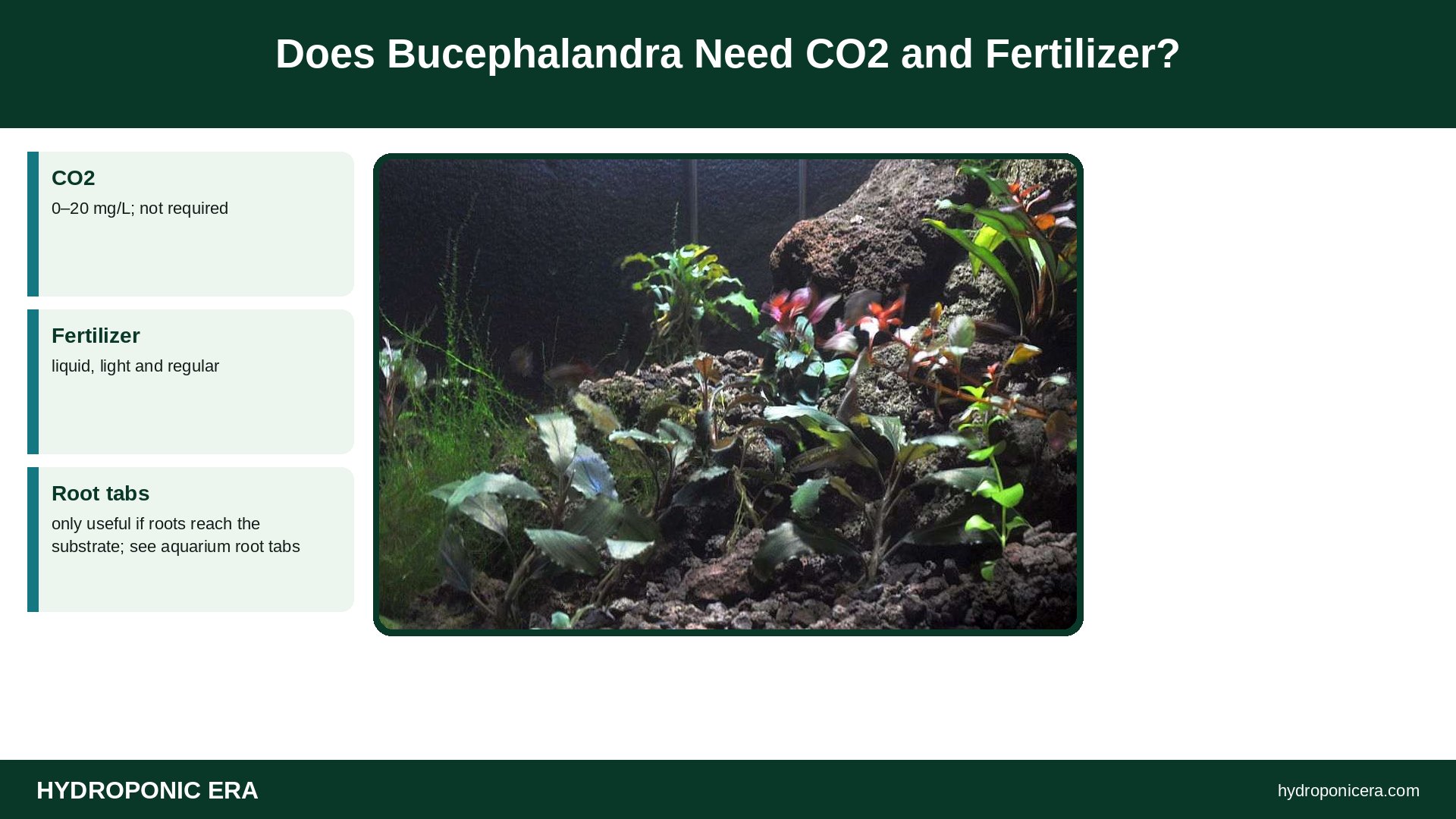
No, CO2 is optional. Dennerle lists a CO2 range of 0 to 20 mg/L, so it grows in low-tech tanks without injection, though added CO2 can speed new leaves. Because the roots grip hardscape rather than substrate, it feeds mostly from the water column. A light weekly dose of a complete liquid fertilizer is usually enough.
Too much fertilizer with slow plants leads to algae. Start small and watch the leaves. For dosing basics, see aquarium plant fertilizer and aquarium CO2 for plants.
- CO2: 0–20 mg/L; not required.
- Fertilizer: liquid, light and regular.
- Root tabs: only useful if roots reach the substrate; see aquarium root tabs.
What Water Parameters Does Bucephalandra Like?
This aroid does well in soft to moderately hard tropical water. Dennerle lists 68 to 82°F (20 to 28°C), pH 5 to 8 and soft to moderate hardness. Its natural stream habitat has clean, flowing water, so steady filtration and regular water changes help more than chasing exact numbers.
- Temperature: 68–82°F (20–28°C).
- pH: 5–8.
- Hardness: soft to moderate.
- Flow: gentle to moderate; keeps debris off leaves.
How Do You Propagate Bucephalandra?
Cut the rhizome. Dennerle lists rhizome cuttings as the propagation method. Once the rhizome has several leaves along its length, use a sharp blade to cut it into pieces with at least three or four leaves each, then attach each piece to its own rock or wood.
- Wait until the rhizome is long, with several leaves.
- Cut cleanly between leaves with a sterile blade.
- Make sure each section has leaves and roots.
- Tie or glue each piece onto new hardscape.
Growth is slow, Dennerle notes, so expect only a few new leaves a month. Patience is part of keeping these plants.
Why Is Bucephalandra Melting or Not Growing?
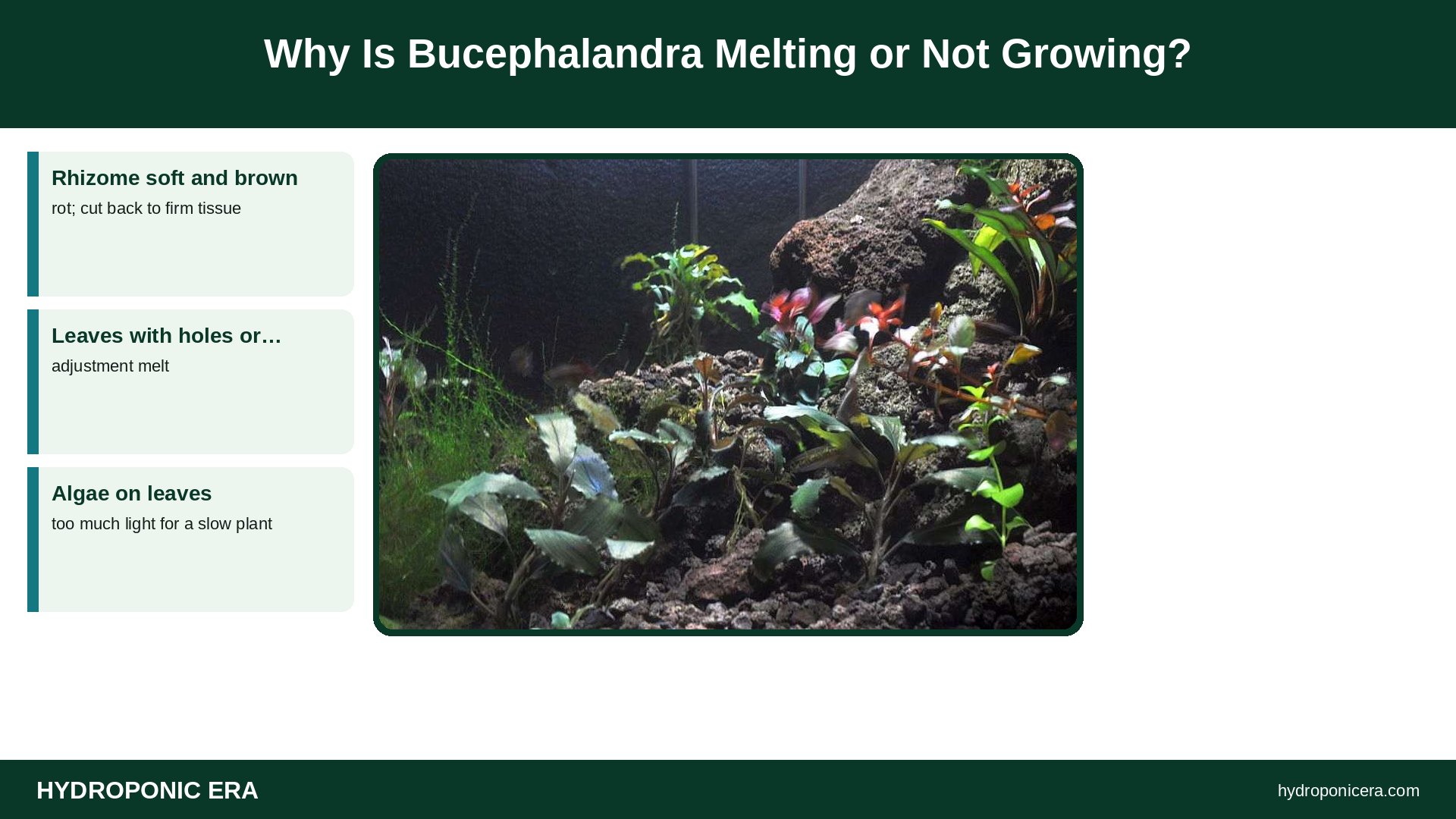
Melting usually follows a buried rhizome, sudden water changes or the switch from emersed to submerged growth. Many plants are farmed out of water, so some older leaves may drop as the plant adjusts. Keep the rhizome exposed, avoid large parameter swings and trim mushy leaves. Healthy rhizomes usually send out new leaves within weeks.
- Rhizome soft and brown: rot; cut back to firm tissue.
- Leaves with holes or transparent patches: adjustment melt.
- Algae on leaves: too much light for a slow plant.
- No new growth: check temperature, nutrients and patience.
Shrimp clean the leaves well; our shrimp aquaponics guide covers keeping them with plants.
FAQ About Bucephalandra
Can you bury the rhizome in substrate?
Do not bury the rhizome; attach it to rock or wood.
Does bucephalandra need CO2?
No; Dennerle lists 0–20 mg/L.
How fast does it grow?
Slowly, often just a few leaves a month.
Where does bucephalandra come from?
Borneo; it is endemic to the island.
Is it good for shrimp tanks?
Yes; it is slow, hardy and gives grazing surface.
How tall does bucephalandra get?
Dennerle lists up to about 3 inches (8 cm).
Sources
- Reinwardtia (BRIN), 2025 — Synthesis of Bucephalandra Schott studies in Kalimantan, Indonesia: checklist, key, and updated distribution maps
- Dennerle Plants — Bucephalandra pygmaea ‘Bukit Kelam’ plant profile/22988)
- Photo credits (Wikimedia Commons, edited with titles): Bucephalandra motleyana kz01 by Krzysztof Ziarnek, Kenraiz (CC BY-SA 4.0); Bucephalandra Shine Blue and Bucephalandra pygmaea ex situ by Manuel Werner / CC-BY-SA-3.0 Werner, Deutschland (CC BY-SA 4.0)