
How do you grow Pogostemon helferi? Plant Pogostemon helferi in the foreground of a nutrient-rich substrate, split into 4 to 5 small blocks set 1 to 2 inches (3 to 5 cm) apart. Give it medium to strong light and regular liquid fertilizer with iron. CO2 speeds growth but is optional. It likes 73 to 86°F (23 to 30°C).
Key takeaway: Pogostemon helferi, called “Downoi” or little star in Thailand, is a curly-leaved foreground stem plant that grows 2 to 4 inches (5 to 10 cm) tall. Tropica rates it medium light and medium CO2, and its plant biologist Ole Pedersen calls it one of the easiest foreground plants. Stronger light keeps it compact. Yellowish new leaves usually mean it needs more iron.
| Need | What sources report | Source |
|---|---|---|
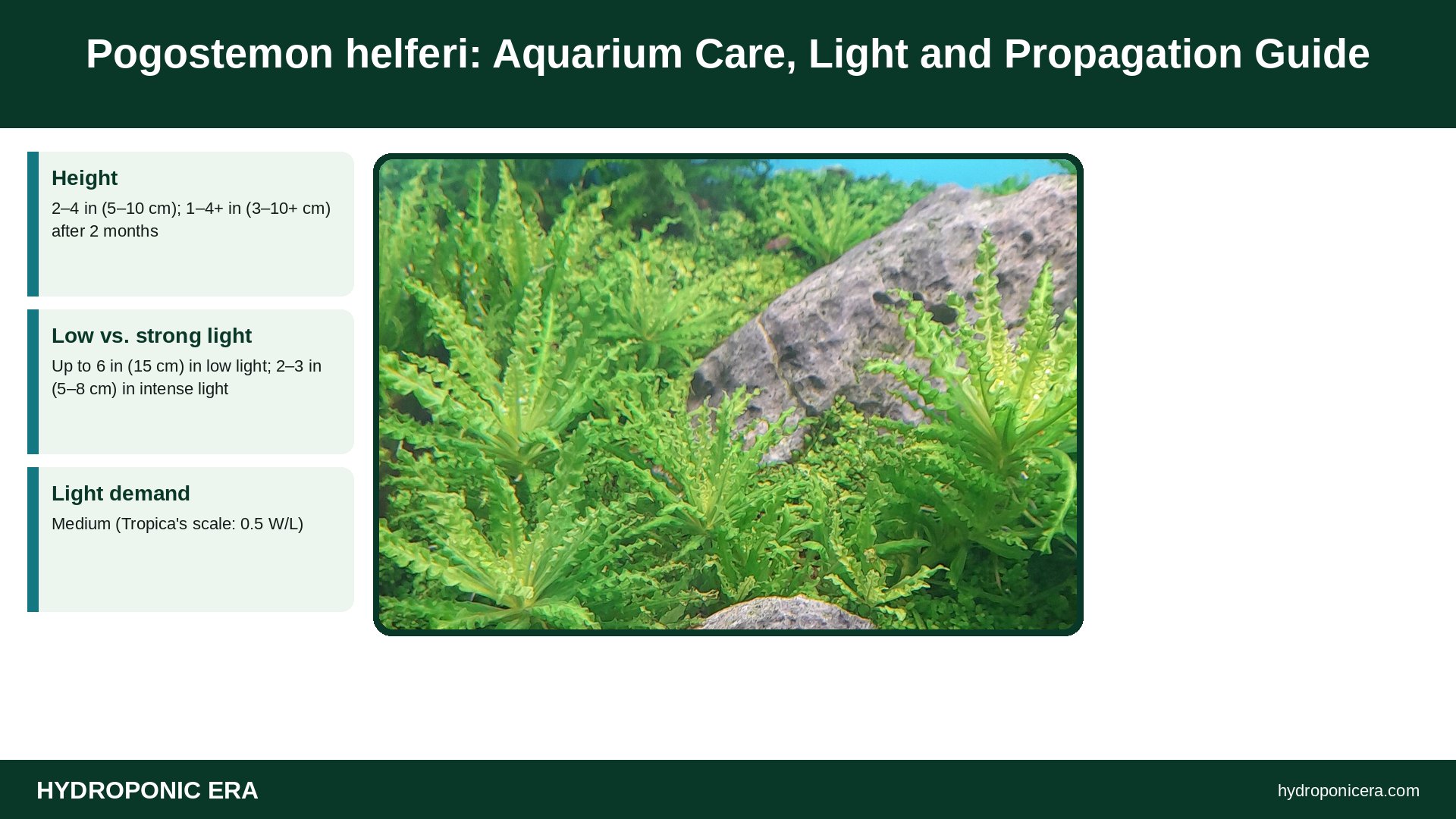
| Height | 2–4 in (5–10 cm); 1–4+ in (3–10+ cm) after 2 months | Tropica |
| Low vs. strong light | Up to 6 in (15 cm) in low light; 2–3 in (5–8 cm) in intense light | Tropica (Pedersen) |
| Light demand | Medium (Tropica’s scale: 0.5 W/L) | Tropica |
| CO2 | Medium, 6–14 mg/L; helps but not required | Tropica |
| Temperature | 73–86°F (23–30°C) | Tropica (Pedersen) |
| Planting | 4–5 blocks, 1–2 in (3–5 cm) apart | Tropica (Pedersen) |
| Common deficiency | Iron: yellowish new leaves | Tropica (Pedersen) |
What Is Pogostemon helferi?
Pogostemon helferi is an aquarium stem plant with crinkled, wavy dark green leaves arranged like a small star. Tropica says aquarists found it in Thailand near the border with Myanmar, where it is called “Downoi,” meaning little star. Each plant grows about 2 to 4 inches (5 to 10 cm) tall and wide, and it sends out side shoots that root and form a carpet.
In the wild, Tropica’s Ole Pedersen writes, Downoi grows among amphibious plants along creeks and small rivers. It is submerged in the wet season and above water in the dry season, rooted in iron-rich clay. That history explains two things about the plant in a tank: it adapts well to different water, and it likes iron.
- Family: Lamiaceae, a relative of Pogostemon stellatus.
- Role: foreground or midground accent.
- Flowers: lavender spikes, usually only when grown above water.
How Do You Grow Pogostemon helferi in an Aquarium?
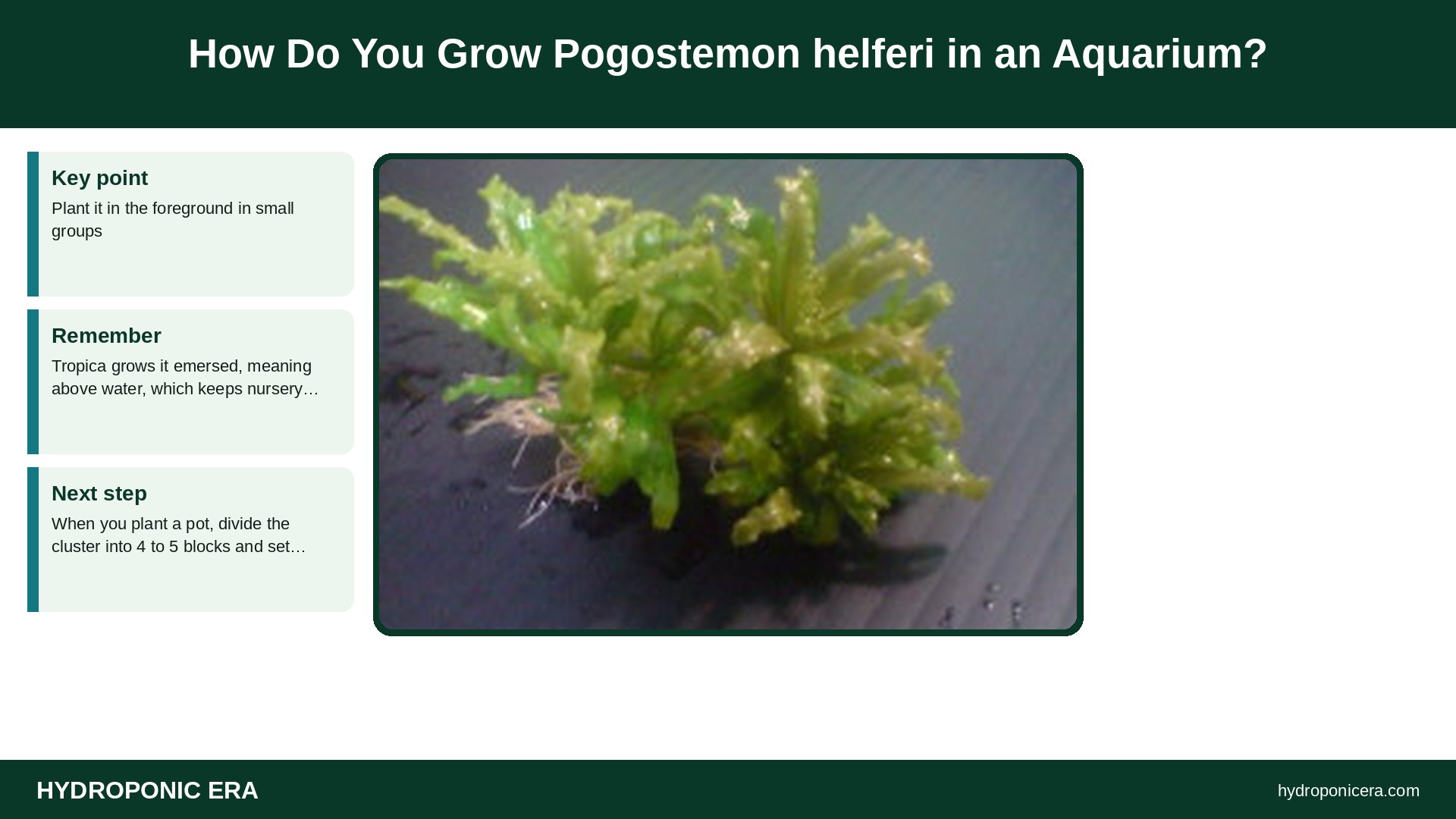
Plant it in the foreground in small groups. Tropica grows it emersed, meaning above water, which keeps nursery plants algae-free and helps them adapt to new tanks. When you plant a pot, divide the cluster into 4 to 5 blocks and set them 1 to 2 inches (3 to 5 cm) apart so they knit into an even carpet.
- Remove the pot and rock wool, keeping the roots intact.
- Pull off loose or already dying leaves and large lumps of old roots; Pedersen says this tissue decays and slows establishment.
- Split the clump into 4 to 5 blocks.
- Plant each block with tweezers, 1 to 2 inches (3 to 5 cm) apart.
- Keep taller plants from shading the group.
For other low-growing foreground choices, compare Staurogyne repens, Lilaeopsis and Monte Carlo.
What Light, CO2 and Fertilizer Does Pogostemon helferi Need?
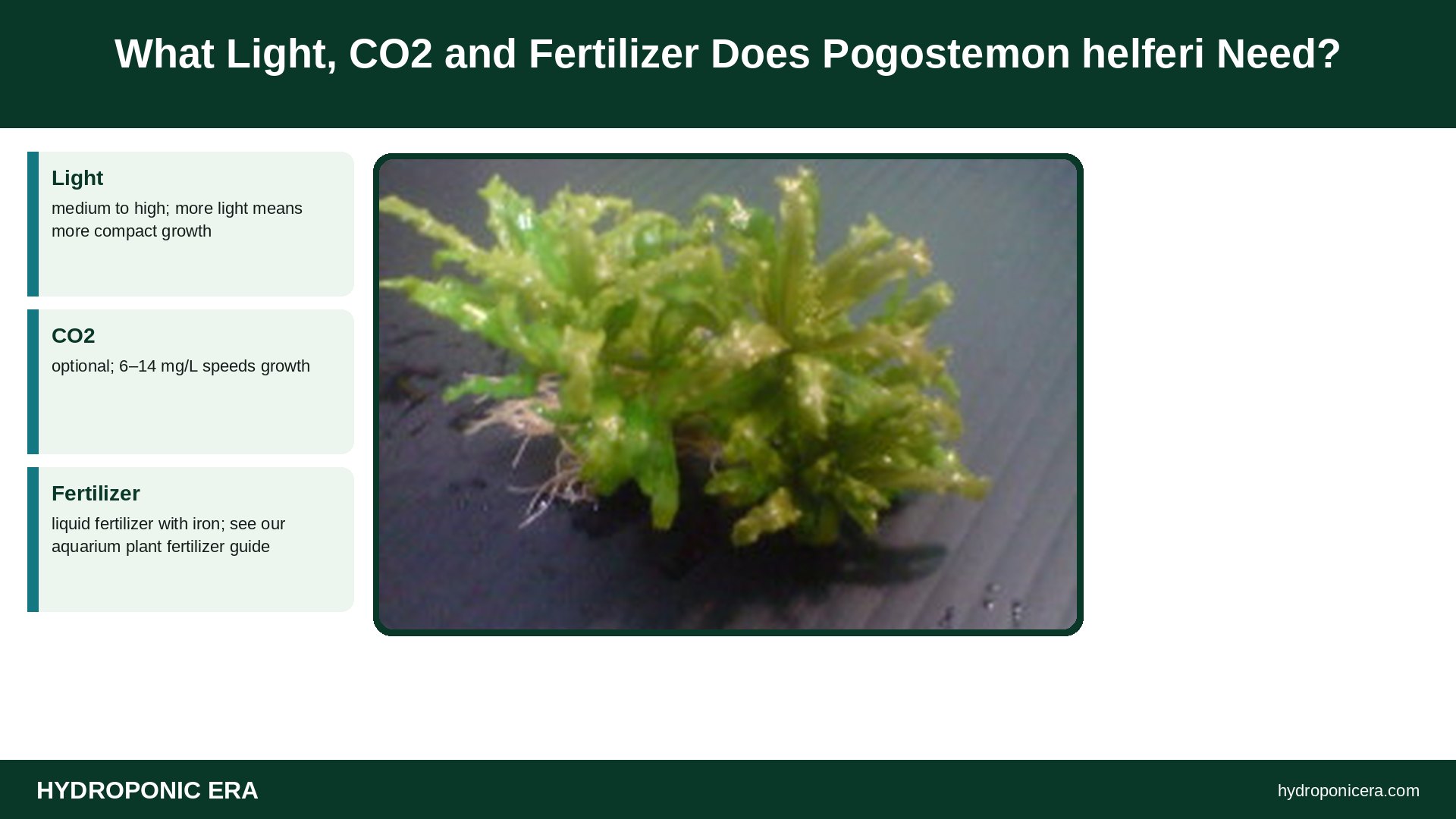
Medium light, medium CO2 and steady nutrients. Tropica lists it at medium light (about 0.5 W/L on its scale) and medium CO2 (6 to 14 mg/L). Pedersen adds that CO2 always boosts growth but is not required; without it the plant just grows slower. Because it grows fairly fast, it needs added nutrients, especially iron.
- Light: medium to high; more light means more compact growth.
- CO2: optional; 6–14 mg/L speeds growth.
- Fertilizer: liquid fertilizer with iron; see our aquarium plant fertilizer guide.
- Temperature: 73–86°F (23–30°C).
If you plan to add gas, our aquarium CO2 guide covers safe targets for fish.
Why Is Pogostemon helferi Melting or Not Growing?
Most problems trace back to iron, light or leftover nursery tissue. Pedersen says yellowish new leaves signal iron deficiency, easily fixed with a complete liquid fertilizer at label doses. In low light, it does not die but grows taller and looser, up to about 6 inches (15 cm). Old emersed leaves left on at planting can rot and slow the start.
- Yellow new leaves: add iron; see iron deficiency in hydroponics for the same symptom on land plants.
- Tall, leggy stems: raise light or remove shading plants.
- Decaying leaves after planting: trim them off; new growth should follow.
- Slow growth: check fertilizer first, then consider CO2.
How Do You Trim and Propagate Downoi?
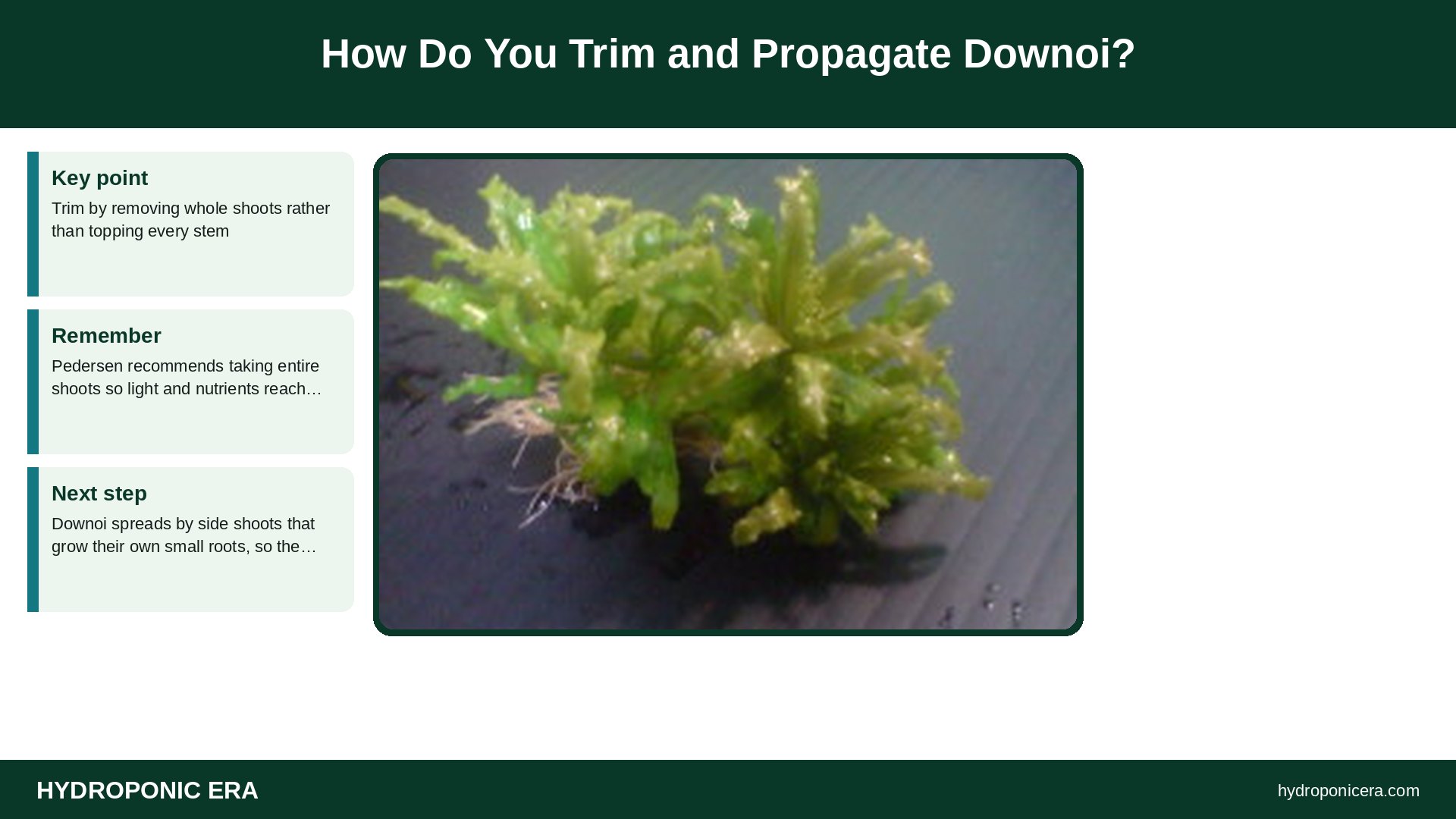
Trim by removing whole shoots rather than topping every stem. Pedersen recommends taking entire shoots so light and nutrients reach the shoots that remain. Downoi spreads by side shoots that grow their own small roots, so the shoots you remove can be replanted elsewhere in the foreground to grow new clumps.
- Pick crowded shoots at the edge or center of the clump.
- Pull or cut the whole shoot at the base.
- Replant rooted side shoots 1 to 2 inches (3 to 5 cm) apart.
Pair it with fine-leaved carpets such as glossostigma or Hemianthus for contrast, as Tropica suggests.
FAQ About Pogostemon helferi
Is Pogostemon helferi easy?
Tropica calls it one of the easiest foreground plants because it is not very light demanding.
Does Downoi need CO2?
No; CO2 speeds growth, but it grows slower without it.
How tall does it get?
About 2–4 in (5–10 cm), up to 6 in (15 cm) in low light.
Why are new leaves yellow?
Usually iron deficiency; add a liquid fertilizer.
What temperature suits it?
About 73–86°F (23–30°C).
How far apart should I plant it?
About 1–2 in (3–5 cm).
Sources
- Tropica Aquarium Plants — Pogostemon helferi plant details
- Tropica Aquarium Plants (Ole Pedersen) — Pogostemon helferi
- Photo credits (Wikimedia Commons, edited with titles): Pogostemon helferi-1-veda aquarium-R.M.Nagar-bengaluru-India by Yercaud-elango (CC BY-SA 3.0); Pogostemon3 by No machine-readable author provided. S.Tanaka~commonswiki assumed (based on copy (Public domain)