
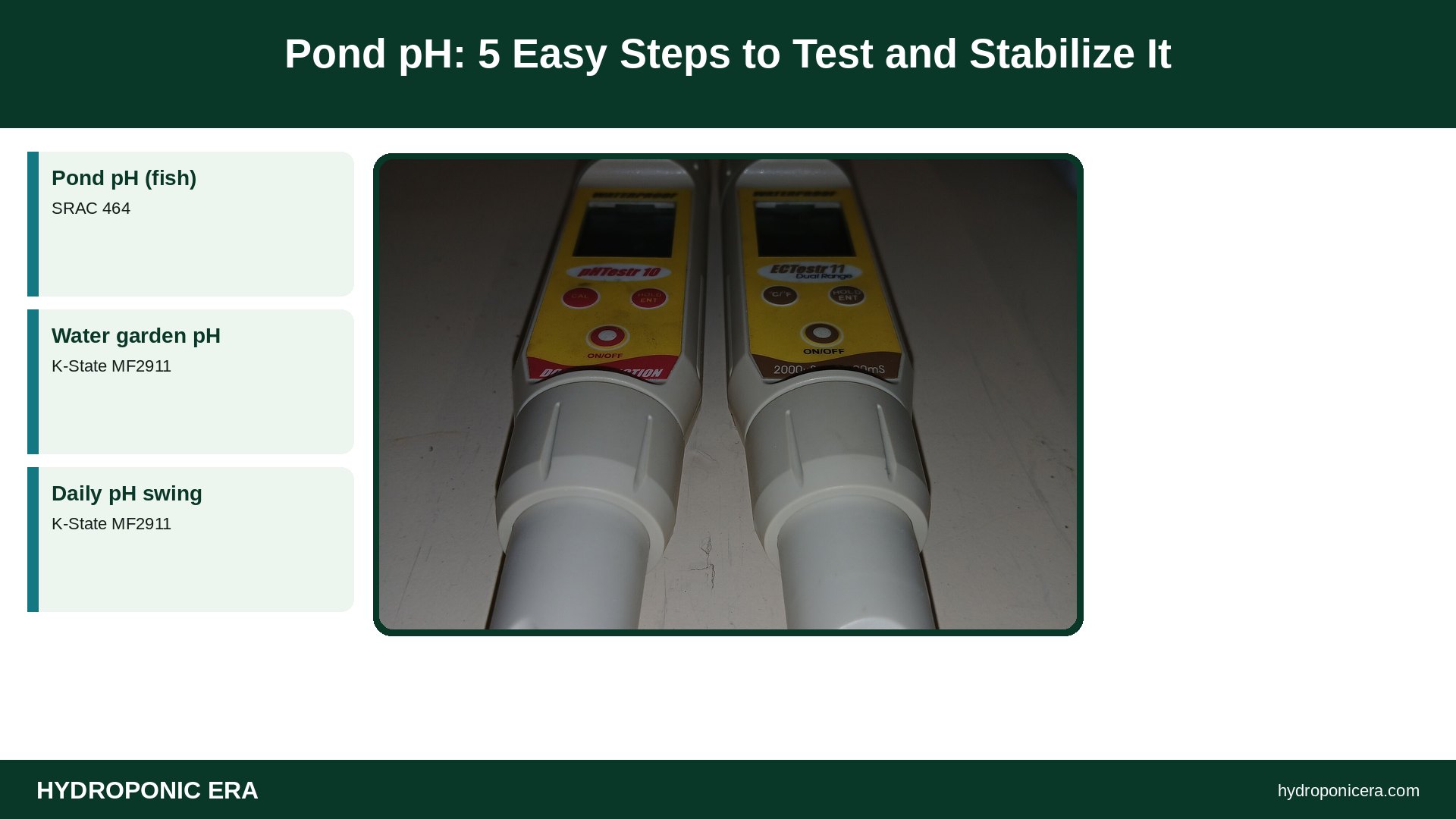
What should pond pH be for fish? Pond pH for fish should stay near 7.0–8.0, close to fish blood, says SRAC, giving 6.5–9.0 as the wider aquaculture range. K-State Extension recommends 6.8–8.2 for water gardens, with no more than 0.8 of a swing per day. Stable pH comes from good alkalinity, so test carbonate hardness (KH) first, then pH.
Key takeaway: Pond pH rises by day as algae use CO2 and falls at night as everything respires. Keep it steady by holding carbonate hardness at about 90–180 ppm, testing at the same time each day, adding baking soda slowly if KH is low and remembering that high pH makes ammonia far more toxic to fish.
| Measure | Target | Source |
|---|---|---|
| Pond pH (fish) | 7.0–8.0 ideal; 6.5–9.0 acceptable | SRAC 464 |
| Water garden pH | 6.8–8.2 | K-State MF2911 |
| Daily pH swing | No more than 0.8 | K-State MF2911 |
| Carbonate hardness (KH) | 90–180 ppm | K-State MF2911 |
| Total alkalinity for fish | 75–200 mg/L as CaCO3 | SRAC 464 |
| Danger zone | Below 5 or above 10 | SRAC 464 |
What Is a Safe Pond pH?
A safe pond pH is close to fish blood, about 7.0–8.0. SRAC explains that fish blood averages pH 7.4 and comes into close contact with water in the gills, so pond water in that range causes the least stress. SRAC’s broader aquaculture range is 6.5–9.0, and fish may become stressed and die below pH 5 or above 10.
K-State Extension gives a similar water garden target of 6.8–8.2. Above 8.2, it says, high pH can stress fish, slow plant growth and curb beneficial bacteria, leading to more algae.
Why Does Pond pH Change During the Day?
Pond pH changes because plants and algae use carbon dioxide in daylight and everything releases it at night. SRAC says that after sunset, oxygen falls while CO2 rises from respiration, forming carbonic acid that lowers pH. In daylight, photosynthesis removes CO2 and pH climbs. Dense algae blooms in soft water can push afternoon pH dangerously high.
- Lowest pH: around dawn, after a night of respiration.
- Highest pH: late afternoon on sunny days.
- Bigger swings: low alkalinity and heavy algae.
K-State recommends a daily swing of no more than 0.8 pH units.
How Do You Test Pond pH?
Test pond pH with a liquid kit, test strips or a calibrated meter, at the same spot and the same time each day. Because readings shift through the day, compare like with like. Test carbonate hardness at the same time, since KH controls how much pH can move. K-State advises retesting monthly through the growing season.
- Take a sample from mid-depth, away from the waterfall or inflow.
- Read pH promptly; SRAC notes pH should be measured within 30 minutes of sampling for CO2 estimates.
- Test KH (carbonate hardness) with a drop-count kit.
- Record results with the date and time.
Our GH and KH water tests guide explains how drop-count kits work.
How Do You Stabilize Pond pH?
Stabilize pond pH by fixing alkalinity first. SRAC says waters with moderate to high alkalinity stay near pH 7.0–8.3 and do not swing widely. K-State recommends carbonate hardness of 90–180 ppm and says that if carbonates fall below 125 ppm, sodium bicarbonate (baking soda) can raise them. Retest after six hours and add more only as needed.
- Test KH; if below about 125 ppm, add baking soda in small doses.
- Use the dose table in K-State’s MF2911 for your pond size in gallons.
- Retest after six hours before dosing again.
- Once KH is in range, adjust pH only if it is still outside 6.8–8.2.
K-State notes plants and bacteria use up carbonates over time. For background on buffering, see our alkalinity and bicarbonate guide.
Why Does High Pond pH Make Ammonia Dangerous?
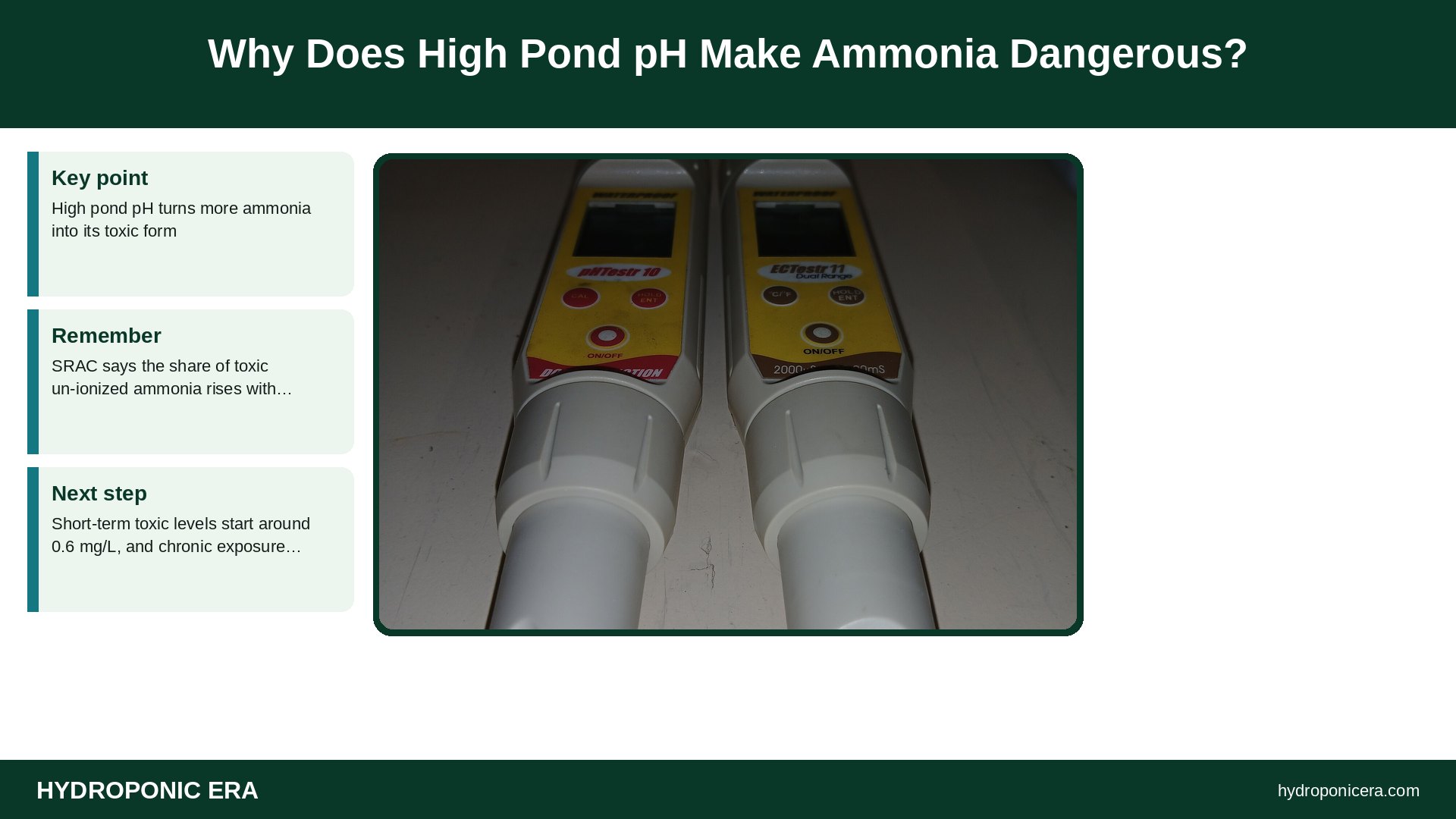
High pond pH turns more ammonia into its toxic form. SRAC says the share of toxic un-ionized ammonia rises with temperature and pH, increasing about tenfold for each one-unit rise in pH. Short-term toxic levels start around 0.6 mg/L, and chronic exposure as low as 0.06 mg/L can damage gills and kidneys.
- Test ammonia whenever pH runs high.
- Avoid overfeeding; SRAC says ammonia rises with feeding rates.
- Keep the biofilter healthy to convert ammonia.
How Do You Lower High Pond pH?
Lower high pond pH by fixing the cause, usually low alkalinity with a heavy algae bloom. K-State says that if pH is above 8.2 after KH is in range, sodium bisulfate or other safe acids can be used, and if pH is too low, changing 20–25% of the water usually helps. Add shade plants to curb algae over time.
What is the ideal pond pH for koi and goldfish?
About 7.0–8.0, per SRAC, within K-State’s 6.8–8.2 water garden range.
Why is my pond pH high in the afternoon?
Algae remove CO2 during daylight photosynthesis, raising pH; it falls again overnight, as SRAC explains.
Does baking soda raise pond pH?
It raises carbonate hardness, which buffers pH. K-State recommends it when KH is below 125 ppm.
How often should I test pond pH?
At least monthly in the growing season, per K-State, and more often after problems or big water changes.
Can high pH kill pond fish?
Yes. SRAC says fish may die above pH 10, and high pH makes ammonia far more toxic.
Sources
- Southern Regional Aquaculture Center. SRAC 464: Interactions of pH, Carbon Dioxide, Alkalinity and Hardness in Fish Ponds.
- Southern Regional Aquaculture Center. SRAC 463: Ammonia in Fish Ponds.
- Kansas State University. MF2911 Water Gardening: Biological Balance.
- Photo credits (Wikimedia Commons, edited with titles): PH- und Leitfähigkeitsmessgeräte by Rotkaeppchen68 (CC0); Covid test kit 2022 by Downtowngal (CC BY-SA 4.0); Pond-edge plants at Achamore Garden – geograph.org.uk – 5446824 by M J Richardson (CC BY-SA 2.0); PH- und Leitfähigkeitsmessgeräte by Rotkaeppchen68 (CC0)