
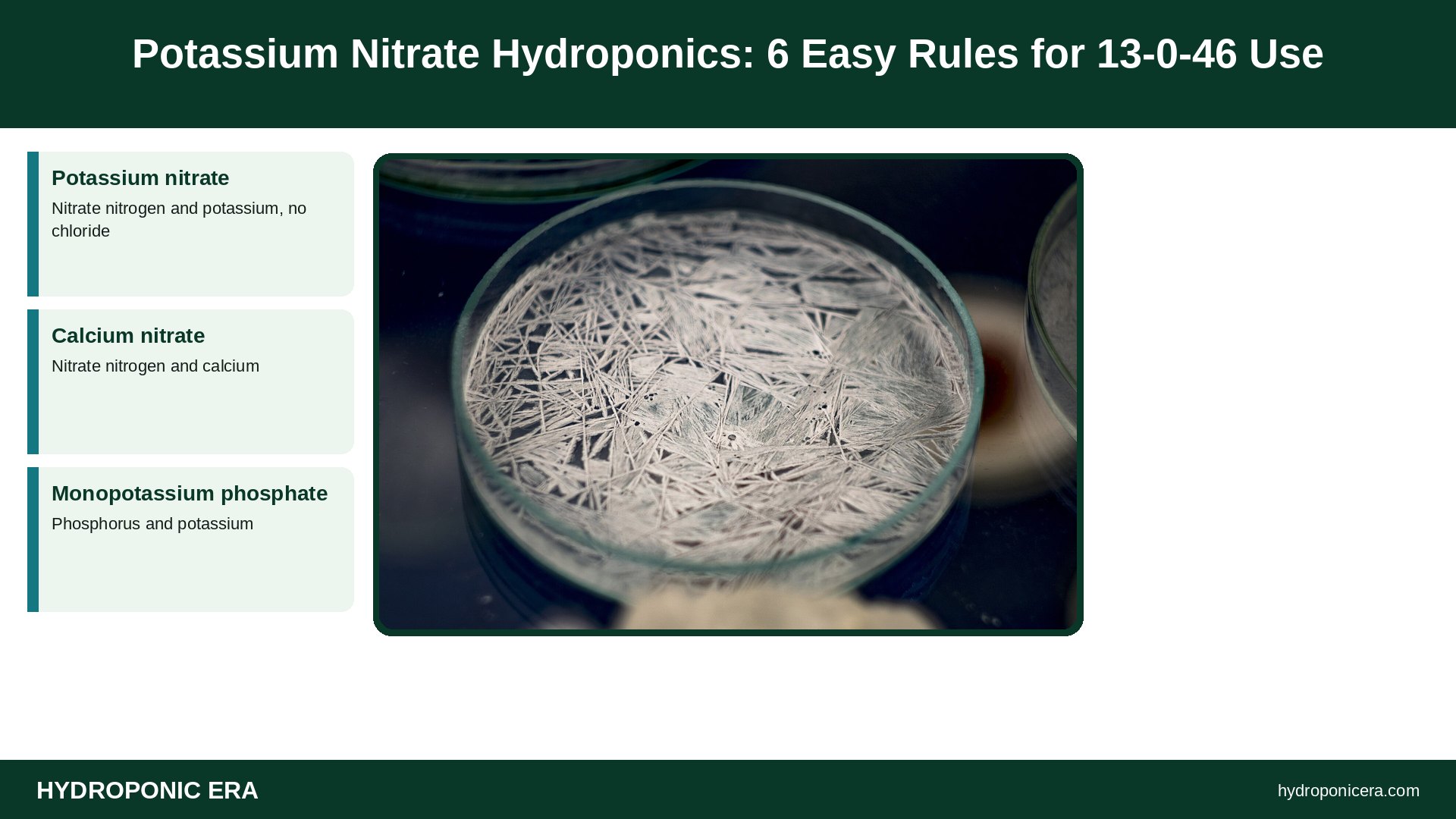
What is potassium nitrate hydroponics? Potassium nitrate hydroponics means using KNO3, a 13-0-46 fertilizer, as a chloride-free source of potassium and nitrate nitrogen in a nutrient solution. It is usually mixed with calcium nitrate and other salts. Most growers add it to boost potassium during flowering or fruiting.
Key takeaway: Potassium nitrate hydroponics is simple math: 1 gram per US gallon (3.8 L) of 13-0-46 adds roughly 100 ppm potassium and about 34 ppm nitrogen. Keep it in a separate stock tank from calcium and sulfate or phosphate salts, and avoid overshooting, because too much potassium blocks calcium and magnesium.
| Fertilizer | Typical analysis | What it supplies |
|---|---|---|
| Potassium nitrate | 13-0-46 | Nitrate nitrogen and potassium, no chloride |
| Calcium nitrate | 15.5-0-0 with calcium | Nitrate nitrogen and calcium |
| Monopotassium phosphate | 0-52-34 | Phosphorus and potassium |
| Magnesium sulfate (Epsom salt) | Magnesium and sulfur | Magnesium, no nitrogen |
Why Do Growers Use Potassium Nitrate Hydroponics Recipes?
Growers use potassium nitrate hydroponics recipes because KNO3 dissolves cleanly, supplies two major nutrients and contains no chloride. Virginia Tech, Penn State and University of Missouri hydroponic guides include it as a standard soluble salt for building complete solutions from single ingredients.
Most commercial base nutrients already include potassium nitrate. You mainly reach for potassium nitrate hydroponics blends when you mix your own formula or need to correct a potassium shortage. For a ready-made option, compare one-part vs two-part vs three-part nutrients before you decide to build from salts.
- Nitrogen source: the 13% nitrogen is entirely nitrate, which plants take up quickly.
- Potassium source: the 46% K2O supports fruit size, water balance and disease resistance.
- No chloride: a plus for sensitive crops compared with muriate of potash.
- Soluble: it dissolves in water, though it chills the water as it does.
How Much Potassium Nitrate Hydroponics Dosing Is Needed?
Start with the potassium you need, then work backward. Because 13-0-46 contains about 38% elemental potassium (46% K2O × 0.83), about 0.26 g per liter, or 1 g per US gallon (3.8 L), adds roughly 100 ppm potassium and about 34 ppm nitrogen.
Always calculate from your full recipe rather than adding potassium nitrate hydroponics doses by eye. Penn State’s two-equation method for hydroponic recipes shows how to balance each nutrient from the fertilizer analysis, and Virginia Tech’s guide lists the percentage of nutrients in each salt. Test the final EC and compare with our guide to EC and TDS in hydroponics.
| Target K | Amount of 13-0-46 per gallon (3.8 L) | Nitrogen added |
|---|---|---|
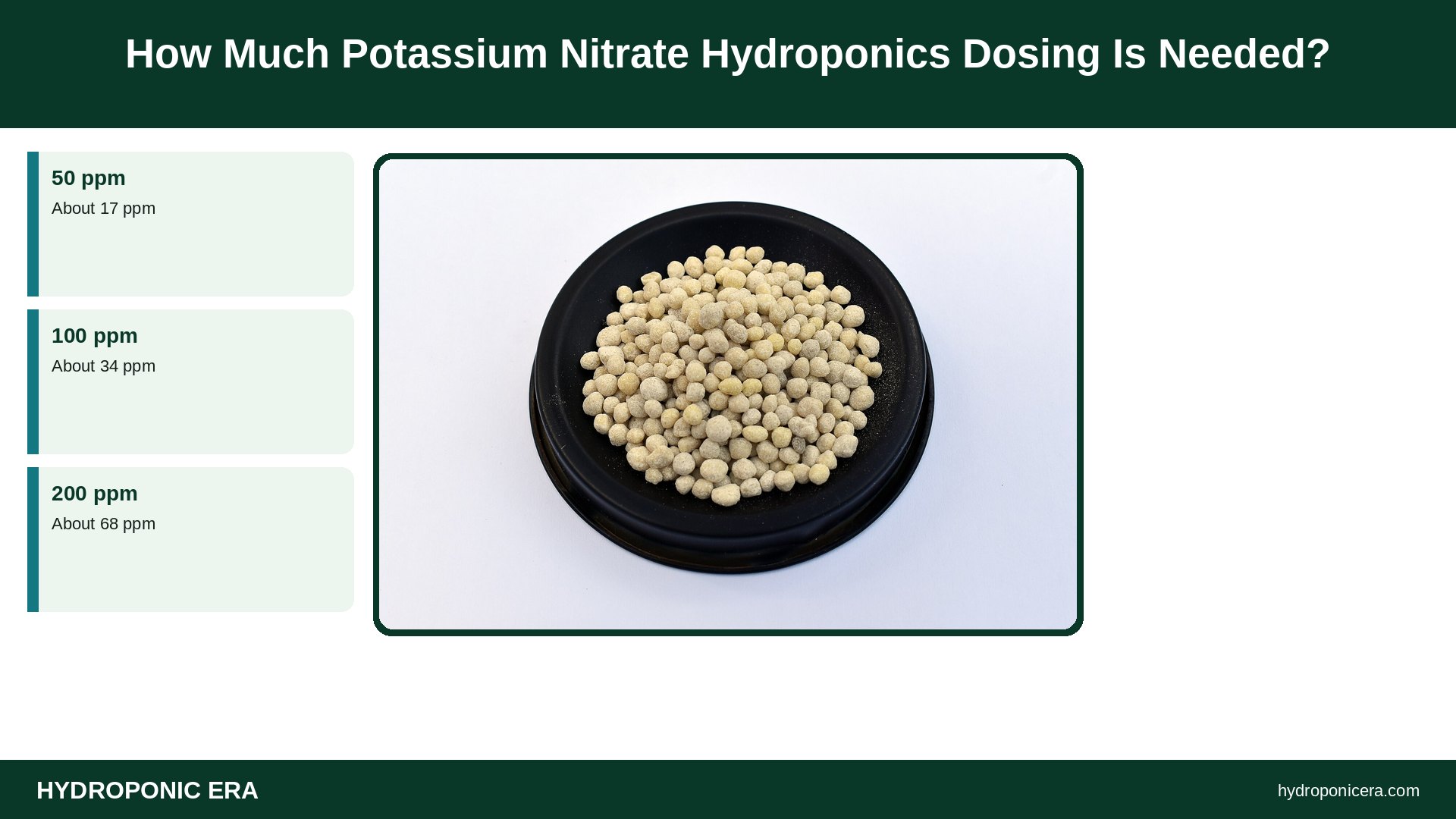
| 50 ppm | About 0.5 g | About 17 ppm |
| 100 ppm | About 1 g | About 34 ppm |
| 200 ppm | About 2 g | About 68 ppm |
Work through a quick example. If your recipe calls for 150 ppm potassium and your other salts already provide 50 ppm, potassium nitrate hydroponics dosing needs to supply the remaining 100 ppm, which is about 1 g per US gallon (3.8 L). how much nitrogen that adds so you do not overshoot your nitrate target. Weigh with a gram scale, not a spoon, because grain size changes the weight in a teaspoon. Add potassium nitrate hydroponics salts to warm water, dissolve fully and then top up to volume.
Can You Mix Potassium Nitrate Hydroponics Stocks With Calcium?
Potassium nitrate and calcium nitrate are often kept together in one concentrate because both are nitrates and stay dissolved. The problem is mixing concentrated calcium with sulfates or phosphates, which can precipitate. Keep magnesium sulfate and MKP in a second stock tank.
This is the logic behind the A and B tanks used in most two-part nutrients. If you make your own, follow the nutrient mixing order to prevent precipitation and use plenty of water for each salt. Our post on calcium nitrate in hydroponics explains the calcium side of the pair.
- Dissolve the calcium nitrate and potassium nitrate in the A tank.
- Dissolve magnesium sulfate, MKP and micronutrients in the B tank.
- Dilute each stock separately into the reservoir, never concentrate to concentrate.
- Check pH and EC after both are in and mixed.
What Happens If Potassium Nitrate Hydroponics Doses Run Too High?
Too much potassium nitrate hydroponics dosing raises EC and competes with calcium and magnesium for uptake. Plants may show blossom end rot, curled leaf margins or interveinal yellowing, even when calcium and magnesium are present. Flush and reduce potassium rather than adding more of the other two.
Extension guidance warns that excess potassium antagonizes calcium and magnesium uptake. If you see magnesium or calcium problems after raising potassium, read calcium and magnesium deficiency in hydroponics before adding more supplements.
Is Potassium Nitrate Hydroponics Better Than Other Potassium Sources?
Potassium nitrate suits most hydroponic systems because it adds both nitrate and potassium without chloride. Potassium sulfate adds sulfur and no nitrogen, MKP adds phosphorus, and potassium chloride adds chloride, which can stress some crops. The right choice depends on what your recipe lacks.
| Source | Main benefit | Watch out for |
|---|---|---|
| Potassium nitrate | Nitrate N plus potassium | Raises nitrogen too |
| Potassium sulfate | Potassium plus sulfur | Lower solubility in cold water |
| MKP (0-52-34) | Phosphorus plus potassium | Lowers pH, adds P |
| Potassium chloride | Cheap potassium | Chloride burn in sensitive crops |
In a recipe, potassium nitrate hydroponics balance usually comes first, then you fill any gap in potassium with sulfate or MKP. See our potassium deficiency in hydroponics guide for symptoms such as scorched leaf edges.
How Do You Store and Handle Potassium Nitrate Safely?
Store potassium nitrate in a sealed container, away from heat, fuel, combustible materials and children, because it is an oxidizer. Wear gloves and eye protection, mix it only with water and fertilizer salts, and follow the label. Never mix dry salts with organic dust or sugars.
Buy fertilizer-grade product from a hydroponic or garden supplier, not a chemical you cannot label. Date each container and keep stock solutions away from sun to reduce algae. Our guide to stock concentrate shelf life covers storage in more detail.
FAQ About Potassium Nitrate Hydroponics
Is potassium nitrate the same as saltpeter?
The chemical is the same, KNO3, but use only fertilizer-grade product for plants and follow the label.
Can I use potassium nitrate alone as a nutrient?
No. It supplies nitrogen and potassium only. You still need calcium, magnesium, phosphorus, sulfur and micronutrients.
How do I convert K2O to potassium?
Elemental potassium is K2O multiplied by 0.83, so 46% K2O is about 38% K.
Does potassium nitrate change pH?
It has only a mild effect compared with acids or MKP. Still check pH after mixing.
Why does the water get cold when I dissolve it?
Dissolving potassium nitrate absorbs heat, so the water cools. Use warm water and stir.
Sources
- Virginia Tech Extension — Hydroponic Nutrient Solutions (SPES-263)
- Penn State Extension — Hydroponics Systems: Using the Two Basic Equations to Calculate a Nutrient Solution Recipe
- University of Missouri Extension — Hydroponic fertilizer guide G6984
- Servi-Tech Laboratories — Potassium nitrate 0-0-46 fertilizer reference
- Photo credits (Wikimedia Commons, edited with titles): Potassium nitrate crystals by Adam Rędzikowski (CC BY-SA 4.0); DAP (Diammonium Phosphate) Granules (3) by Suyash Dwivedi (CC BY-SA 4.0); Calcium nitrate, waste water treatment by Cjp24 (CC BY-SA 4.0); Electrical conductivity meter by Nuno Nogueira (Nmnogueira) (CC BY-SA 2.5)