
Pumice hydroponics uses crushed pumice, a light, porous volcanic rock, as the growing medium. Pumice is chemically close to inert, holds a moderate amount of water inside its pores, drains freely and lasts for years without breaking down. The UN Food and Agriculture Organization (FAO) lists pumice as a neutral-pH, lightweight, long-lasting medium that is easy to work with. Studies show tomatoes grow well in pumice-based beds, and it is a strong, cheaper alternative to clay pebbles in drip, ebb and flow and aquaponics media beds.
Key takeaway: Choose pumice sized about 1/8–3/4 inch (3–20 mm) for your system, rinse off the dust, and water more often than you would with coir or rockwool because it drains fast.
| Property (FAO Table 4.1) | Pumice | Volcanic tuff | Expanded clay (LECA) | Limestone gravel |
|---|---|---|---|---|
| Surface area | 200–300 m²/m³ | 300–400 m²/m³ | 250–300 m²/m³ | 150–200 m²/m³ |
| pH | Neutral | Neutral | Neutral | Basic |
| Weight | Light | Medium | Light | Heavy |
| Water retention | Medium | Medium–poor | Medium–poor | Poor |
| Lifespan | Long | Long | Long | Long |
| Ease to work with | Easy | Medium | Easy | Difficult |
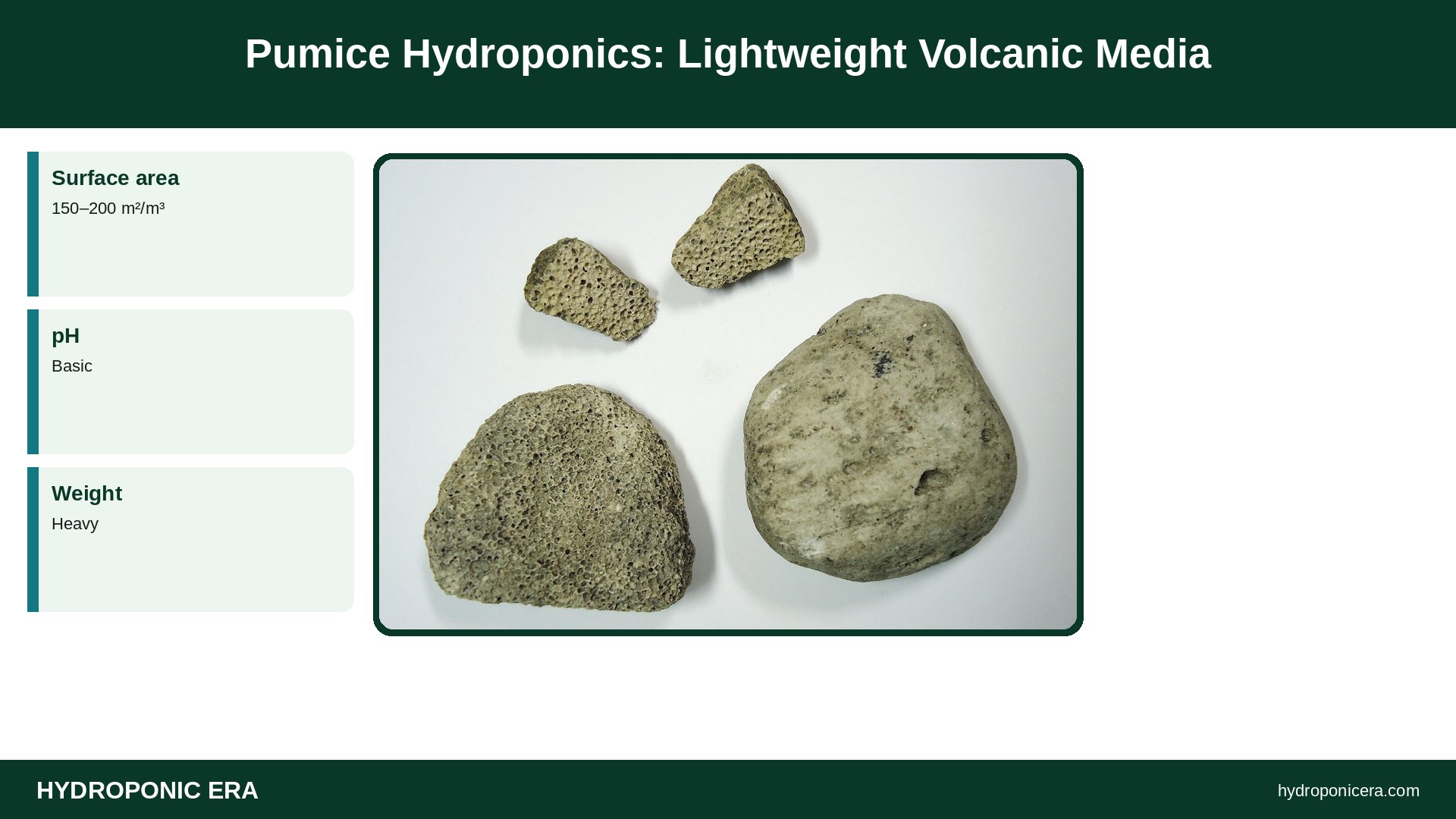
What Is Pumice?
Pumice forms when gas-rich lava cools so fast that bubbles are frozen into the rock. The result is a white to gray stone full of tiny holes, light enough that dry pieces often float. FAO’s Small-scale aquaponic food production manual describes pumice as a white/gray volcanic material popularly used as a growing medium in hydroponics. In the US it’s sold as a soil amendment, a bonsai and succulent mix ingredient and a horticultural aggregate.
Don’t confuse it with perlite. Perlite is volcanic glass that is heated until it pops like popcorn, so it is much lighter and softer. Pumice is a natural rock that’s only crushed and screened, so it is heavier, stronger and far less likely to wash away.
Why Use Pumice Hydroponics?
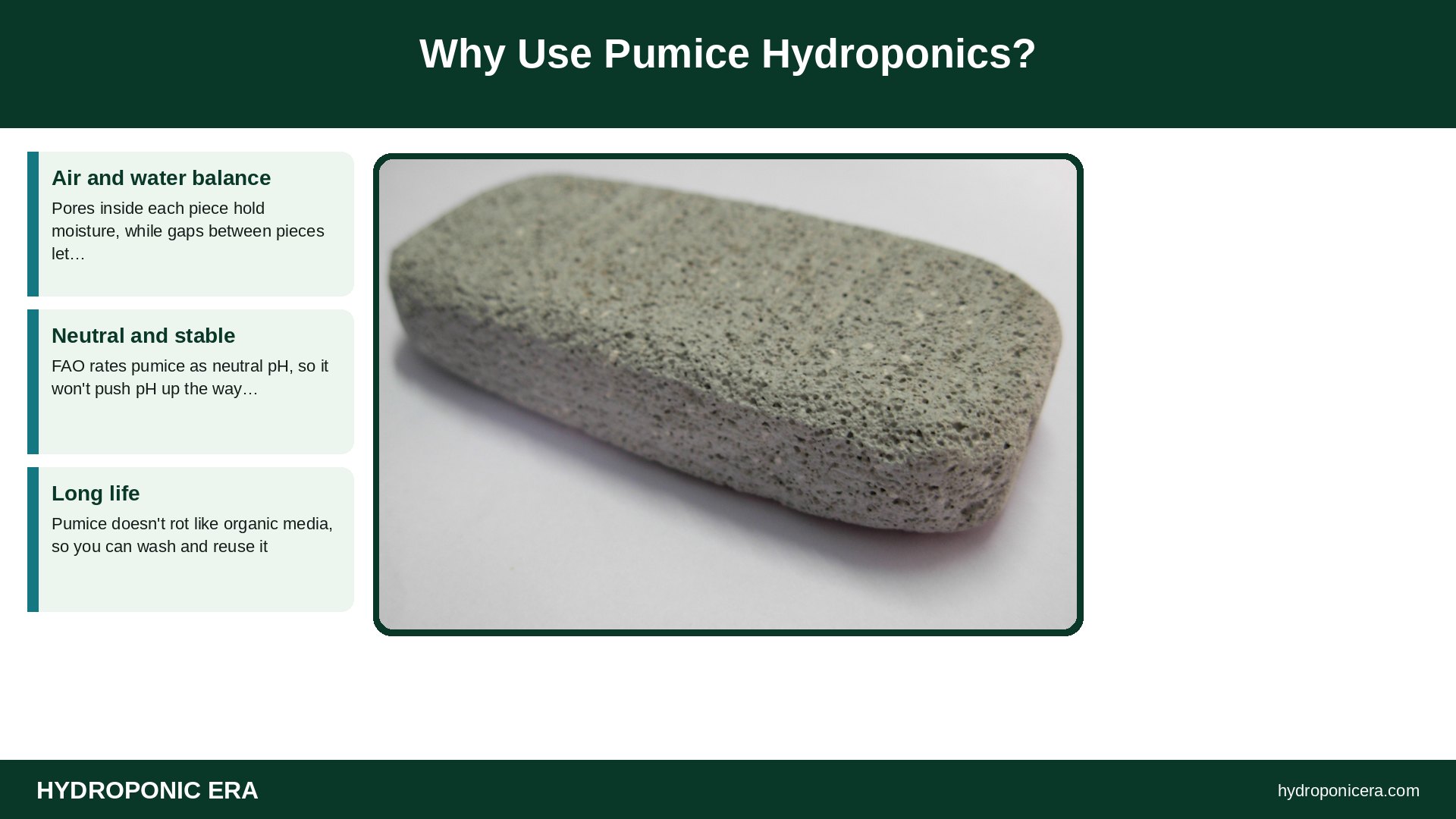
- Air and water balance: Pores inside each piece hold moisture, while gaps between pieces let air reach roots.
- Neutral and stable: FAO rates pumice as neutral pH, so it won’t push pH up the way limestone gravel does.
- Long life: Pumice doesn’t rot like organic media, so you can wash and reuse it.
- Weight: FAO classes it as light, unlike medium-weight tuff or heavy limestone, which matters for shelves and rooftops.
- Biofilter surface: At 200–300 m²/m³, pumice offers plenty of surface for nitrifying bacteria in aquaponics.
What Pumice Hydroponics Research Shows
In a greenhouse bag-culture trial published by the International Society for Horticultural Science, Alan, Zulkadir and Padem grew tomatoes in soil, perlite, peat, sand, pumice and mixes. The highest marketable (4.8 lb (2.17 kg) per plant) and total (6.3 lb (2.87 kg) per plant) yields came from a mix of 80% pumice, 10% perlite and 10% peat, about 30% more than plants in 100% soil.
A 2021 study in Mexico by Luna-Fletes, Cruz-Crespo and Can-Chulim compared pumice with tezontle, a red volcanic scoria, for cherry tomatoes. Plants in pumice produced more fruit, grew more and had higher leaf nutrient content than plants in tezontle. The authors concluded that pumice combined with Steiner nutrient solution was the most viable option.
Results are not always better than other media. Tzortzakis and Economakis found that tomatoes in pure pumice and pure perlite gave lower total yields than mixes with shredded maize stems, so blending media can help. A 2021 Horticulturae study of tomato quality found that pumice, in pots or sacks, enhanced visual and flavor traits the most among the substrates tested.
Choosing the Right Pumice Size
Size changes how pumice hydroponics behaves more than any other choice you make. Fine grades hold more water; coarse grades drain faster and hold more air.
- Fine, about 1/8–1/4 inch (3–6 mm): Seed starting mixes, wick pots and succulent mixes.
- Medium, about 1/4–3/8 inch (6–10 mm): Drip buckets, Dutch buckets and net cups.
- Coarse, about 3/8–3/4 inch (10–20 mm): Ebb and flow trays and aquaponics media beds. FAO recommends about 5/16–3/4 inch (8–20 mm) for volcanic gravel in media beds, because smaller pieces clog with fish waste and larger ones lack surface area and plant support.
How to Set Up Pumice Hydroponics
- Rinse well. FAO stresses washing volcanic media thoroughly, because dust and tiny particles can clog systems and harm fish gills.
- Soak to sink. Soak dry pumice for a day so floating pieces fill with water.
- Check pH. Pumice is close to neutral, but test the first reservoir fill and adjust.
- Plant rooted starts. Set seedlings from plugs or rockwool cubes into the media, or sow larger seeds directly in fine pumice.
- Water often. In drip systems, run several short cycles a day. In ebb and flow, use frequent floods during warm, bright weather. See flood and drain cycle timing.
Pumice Hydroponics in Aquaponics
Media beds in aquaponics do triple duty: they hold plants, filter solids and host nitrifying bacteria. FAO calls volcanic gravel the most popular medium for media bed units where available, and lists pumice as a lighter, easy-to-handle option. FAO also recommends media beds about 12 inches (30 cm) deep for large fruiting crops and 6–8 inches (15–20 cm) for small leafy greens. Learn more in aquaponics media bed.
Pumice Hydroponics vs Other Media
Compared with clay pebbles, pumice is usually cheaper and wicks better but is dustier and has sharper edges. Compared with perlite, it is heavier and won’t float out of flood trays once soaked. Compared with gravel, it’s lighter and holds more water. For a full rundown of options, see growing media for hydroponics.
Downsides of Pumice Hydroponics
- Dust on new bags must be rinsed off.
- Rough edges can scratch hands; wear gloves.
- Dry pumice floats until it soaks.
- FAO notes volcanic media can release small amounts of iron and magnesium and absorb some phosphate and potassium in the first months of a new system.
- Quality varies by source, so buy horticultural grade, screened to size.
Caring for a Pumice Hydroponics System
Once running, pumice hydroponics needs little care. Check the reservoir pH and EC a few times a week, top up with plain water as plants drink, and flush the media with clean water between crops to clear salt buildup. If you see white crust on the surface, see salt crust on media. Because pumice drains so well, watch for wilting on hot afternoons and add an extra irrigation cycle if leaves droop. At the end of a crop, pull out old roots, soak the stones in a mild sanitizing solution, rinse and let them dry before storing.
FAQs
Is pumice hydroponics good for beginners?
Yes; it is neutral, porous, light and long lasting, and tomatoes yield well in pumice mixes.
Does pumice change pH?
FAO rates it neutral, but test your first reservoir after setup.
Is pumice better than perlite?
For flood systems, yes; it is heavier and doesn’t wash away.
Can you reuse pumice?
Yes; remove roots, wash and sanitize between crops.
Does pumice float?
Dry pieces can; soak them until they sink.
What size pumice is best for aquaponics?
About 5/16–3/4 inch (8–20 mm), the size FAO recommends for volcanic gravel.
Sources
- FAO — Small-scale Aquaponic Food Production: Integrated Fish and Plant Farming
- Alan, Zulkadir and Padem, Acta Horticulturae (ISHS) — The Influence of Growing Media on Growth, Yield and Quality of Tomato Grown Under Greenhouse Conditions
- Luna-Fletes, Cruz-Crespo and Can-Chulim (2021), Terra Latinoamericana — Pumice, Tezontle and Nutritive Solutions in Cherry Tomato Crop
- Tzortzakis and Economakis, Horticultural Science — Impacts of the Substrate Medium on Tomato Yield and Fruit Quality in Soilless Cultivation
- Horticulturae (2021) — Functional, Flavor and Visual Traits of Hydroponically Produced Tomato Fruit in Relation to Substrate, Plant Training System and Harvesting Time
- Photo credits (Wikimedia Commons, edited with titles): Pumice stones by Mauro Cateb (CC BY-SA 3.0); Pumice Stone by Ambuj Saxena (CC BY 2.0); South Sister lava flows, USGS by C. Dan Miller, USGS/Cascades Volcano Observatory (Public domain); Solanum lycopersicum in aquaponics at the NC Greenhouse Nursery by Gogerr (CC BY-SA 4.0); Hydroponic g12 by Giancarlo Dessì (CC BY-SA 3.0)