
How do you grow radish sprouts? Soak about 3 tablespoons of radish seed in cool water for 4–12 hours, then drain. Rinse and drain every 8–12 hours, moving the jar to indirect light on day 3 or 4. Radish sprouts are ready in about 5–6 days when leaves open and green. Remove hulls, dry and refrigerate.
Key takeaway: Radish sprouts are one of the easiest and fastest leafy sprouts, with a peppery bite. Drain very thoroughly, don’t panic at fuzzy root hairs, de-hull before storing, and follow the same seed-safety steps as any raw sprout.
| Radish sprouts step | Guideline | Source |
|---|---|---|
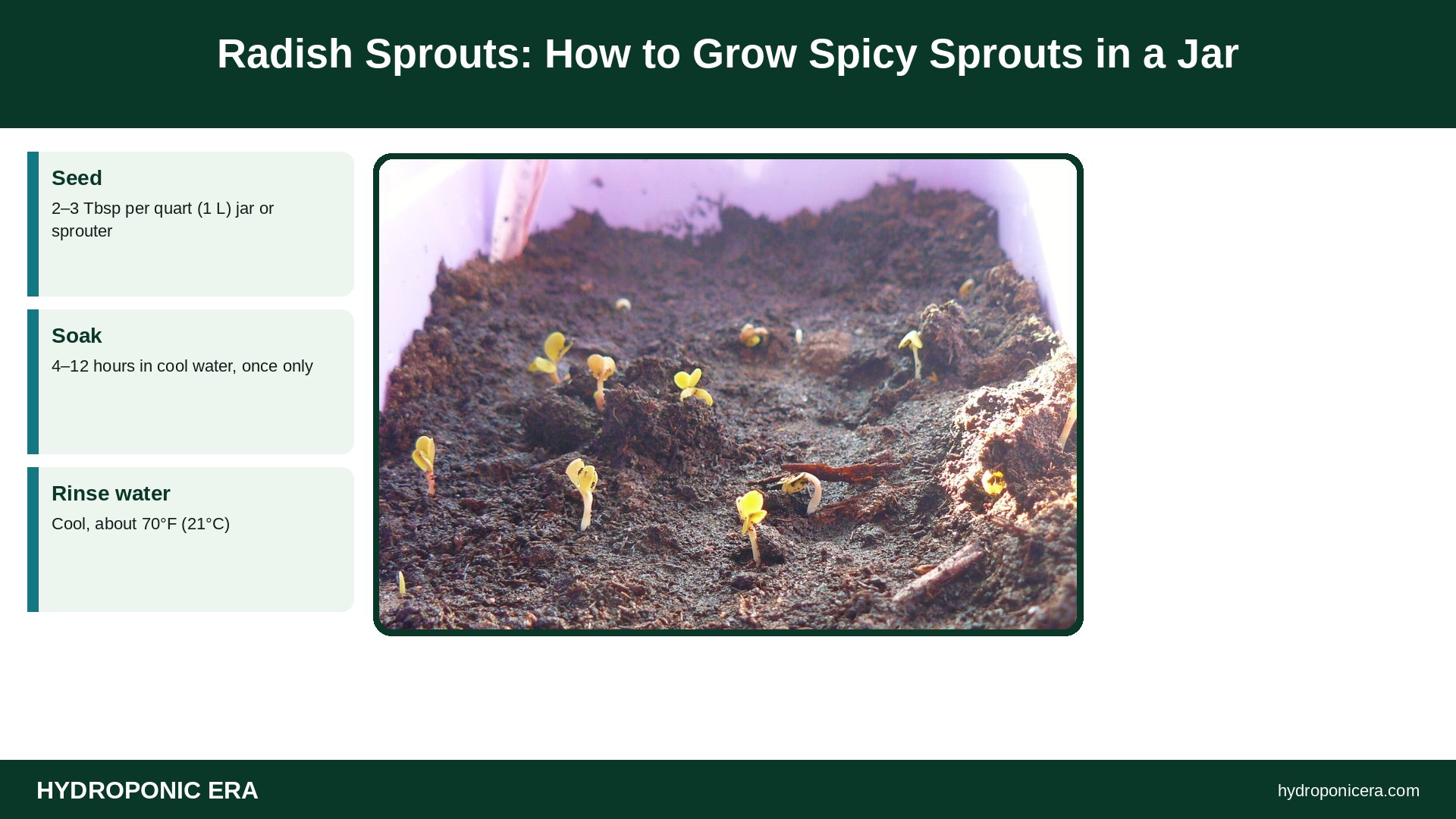
| Seed | 2–3 Tbsp per quart (1 L) jar or sprouter | Sprout People |
| Soak | 4–12 hours in cool water, once only | Sprout People |
| Rinse water | Cool, about 70°F (21°C) | Sprout People |
| Rinse/drain | Every 8–12 hours | Sprout People |
| Greening | Indirect light from day 3–4 | Sprout People, USask |
| Harvest | Day 5–6; about 5:1 yield | Sprout People |
What Are Radish Sprouts?
Radish sprouts are radish seeds germinated for about a week and eaten whole: thin white stems, small green leaves and tiny roots. They taste like a mild radish with a peppery finish. Radish is a brassica, like broccoli and mustard, and it is one of the “leafy sprouts” grown from small seeds. The University of Saskatchewan and NC State Extension both list radish among recommended home sprouting seeds.
What Do You Need to Grow Radish Sprouts?
- Seed sold for sprouting: not treated garden seed, which Virginia Tech Extension warns is often pesticide-coated.
- A sprouter: a wide-mouth quart (1 L) jar with a mesh lid, or a tray sprouter.
- Cool, clean water: NC State suggests non-chlorinated water.
- A drain rack or bowl to hold the jar tilted upside down.
How Do You Grow Radish Sprouts Step by Step?
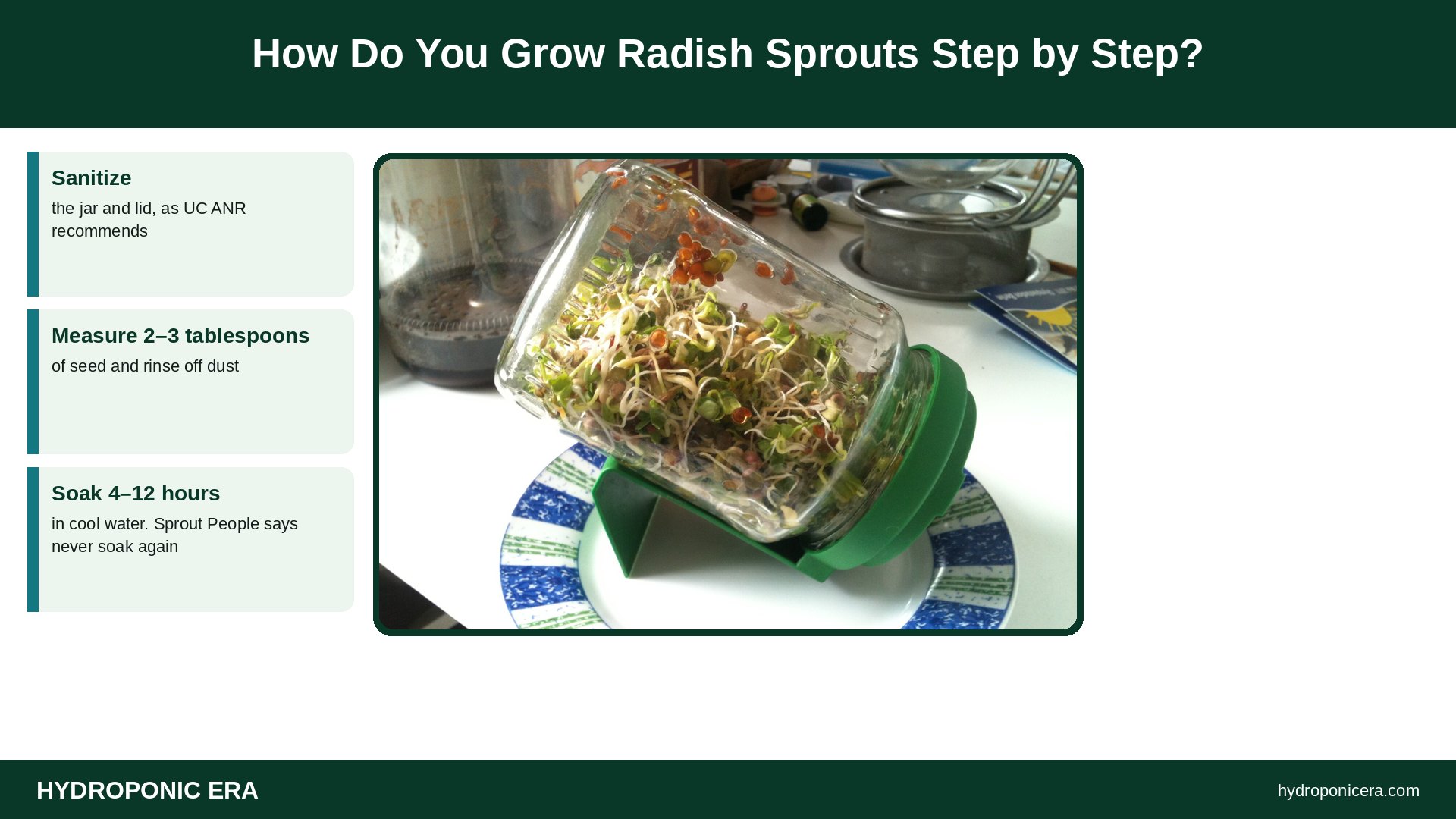
- Sanitize the jar and lid, as UC ANR recommends.
- Measure 2–3 tablespoons of seed and rinse off dust.
- Soak 4–12 hours in cool water. Sprout People says never soak again.
- Drain off the soak water. Sprout People notes it can water houseplants.
- Rinse and drain thoroughly every 8–12 hours with cool water.
- Keep the jar out of direct sun at room temperature with some air movement.
- Move to indirect light on day 3–4 so leaves turn green.
- Remove hulls by floating them off in a bowl of water.
- Harvest on day 5–6 when most leaves are open and green.
For the full jar method, read how to grow sprouts in a jar.
How Long Do Radish Sprouts Take?
Most batches take 5–6 days from the end of the soak. Sprout People lists a harvest window of 3–6 days and suggests tasting at each rinse. Its detailed guide says a crop of leafy sprouts usually takes about 6 days after soaking. Rooms near 70°F (21°C) grow them steadily; NC State gives 70–80°F (21–27°C) as a good sprouting range.
| Day (after soak) | What you see | Task |
|---|---|---|
| 1 | Seeds split, tiny roots | Rinse and drain |
| 2–3 | White roots and fuzzy root hairs | Rinse, drain very well |
| 3–4 | Yellow leaves start to open | Move to indirect light |
| 5–6 | Green leaves, hulls loose | De-hull, dry, refrigerate |
Is the White Fuzz on Radish Sprouts Mold?
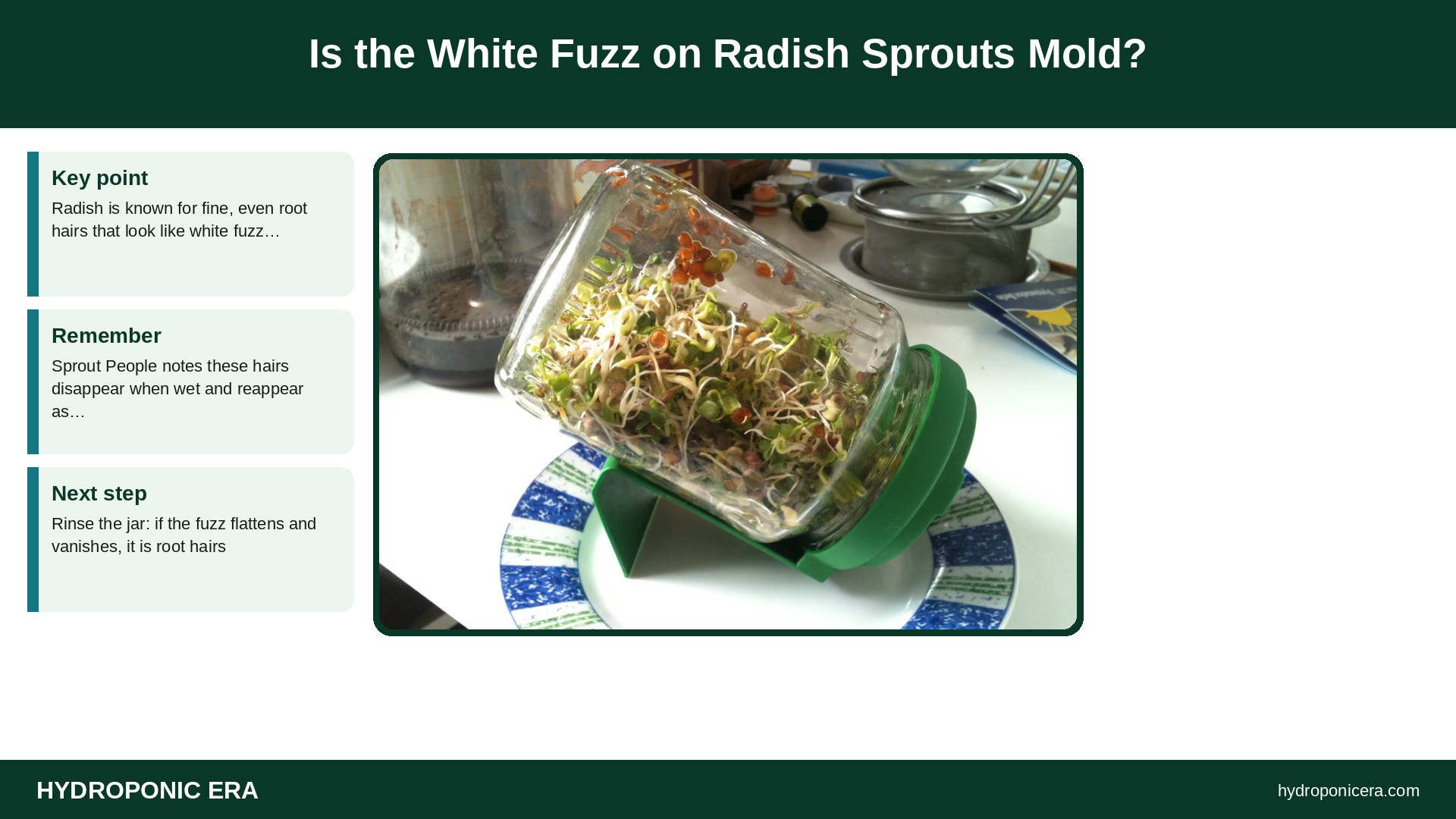
Usually not. Radish is known for fine, even root hairs that look like white fuzz along the roots, especially just before a rinse when the sprouts are driest. Sprout People notes these hairs disappear when wet and reappear as the sprouts dry. Rinse the jar: if the fuzz flattens and vanishes, it is root hairs. Gray, dark or colored patches, slime or a musty smell mean spoilage, so discard the batch.
Why Is Draining So Important?
Sprout People calls poor drainage the most common cause of inferior sprouts. Small seeds hold water between them, and standing water favors rot. After each rinse, shake or tap the jar until it stops dripping, then rest it tilted mouth-down. Tray sprouters spread small seed thinner, which can make draining easier.
Are Radish Sprouts Safe to Eat Raw?
Raw sprouts carry a known food-safety risk because the warm, humid conditions used to sprout seeds also let bacteria grow. The FDA advises children, older adults, pregnant people and anyone with a weakened immune system to avoid raw or lightly cooked sprouts.
- Treat seed first: UC ANR describes 5 minutes in 3% hydrogen peroxide heated to 140°F (60°C), then a 1-minute rinse.
- Skim floaters and debris during soaking; UC ANR links them to most contamination.
- Sanitize equipment between batches.
- Cook sprouts to 165°F (74°C) for higher-risk eaters.
How Do You Store Radish Sprouts?
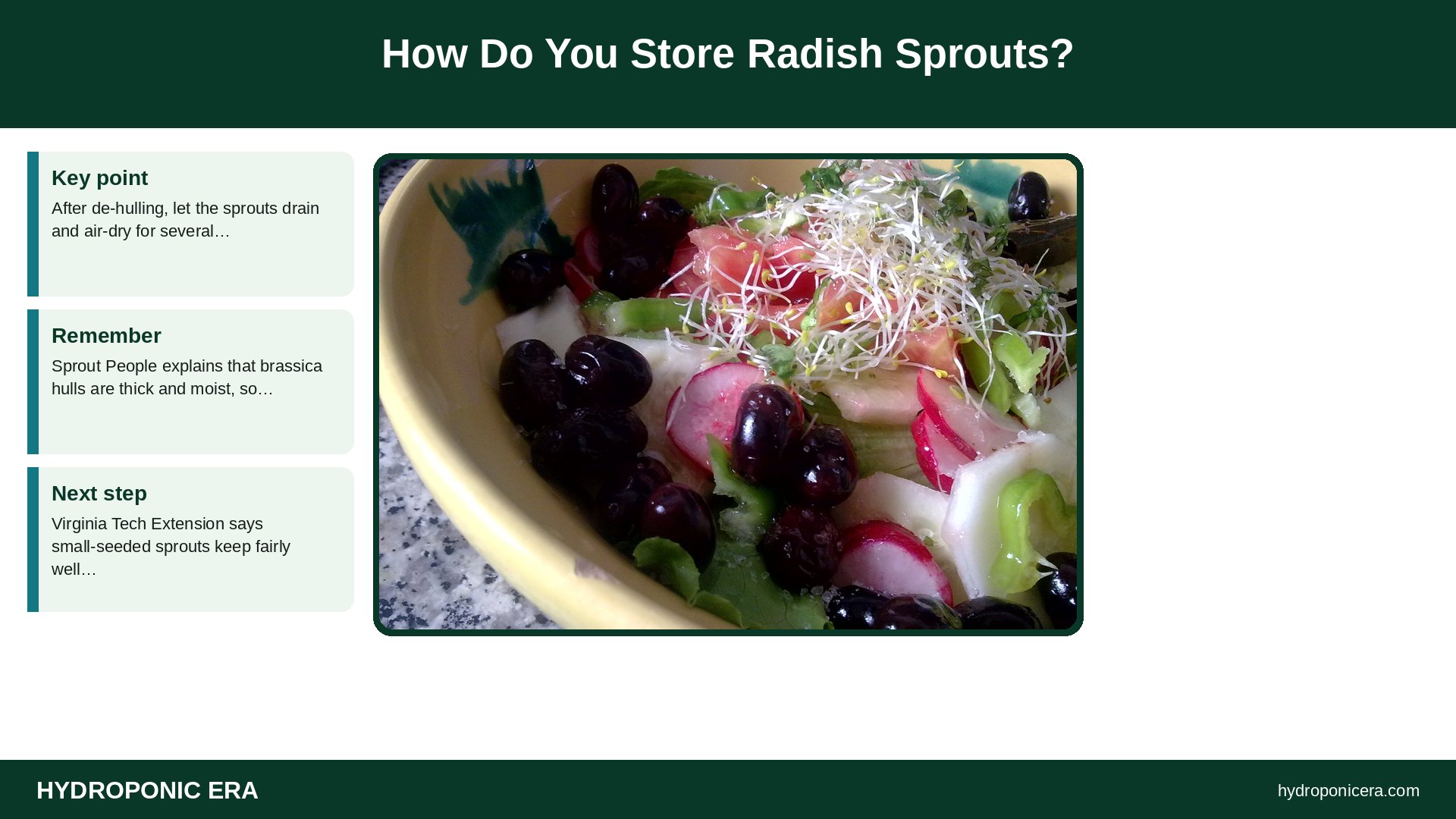
After de-hulling, let the sprouts drain and air-dry for several hours, or spin them dry, then refrigerate in a covered container. Sprout People explains that brassica hulls are thick and moist, so removing them is key to longer shelf life. Virginia Tech Extension says small-seeded sprouts keep fairly well for a week or more. NC State suggests 38–50°F (3–10°C).
Radish Sprouts vs Radish Microgreens: What Is the Difference?
Radish sprouts grow in a jar with water only and are eaten roots and all. Radish microgreens grow on a tray of media under light and are cut above the roots. Utah State University’s microgreens table lists radish at about 1.5 oz (42 g) of seed per standard 10×20 in (25×50 cm) tray, no soak, 1–2 days of darkness and harvest at 8–12 days. Try our hydroponic microgreens guide, or grow roots with hydroponic radish.
What Are Common Radish Sprout Problems?
- Low germination: old seed, chlorinated water or a cold room. Try fresh seed and water near 70°F (21°C).
- Slimy patches: water left standing; drain harder and rinse more evenly.
- Pale yellow leaves: not enough indirect light at the end.
- Bitter or tough sprouts: grown too long; harvest a day earlier.
- Hulls everywhere: float them off in a bowl before storing.
How Do You Use Radish Sprouts?
Add them where a peppery crunch helps: sandwiches, wraps, salads, tacos, sushi rolls, noodle bowls and avocado toast. Virginia Tech Extension also lists soups, omelets and stir-fries. A quick stir-fry softens the bite and lowers food-safety risk.
FAQs
Do radish sprouts need light?
Only for greening in the last 2–3 days. Bright indirect light or a grow light is enough; never direct sun.
Why do some stems look pink?
Some radish varieties, such as red-stemmed types, color up in light.
Can I mix radish with other seeds?
Yes, with seeds of similar timing such as broccoli, clover or alfalfa.
Why did my sprouts smell sour?
Usually poor draining or warm, stale air. Drain better and add airflow.
How much does 3 tablespoons make?
Sprout People lists about a 5:1 yield by weight.
Sources
- Sprout People — Radish Sprouts growing guide
- UC ANR — Growing Seed Sprouts at Home (Publication 8151)
- U.S. FDA — Selecting and Serving Produce Safely
- NC State Extension — Bean Sprouts and Other Vegetable Seed Sprouts
- Virginia Cooperative Extension — Sprouting Seeds for Food
- University of Saskatchewan — Sprouts
- Utah State University Extension — Grow Your Own Microgreens
- Photo credits (Wikimedia Commons, edited with titles): Radish sprouts (1 etap) by MOs810 (CC BY-SA 3.0); Growing bean sprouts by User:tlcoles (CC BY-SA 3.0); Growing bean sprouts by User:tlcoles (CC BY-SA 3.0); Salad, Romaine lettuce, cucumber, tomato, green pepper, radish, alfalfa sprouts, black olives, lemon juice, salt & olive oil (7765310086) by Lablascovegmenu from London (CC BY 2.0); Mung bean sprouts, close-up by pics_pd (CC0)