
How do you grow red tiger lotus in an aquarium? Set the bulb on top of a nutrient-rich substrate with only its base pressed in, give medium light and warm water of 72 to 82°F (22 to 28°C). Tropica rates red tiger lotus low for CO2 and medium for light. Trim floating pads and old leaves at the bulb to keep the red underwater leaves compact.
Key takeaway: Red tiger lotus (Nymphaea lotus, red form) is a bulb plant from tropical Africa grown for its spotted red underwater leaves. Tropica rates it medium for light and low for CO2 and says it can reach 8–31 in (20–80 cm). Dennerle lists 72–82°F (22–28°C), pH 5–8 and propagation from daughter plants. Cut floating leaves and old leaves at the bulb to keep it compact.
| Fact | What sources report | Source |
|---|---|---|
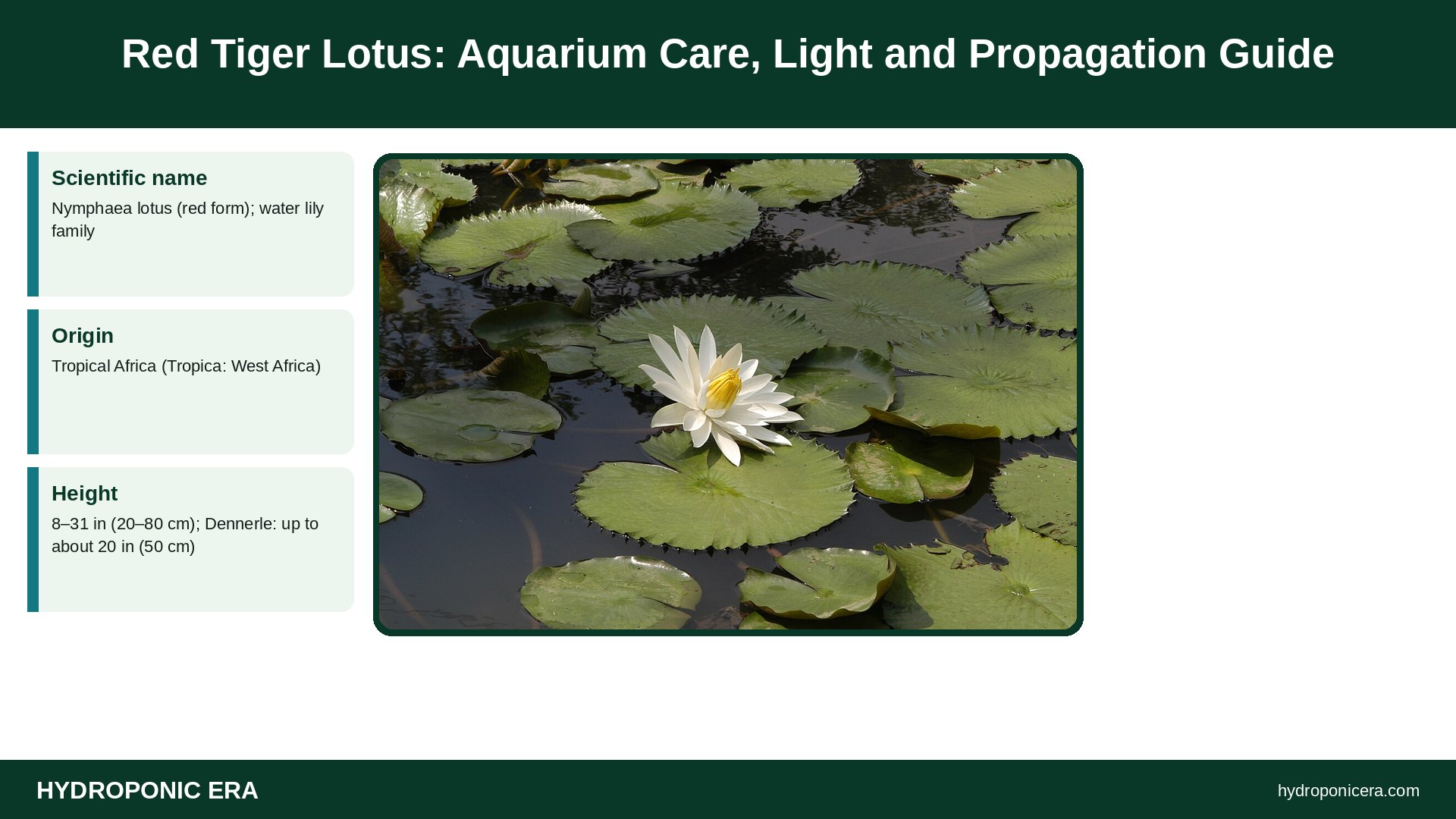
| Scientific name | Nymphaea lotus (red form); water lily family | Tropica, Dennerle |
| Origin | Tropical Africa (Tropica: West Africa) | Tropica, Dennerle |
| Height | 8–31 in (20–80 cm); Dennerle: up to about 20 in (50 cm) | Tropica, Dennerle |
| Light | Medium (Tropica); high–medium (Dennerle) | Tropica, Dennerle |
| CO2 | Low (Tropica); 10–20 mg/L (Dennerle) | Tropica, Dennerle |
| Temperature and pH | 72–82°F (22–28°C); pH 5–8 | Dennerle |
| Propagation | Seeds and daughter plants from the bulb | Dennerle |
What Is Red Tiger Lotus?
Red tiger lotus is the red-leaved form of Nymphaea lotus, a tropical water lily. Tropica describes it as a varied species from West Africa with green to red-brown leaves and varying numbers of purple spots. Dennerle says it is broadly distributed across tropical Africa, in temporary pools, lakes and flowing water, and stores nutrients in a bulb.
In aquariums it is grown for its arrow-shaped juvenile leaves, which stay below the surface. Dennerle notes the red variant is the more popular one and the green form is hard to find commercially. Left alone, the plant will send up lily pads like a pond water lily in a container.
- Leaves: red to bronze with darker spots.
- Form: a single bulb with a rosette of leaves.
- Best for: a centerpiece in medium to large tanks.
How Do You Plant Red Tiger Lotus?
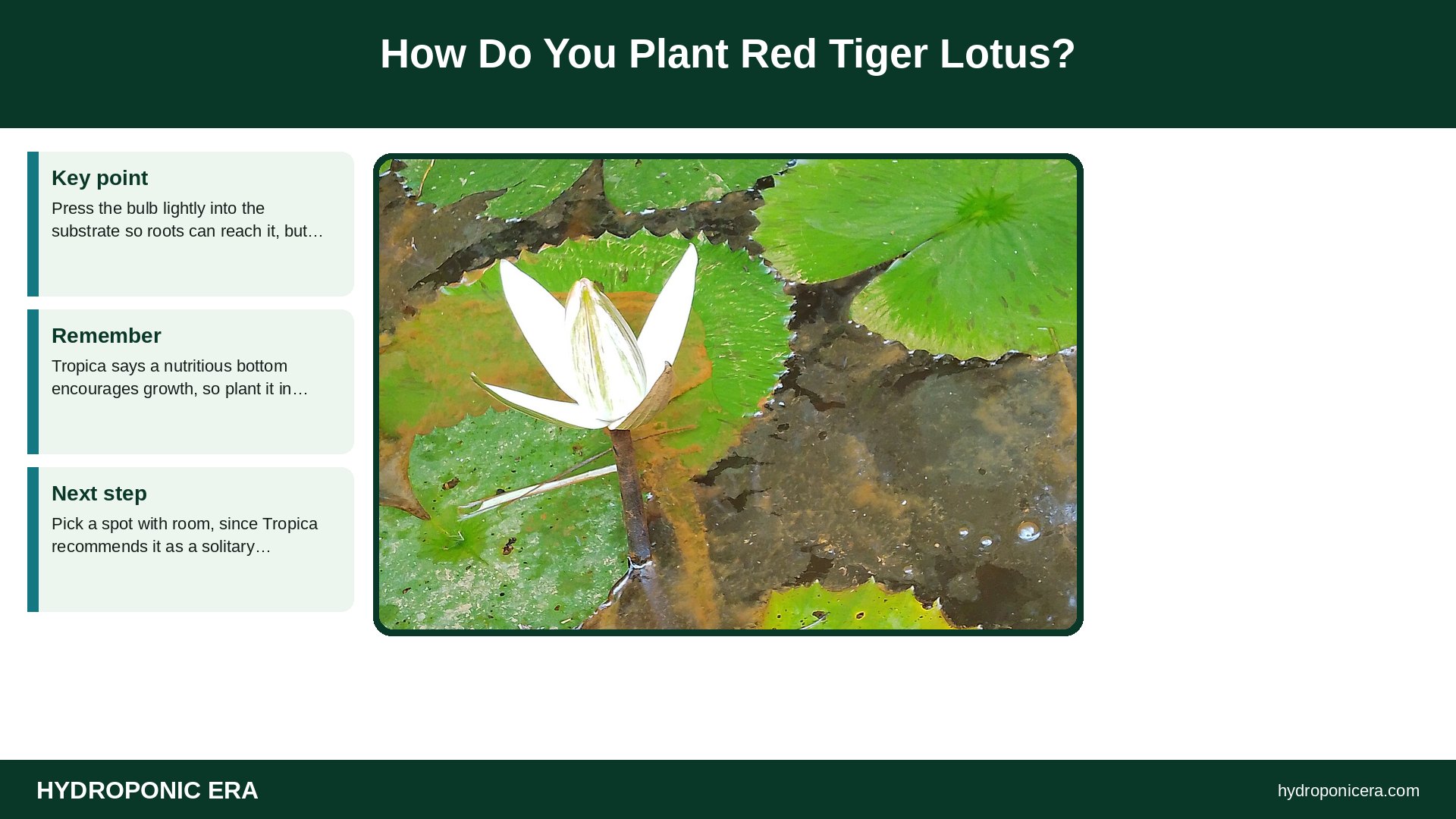
Press the bulb lightly into the substrate so roots can reach it, but keep the top of the bulb and growing point exposed. Tropica says a nutritious bottom encourages growth, so plant it in aquarium soil or add root tabs under it in sand or gravel. Pick a spot with room, since Tropica recommends it as a solitary plant for large aquariums.
- Rinse the bulb and remove any soft, rotten patches.
- Set it on the substrate and nudge the base about 1/4 inch (6 mm) in.
- Weigh it down with a small stone if it floats.
- Add a root tab nearby if the substrate is inert.
- Expect the first new leaves in a few weeks.
Some bulbs sit dormant for a while after shipping. Leave them in place, and do not bury them deeper to “help,” which can cause rot.
What Light and CO2 Does Red Tiger Lotus Need?
Medium light and no CO2 are enough. Tropica rates red tiger lotus as medium for light, about 0.5 W/L, and low for CO2. Dennerle lists high to medium light and 10 to 20 mg/L CO2 for faster growth. Stronger light deepens the red tones, while low light gives greener, larger leaves that reach for the surface.
Because it can be grown without injection, it suits low-tech tanks. If you do run CO2, see aquarium CO2 for plants to keep levels safe for fish.
How Do You Feed Red Tiger Lotus?
Feed the roots. This lily is a heavy root feeder, which is why Tropica stresses a nutritious bottom. Place a root tab under or beside the bulb every two to three months and dose a complete liquid fertilizer for the leaves. Pale new leaves or small, slow growth usually mean the substrate is running out of nutrients.
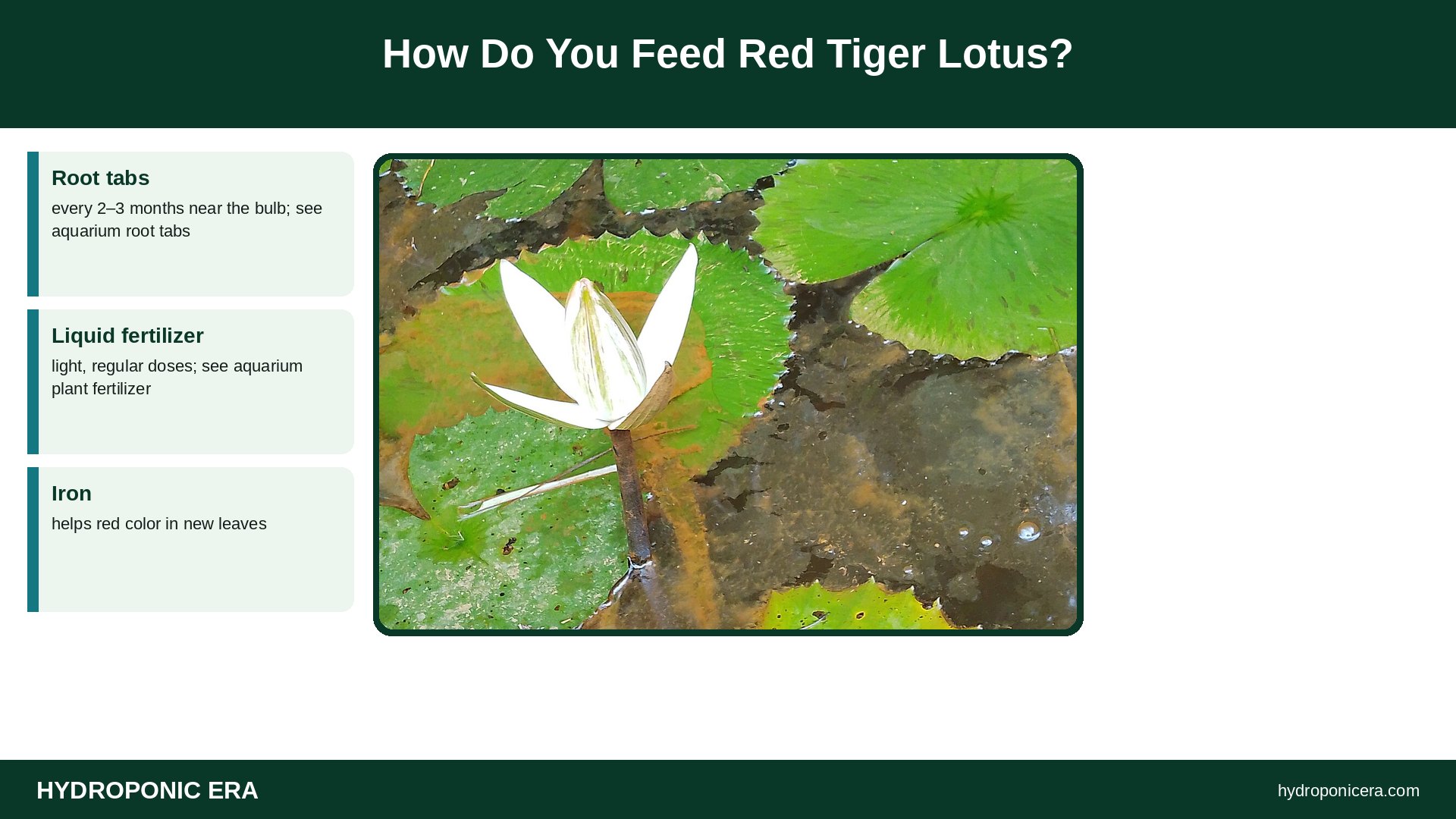
- Root tabs: every 2–3 months near the bulb; see aquarium root tabs.
- Liquid fertilizer: light, regular doses; see aquarium plant fertilizer.
- Iron: helps red color in new leaves.
How Do You Stop Red Tiger Lotus From Making Lily Pads?
Cut floating leaves and long stems as soon as they appear. Tropica says the plant forms many underwater leaves before floating ones, and if you don’t want floating leaves, prune the roots and leaves. Dennerle adds that older, larger leaves should always be removed at the base of the bulb. Regular trimming keeps the plant low and bushy.
- Follow the long stem down to the bulb.
- Cut it at the base with long aquarium scissors.
- Remove one or two of the largest old leaves each month.
If you have an open-top tank, you can let a few pads grow. Tropica notes the aromatic flowers can be fully appreciated in open aquariums. Pads will shade plants below, much like floating plants for aquariums.
What Water Parameters Does Red Tiger Lotus Like?
Keep the water warm and stable. Dennerle lists 72 to 82°F (22 to 28°C), pH 5 to 8 and very soft to hard water, and calls tiger lotus generally undemanding. That fits most tropical community tanks. Cooler water slows growth, and the bulb may stop sending up leaves.
- Temperature: 72–82°F (22–28°C).
- pH: 5–8.
- Hardness: very soft to hard.
- Tank size: a 20 gallon (75 L) or larger tank gives it room.
How Do You Propagate Red Tiger Lotus?
Wait for daughter plants. Dennerle lists seeds and daughter plants from the bulb as the propagation methods. Healthy bulbs send out runners that form new small plants nearby. When a baby has several leaves and its own roots, cut the runner and replant it, or let it grow where it is.
Seeds can form if flowers are pollinated above the water, but runners are far more common in home tanks. Healthy bulbs often produce new plantlets every few months.
Why Is Red Tiger Lotus Melting or Not Growing?
The usual causes are a buried or rotting bulb, poor substrate nutrition, cool water or dormancy after shipping. Healthy bulbs feel firm, while rotting ones turn soft and smell bad. Keep the top of the bulb exposed, add a root tab and keep the water above 72°F (22°C). Remove melting leaves so they do not foul the water.
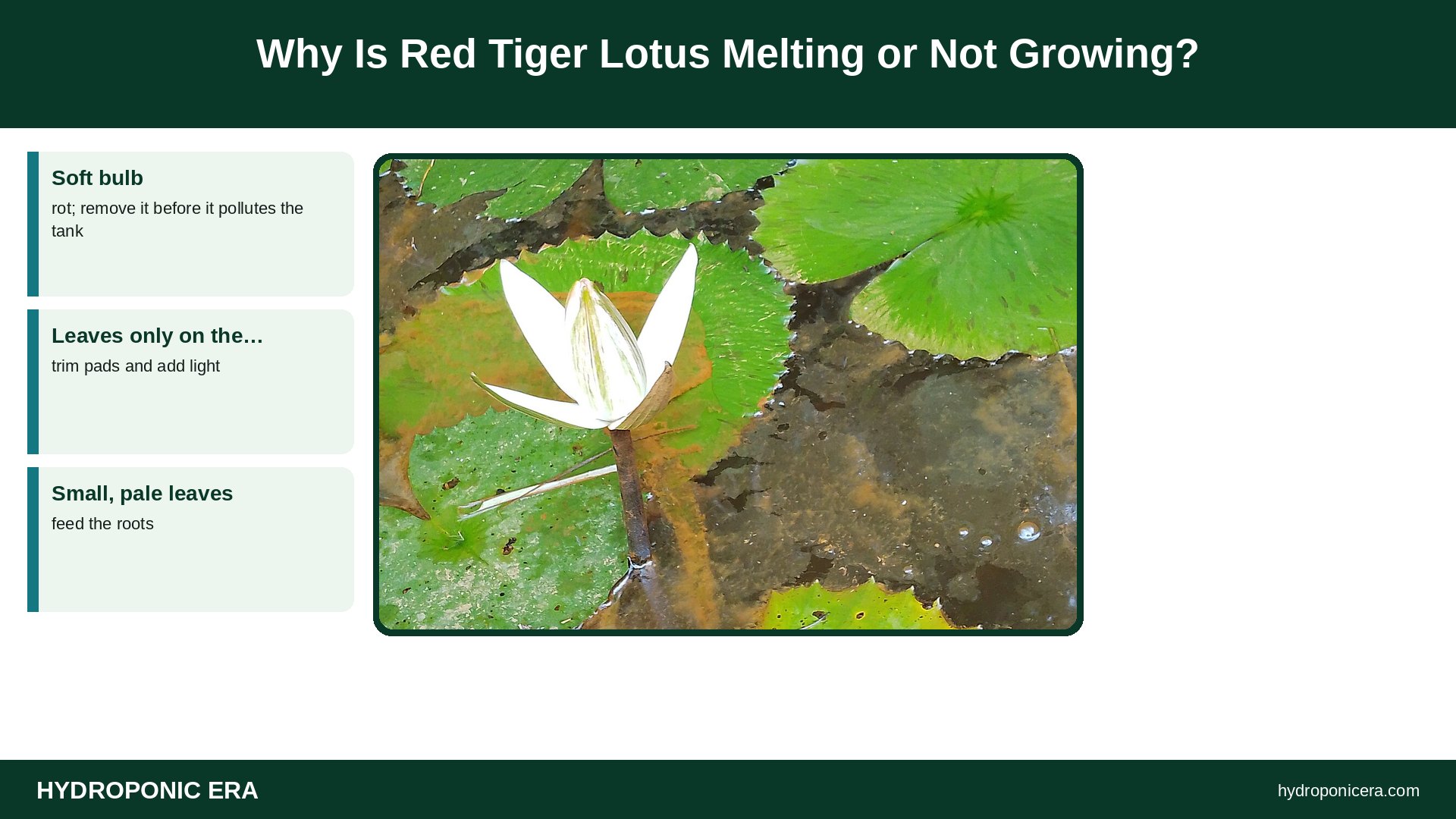
- Soft bulb: rot; remove it before it pollutes the tank.
- Leaves only on the surface: trim pads and add light.
- Small, pale leaves: feed the roots.
- No growth for weeks: bulb may be dormant; be patient.
FAQ About Red Tiger Lotus
Does red tiger lotus need CO2?
No; Tropica rates its CO2 need as low.
How big does red tiger lotus get?
Tropica says 8–31 inches (20–80 cm).
Should you bury the bulb?
No; press the base in and keep the top exposed.
Why does it make lily pads?
It is a water lily; trim pads to keep it low.
Can it grow in a small tank?
Tropica recommends large aquariums.
What temperature does red tiger lotus need?
72–82°F (22–28°C), per Dennerle.
Sources
- Tropica Aquarium Plants — Nymphaea lotus plant info
- Dennerle Plants — Nymphaea lotus ‘Red’ plant profile/23029)
- Photo credits (Wikimedia Commons, edited with titles): Nymphaea lotus3 by Meneerke bloem (CC BY-SA 3.0); Nymphaea lotus opening flower bud and leaves by GNAWE Marcelline (CC BY-SA 4.0)
1 thought on “Red Tiger Lotus: Aquarium Care, Light and Propagation Guide”