
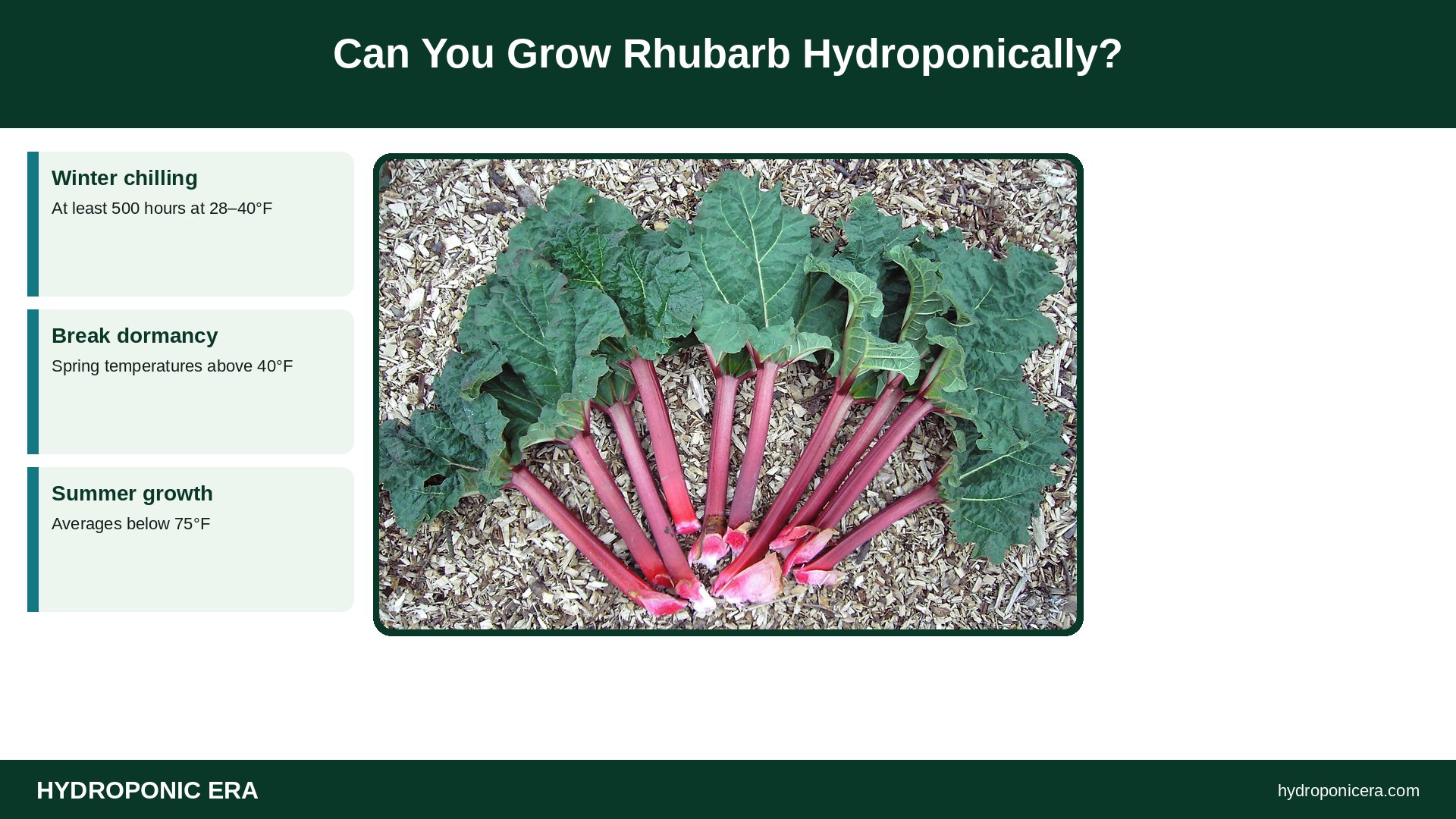
Rhubarb hydroponics is possible but uncommon, and it’s one of the harder crops to grow indoors year-round. Rhubarb is a large, cool-season perennial that needs a winter rest: Oregon State University Extension says it needs at least 500 hours of winter temperatures between 28°F and 40°F to form new leaf buds, spring temperatures above 40°F to break dormancy, and summer temperatures averaging below 75°F. A mature plant can reach 2½–3 feet tall and 3–3½ feet wide. If you try it, grow a single crown in a large drip-fed container of coarse media, and give it a cold dormant period each winter.
Key takeaway: Rhubarb can grow in a big media-filled container, but it needs months of winter chill and cool summers. Leaves are toxic; eat only the stalks.
| Need | OSU Extension figure |
|---|---|
| Winter chilling | At least 500 hours at 28–40°F |
| Break dormancy | Spring temperatures above 40°F |
| Summer growth | Averages below 75°F |
| Mature size | 2½–3 ft tall, 3–3½ ft wide |
| Soil pH (in ground) | 6.0–6.8 |
| First harvest | Second year, only 3–4 stalks |
Is Rhubarb Hydroponics Practical?
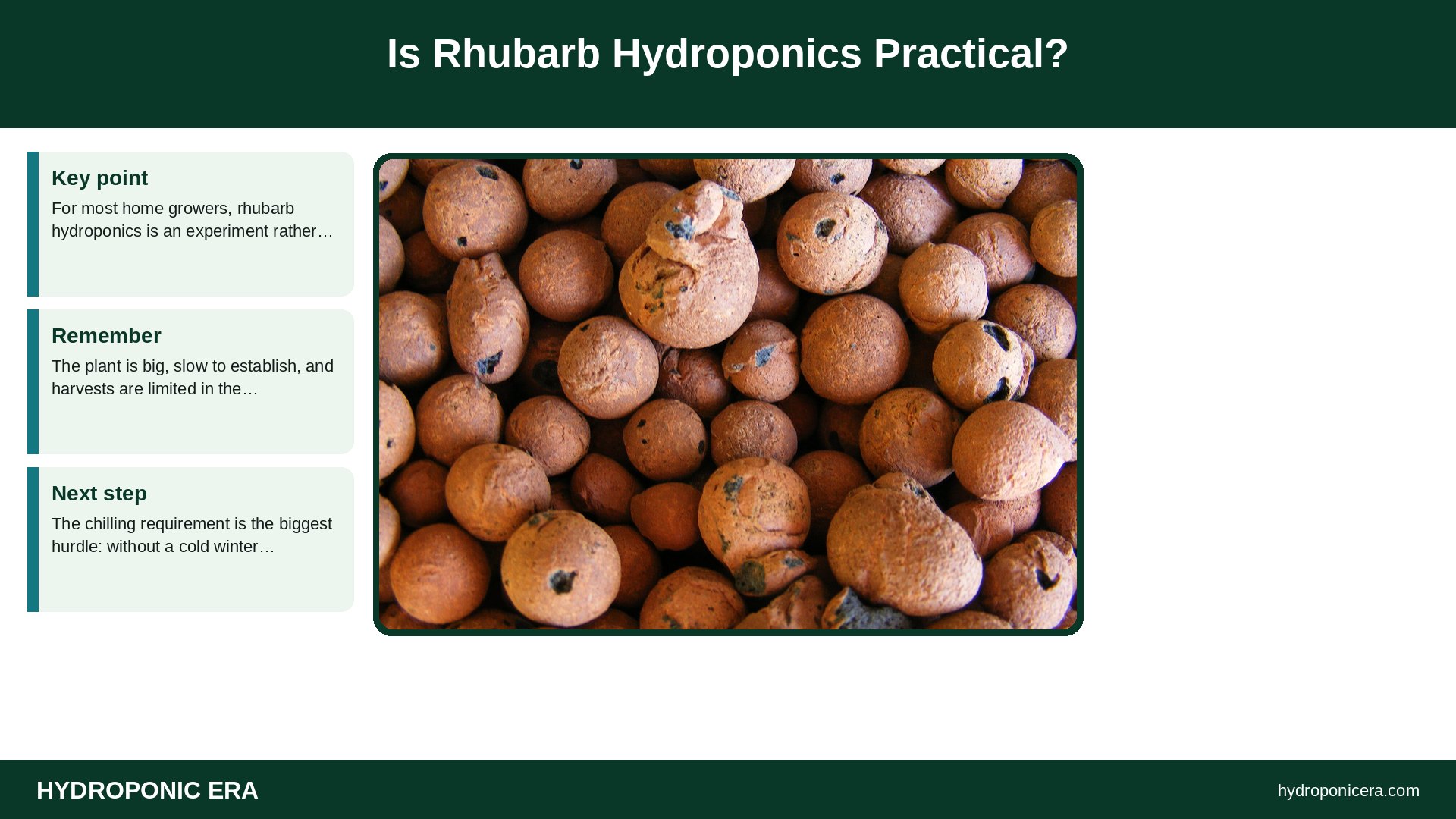
For most home growers, rhubarb hydroponics is an experiment rather than a reliable crop. The plant is big, slow to establish, and harvests are limited in the first years. The chilling requirement is the biggest hurdle: without a cold winter rest, rhubarb doesn’t form new buds properly. Growers in cold northern states can move a container outdoors or into an unheated garage for winter, while those in warm zones will struggle.
Rhubarb Hydroponics Safety: Eat Only the Stalks
OSU Extension warns rhubarb leaves are toxic to humans and animals because of their high oxalic acid and soluble salt content. Only the leaf stalk is eaten. Keep leaves away from pets and children, and compost them rather than feeding them to animals. OSU also warns that if frost or freeze damages the leaves, oxalic acid can move into the stalks; discard any stalks that turn soft or limp.
Best Systems for Rhubarb Hydroponics
Rhubarb has a large, woody rhizome with fibrous roots and is prone to crown rot in wet conditions. OSU Extension names Phytophthora crown rot as a serious disease and stresses good drainage. That makes a well-drained container of coarse media, such as perlite, coco, or clay pebbles, with drip feeding the safest choice. Deep water culture and NFT are poor fits. Use a container of at least 15–20 gallons for a mature crown. See growing media for hydroponics.
Starting Rhubarb Hydroponics
- Start with a dormant crown division, the method OSU recommends for propagation.
- Rinse soil from the crown gently and trim damaged roots.
- Plant so the crown sits just at or slightly below the media surface, with buds facing up.
- Feed lightly with a complete nutrient until new leaves expand.
- Keep the container cool and in bright light.
Seed is mainly used by breeders, OSU notes, because seedlings seldom resemble the parent.
Nutrients for Rhubarb Hydroponics
OSU gives a soil pH target of 6.0–6.8 for rhubarb. In hydroponics, aim for the upper part of the usual 5.5–6.5 range. Use a complete vegetable nutrient with calcium and micronutrients. Rhubarb has a high water need and is less productive when moisture-stressed, so drip cycles should keep media evenly moist without waterlogging the crown. See how to lower EC.
Rhubarb Hydroponics Temperature and Chilling
OSU says rhubarb grows most vigorously when summer temperatures average below 75°F, and high temperatures give green rather than red stalks. In warm areas, late-afternoon shade helps. In winter, let the plant go dormant and give it the 500-plus chilling hours between 28°F and 40°F. A garage, unheated shed, or outdoor spot with the container protected from deep freezing can provide that.
Harvesting Rhubarb Hydroponics Crops
OSU advises waiting until at least the second year after planting, then harvesting only 3–4 stalks per plant. In later years, leave about half a dozen stalks on the plant at all times. Grasp the stalk near the crown and twist and pull sideways rather than cutting, to avoid damaging buds. A normal harvest season lasts about 8 weeks; then let the plant regrow and store food for next year.
Seed Stalks in Rhubarb Hydroponics
OSU notes that heat, drought, low fertility, alternating hot and cold, and age can trigger seed stalks. Cut them off as they appear, because they take energy from the plant and reduce bud formation for the next season.
Varieties for Rhubarb Hydroponics
OSU lists Crimson as a leading red variety, with Valentine, Canada Red, MacDonald, and Victoria also grown. Valentine and Ruby Red produce fewer seed stalks, a useful trait for containers. Ornamental rhubarb (Rheum palmatum) is not edible.
Common Problems
- Crown rot: media too wet; improve drainage.
- Weak growth: not enough winter chill.
- Green stalks: heat; OSU notes cool spring weather improves red color.
- Slugs: can damage new plants outdoors.
- Many thin stalks: old, crowded crown that needs dividing.
Weekly Routine for Rhubarb Hydroponics
- Check pH and EC and record them.
- Make sure drip emitters run and media drains freely.
- Remove seed stalks as they appear.
- Look for rot at the crown.
- Flush media with plain water every few weeks.
Dividing Crowns for Rhubarb Hydroponics
OSU suggests dividing when a plant starts making 25–30 or more small stalks instead of 12–18 larger ones, often around the fifth or sixth year. Divide while dormant, leaving each piece with at least one large bud.
Forcing Early Stalks in Rhubarb Hydroponics
OSU Extension notes that covering mature crowns in early February, after dormancy, with clear plastic, straw, or row cover can produce usable stalks about 10 days earlier. In a container, you can do the same by covering the pot with a vented clear cover once the chill period is complete. OSU advises cutting quarter-inch ventilation holes in plastic as growth starts and removing the cover when stalks press against it. Black covers give bright red stalks but lower yields, according to OSU.
FAQs: Rhubarb Hydroponics
Can rhubarb grow hydroponically?
Yes, in a large container of coarse media, but it needs winter chilling.
Are rhubarb leaves poisonous?
Yes. OSU says the leaves are toxic; eat only the stalks.
How much cold does rhubarb need?
At least 500 hours between 28°F and 40°F, according to OSU.
When can I harvest?
From the second year, starting with only 3–4 stalks.
Can I grow rhubarb indoors year-round?
Not well; it needs a cold dormant period each winter.
Sources
- Oregon State University Extension — Grow Your Own Rhubarb (EC 797)
- Photo credits (Wikimedia Commons, edited with titles): Rheum rhabarbarum.2006-04-27.uellue by Dieter Weber (User:Uellue) (CC BY-SA 3.0); Hydroton by Lucis (CC BY-SA 3.0); Drip irrigation (2552390830) by Dwight Sipler from Stow, MA, USA (CC BY 2.0); Ennis – Market Place – Farmers’ Market – Vegetable Stand – geograph.org.uk – 3038450 by Joseph Mischyshyn (CC BY-SA 2.0); SantoriniGrapeVine06679 by User:Leonard G. (Public domain)