
How do you grow soybean sprouts at home? Use small soybeans sold for sprouting. Rinse, soak until the beans soften (about 4 hours for short sprouts, up to 24 hours for Korean kongnamul), drain, and keep them dark. Water or rinse often and drain well. Short soybean sprouts are ready in 2–6 days; long kongnamul reaches about 4 inches (10 cm) in 4–6 days. Cook before eating.
Key takeaway: Soybean sprouts need more care than most sprouts. Pick sprouting-type beans, avoid over-soaking, keep them in the dark so they stay yellow, and water frequently so they don’t heat up or sour. Harvest, chill and cook them for dishes like kongnamul muchim and kongnamulguk.
| Step | Short sprouts (jar) | Kongnamul (long, Korean style) |
|---|---|---|
| Seed | ½ cup per quart (1 L) jar | 1 cup, 6½ oz (180 g) |
| Soak | About 4 h; check at 2 h; up to 12 h | 24 h |
| Water | Rinse every 8–12 h | Every 3–4 h |
| Light | Little effect | Dark cloth; light turns them green |
| Harvest | Tails ¹⁄₁₆–¼ in (2–6 mm), 2–6 days | About 4 in (10 cm), 4–6 days |
| Yield | About 2:1 | About 1½ lb (680 g) |
Sources: Sprout People (short sprouts); Maangchi (kongnamul).

What Are Soybean Sprouts?
Soybean sprouts are soybeans that have soaked and grown a root, with the yellow bean head still attached. In Korea they are called kongnamul. Maangchi, a well-known Korean cooking teacher, calls them one of the most commonly used ingredients in Korean cuisine, used weekly in many homes for seasoned sprouts (kongnamul muchim) and soybean sprout soup (kongnamulguk). Soybean sprouts are larger and crunchier than mung bean sprouts and have a nutty bean head.
Which Soybeans Should You Use for Sprouting?

Choose beans sold for sprouting. Maangchi explains that soybeans for sprouting (kongnamul kong) are smaller than usual soybeans and that regular soybeans, used for tofu, soy milk and doenjang, won’t sprout easily. Sprout People notes that soy has a lower germination rate than most beans, with their seed at about 80%, and that not every bean will sprout even in a good batch. Look for clean, whole, unsplit beans and store extra seed in a cool, dark, dry place; Sprout People lists a 4-year seed shelf life.
How Do You Sprout Soybeans in a Jar?
- Sanitize your jar, as UC ANR recommends.
- Measure ½ cup of beans into a quart (1 L) jar; Sprout People says this yields about 1 cup.
- Soak in 2–3 times as much cool 60–70°F (16–21°C) water. Check after 2 hours; Sprout People finds about 4 hours is usually right.
- Don’t over-soak. Over-soaked soybeans can split in half, sprout poorly or rot.
- Drain and rinse thoroughly.
- Rinse and drain every 8–12 hours at about 70°F (21°C), out of direct sun.
- Harvest when most tails are ¹⁄₁₆–¼ inch (2–6 mm), in 2–6 days.
- Dry and chill: let them drain 8–12 hours after the last rinse, then refrigerate.
For jar basics, see how to grow sprouts in a jar.
How Do You Grow Kongnamul (Long Soybean Sprouts)?
Korean-style soybean sprouts grow long, crowded and pale in a container that drains from the bottom. Maangchi’s method:
- Rinse 1 cup of sprouting soybeans and soak for 24 hours.
- Pick out dead or broken beans.
- Put the beans in a planter or pot with small holes in the bottom, set over a bowl or in the sink.
- Pour water over them little by little until all beans are evenly wet; let it drain out.
- Cover with a black cloth. Light turns the beans green instead of yellow.
- Water every 3–4 hours for 4–6 days, until sprouts are about 4 inches (10 cm).
- Rinse a couple of times, drain and refrigerate.
Traditionally, Maangchi notes, Koreans used a siru, an earthenware bowl with holes, set over a basin, and scooped the drained water back over the beans. A colander over a bowl in a dark cupboard works for small batches.
How Many Soybeans Should You Start With?
Plan by yield. Sprout People puts soybean sprouts at roughly a 2:1 yield by weight, and advises filling a sprouter only ¼–⅓ full with dry seed so the beans have room to swell and drain. Maangchi reports that 1 cup of dried sprouting soybeans makes about 1½ pounds (680 g) of long kongnamul. Because soybean sprouts keep only about a week, start a small batch every few days instead of one huge batch.
| Household use | Dry beans per batch | Method |
|---|---|---|
| One side dish | ½ cup | Quart (1 L) jar |
| Soup plus side dish | 1 cup | Colander or draining pot |
| Weekly family supply | 1 cup twice a week | Staggered batches |
Want leafy greens instead of sprouts? See our hydroponic microgreens guide.
Why Do Soybean Sprouts Smell Sour or Rot?
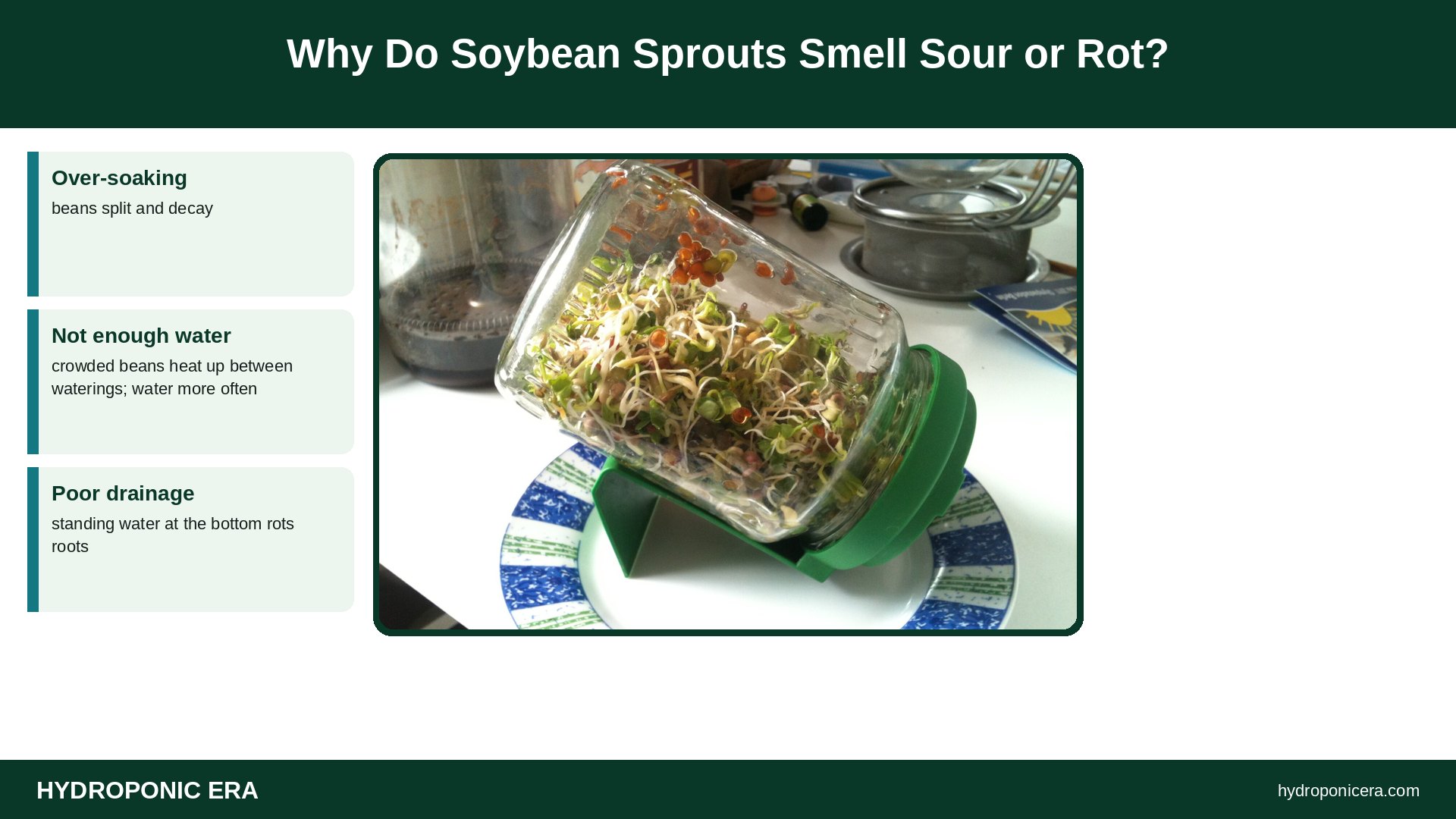
- Over-soaking: beans split and decay.
- Not enough water: crowded beans heat up between waterings; water more often.
- Poor drainage: standing water at the bottom rots roots.
- Dead or broken beans left in the batch; remove them early.
- Too warm: keep near 70°F (21°C).
A faint bean smell is normal, but discard any batch that smells strongly sour or looks slimy.
Are Soybean Sprouts Safe to Eat Raw?
Raw sprouts of any kind carry a food-safety risk, because warm, moist sprouting conditions also favor bacteria. The FDA advises children, older adults, pregnant people and anyone with a weakened immune system to avoid raw or lightly cooked sprouts. Soybean sprouts are traditionally eaten cooked, and Sprout People says they prefer not to eat them raw because they find them hard to digest. UC ANR suggests cooking sprouts to 165°F (74°C) for safety.
How Do You Store and Use Soybean Sprouts?

Drain well so they are dry to the touch, bag them and refrigerate. Maangchi says homegrown kongnamul keeps up to about 1 week in the fridge. NC State suggests refrigerating sprouts at 38–50°F (3–10°C).
| Dish | How soybean sprouts are used |
|---|---|
| Kongnamul muchim | Boiled, then seasoned as a side dish |
| Kongnamulguk | Simmered in a light soup |
| Bibimbap | Cooked sprouts as a topping |
| Stir-fries and stews | Added for crunch |
Homegrown sprouts may need longer cooking than store-bought; cook until the bean heads reach the texture you like.
FAQs
Can I sprout regular soybeans?
Maangchi says regular soybeans won’t sprout easily; buy sprouting beans.
Why did my soybean sprouts turn green?
They got light. They are still edible, but cover them for yellow sprouts.
Do I need to remove the roots?
No. You can snip them, but Maangchi uses roots too.
How long do soybean sprouts take?
Short sprouts 2–6 days; long kongnamul about 4–6 days.
How are they different from mung bean sprouts?
They keep a large yellow bean head and taste nuttier.
Sources
- Sprout People — Soy Bean Sprouts growing guide
- Maangchi — How to grow Soybean Sprouts (Kongnamul)
- UC ANR — Growing Seed Sprouts at Home (Publication 8151)
- U.S. FDA — Selecting and Serving Produce Safely
- NC State Extension — Bean Sprouts and Other Vegetable Seed Sprouts
- Photo credits (Wikimedia Commons, edited with titles): Kongnamul(soybean sprouts) by milivanily (CC0); NRCSIA99680 – Iowa (3981)(NRCS Photo Gallery) by Photo by Lynn Betts, USDA Natural Resources Conservation Service. (Public domain); Growing bean sprouts by User:tlcoles (CC BY-SA 3.0); Salad, Romaine lettuce, cucumber, tomato, green pepper, radish, alfalfa sprouts, black olives, lemon juice, salt & olive oil (7765310086) by Lablascovegmenu from London (CC BY 2.0); Mung bean sprouts, close-up by pics_pd (CC0)