
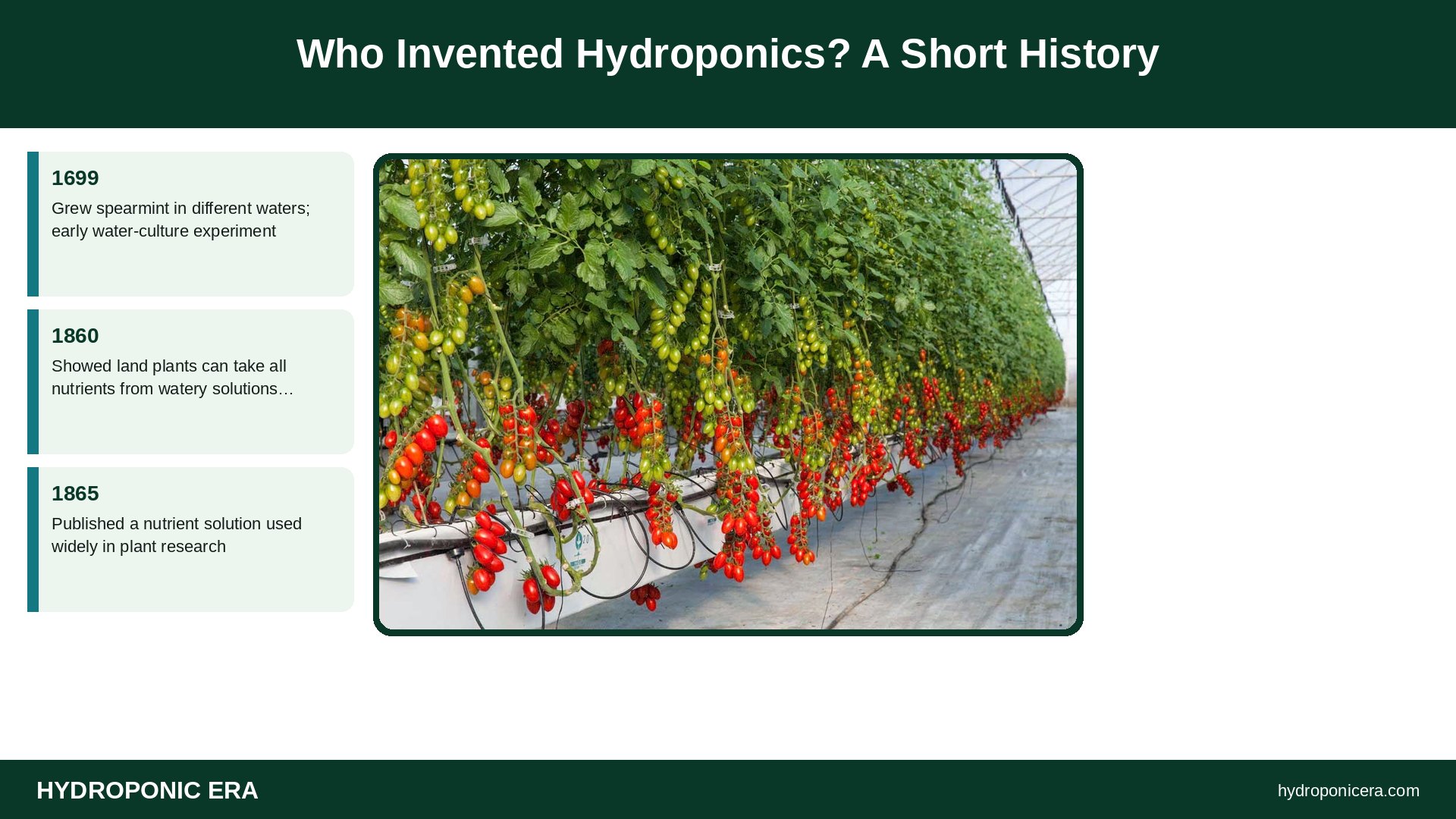
Who invented hydroponics? No single person. Scientists grew plants in water for centuries, Julius von Sachs and Wilhelm Knop proved around 1860 that plants could live on mineral solutions alone, and William F. Gericke of the University of California turned the lab method into practical crop production in the late 1920s and 1930s, popularizing the word “hydroponics.”
| Year | Who | Contribution |
|---|---|---|
| 1699 | John Woodward (England) | Grew spearmint in different waters; early water-culture experiment |
| 1860 | Julius von Sachs (Germany) | Showed land plants can take all nutrients from watery solutions without soil |
| 1865 | Wilhelm Knop (Germany) | Published a nutrient solution used widely in plant research |
| Late 1920s–1930s | William F. Gericke (University of California) | Adapted water culture for commercial crops; the term “hydroponics” spread |
| 1938 / 1950 | D. R. Hoagland and D. I. Arnon (UC) | Published the water-culture circular and solution still cited today |
| 1960s | Glasshouse Crops Research Institute (England) | Developed the nutrient film technique (NFT) |
| 2015–2022 | NASA | Space-grown lettuce eaten in orbit; hydroponic and aeroponic tests on the ISS |
Who Invented Hydroponics, and Why Is the Answer Complicated?
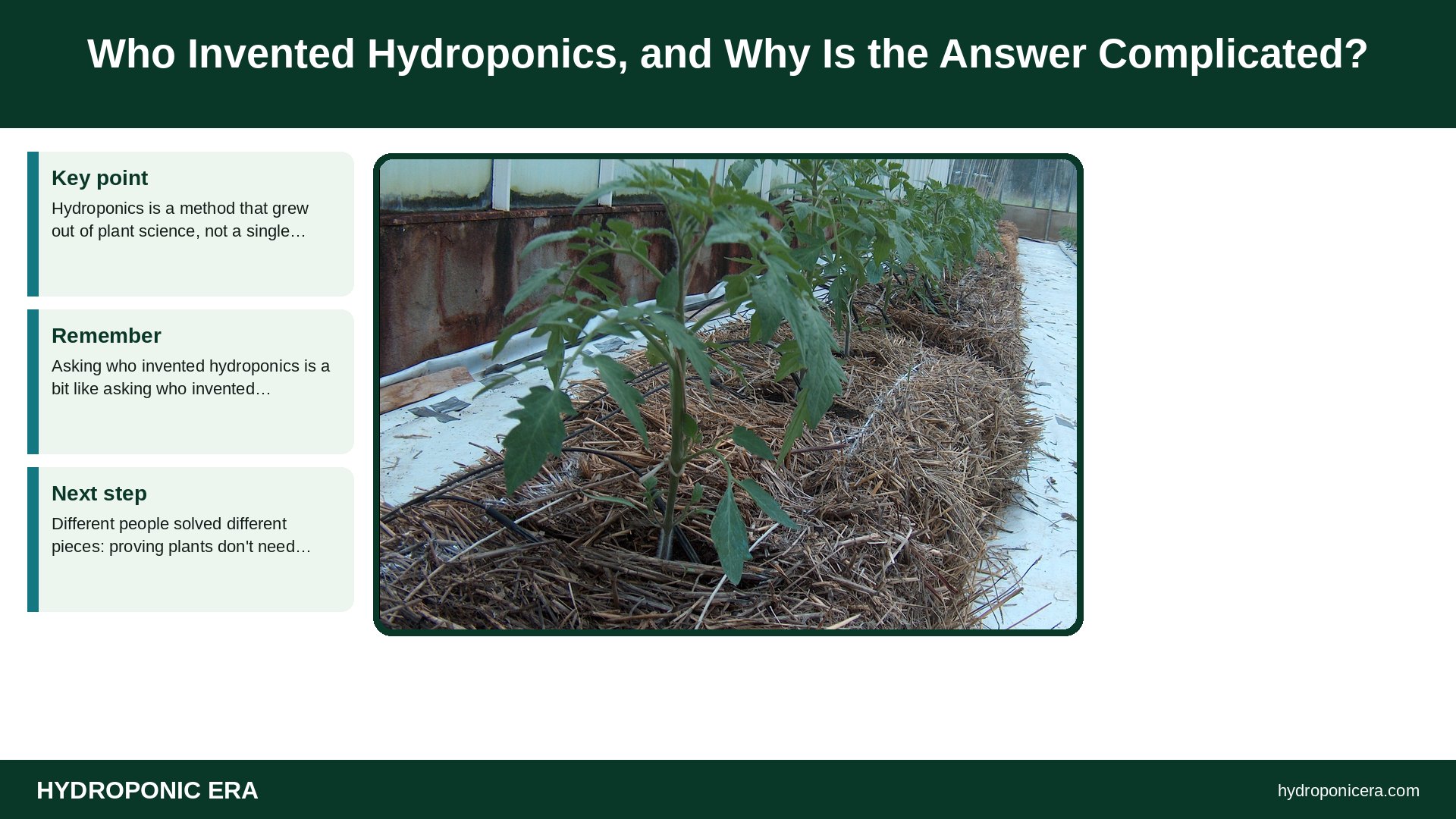
Hydroponics is a method that grew out of plant science, not a single invention with a patent date. Asking who invented hydroponics is a bit like asking who invented gardening. Different people solved different pieces: proving plants don’t need soil, working out which minerals they need, and making the method practical at scale.
The best primary source on who invented hydroponics is “The Water-Culture Method for Growing Plants Without Soil,” University of California Agricultural Experiment Station Circular 347 by D. R. Hoagland and D. I. Arnon. It traces the story from 17th-century experiments to the 1930s publicity around commercial “tank farming.”
What Did the Early Water-Culture Experiments Show?
According to Hoagland and Arnon, John Woodward grew spearmint in 1699 in rain, river and conduit water, adding garden soil to one sample. The plants grew most in the water with the most soil mixed in, and he concluded that “earth” was the source of plant nourishment. He was wrong about why, but his setup was an early water-culture experiment.
Over the next 150 years, chemists showed that plants need specific mineral elements. Researchers first grew plants in washed sand and other inert solids, then took the final step of removing the solid medium entirely.
How Did Sachs and Knop Prove Plants Don’t Need Soil?

In 1860, the German botanist Julius von Sachs published experiments showing that land plants can absorb their nutrients from watery solutions without soil, and can be kept alive and growing that way for long periods. Wilhelm Knop worked on the same problem at about the same time and in 1865 proposed a nutrient solution that became one of the most widely used in plant nutrition studies. Their work is why many historians point to Sachs and Knop when people ask who invented hydroponics as a science.
These were laboratory tools, though. Nobody was growing tomatoes for sale in jars of Knop’s solution.
What Did William Gericke Do for Hydroponics?
At the University of California, Dr. William F. Gericke had the idea that the water-culture method, until then used only for scientific study, could be adapted for commercial crops. He devised special techniques for large-scale growing in covered tanks, and in the 1930s his work drew wide newspaper attention. Hoagland and Arnon note that the process was called “tray agriculture,” “tank farming” and “hydroponics.”
The word “hydroponics” is widely credited to Gericke in the 1930s; some accounts say a colleague suggested it. He later wrote “The Complete Guide to Soilless Gardening” (1940). So if you want one name for who invented hydroponics as a practical growing method, Gericke is the usual answer.
Why Did Hoagland and Arnon Matter?
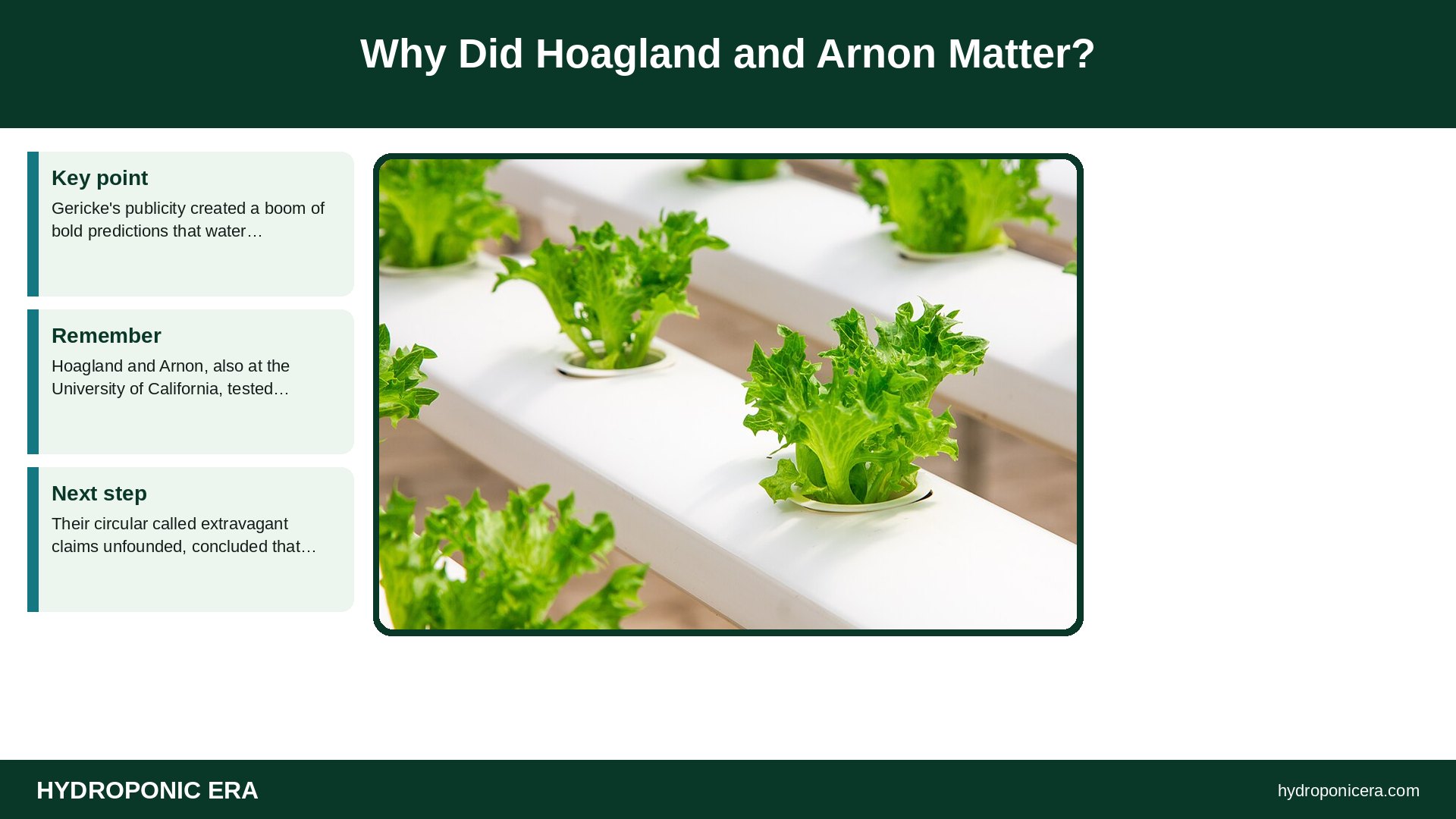
Gericke’s publicity created a boom of bold predictions that water culture would replace soil farming. Hoagland and Arnon, also at the University of California, tested those claims. Their circular called extravagant claims unfounded, concluded that yields were “not strikingly different” from good soil under comparable conditions, and warned that small-scale results don’t predict large-scale yields. It also published nutrient solution formulas. “Hoagland solution” is still a standard reference in plant research labs.
That healthy skepticism is a good lesson for today’s growers comparing marketing claims. See our guide to realistic home yield expectations.
How Did Modern Hydroponics Develop?
- Nutrient film technique (NFT). Developed in the 1960s at England’s Glasshouse Crops Research Institute, a method commonly credited to researcher Allen Cooper. A thin film of solution flows past bare roots in a sloped channel. See NFT for beginners.
- Rockwool and media systems. Commercial greenhouses adopted inert media and drip irrigation for tomatoes and cucumbers. See rockwool for hydroponics.
- Passive methods. Researchers at the University of Hawaii described the non-circulating Kratky method. See Kratky method.
- LED indoor and vertical farms. Efficient LEDs made fully indoor growing practical. See vertical farming.
- Space research. NASA astronauts ate space-grown lettuce in 2015. Read hydroponics in space.
Who Invented Hydroponics in America?
For US readers, the American chapter of the story runs through California. Gericke, Hoagland and Arnon all worked at the University of California, and their debates in the 1930s shaped how American extension services described soilless growing for decades. Later, US universities such as Penn State, the University of Florida and Kansas State published hydroponics guides for greenhouse growers, and NASA’s Kennedy Space Center carried the work into orbit. So when someone in the US asks who invented hydroponics, the most accurate answer is a chain of researchers, with Gericke as the person who made it a farming method.
Myths About Who Invented Hydroponics
| Myth | What the evidence supports |
|---|---|
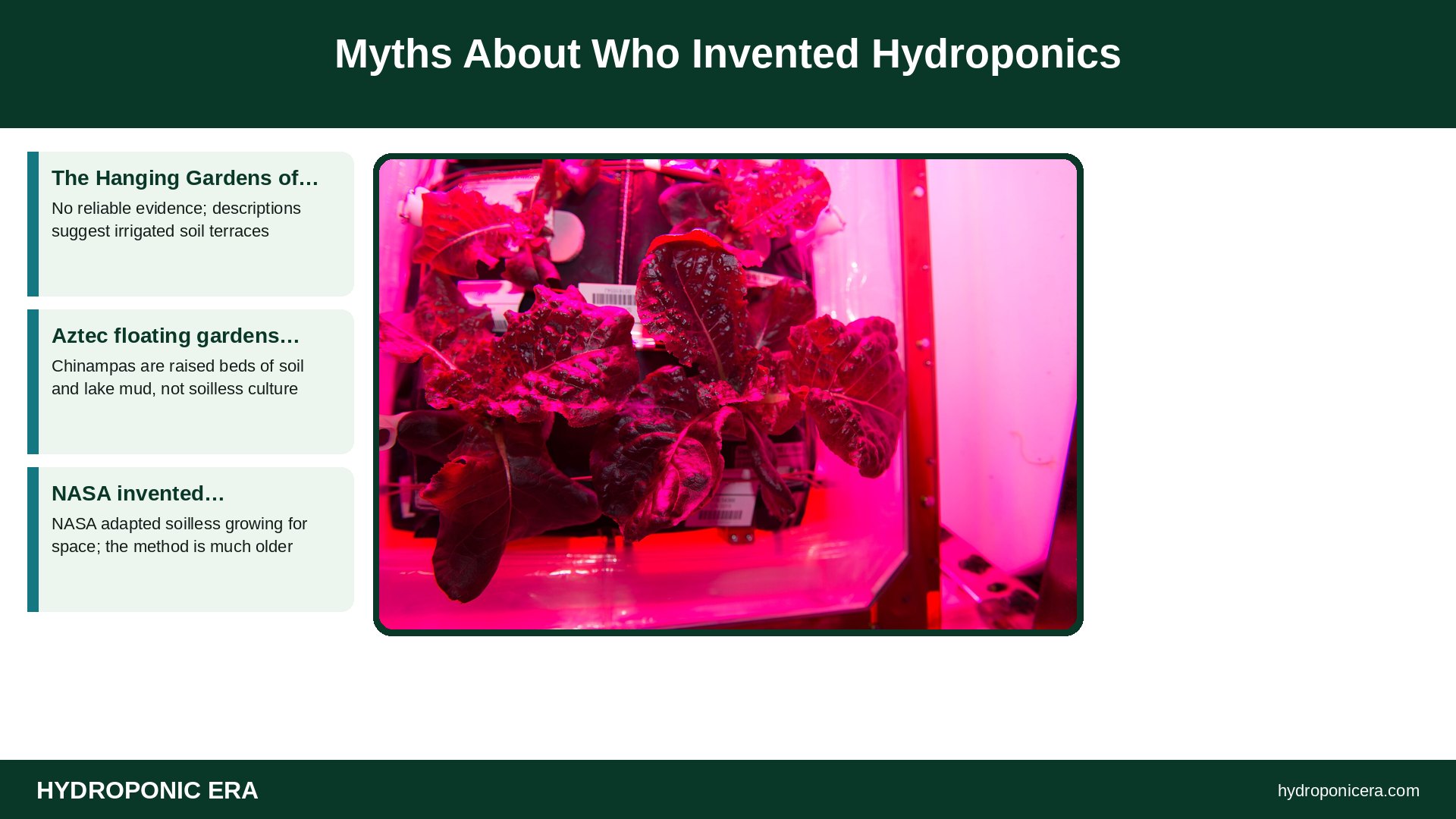
| The Hanging Gardens of Babylon were hydroponic. | No reliable evidence; descriptions suggest irrigated soil terraces. |
| Aztec floating gardens (chinampas) were hydroponics. | Chinampas are raised beds of soil and lake mud, not soilless culture. |
| NASA invented hydroponics. | NASA adapted soilless growing for space; the story of who invented hydroponics starts centuries earlier. |
| Gericke discovered that plants can grow in water. | Sachs and Knop showed that in the 1860s; Gericke made it practical. |
Why Does Knowing Who Invented Hydroponics Matter to Home Growers?
Every modern nutrient bottle traces back to the same question Sachs answered: which minerals do plants need, and in what form? Understanding that helps you read labels, mix solutions correctly and ignore products that promise miracles. Start with our guides to using hydroponic nutrients and NPK ratios by growth stage.
FAQs About Who Invented Hydroponics
Who is the father of hydroponics?
William F. Gericke is often called the father of modern hydroponics because he turned water culture into a practical growing method and popularized the name. If you ask who invented hydroponics as a practical method, he is the best single answer.
When was hydroponics invented?
The science dates to the 1860s (Sachs in 1860, Knop in 1865). Practical commercial hydroponics dates to Gericke’s work in the late 1920s and 1930s.
What does the word hydroponics mean?
It combines the Greek words for water (“hydro”) and labor or work (“ponos”), roughly “water working.”
Is hydroponics a new technology?
No. It is about a century old as a growing method and much older as a lab technique. LEDs, sensors and automation are the newer parts.
Where can I read the original sources on who invented hydroponics?
Hoagland and Arnon’s Circular 347 is freely available through the Internet Archive; see the Sources list below.
Related HydroponicEra Guides
Sources
- Hoagland, D. R. and Arnon, D. I. — The Water-Culture Method for Growing Plants Without Soil, California Agricultural Experiment Station Circular 347 (Internet Archive)
- GCRI Trust — History of the Glasshouse Crops Research Institute
- Kansas State University (historic extension publication) — MF1169 Hydroponic Systems (PDF)
- NASA — Growing Plants in Space