
Are mosquito dunks in pond water safe for fish and plants? Yes, when you follow the label. Mosquito dunks in pond water release Bti, a soil bacterium whose toxin targets mosquito, black fly and fungus gnat larvae. The EPA says Bti has no toxicity to people, and the Summit label lists fish ponds, water gardens and even aquaponics among its approved sites.
Key takeaway: For mosquito dunks in pond water, use one dunk per 100 square feet (9.3 m²) of water surface, regardless of depth, and replace it about every 30 days or when it has dissolved. Mosquito larvae need only 5 to 7 days to become biting adults, so keep a dunk in the pond through the whole warm season instead of waiting until you see wrigglers.
| Fact | What sources report | Source |
|---|---|---|
| Active ingredient | Bacillus thuringiensis israelensis (Bti) | EPA |
| Insects affected | Larvae of mosquitoes, black flies and fungus gnats | EPA |
| Dose | 1 dunk per 100 sq ft (9.3 m²) of surface, any depth | Summit Dunks label |
| Small ponds | ¼ dunk up to 25 sq ft (2.3 m²); ½ dunk up to 50 sq ft (4.6 m²) | Summit Dunks label |
| How long it lasts | About 30 days under typical conditions | Summit Dunks label |
| Larval development | 5 to 7 days from egg to adult | Illinois Extension |
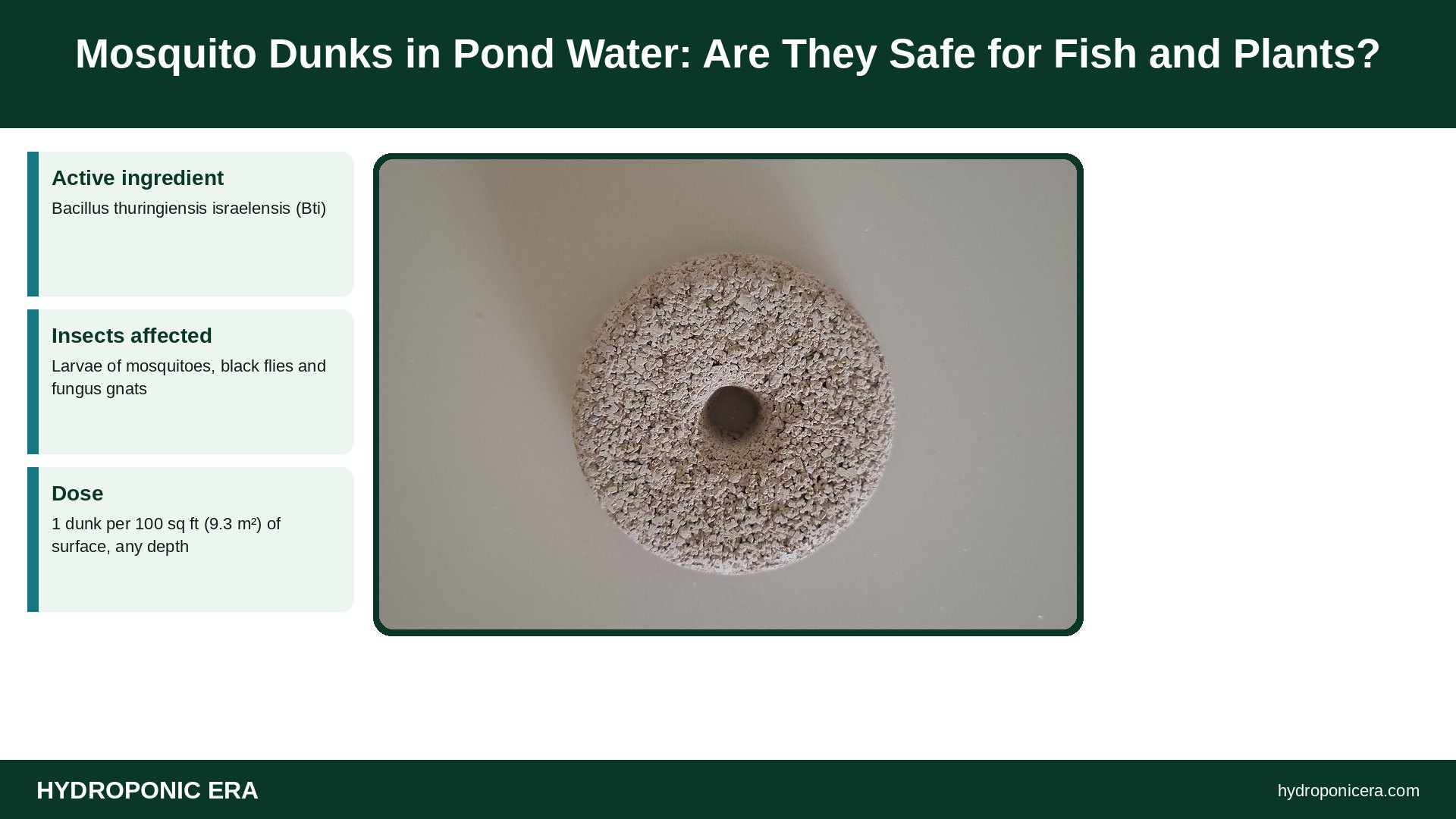
What Are Mosquito Dunks in Pond Water and How Do They Work?
Mosquito dunks are floating, donut-shaped cakes that slowly release Bti into the water. Mosquito larvae swallow the Bti as they feed, and its toxin kills them before they can become adults. The label says the cake releases Bti at the surface and that it gradually settles to the bottom too.
The EPA explains that Bti contains spores that produce toxins which specifically target the larvae of mosquitoes, black flies and fungus gnats. That narrow target is why the same active ingredient is sold as granules for gnats in potting mixes, which we cover in our guide to Mosquito Bits for fungus gnats.
Mosquito dunks in pond water do nothing to adult mosquitoes. It only stops the next generation, so it works best as steady prevention in any pond, water garden or tub that holds still water.
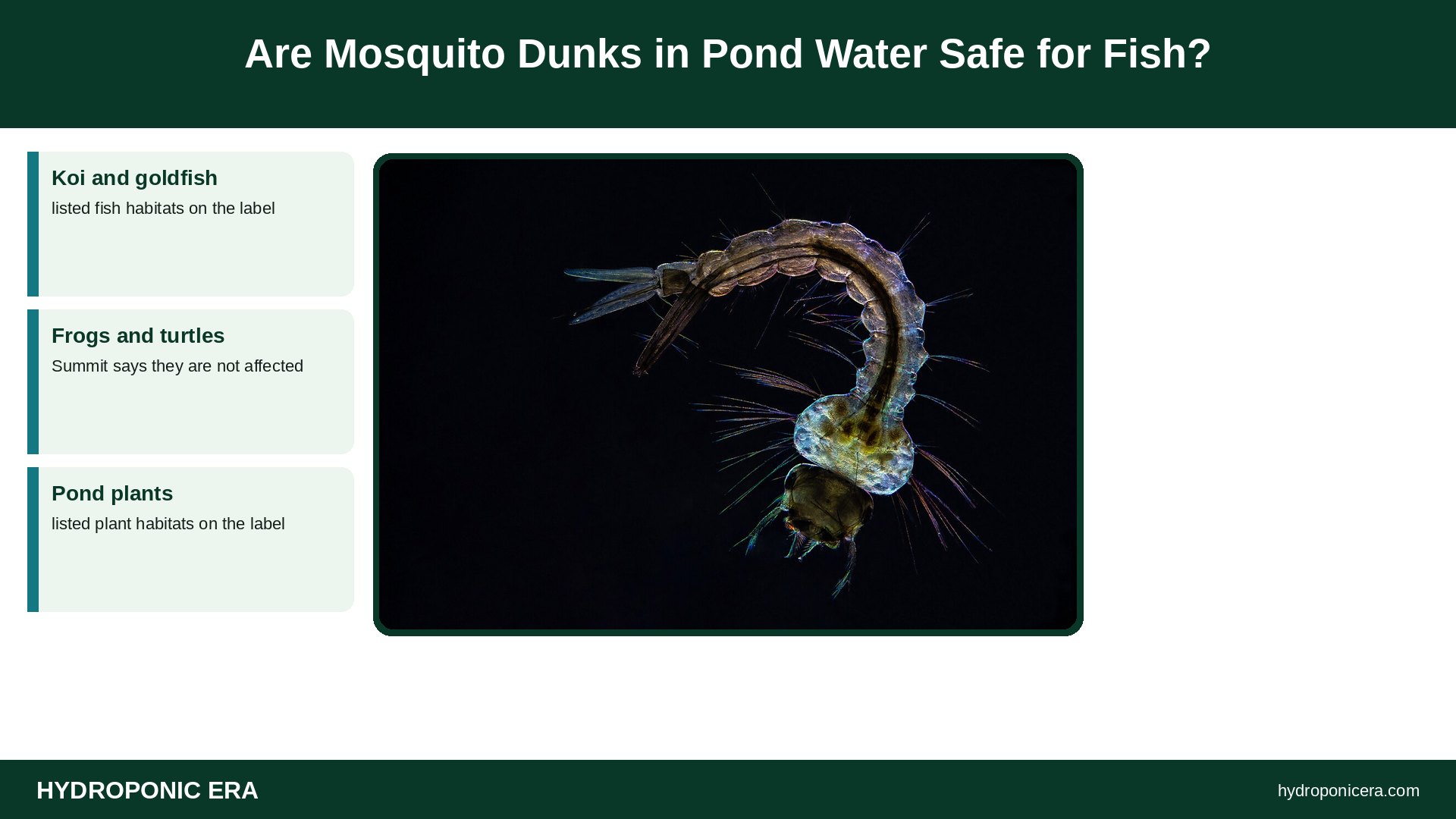
Are Mosquito Dunks in Pond Water Safe for Fish?
Yes. The current EPA-accepted Dunks label is titled “Can Be Used In Plant and Fish Habitats” and lists plant and fish water gardens, ponds, fish farms, bird baths, animal watering troughs, aquaponics and hydroponics. Summit says the product is harmless to plants, fish, frogs, turtles and beneficial insects when used as directed.
Independent work points the same way. The EPA reports that Bti has minimal toxicity to honey bees, and a Seattle catch-basin study found Bti posed little direct hazard to juvenile salmon. University of Florida IFAS also describes Bti as safe in fish habitats, with one firm limit: do not use it in water meant for drinking.
- Koi and goldfish: listed fish habitats on the label.
- Frogs and turtles: Summit says they are not affected.
- Pond plants: listed plant habitats on the label.
- Pets and livestock: label allows watering troughs and bird baths.
How Many Mosquito Dunks in Pond Water Do You Need?
To dose mosquito dunks in pond water, measure the surface, not the volume. The label rate is one dunk per 100 square feet (9.3 m²) of surface area regardless of depth. A pond that is 10 feet (3 m) by 10 feet (3 m × 3 m) needs one dunk, while a 5-by-5-foot (1.5 m × 1.5 m) water garden needs only a quarter of a dunk.
| Pond surface area | Dunks to use |
|---|---|
| 0 to 25 sq ft (up to 2.3 m²) | ¼ dunk |
| 25 to 50 sq ft (2.3 to 4.6 m²) | ½ dunk |
| 50 to 75 sq ft (4.6 to 7 m²) | ¾ dunk |
| 75 to 100 sq ft (7 to 9.3 m²) | 1 dunk |
The label measures small doses in quarter dunks, so break or cut a dunk into pieces for small ponds. For larger ponds, add one dunk for each extra 100 square feet (9.3 m²). The label allows up to four times the normal rate only in heavily polluted, high-organic water such as sewage ponds, so a normal garden pond should stay at the standard rate.
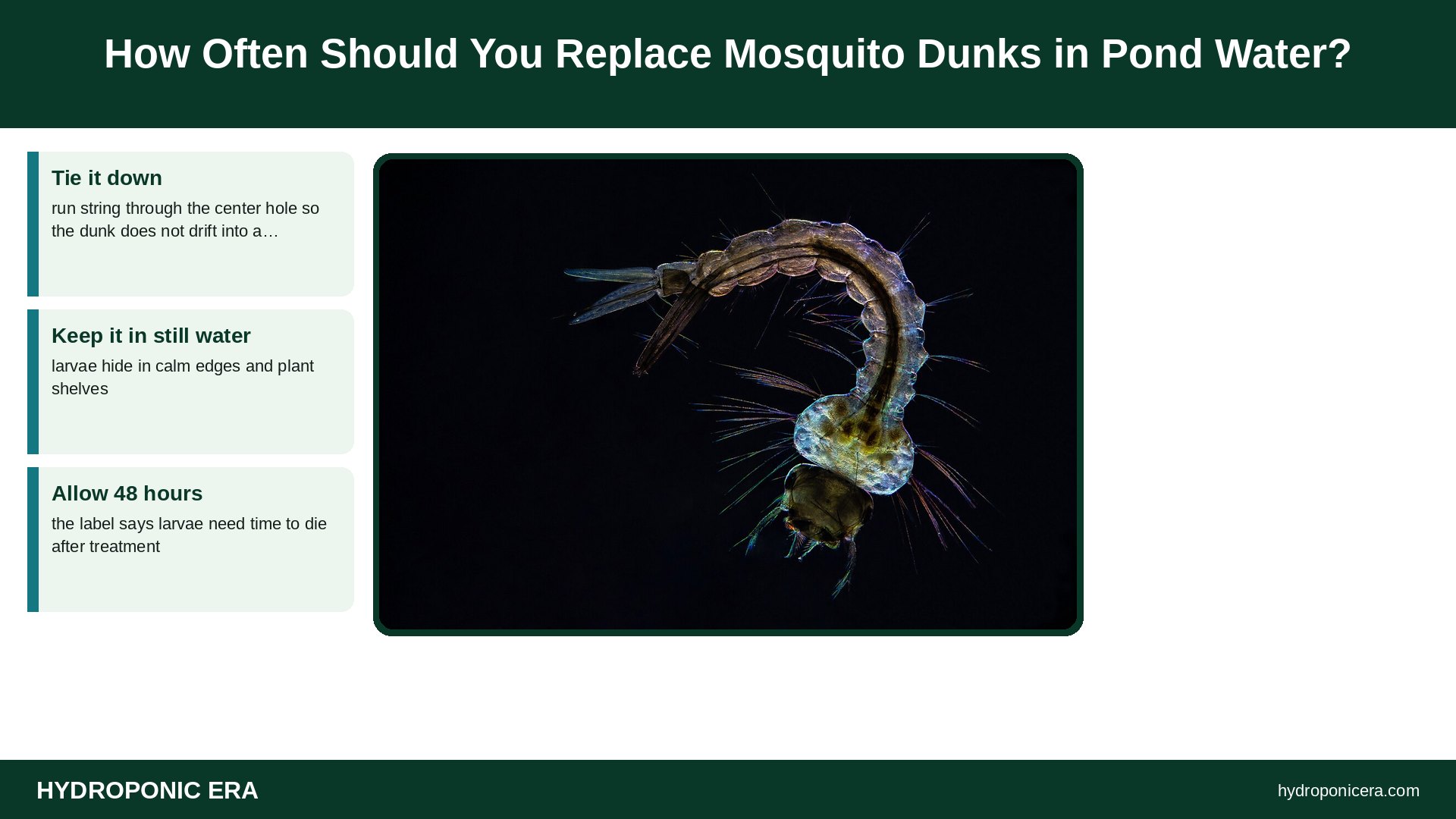
How Often Should You Replace Mosquito Dunks in Pond Water?
Replace mosquito dunks in pond water about every 30 days. The label says each dunk releases effective levels of Bti for 30 days under typical conditions, and Summit says to replace it when it has disappeared. Heavy rain, fast flow or a waterfall can wear it down sooner, so check it every couple of weeks.
Illinois Extension notes that larvae can mature in 5 to 7 days, which is why a gap of even one week can let a new batch hatch. Start in spring when nights warm up and keep dunks in place until the first hard frost.
- Tie it down: run string through the center hole so the dunk does not drift into a skimmer.
- Keep it in still water: larvae hide in calm edges and plant shelves.
- Allow 48 hours: the label says larvae need time to die after treatment.
- Dry spells are fine: the label says wetting and drying does not reduce effectiveness.
Where Should You Place Mosquito Dunks in Pond Setups?
Put the dunk where water is calmest, usually among marginal plants, lily pads or a shallow corner. Larvae gather in still, sheltered water at the edge. Tie the dunk to a plant basket or a small stake so it stays there instead of being pulled into a pump intake or skimmer box.
If the pond has a strong waterfall or fountain, the open water is often too rough for larvae anyway. Focus on the quiet bays. Also check nearby containers that hold water, such as saucers, gutters and rain barrels, since a treated pond will not stop mosquitoes breeding a few feet away.
Can You Use Mosquito Dunks in Aquaponics or Hydroponics?
The label lists both aquaponics and hydroponics as approved sites, so yes, you can use Bti in sumps, fish tanks and nutrient reservoirs that breed mosquitoes. Use the same surface-area rate. Bti will not harm fish, beneficial bacteria or plant roots, but it also will not fix the open water that lets mosquitoes in.
In most systems, a lid is a better first step. Our guide to mosquito larvae in hydroponics explains how to cover reservoirs and treat outbreaks. For gnats in grow media, the granule form is easier to use.
What Are Fish-Safe Alternatives to Mosquito Dunks in Pond Water?
The main alternative is fish that eat larvae. Illinois Extension recommends stocking ornamental ponds with minnows or other surface-feeding fish and notes that koi will not help much because they mainly eat plants. Moving water, a fountain and removing standing water nearby also cut breeding sites without any product.
- Mosquitofish: effective larvae eaters, but check local rules first; see our mosquito fish guide.
- Fathead minnows: hardy native surface feeders; see fathead minnow aquaponics.
- Circulation: a pump or fountain makes the surface less inviting for egg-laying.
- Cleanup: remove leaf litter and floating debris that shelter larvae.
Many pond owners combine fish with mosquito dunks in pond corners: fish for steady control and a dunk in plant shelves or overflow areas where fish cannot reach.
What Mistakes Should You Avoid With Mosquito Dunks in Pond Water?
The biggest mistakes are overdosing, using dunks in drinking water, and expecting them to kill adult mosquitoes. Extra mosquito dunks in pond water do not work faster in a clean pond. The label prohibits applying them directly to treated, finished drinking water reservoirs, and UF/IFAS says not to use Bti in water intended for human consumption.
- Wrong measure: dose by surface area, never by gallons.
- Gaps: let a dunk dissolve and larvae return within days.
- Wrong product: some mosquito products are not Bti; read the label.
- Ignoring the yard: clean gutters, saucers and tires too.
FAQ About Mosquito Dunks in Pond Water
Will mosquito dunks hurt koi or goldfish?
No; the label lists fish ponds, and Summit says fish are not affected.
Can birds drink from a pond with a mosquito dunk?
Yes; the label also lists bird baths and watering troughs.
Do mosquito dunks kill frogs or tadpoles?
Summit says they are harmless to frogs and turtles.
How long does one mosquito dunk last?
About 30 days under typical conditions, per the label.
Can I cut a mosquito dunk in half?
Yes; the label gives quarter, half and three-quarter doses.
Are mosquito dunks organic?
Summit says they are approved for use in organic production.
Sources
- U.S. Environmental Protection Agency — Bti for Mosquito Control
- U.S. EPA — Pesticide Product Label: DUNKS (EPA Reg. 6218-87)
- Summit Responsible Solutions — Mosquito Dunks product page and FAQ
- University of Illinois Extension — Mosquitos
- UF/IFAS Extension Hillsborough County — Mosquito Management
- Journal of the American Mosquito Control Association 28(3) — Efficacy, Fate, and Potential Effects on Salmonids of Mosquito Larvicides in Catch Basins in Seattle, Washington
- Photo credits (Wikimedia Commons, edited with titles): A mosquito dunk by Inpacod2 (CC0); Mosquito larva2 by Janek Lass (CC BY 4.0)