
Is the fathead minnow good for ponds and aquaponics? Yes, for forage and small systems. The fathead minnow is a hardy native fish about 4 in (10 cm) long, per USGS. It spawns once water warms to 60–65°F (16–18°C) and stops near 85°F (29°C), says SRAC. It is too small to eat, so growers raise it as forage or bait.
Key takeaway: Fathead minnows are tough, cheap and easy to breed. Texas A&M recommends stocking them at 5–15 lb (2.3–6.8 kg) per acre in new bass ponds as forage. Males guard eggs laid under flat surfaces, and a 28–32% protein catfish feed suits breeders. Never release them into streams; bait-bucket releases have spread them across the US.
| Fact | Detail | Source |
|---|---|---|
| Adult size | About 4 in (10 cm) | USGS NAS |
| Native range | Quebec to Northwest Territories, south to Alabama, Texas, New Mexico | USGS NAS |
| Spawning starts | 60–65°F (16–18°C) | SRAC 1203 |
| Spawning stops | About 85°F (29°C) | SRAC 1203 |
| Breeder feed | 28–32% protein catfish feed | SRAC 1203 |
| Forage stocking | 5–15 lb (2.3–6.8 kg) per acre in fall | Texas A&M AgriLife |
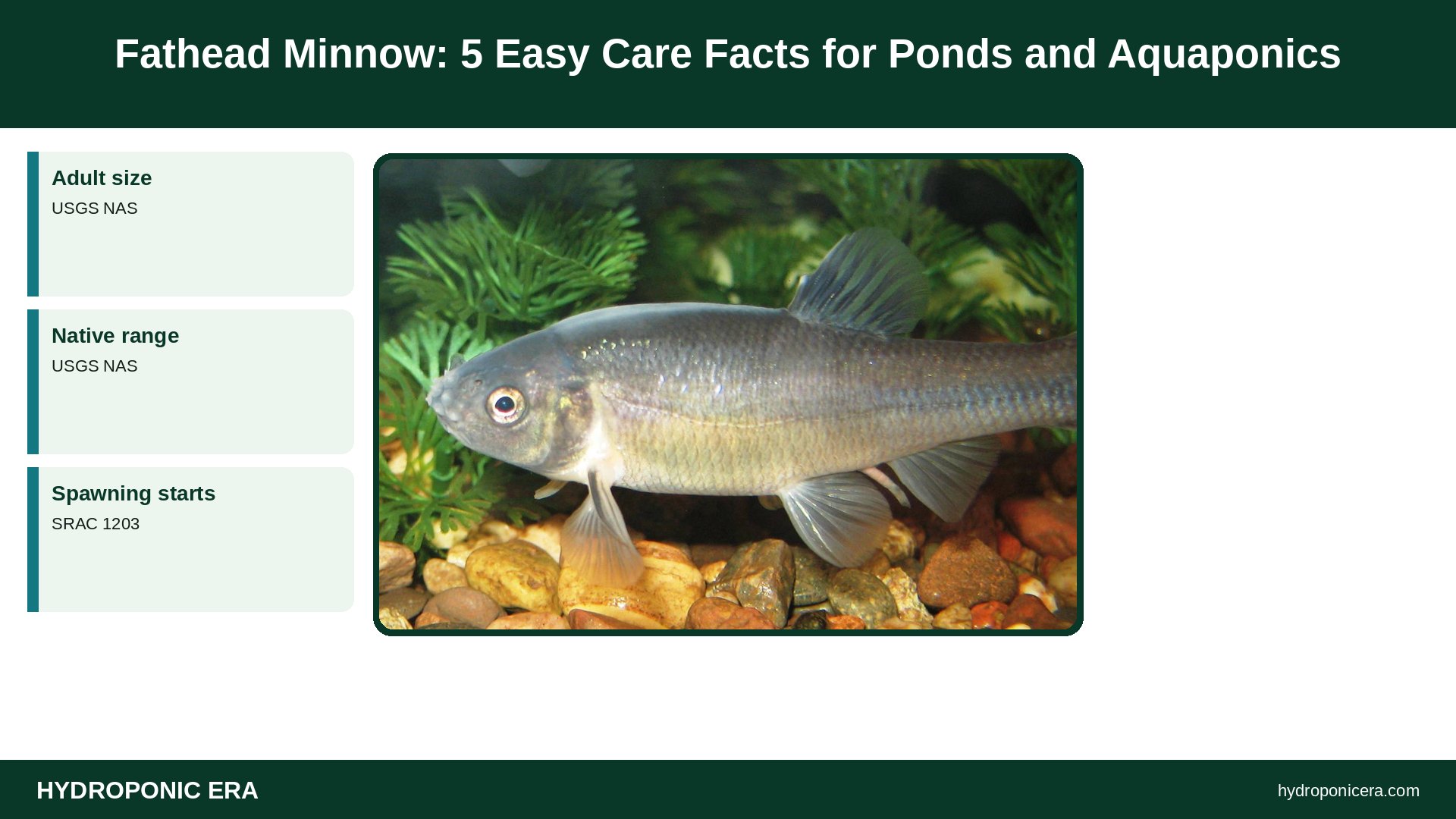
What Is a Fathead Minnow?
The fathead minnow (Pimephales promelas) is a small, thick-bodied minnow with a blunt head and small mouth. Texas A&M describes it as dark olive above, silvery below, with a black side stripe, while the “rosy red” strain is orange. Breeding males grow larger than females and develop black heads with rows of bumps called tubercles.
Texas A&M adds that fatheads usually live only a few years, so plan on breeding replacements.
How Do You Use Fathead Minnows as Pond Forage?
Stock them before predators so they can breed first. Texas A&M advises stocking them in new ponds in the fall at 5–15 lb (2.3–6.8 kg) per acre with bluegill and redear fingerlings, before adding largemouth bass in spring. In catfish or hybrid sunfish ponds, add another 5–25 lb (2.3–11 kg) per acre in spring if fish are not fed.
Texas A&M notes they are slow swimmers, so it is normal to stop seeing them within a couple of months of stocking bass or catfish. For mixed pond systems, see our pond aquaponics guide.
How Do Fathead Minnows Breed?
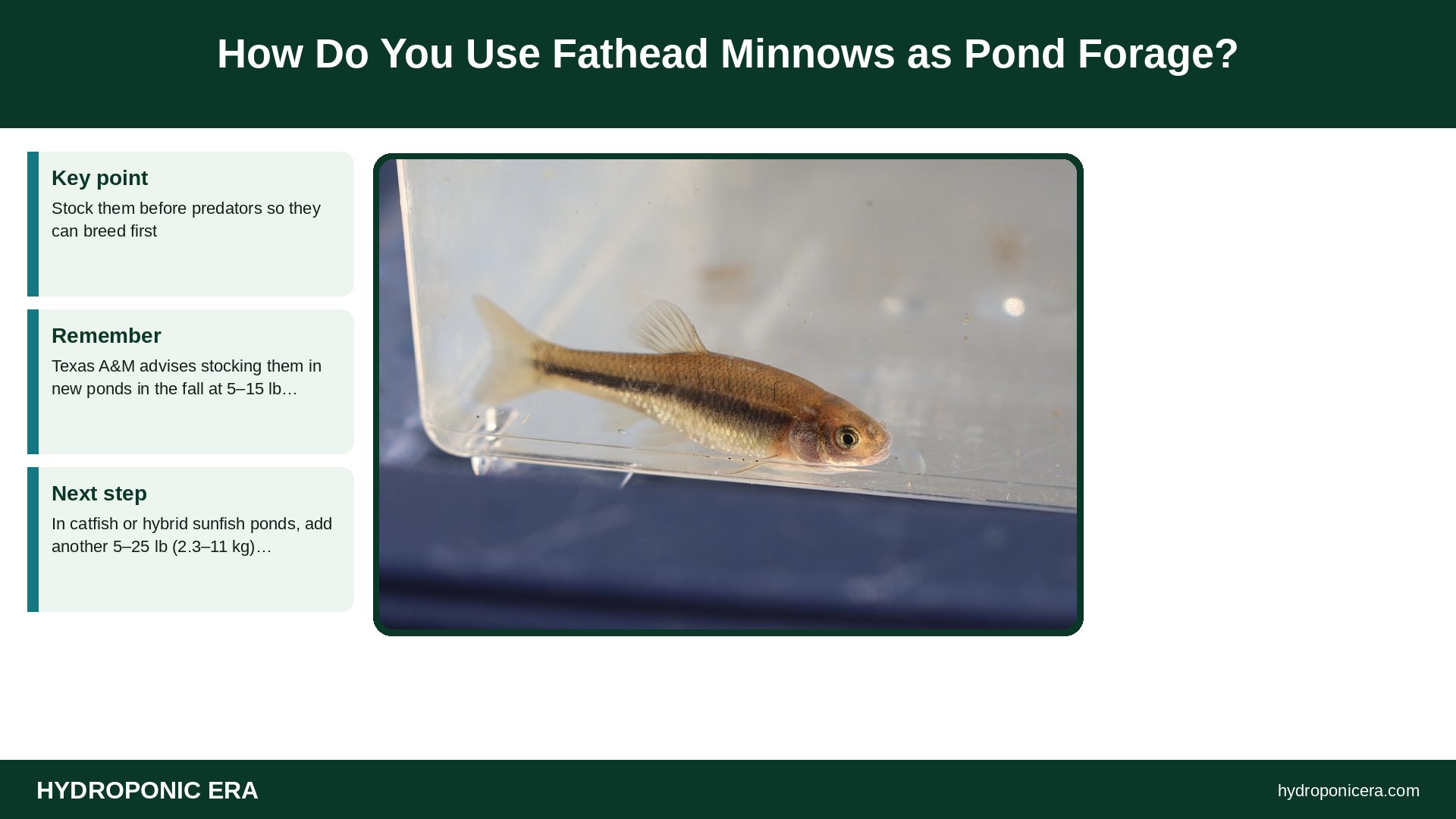
Males claim a nest under a flat object and guard the eggs. SRAC Fact Sheet 1203 says fatheads start spawning at 60–65°F (16–18°C) and stop at about 85°F (29°C). Females lay sticky eggs that must cling to the underside of a surface, and each female may spawn about every 4 days during the long season.
- Spawning surfaces: boards, pallets, plastic tarps or irrigation tubing, per Texas A&M.
- Sex ratio: SRAC notes five females per male is recommended for spawning ponds.
- Hatching: at 68°F (20°C), eggs hatch within 2–4 days, per SRAC.
- Nest depth: nests have been found up to 5 ft (1.5 m) deep.
What Do Fathead Minnows Eat?
In the wild, fathead minnows feed on the bottom, eating small animals and plants mixed with mud, plus zooplankton, according to Texas A&M. SRAC says breeders should be fed daily to satiation with a commercial 28–32% protein catfish feed. Minnows surround and nibble large pellets as they soften, taking at least 30 minutes to reach satiation.
Our aquaponics fish food guide covers feed rates for mixed systems.
Can Fathead Minnows Live in Aquaponics?
Yes, a colony works in a small or backyard system, but it produces little food fish. Their temperature range overlaps many warm- and cool-water crops, they breed readily on simple surfaces, and they can supply live forage for larger fish. Their small size means the fish-to-plant balance depends on stocking many individuals rather than a few big ones.
- Size the tank with our aquaponics fish tank size guide.
- Compare species in best fish for aquaponics.
- Shade spawning tiles if water rises above 85°F (29°C).
How Do You Hatch Minnow Eggs Indoors?
Collect the egg-covered surfaces often and hatch them in clean, aerated water. SRAC says to collect eggs at least every 2 days when water is above 70–75°F (21–24°C), because eggs hatch in 3–5 days and 3 days between collections is too long. Treated eggs have reached 75–80% hatching rates when fungus is controlled.
- Offer spawning tiles or pipe sections under the water surface.
- Lift surfaces every 2 days in warm weather and move them to a hatching tank.
- Screen the tank drain with fine mesh to keep fry in, as SRAC describes.
- Aerate gently and start feeding fine food once fry swim up.
SRAC notes hatchery rearing cuts disease transmission from adults to young and lets you control stocking density. Only about one-third of males spawn at any one time, so a small tank needs only modest surface area.
Are Fathead Minnows Invasive?
Outside their native range they can be. USGS says their popularity as bait and forage fish led to widespread introductions, through angler bait buckets, pond escapes and contaminated fish stocks. Native to much of North America, they have been introduced to waters in California, Arizona, western Colorado and other states. Check state rules before moving or buying live minnows.
How big do fathead minnows get?
About 4 in (10 cm), per USGS; males are usually larger than females.
What temperature do fathead minnows need to spawn?
SRAC says spawning starts at 60–65°F (16–18°C) and stops near 85°F (29°C).
How many fathead minnows per acre?
Texas A&M recommends 5–15 lb (2.3–6.8 kg) per acre in fall for new bass ponds.
Why did my fathead minnows disappear?
Predators such as bass and catfish eat them; Texas A&M says this is expected.
Can I release extra minnows into a creek?
No. USGS links bait-bucket releases to their spread into new waters.
Sources
- U.S. Geological Survey NAS. Pimephales promelas (fathead minnow) fact sheet.
- Southern Regional Aquaculture Center. SRAC 1203: An Indoor Hatching and Intensive Rearing Method for Fathead Minnows.
- Texas A&M AgriLife Extension. Fathead Minnows.
- Photo credits (Wikimedia Commons, edited with titles): Fathead Minnow – Breeding Male by Rankin1958 (CC BY-SA 3.0); Pimephales promelas 365805532 by Cole Wolf (CC BY 4.0); Pond-edge plants at Achamore Garden – geograph.org.uk – 5446824 by M J Richardson (CC BY-SA 2.0); Deep Cut Gardens Koi Pond by FossilDS (CC0)