
How do you grow marsh marigold at a pond edge? Plant marsh marigold (Caltha palustris) in rich, boggy soil at the water’s edge in full sun, per the RHS. It is a native buttercup relative, 8–24 in (20–60 cm) tall, with glossy yellow spring flowers. NC State says it needs constant moisture, and all parts are toxic if eaten raw.
Key takeaway: Marsh marigold is one of the first pond-edge flowers in spring. Give it wet soil and sun in spring, with some afternoon shade in summer, because NC State notes full summer sun can push it into dormancy. Divide clumps in late summer or early spring, wear gloves, and keep pets and livestock from eating it.
| Trait | Detail | Source |
|---|---|---|
| Height | About 8–24 in (20–60 cm) | USDA Forest Service |
| Flowers | Shiny yellow, ½–1½ in (1.3–3.8 cm), mid-April to June | USDA Forest Service |
| Hardiness | USDA zones 3–7; RHS H7 | NC State, RHS |
| Light | Full sun to part shade | NC State |
| Soil | Rich, boggy, poorly drained | RHS |
| Toxin | Protoanemonin | NC State, USDA Forest Service |
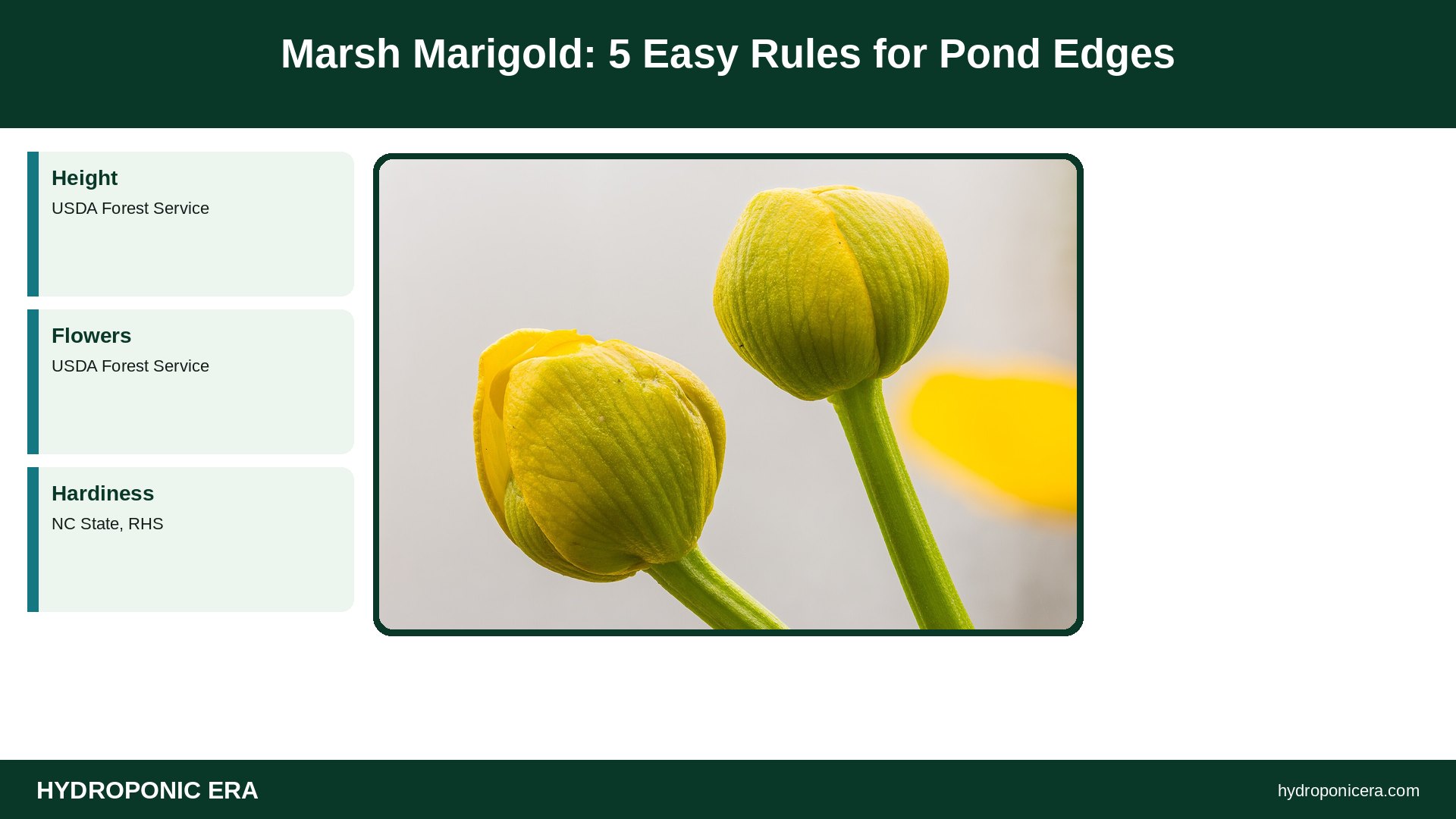
What Is Marsh Marigold?
Marsh marigold is a native wetland perennial in the buttercup family, not a true marigold. NC State says it grows wild from Newfoundland to Alaska and south to Nebraska, Tennessee and North Carolina. The USDA Forest Service lists other names such as cowslip and kingcup, and notes it grows in marshes, fens, ditches, wet woods and swamps.
Leaves are glossy, round to kidney-shaped, and stems are hollow, per the Forest Service.
Where Should You Plant Marsh Marigold?
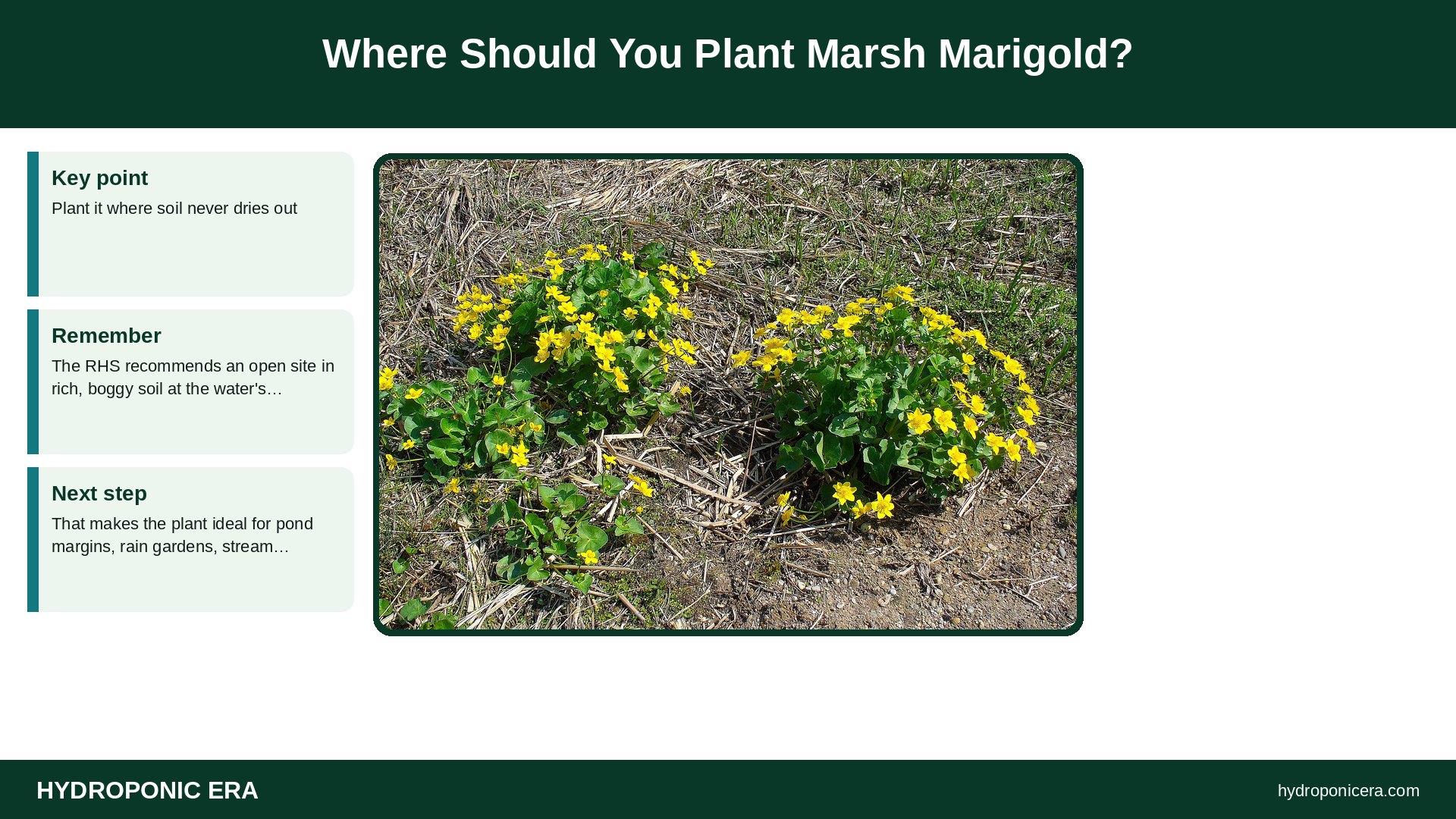
Plant it where soil never dries out. The RHS recommends an open site in rich, boggy soil at the water’s edge in full sun, and NC State lists frequent standing water, moist or occasionally wet soil, and acidic soil below pH 6.0. That makes the plant ideal for pond margins, rain gardens, stream banks and bog gardens.
- Set pots on a shallow marginal shelf with the crown near the surface.
- Or plant it in a wet bed fed by a bog filter.
- Give afternoon shade in hot summers to delay dormancy.
When Does Marsh Marigold Bloom?
It blooms in early spring. The USDA Forest Service says flowers appear from mid-April through June, later in the north, and measure about ½–1½ in (1.3–3.8 cm) across with 5–9 petal-like sepals. Each has 50 to over 100 stamens and offers pollen and nectar to insects, most often hoverflies.
The RHS lists it among its Plants for Pollinators. Bees see an ultraviolet “bee’s purple” pattern on the sepals that people cannot see, per the Forest Service.
Is Marsh Marigold Poisonous?
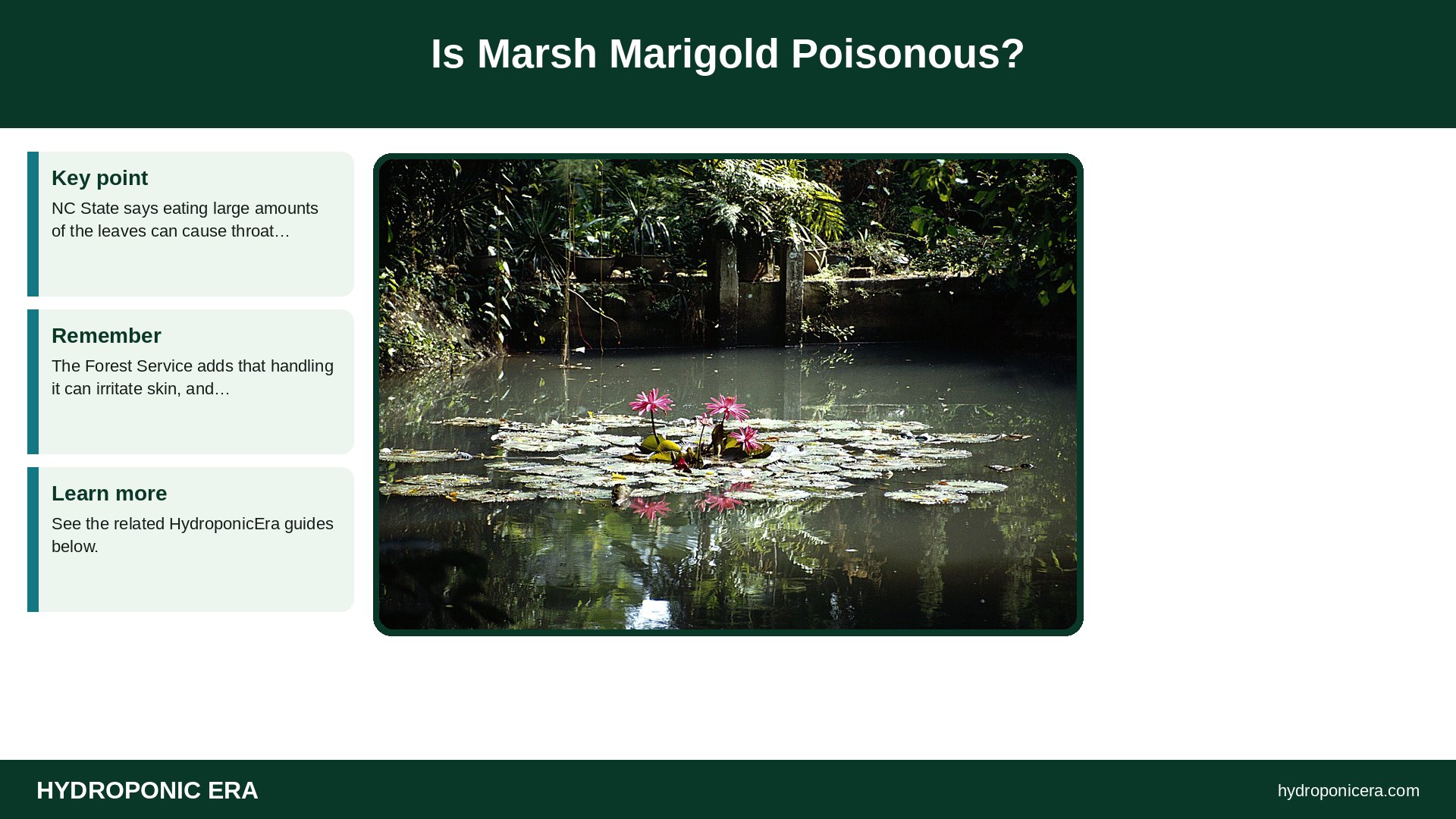
Yes. NC State says eating large amounts of the leaves can cause throat burning, vomiting, bloody diarrhea, dizziness, fainting and convulsions, and no part should ever be eaten raw. The Forest Service adds that handling it can irritate skin, and cattle and horses are poisoned by eating it, though dried plants in hay lose their toxicity.
- Wear gloves when dividing or trimming.
- Keep it away from grazing animals and curious pets.
- The irritant is protoanemonin, a yellow oil.
How Do You Care for Marsh Marigold?
Care is simple once the soil stays wet. NC State calls it low maintenance and deer resistant, but notes it can be greedy and inhibit nearby plants, especially legumes. The RHS advises cutting it back after flowering and says it may suffer from powdery mildew. NC State also lists rust as a possible problem.
- Keep the crown wet from spring through summer.
- Cut back spent stems after flowering.
- Remove yellowed leaves when the plant goes dormant in summer.
- Divide crowded clumps in late summer or early spring.
How Do You Propagate Marsh Marigold?
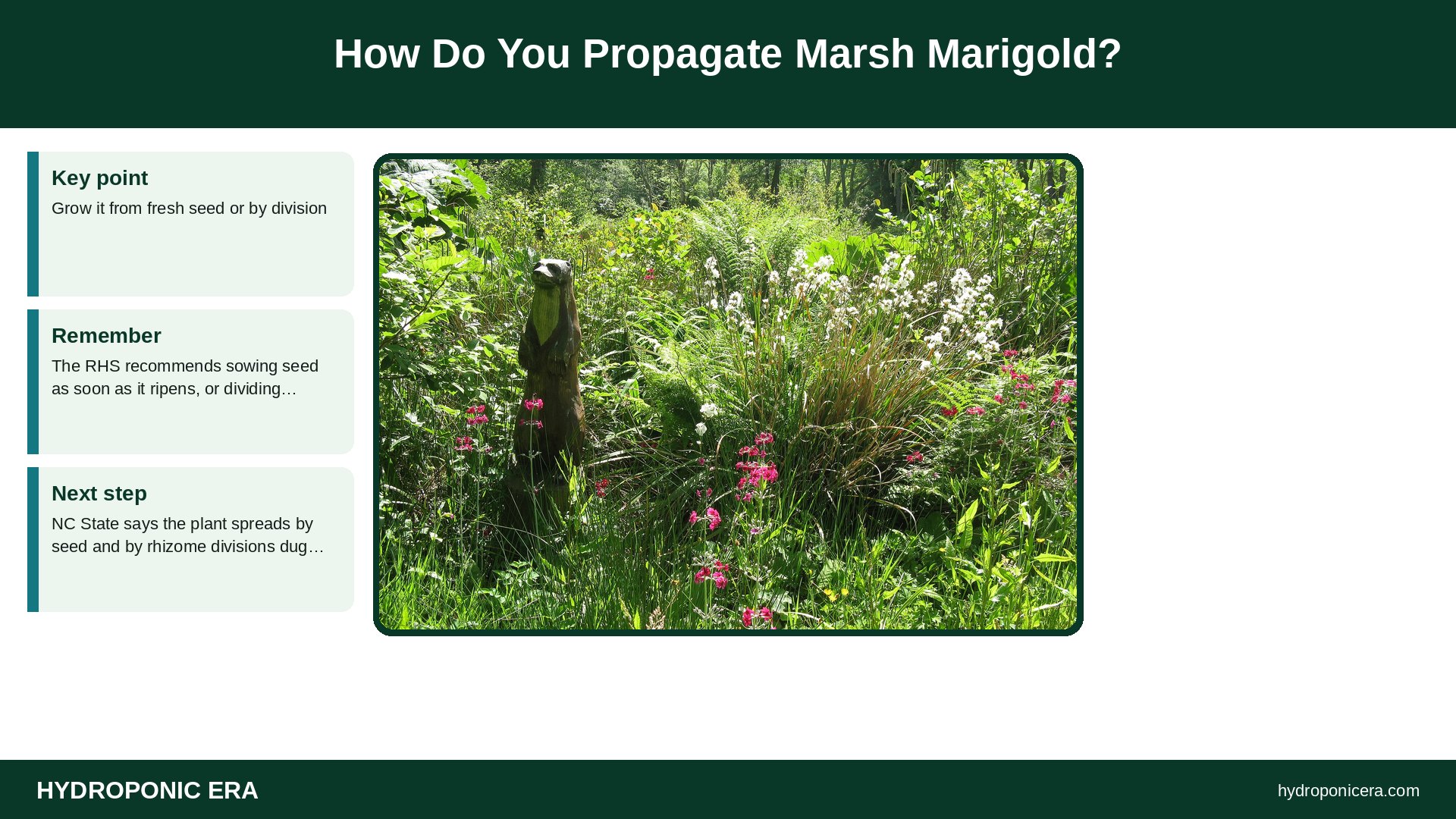
Grow it from fresh seed or by division. The RHS recommends sowing seed as soon as it ripens, or dividing plants in late summer or early spring. NC State says the plant spreads by seed and by rhizome divisions dug in fall and replanted in early spring. Seed pods split open when ripe to release the seed.
Check local rules before collecting wild plants. NC State notes it is on the North Carolina Protected Plant list as endangered, and the Forest Service says it is endangered in Tennessee.
Can Marsh Marigold Handle Changing Water Levels?
Yes, within limits. The RHS lists the species among its Plants for Flood Resilience and its Plants for both Wet and Dry Conditions, meaning it copes with wet winters and drier spells once established. It is rated H7, hardy in the severest European continental climates below -4°F (-20°C).
- Top up the pond in summer so the crown does not dry out completely.
- Expect leaves to die back in autumn; the RHS lists it as deciduous.
- New growth returns from the rhizome each spring.
What Grows Well With Marsh Marigold?
Pair it with later-flowering marginals so the pond edge stays green after this perennial goes dormant. Irises, rushes, sedges and pickerelweed fill in during summer, and floating-leaf plants shade the open water. See our koi pond plants and lotus plant container guides for summer color.
For a fish-and-plant system, our pond aquaponics guide explains how marginal beds use fish waste.
Is marsh marigold native to North America?
Yes. NC State says it ranges from Newfoundland to Alaska, south to Nebraska, Tennessee and North Carolina.
How tall does marsh marigold grow?
About 8–24 in (20–60 cm), per the USDA Forest Service.
Is marsh marigold safe for pets?
No. All parts contain protoanemonin, and NC State says no part should be eaten raw.
Why did my marsh marigold disappear in summer?
It naturally goes dormant, especially in full summer sun, per NC State.
What zones does marsh marigold grow in?
NC State lists USDA zones 3–7.
Sources
- NC State Extension Gardener Plant Toolbox. Caltha palustris.
- USDA Forest Service. Yellow Marsh Marigold, Plant of the Week.
- Royal Horticultural Society. Caltha palustris, marsh marigold.
- Photo credits (Wikimedia Commons, edited with titles): Bloemknoppen van een gewone dotterbloem (Caltha palustris subsp. palustris). 17-03-2024. (d.j.b.) by Dominicus Johannes Bergsma (CC BY-SA 4.0); Caltha palustris 001 by H. Zell (CC BY-SA 3.0); RIBogorSeerose by Ziegler175 (CC BY-SA 4.0); Pond-edge plants at Achamore Garden – geograph.org.uk – 5446824 by M J Richardson (CC BY-SA 2.0)