
Can you raise Arctic char in aquaponics? Yes, but only in a cold-water system. Arctic char aquaponics works when the fish tank stays roughly 41 to 54°F (5 to 12°C), the range a Nordic aquaculture review lists as optimal. That is colder than most aquaponic fish need, so you must pair char with cool-season plants and often a chiller.
Key takeaway: Arctic char is the most cold-adapted salmonid. Research cited in a Nordic review puts its best grow-out temperature at 41 to 54°F (5 to 12°C), with juveniles a little warmer at 46 to 59°F (8 to 15°C). It takes 15 to 30 months to reach market size, so plan Arctic char aquaponics as a slow, cold, long-term project rather than a quick harvest.
| Fact | What sources report | Source |
|---|---|---|
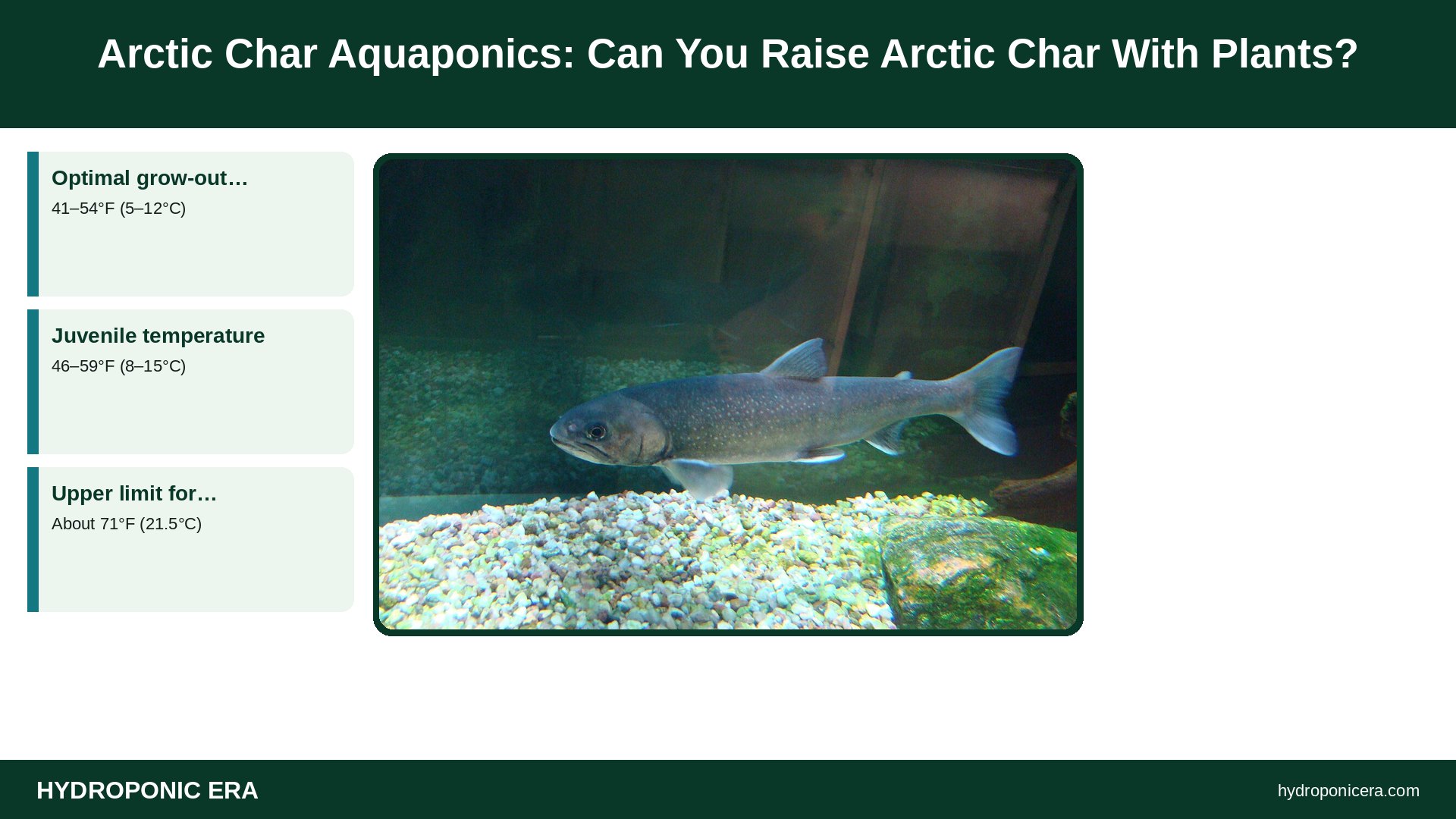
| Optimal grow-out temperature | 41–54°F (5–12°C) | Nordic RAS review (DTU) |
| Juvenile temperature | 46–59°F (8–15°C) | Nordic RAS review (DTU) |
| Upper limit for long-term rearing | About 71°F (21.5°C) | Nord University ArctAqua report |
| Time to market size | 15 to 30 months after hatch | Nordic RAS review (DTU) |
| Feeding | Less aggressive than trout; several meals a day | Nordic RAS review (DTU) |
| Typical aquaponic stocking | Up to 10–20 kg/m³ (about 0.6–1.2 lb per 10 gal) | FAO aquaponics manual |
Is Arctic Char Aquaponics Possible at Home?
Yes, arctic char aquaponics is possible. Arctic char (Salvelinus alpinus) is already farmed in land-based tanks, and a Nordic review notes that some farms in Norway, Sweden and Canada use recirculating aquaculture systems (RAS). An aquaponic unit is a RAS with plants as part of the filter, so the same rules apply: cold, clean, well-oxygenated water and careful feeding.
The catch is temperature. Most aquaponic plants and fish prefer warmer water. The FAO aquaponics manual says even cool crops like lettuce and Swiss chard do best at 64 to 79°F (18 to 26°C), while char thrive well below that. Expect slower plant growth than in a tilapia system.
If you have kept trout in aquaponics, char will feel familiar, but they prefer water a few degrees colder still.
What Water Temperature Does Arctic Char Aquaponics Need?
For arctic char aquaponics, aim for 41 to 54°F (5 to 12°C) during grow-out. The DTU-led review of Nordic recirculating aquaculture says this is the optimal rearing range, with juveniles doing best slightly warmer, at 46 to 59°F (8 to 15°C). The Nord University ArctAqua report adds that char grow well below 50°F (10°C).
The same report gives about 71°F (21.5°C) as the upper limit for young char intended for long-term rearing. Treat that as a danger line, not a target. Warm water holds less oxygen, and stress rises long before that point.
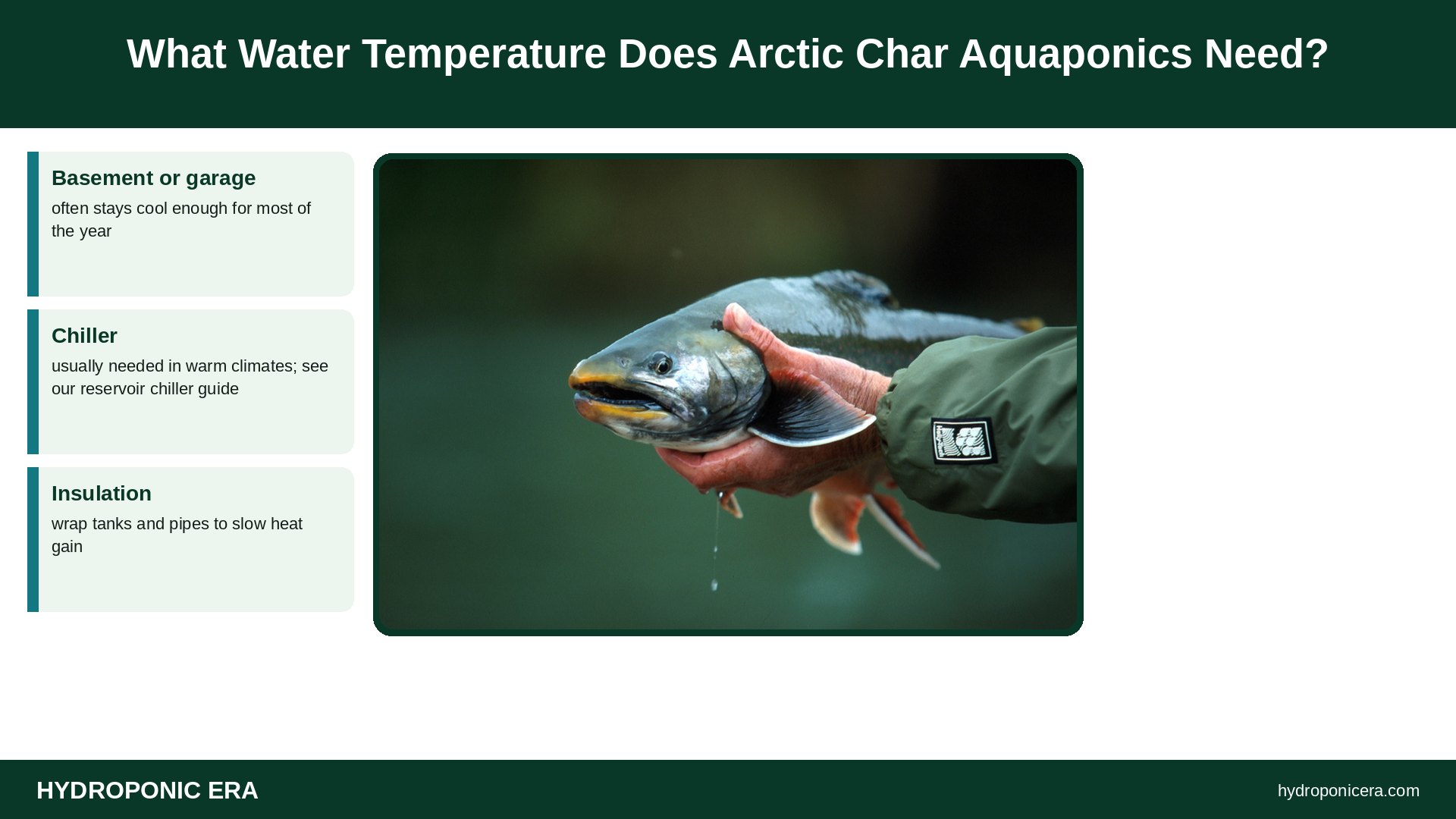
- Basement or garage: often stays cool enough for most of the year.
- Chiller: usually needed in warm climates; see our reservoir chiller guide.
- Insulation: wrap tanks and pipes to slow heat gain.
- Shade: keep grow lights and sun off the fish tank.
What Stocking Density Works for Arctic Char Aquaponics?
Start low, around 10 to 20 kg of fish per cubic meter, the range the FAO small-scale aquaponics manual suggests for its system designs. That is roughly 0.6 to 1.2 pounds (0.27 to 0.54 kg) of fish per 10 gallons (38 L). Char tolerate crowding, but a home system has limited filtration and plants to absorb waste.
Commercial char are kept much denser. The Nord University report describes char as a shoaling fish with low aggression at high densities, and its trial held groups from about 37 kg/m³ up to 83 kg/m³ for 73 days with survival above 99 percent in every group. Those tanks had professional oxygen and water treatment, which a backyard unit usually lacks.
Use our guide to the aquaponics fish to plant ratio to size the grow beds once you know your fish weight.
How Do You Feed Fish in Arctic Char Aquaponics?
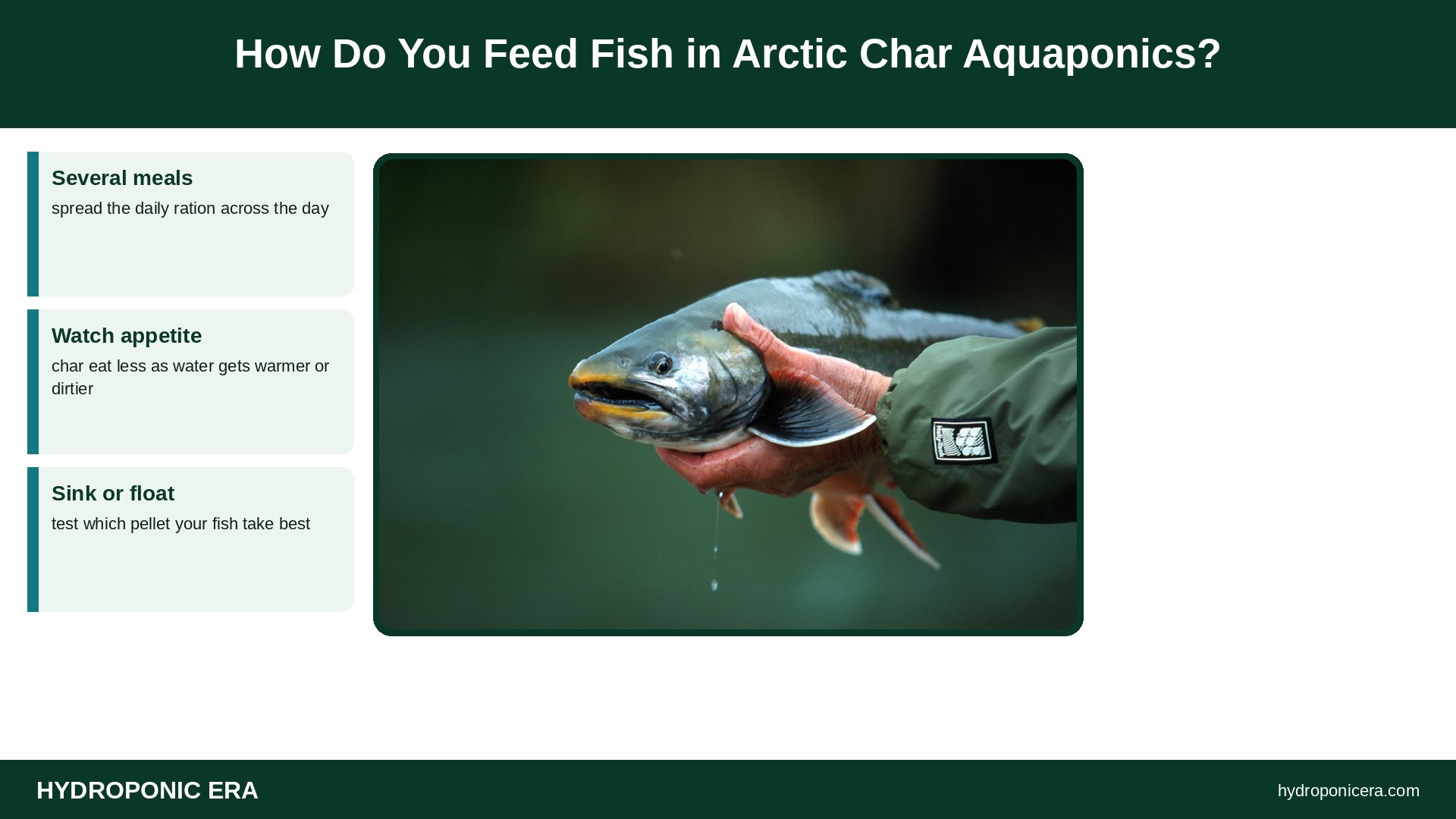
Feed small amounts several times a day. The Nordic review says Arctic char do not feed as aggressively as rainbow trout and need multiple daily feeding events to reach good feed intake. It also notes that several feed companies make diets formulated specifically for char, which is the best choice if you can source it.
For trout, the FAO manual lists a feed protein level of about 42 percent, and char have similar carnivorous needs. The FAO manual suggests letting fish feed for 30 minutes, then removing all uneaten food so it does not rot and spike ammonia. Our aquaponics fish food guide explains how to set a feeding rate.
- Several meals: spread the daily ration across the day.
- Watch appetite: char eat less as water gets warmer or dirtier.
- Sink or float: test which pellet your fish take best.
Which Plants Pair Well With Arctic Char Aquaponics?
Arctic char aquaponics needs cool-season leafy crops. Lettuce, Swiss chard, kale, spinach and herbs such as parsley and mint tolerate cool root zones better than tomatoes, peppers or basil. The FAO manual groups lettuce and Swiss chard among crops that prefer cooler water, so they are the safest starting point, even though they will grow more slowly than in a warm system.
- Lettuce: the most reliable crop; see our romaine lettuce hydroponics guide.
- Swiss chard: handles cool water and repeat cutting.
- Watercress and mint: like cool, moving water.
- Microgreens: short cycles make slow growth less of a problem.
Avoid warm-season fruiting crops unless the plant side has its own heat. A decoupled design, where plants get a separate warmer reservoir, is one way around the temperature gap.
What Water Quality Does Arctic Char Aquaponics Need?
Char need the same clean, oxygen-rich water as other salmonids. For rainbow trout, the FAO manual lists dissolved oxygen above 6 mg/L, ammonia below 0.5 mg/L and nitrite below 0.3 mg/L, and those are sensible targets for char too. Strong aeration and a mature biofilter matter more than any other upgrade.
- Oxygen: run air stones in the fish tank and the sump.
- pH: the FAO manual recommends 6 to 7 as the aquaponics compromise.
- Test weekly: ammonia, nitrite, nitrate and pH.
- Cold biofilters: bacteria work more slowly, so cycle the system before adding fish.
Our aquaponics winter guide covers how cold water affects bacteria and plants.
How Long Does Arctic Char Aquaponics Take to Reach Harvest?
Plan on 15 to 30 months from hatch, depending on temperature, according to the Nordic review. Colder water slows growth, so a tank held near the bottom of the range will take longer. The review also warns that producing fish over about 2.2 pounds (1 kg) can cost growth because of sexual maturation.
For a home system, many growers harvest smaller, pan-size fish to free tank space sooner. See our guide to aquaponics fish harvest for humane handling.
Is Arctic Char Aquaponics Better Than Trout Aquaponics?
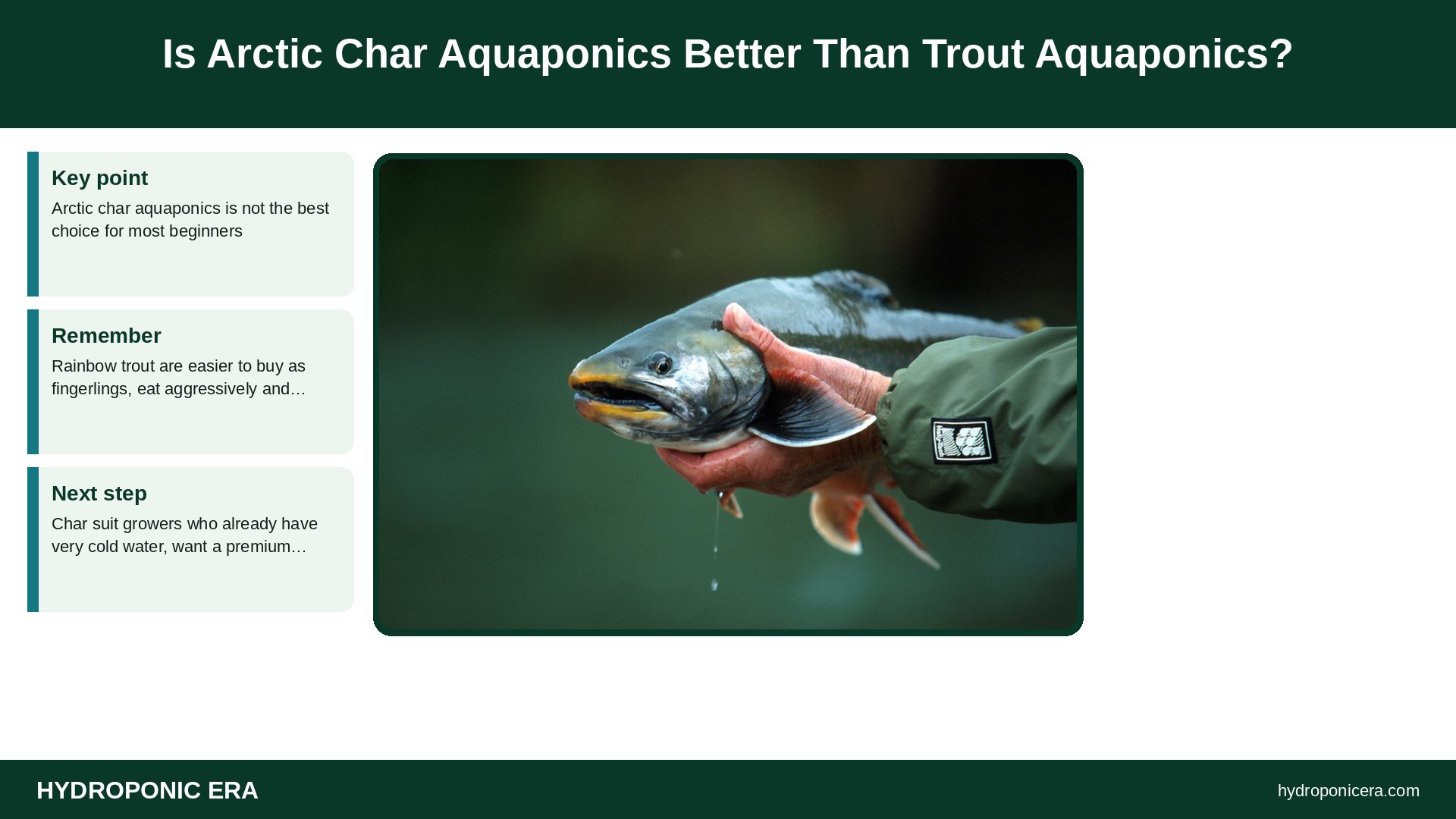
Arctic char aquaponics is not the best choice for most beginners. Rainbow trout are easier to buy as fingerlings, eat aggressively and grow at a slightly warmer 57 to 61°F (14 to 16°C), the optimum the FAO manual lists. Char suit growers who already have very cold water, want a premium fish, and can buy legal, disease-free fingerlings.
Check your state’s fish and wildlife or aquaculture rules before buying char. Many states require permits or approved suppliers for live salmonids.
FAQ About Arctic Char Aquaponics
What is the best temperature for Arctic char?
About 41 to 54°F (5 to 12°C) for grow-out.
Can Arctic char live in warm water?
No; about 71°F (21.5°C) is an upper limit for long-term rearing.
How fast do Arctic char grow?
They reach market size in about 15 to 30 months.
Do Arctic char need a chiller?
In most warm climates, yes, to stay below about 54°F (12°C).
What plants grow with Arctic char?
Lettuce, chard, kale, watercress and cool-season herbs.
Are Arctic char aggressive feeders?
No; they feed less aggressively than trout and need several meals.
Sources
- Dalsgaard et al., Aquacultural Engineering (2013), DTU — Farming different species in RAS in Nordic countries: Current status and future perspectives
- Nord University ArctAqua — Final report on Arctic charr rearing density
- Food and Agriculture Organization of the United Nations — Small-scale aquaponic food production (Fisheries Technical Paper 589)
- Photo credits (Wikimedia Commons, edited with titles): Salvelinus alpinus alpinus by Zouavman Le Zouave (CC BY-SA 3.0); Man holding arctic char by Klaus Jost (CC BY-SA 3.0)