
Can you grow ashwagandha hydroponically? Yes. Ashwagandha hydroponics has been done in research: a 2016 PLOS One study grew Withania somnifera seedlings in rockwool, moved them to a hydroponic system at 4 weeks, and grew them 6 more weeks under 16-hour days at 81/72°F (27/22°C). A 2023 study also grew it in aquaponics. It needs warmth, bright light and a well-drained root zone.
Key takeaway: Ashwagandha (Withania somnifera) is a warm-climate nightshade-family shrub. Germinate seed near 77°F (25°C) in light, grow it at about 68 to 90°F (20 to 32°C), and avoid soggy roots, since NC State warns it does not like wet feet and can get stem and root rot. Leaves can be harvested in about 10 weeks from seed, while roots are usually grown for about six months.
| Fact | What sources report | Source |
|---|---|---|
| Plant family | Nightshade family (Solanaceae) | PLOS One 2016 |
| Growing temperature | 68–90°F (20–32°C) | PLOS One 2016 |
| Germination | Best at 77°F (25°C) with continuous light | Germination study (PubMed Central) |
| Hydroponic schedule | Rockwool start, transplant at 4 weeks, 6 weeks in system | PLOS One 2016 |
| Light period used | 16 hours per day | PLOS One 2016 |
| Root sampling in aquaponics | 1 and 6 months; root withanolide A highest at 6 months | Frontiers in Plant Science 2023 |
| Safety | Toxic if eaten raw; medium-severity poison rating | NC State Extension |
Does Ashwagandha Hydroponics Really Work?
Yes, ashwagandha hydroponics works. A research team writing in PLOS One described how they established hydroponic cultivation of ashwagandha in a plant factory. Seeds were sown in rockwool granules, moved into a recirculating system four weeks after seeding, and grown for six weeks with nutrient EC and pH controlled automatically. A 2023 Indian study grew two varieties in aquaponics.
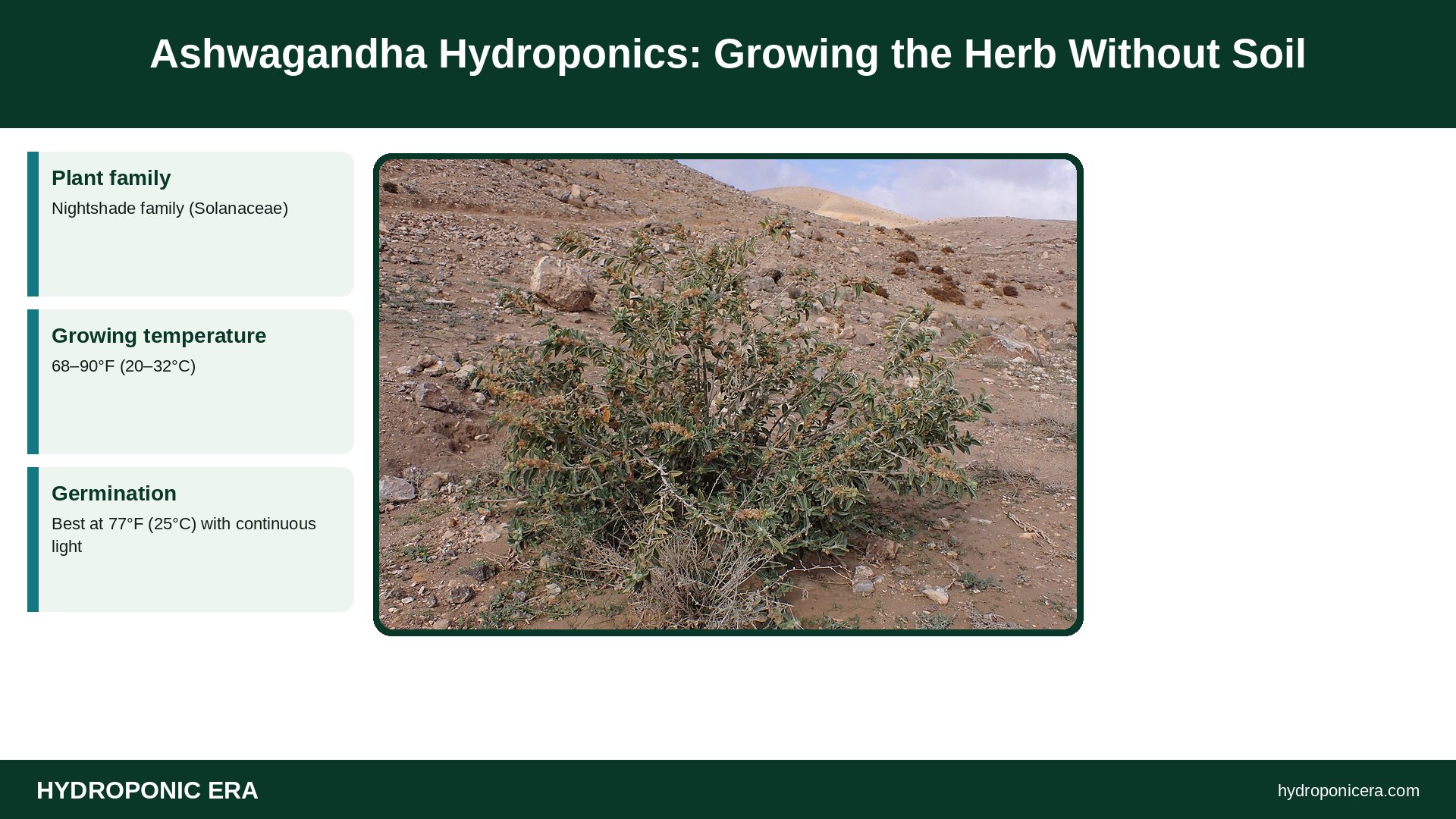
Ashwagandha is a small shrub that PLOS One says grows to about 3 feet (1 m) tall in its native range. NC State notes it does well in pots and is grown as an annual in zones colder than 8, so a container hydroponic system indoors is a natural fit.
It is related to tomatoes and peppers, so if you have grown tomatillos hydroponically, the setup will feel familiar.
How Do You Germinate Seeds for Ashwagandha Hydroponics?
Ashwagandha hydroponics starts with warm seeds kept in the light. A germination study published through PubMed Central found 77°F (25°C) was the optimal temperature for ashwagandha seed and that continuous light favored germination, while 68°F (20°C) was less effective. NC State suggests sowing about 3/4 inch (2 cm) deep in soil once air is above 70°F (21°C).
- Use fresh, fully dried seed; the study notes seed must dry before it germinates well.
- Sow shallowly in rockwool or a seed plug.
- Keep the tray at about 77°F (25°C) under a light.
- Keep plugs moist but not soggy.
The same study found gibberellic acid at 150 µg/mL improved germination, but most home growers do not need it. Our rockwool for hydroponics guide explains how to condition cubes before sowing.
What pH, EC and Temperature Does Ashwagandha Hydroponics Need?
Keep pH at about 5.5 to 6.5, the hydroponic range the 2023 Frontiers aquaponics paper cites, and air at 68 to 90°F (20 to 32°C), the optimal range in PLOS One. The PLOS study grew plants at 81°F (27°C) by day and 72°F (22°C) by night. Neither paper publishes a simple EC target for home growers.
Because no EC is published, start with a moderate general-purpose recipe like you would use for peppers or tomatillos, and raise it only if lower leaves pale. Our hydroponic PPM chart converts between EC and ppm, and our guide to pH rising vs falling helps you read daily swings.
- pH: 5.5–6.5.
- Day temperature: about 81°F (27°C) in the PLOS trial.
- Night temperature: about 72°F (22°C).
- Below 68°F (20°C): growth and germination slow.
Which System Is Best for Ashwagandha Hydroponics?
Ashwagandha hydroponics needs a system with good drainage around the crown, such as a Dutch bucket, drip-fed rockwool or an ebb-and-flow tray. The PLOS study grew plants in pots of rockwool granules fed by a timer-controlled pump, not in standing water. NC State notes ashwagandha does not like wet feet and can suffer stem and root rot.
- Dutch bucket or drip: closest to the research setup.
- Ebb and flow: good for many small plants.
- Deep water culture: possible, but keep strong aeration and cool, clean water.
- Media: rockwool, coco coir or a perlite blend.
For a simple start, a single drip-fed bucket per plant is easy to manage. Our guide to growing media for hydroponics compares options.
How Much Light Does Ashwagandha Hydroponics Need?
Give it full sun outdoors or a strong grow light indoors for about 16 hours a day, the photoperiod used in the PLOS One trial. NC State recommends full sun for garden plants. The PLOS team also found that changing the light conditions altered the levels of active withanolides in the leaves.
Do not experiment with UV lamps at home. Changes in light quality are a research tool, and too much stress can damage plants. A full-spectrum LED at a comfortable distance is all a home grower needs.
How Long Does Ashwagandha Hydroponics Take to Harvest?
Leaves can be harvested after about 10 weeks from seed, matching the PLOS schedule of 4 weeks in rockwool plus 6 weeks in hydroponics. Roots take longer. In the 2023 aquaponics study, root withanolide A was highest in six-month-old plants. NC State says seed-grown plants flower and fruit in their first year.
- Leaves: about 10 weeks from seed.
- Roots: about 6 months for mature roots.
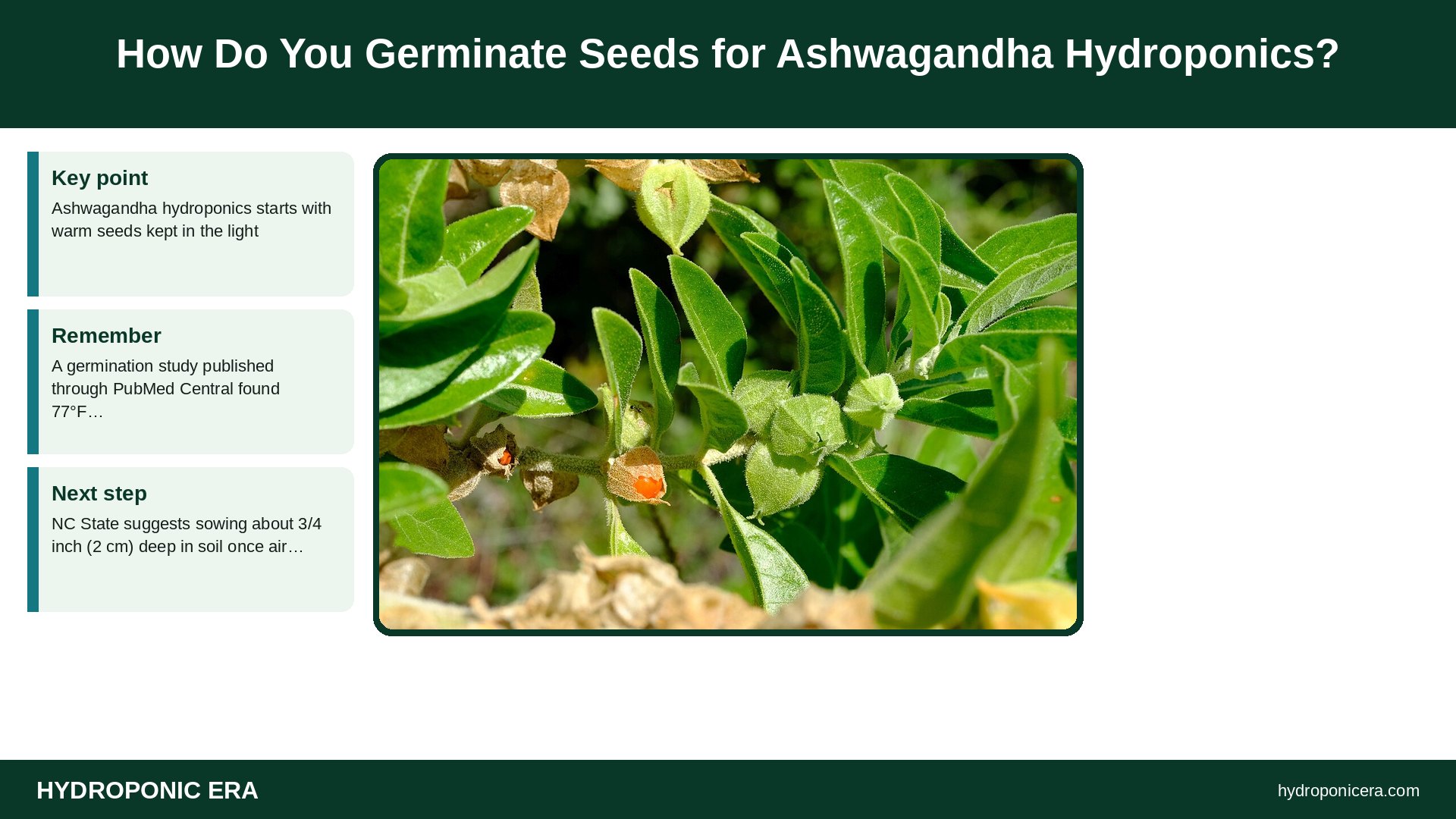
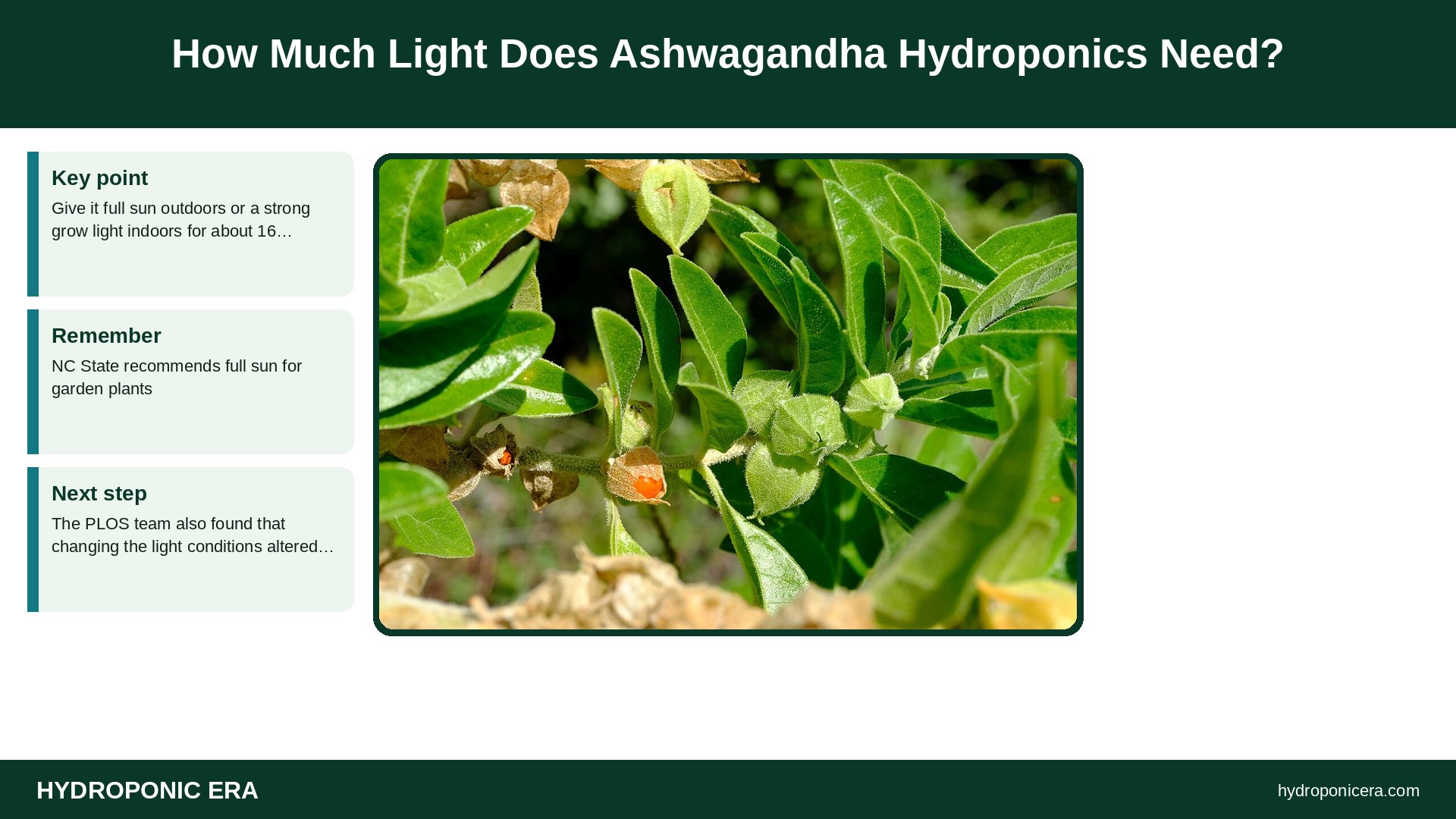
- Berries: orange-red berries inside a papery husk after flowering.
The PLOS paper also reports that leaves held a higher proportion of active withanolides than roots in field-raised plants, which is why researchers focused on leaves in hydroponics.
Is Ashwagandha Hydroponics Safe for Home Use?
Treat ashwagandha hydroponics as plant growing, not do-it-yourself medicine. NC State gives ashwagandha a medium-severity poison rating, says the plant is toxic if eaten, and warns that it can decrease the effectiveness of immunosuppressant drugs. Talk to a doctor or pharmacist before using any home-grown herb as a supplement.
Keep plants away from children and pets, wash hands after handling berries, and label the plant clearly in mixed herb gardens.
What Problems Affect Ashwagandha Hydroponics?
The main problems in ashwagandha hydroponics are root rot from wet media, slow growth in cool rooms, and the usual sap-sucking pests of nightshade crops. NC State lists stem and root rot as problems. Keep media free-draining, the room warm, and check leaf undersides weekly for aphids, whiteflies and spider mites.
- Yellow, wilting plant: check roots for brown, soft tissue.
- Leggy seedlings: move the light closer.
- Slow growth: raise air temperature toward 77°F (25°C).
- Sticky leaves: look for aphids or whiteflies.
FAQ About Ashwagandha Hydroponics
Can ashwagandha grow indoors?
Yes, in pots or hydroponics with warm air and strong light.
What temperature does ashwagandha need?
About 68 to 90°F (20 to 32°C).
How long do ashwagandha seeds take to germinate?
Untreated seed began germinating in about 8 days at 77°F (25°C).
Is ashwagandha a perennial?
Yes in its native range; NC State says grow it as an annual below zone 8.
Can you grow ashwagandha in aquaponics?
Yes; a 2023 Frontiers study grew it in aquaponics.
Is the ashwagandha plant poisonous?
NC State says it is toxic if eaten.
Sources
- PLOS One (2016) — Novel Methods to Generate Active Ingredients-Enriched Ashwagandha Leaves and Extracts
- Frontiers in Plant Science (2023) — Estimating the production of withaferin A and withanolide A in Withania somnifera using aquaponics
- PubMed Central — Germination behaviour of seeds of Withania somnifera (L.) Dunal: a high value medicinal plant
- North Carolina Extension Gardener Plant Toolbox — Withania somnifera (Ashwagandha)
- Photo credits (Wikimedia Commons, edited with titles): Withania somnifera kz05 by Krzysztof Ziarnek, Kenraiz (CC BY-SA 4.0); Withania somnifera SA fruit by botaneek (CC BY-SA 4.0)