
Does perpetual spinach hydroponics work? Yes. Perpetual spinach is a leaf beet, a type of chard, and chard grows well in hydroponics. A South African study grew Swiss chard at pH 5.8 to 6.1 and EC 2.0 to 2.4 mS/cm, with the first harvest 30 days after transplant and the best yield from picking every 14 days.
Key takeaway: Perpetual spinach hydroponics is easy because the plant is Beta vulgaris subsp. cicla, the same leaf beet as Swiss chard, not true spinach. RHS calls it a cut-and-come-again crop with young leaves in about 8 weeks. A 2013 hydroponic chard study used pH 5.8–6.1 and EC 2.0–2.4 mS/cm and got the top yield at 40 plants per m² harvested every 14 days.
| Fact | What sources report | Source |
|---|---|---|
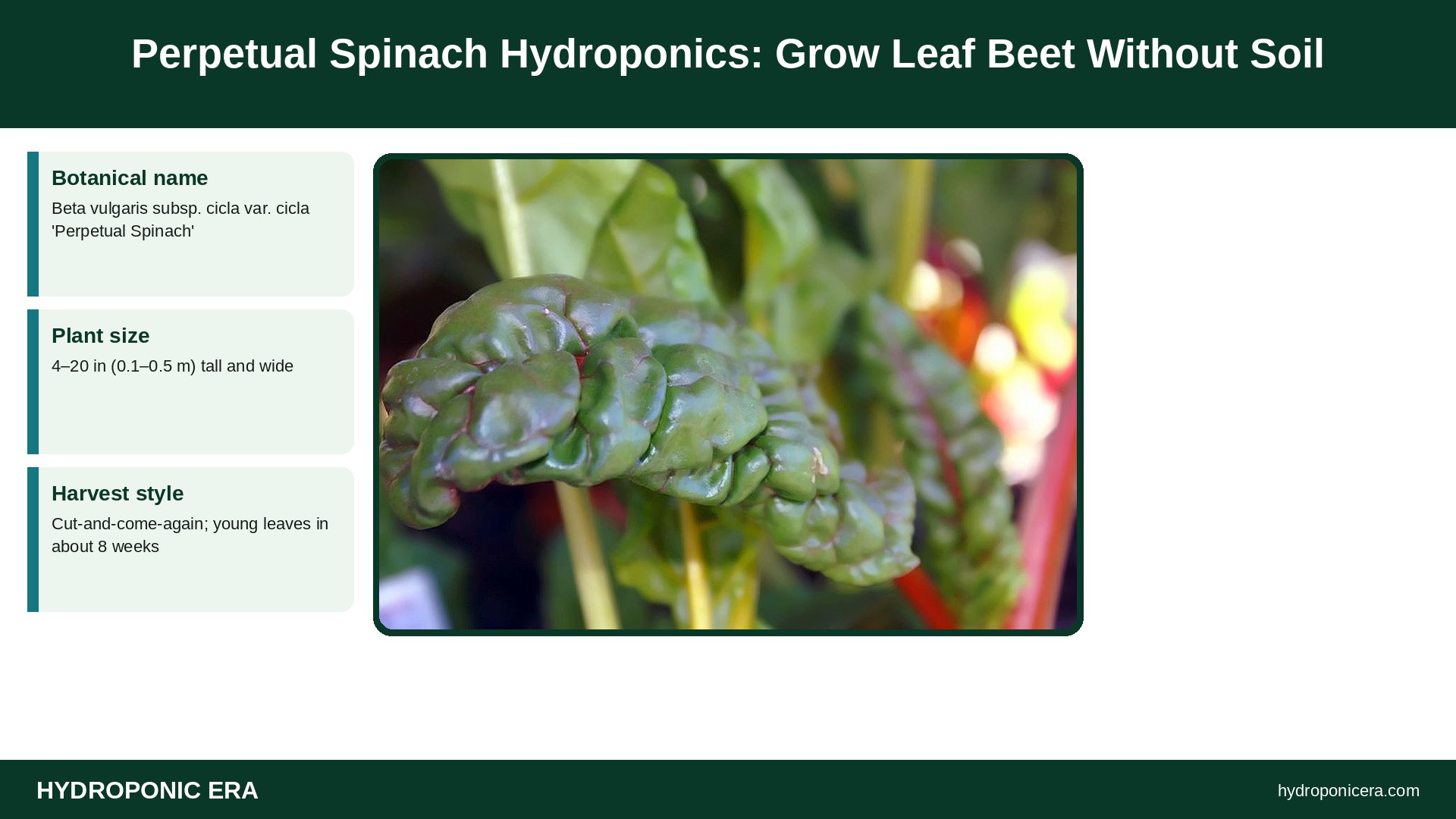
| Botanical name | Beta vulgaris subsp. cicla var. cicla ‘Perpetual Spinach’ | RHS |
| Plant size | 4–20 in (0.1–0.5 m) tall and wide | RHS |
| Harvest style | Cut-and-come-again; young leaves in about 8 weeks | RHS |
| Solution pH | 5.8–6.1 | Maboko and Du Plooy (2013) |
| Solution EC | 2.0–2.4 mS/cm | Maboko and Du Plooy (2013) |
| First harvest | 30 days after transplanting 28-day plantlets | Maboko and Du Plooy (2013) |
| Best density | 40 plants per m² (about 3.7 per sq ft), cut every 14 days | Maboko and Du Plooy (2013) |
What Is Perpetual Spinach?
Perpetual spinach is not spinach. The RHS lists it as Beta vulgaris subsp. cicla var. cicla ‘Perpetual Spinach’, or spinach beet. Its chard guide notes that chard is also known as Swiss chard, perpetual spinach or leaf beet, and is closely related to beetroot. It has smaller, smoother leaves and thinner green stems than most Swiss chard.
The name comes from its long harvest. Unlike true spinach, which bolts quickly in long days (see spinach bolting in hydroponics), beet-family leaf crops are biennials that normally flower in their second year. That makes it a steady source of spinach-like greens.
- Taste: mild, like spinach; cook larger leaves.
- Size: RHS lists 4–20 in (0.1–0.5 m) tall.
- Close relative: hydroponic Swiss chard.
Can You Grow Perpetual Spinach Hydroponically?
Yes, perpetual spinach hydroponics works well. Leaf beet adapts well to NFT, DWC and Kratky. In a 2013 study in the African Journal of Agricultural Research, Maboko and Du Plooy grew Swiss chard in a closed gravel-film hydroponic system. Plants were transplanted 28 days after seeding, and the first harvest came 30 days later. The same approach suits perpetual spinach hydroponics.
- Best for home: Kratky or DWC in a 3–5 gallon (11–19 L) bin.
- Best for volume: NFT channels.
- Spacing: the study’s best density was 40 plants per m² (about 3.7 per sq ft).
How Do You Start Perpetual Spinach Hydroponics From Seed?
Sow seed in rockwool or plugs. Each beet “seed” is a cluster that can give 2 or more seedlings, so thin to the strongest one. Move plugs into net pots once roots show through, about 3 to 4 weeks after sowing; the study transplanted at 28 days. Keep the seedlings under moderate light until they are established.
- Soak rockwool cubes in pH-adjusted water.
- Sow 1 seed cluster per cube, 1/4–1/2 inch (6–13 mm) deep.
- Keep at room temperature and moist until sprouts appear.
- Thin to 1 seedling per cube.
- Transplant at about 3 to 4 weeks.
What pH, EC and Temperature Does Perpetual Spinach Need?
For perpetual spinach hydroponics, follow the chard study: pH 5.8 to 6.1 and EC 2.0 to 2.4 mS/cm, with the nutrient solution renewed weekly. Start seedlings lower, around 1.2 to 1.5 mS/cm, and raise it as plants grow. Leaf beet is a cool-season crop, so moderate room and water temperatures help; very warm water raises the risk of root rot.
- pH: 5.8–6.1.
- EC: 2.0–2.4 mS/cm for mature plants.
- Solution: refresh weekly, as in the study.
- Light: RHS lists full sun to partial shade outdoors.
Use a meter to check both daily; see hydroponic pH and EC meters.
How Long Does Perpetual Spinach Hydroponics Take to Harvest?
Perpetual spinach hydroponics is quick to pay off. RHS says young leaves are ready for salads in about 8 weeks from sowing. In the hydroponic chard study, the first harvest came 30 days after transplanting 28-day-old plants, roughly the same 8 weeks. After that, cut outer leaves regularly; the best yield for ‘Fordhook Giant’ came from harvesting every 14 days.
- Harvest the outer, larger leaves at the base.
- Leave the central growing point and 4 to 5 inner leaves.
- Repeat about every 1 to 2 weeks.
- Replace plants once they slow down or start to flower.
What Problems Affect Perpetual Spinach Hydroponics?
Most problems in perpetual spinach hydroponics come from crowding, warm water or harvest timing. Plants too close together shade each other and lose lower leaves. Warm, still reservoirs invite root rot. Waiting too long between cuts gives tough leaves. Tip burn can appear on fast-growing leaves, as with other leafy crops.
- Tip burn: see tip burn in hydroponics.
- Brown roots: add aeration and cool the reservoir.
- Tough leaves: harvest more often.
- Flower stalk: remove the plant and start a new one.
FAQ About Perpetual Spinach Hydroponics
Is perpetual spinach the same as chard?
Yes; RHS lists it as a leaf beet, Beta vulgaris subsp. cicla.
What EC does perpetual spinach need?
About 2.0–2.4 mS/cm, based on a hydroponic chard study.
What pH should I use?
5.8–6.1.
How long until the first harvest?
About 8 weeks from sowing.
How often can you harvest?
Every 1–2 weeks; every 14 days gave the best yield in one study.
Does perpetual spinach bolt?
It is a biennial, so it usually flowers in its second year, not the first.
Sources
- Royal Horticultural Society — Beta vulgaris subsp. cicla var. cicla ‘Perpetual Spinach’
- Royal Horticultural Society — How to grow chard
- Maboko and Du Plooy, African Journal of Agricultural Research (2013) — Effect of plant spacing and harvesting frequency on the yield of Swiss chard in a closed hydroponic system
- Photo credits (Wikimedia Commons, edited with titles): Beta vulgaris cicla 0zz by Photo by David J. Stang (CC BY-SA 4.0); Starr-090801-3525-Beta vulgaris subsp cicla-leaf-Olinda-Maui (24852849582) by Forest and Kim Starr (CC BY 3.0 us)