
Quick Answer
Grow Swiss chard hydroponically when you want a colorful leafy crop that often handles mild warmth better than spinach. Use a complete mild nutrient solution, pH near 5.5–6.5, steady leafy light, and outer-leaf harvests. University of Minnesota Extension notes spinach is day-length sensitive while chard is not—and both can regrow after baby-leaf harvests. Wisconsin Horticulture’s Swiss chard guidance supports treating chard as a productive leafy vegetable for repeated picking.
If spinach keeps bolting in your room, chard is often the more forgiving leafy swap. Still pair with pH, nutrients, and spinach hydroponics for comparison.
Key Takeaways
- UMN Extension: spinach is day-length sensitive; Swiss chard is not—useful when planning indoor cycles.
- Chard and spinach can both support multiple harvests if you take baby or outer leaves.
- Wisconsin Horticulture provides practical home-garden framing for Swiss chard culture and harvest.
- UF HS1279 remains a strong leafy hydroponics/protected-culture reference.
- Colored petioles (rainbow mixes) are edible cosmetics—manage like any leafy crop for EC and tip burn.
- Outer-leaf harvest beats waiting for oversized, tough leaves.
- Keep roots oxygenated; warm stagnant DWC still causes trouble (DO, brown roots).
Related HydroponicEra guides
- Grow spinach hydroponically
- Grow lettuce hydroponically
- Best plants for hydroponics
- DWC beginners
- NFT beginners
- Calcium/magnesium deficiency
- PPFD and DLI
Why Swiss Chard Often Beats Spinach Indoors
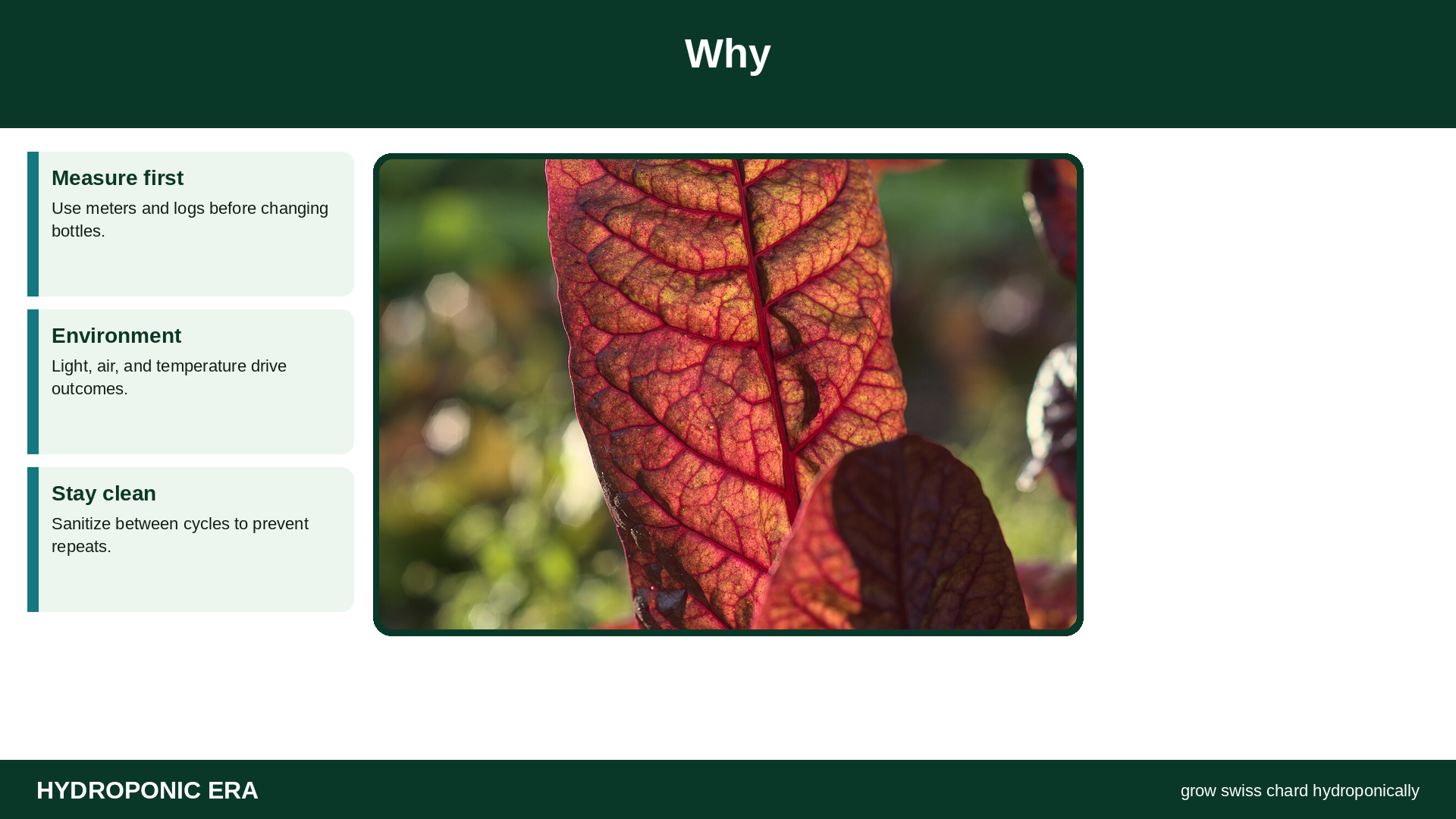
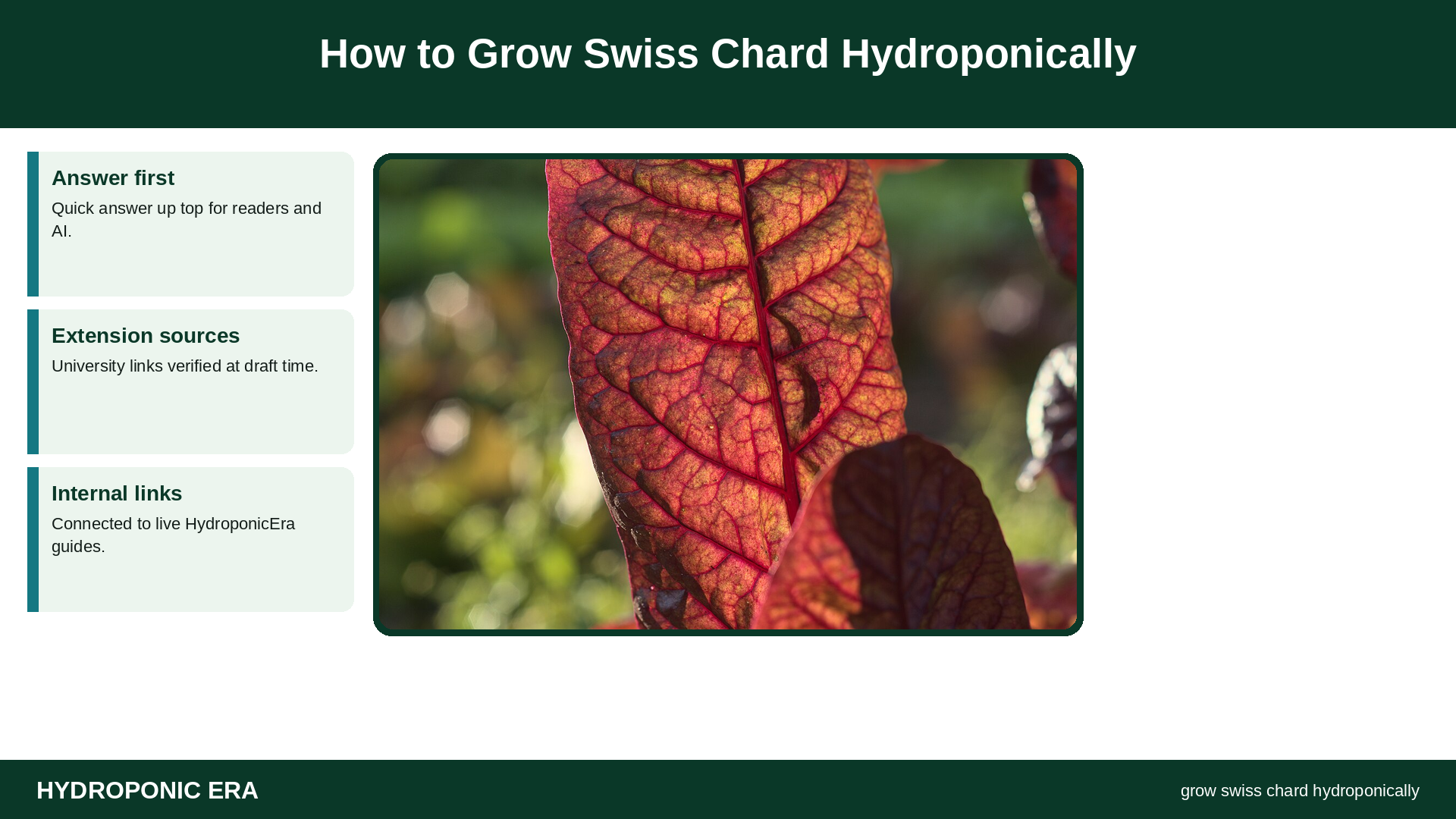
Swiss chard (Beta vulgaris) is the leafy relative of beets. UMN Extension contrasts it with spinach: spinach responds strongly to day length and heat toward bolting, while chard continues leaf production more steadily. That does not make chard heat-proof—it makes it a smarter leafy candidate for imperfect indoor rooms.
Wisconsin Horticulture treats Swiss chard as a garden leafy staple with colorful stems and repeated harvest potential. Hydroponic growers should still use mild leafy nutrition and watch tip burn on fast new leaves under strong LEDs.
UF leafy hydroponic publications (HS1279, HS1422) reinforce that environment and system choice drive leafy success more than brand loyalty to a nutrient bottle.
Choose a System
| System | Beginner fit | Watch-outs |
|---|---|---|
| NFT | Good for baby/mid leaves | Large plants may outgrow narrow channels |
| DWC / raft | Good with aeration | Support heavy petioles; keep cool-moderate |
| Media / drip | Excellent for big chard | Avoid anaerobic media |
| Kratky | Small trials | Limited oxygen as plants enlarge |
| Dutch bucket | Possible long-term | Often more than needed |
Compare in DWC vs NFT vs Dutch bucket.
Step-by-Step
- Pick green or colorful cultivars for your kitchen and photos.
- Start seeds in clean plugs; chard germinates readily in moderate conditions.
- Transplant when roots hold the plug (transplant guide).
- Use mild leafy nutrients; avoid tomato-strength EC on young plants.
- Set pH ~5.5–6.5 after mixing.
- Provide steady leafy light (lights, DLI).
- Aerated roots always (air pumps).
- Harvest outer leaves at usable size; leave the center growing point.
- Watch tip burn when pushing light and EC together.
- Clean between long runs (cleaning guide).
Important Variables
| Variable | Guidance | Notes |
|---|---|---|
| Day length sensitivity | Lower than spinach | UMN contrast with spinach |
| Temperature | Moderate; cooler improves tenderness | Not a tropical herb |
| pH | ~5.5–6.5 | Meter weekly |
| EC | Mild leafy | Tip burn risk if high |
| Light | Steady leafy DLI | Measure, do not guess forever |
| Harvest | Outer leaves | Multiple harvests possible |
Common Mistakes
- Treating chard exactly like spinach bolting panic—or ignoring heat entirely
- Fruiting-crop feed on baby leaves
- Never harvesting, then blaming toughness on hydroponics
- Ignoring tip burn while raising PPFD and EC
- Letting heavy leaves shade the crown until new growth fails
- Skipping pH checks on yellow new leaves
Troubleshooting
| Symptom | Likely causes | What to do |
|---|---|---|
| Tip burn | High EC / low airflow / Ca uptake | Moderate environment; Ca/Mg, burn |
| Yellow older leaves | Mobile nutrient issues / aging | Check EC/pH; refresh solution |
| Yellow new leaves | Lockout / micronutrients | Lockout |
| Wilting wet | Low DO / root disease | Brown roots |
| Tough leaves | Late harvest / heat | Harvest younger; cool room |
| Pests on soft growth | Aphids/mites | Pest IPM |
What to Check
- Whether you are harvesting outer leaves on schedule
- Afternoon temperatures
- EC drift and tip burn on newest leaves
- Root color and smell
- Canopy crowding
- pH stability after top-offs
Suggested Schedule
| Stage | Focus | Actions |
|---|---|---|
| Germination | Even sprouts | Moist plugs |
| Seedling | Compact growth | Mild feed; light |
| Production | Leaf quality | Hold pH/EC/oxygen |
| Harvest | Outer leaves | Repeat for weeks |
| Reset | Hygiene | Clean system |
Chard vs Spinach Decision
Choose spinach when you can keep conditions distinctly cool and want classic spinach flavor. Choose chard when your room runs warmer, you want colorful stems, or you need a longer cut-and-come-again leafy plant. Many home growers run both in succession rather than forcing one crop in the wrong climate.
Track EC with EC/TDS. Keep reservoirs sane with water changes and temperature control.
Final Checklist
- Mild leafy nutrition and stable pH
- Steady light without heat extremes
- Oxygenated roots
- Outer-leaf harvest rhythm
- Tip-burn awareness under strong LEDs
- Clean resets after long runs
Color Cultivars and Market/Kitchen Notes
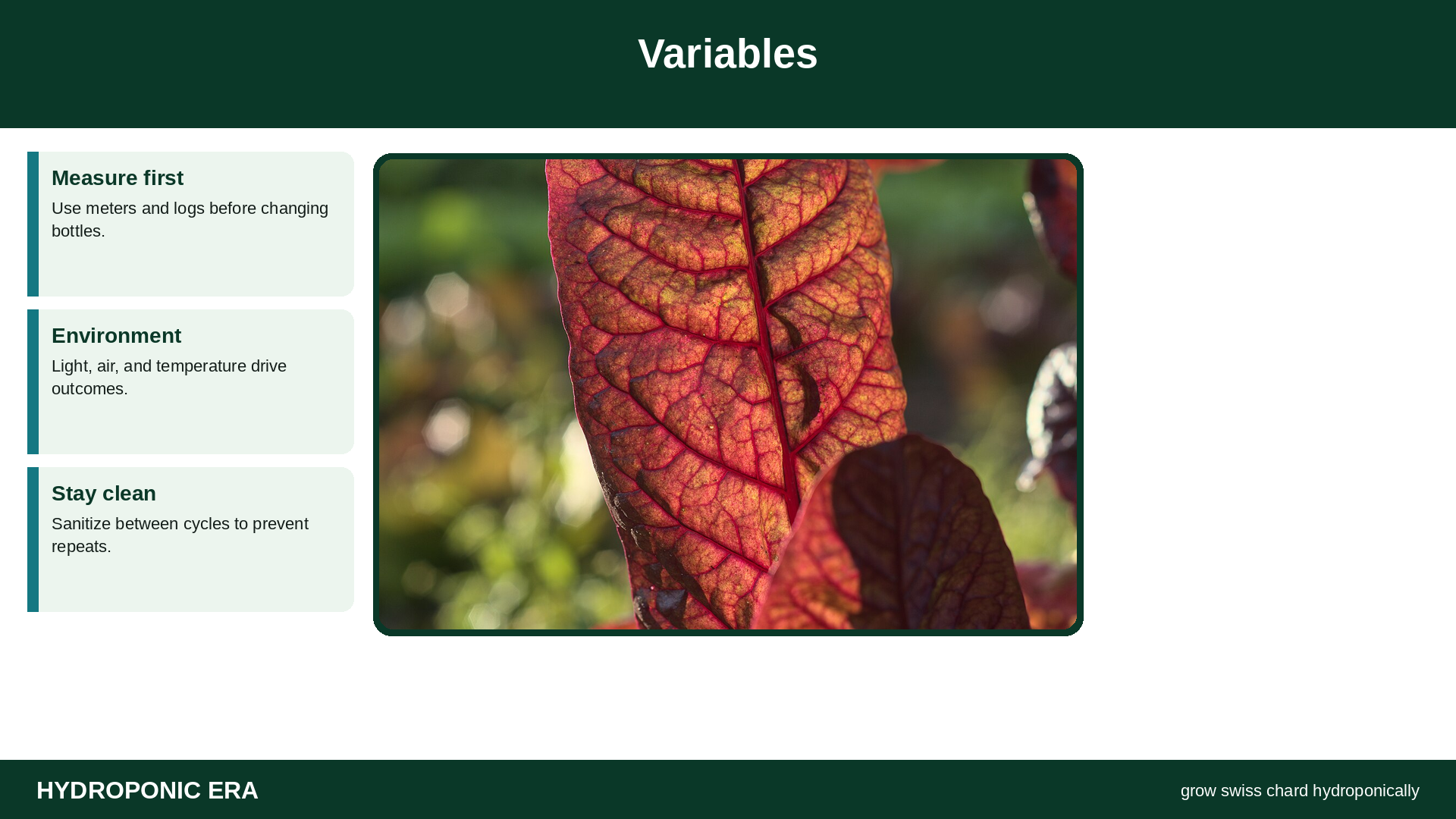
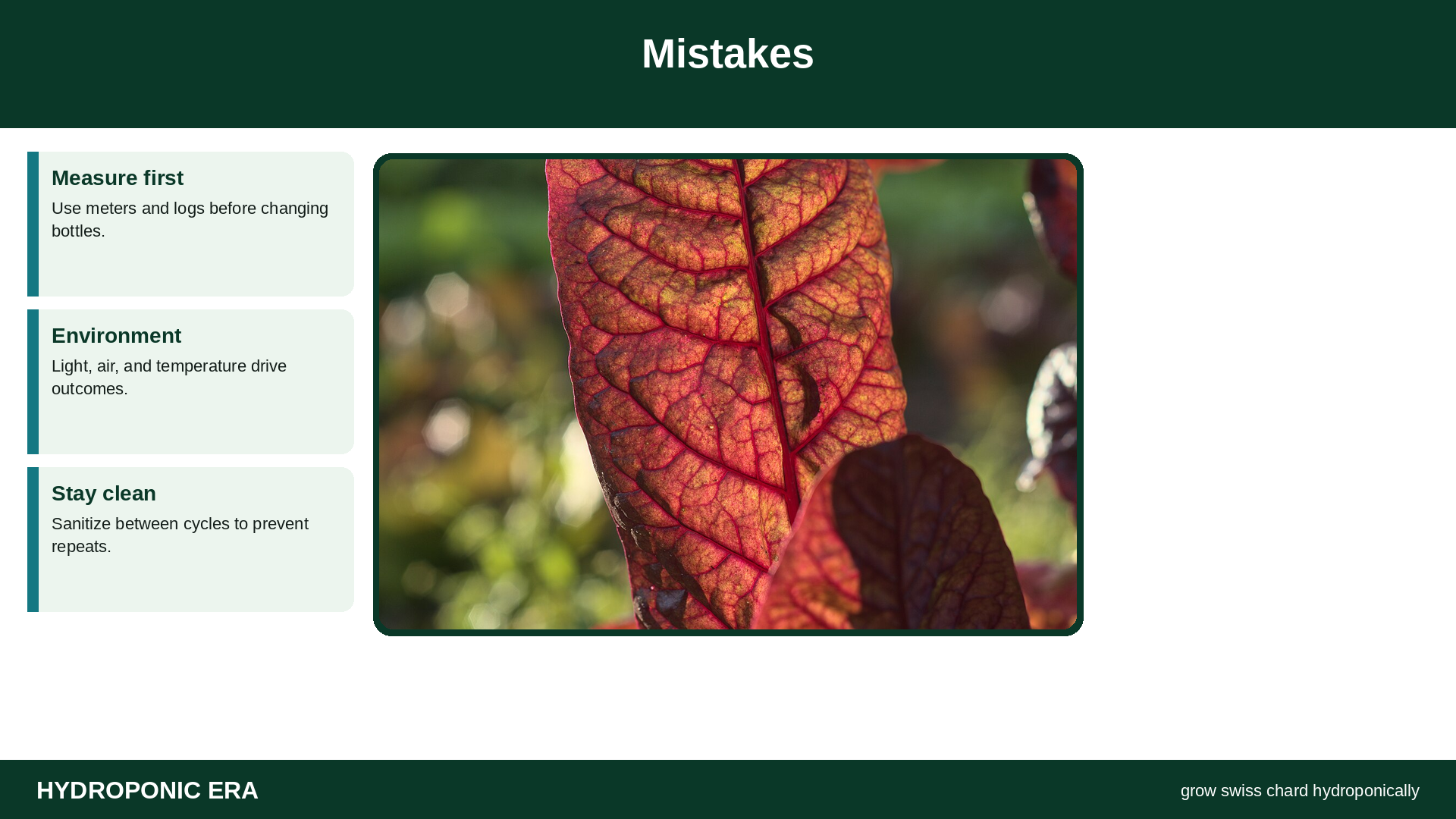
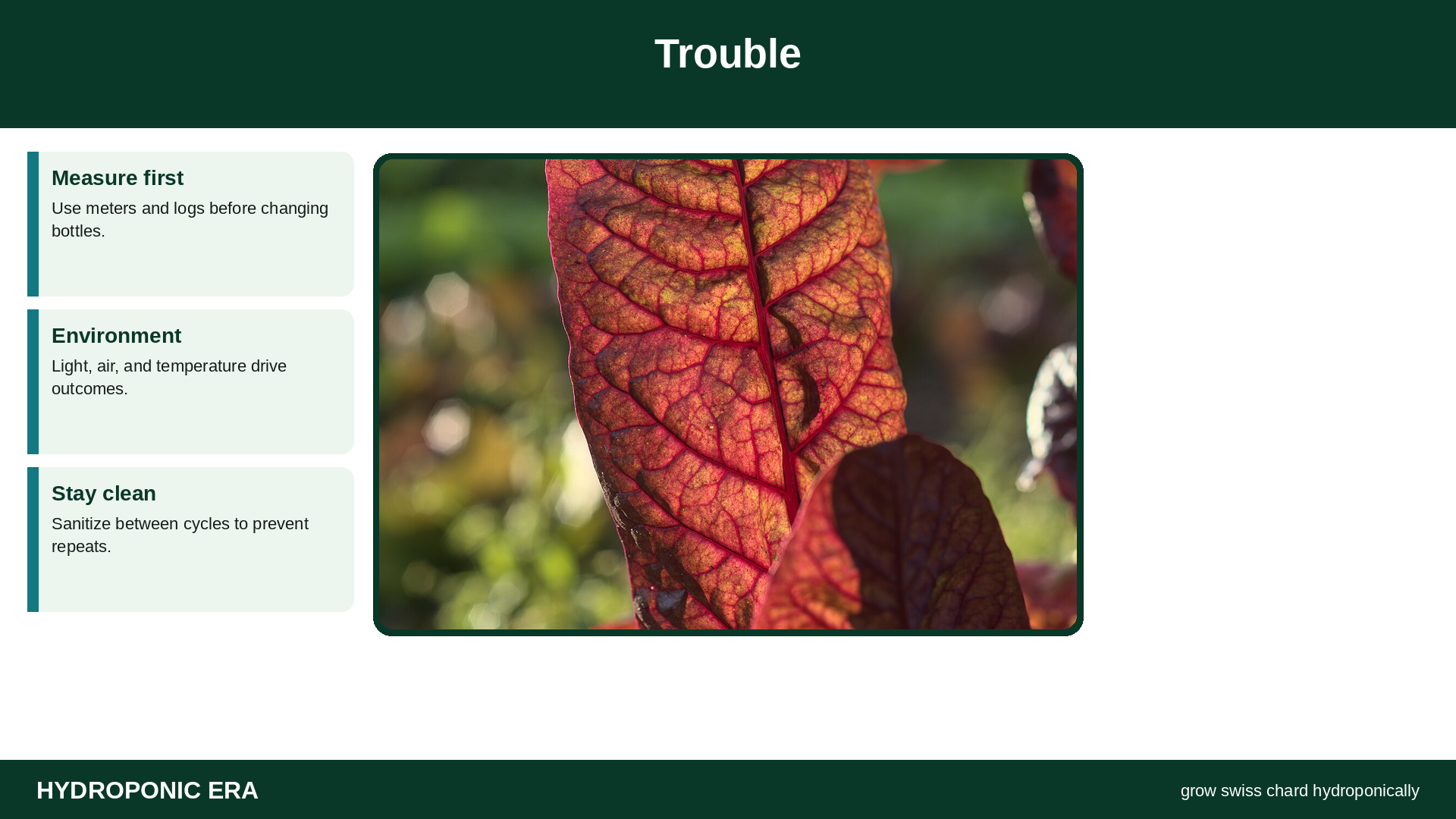
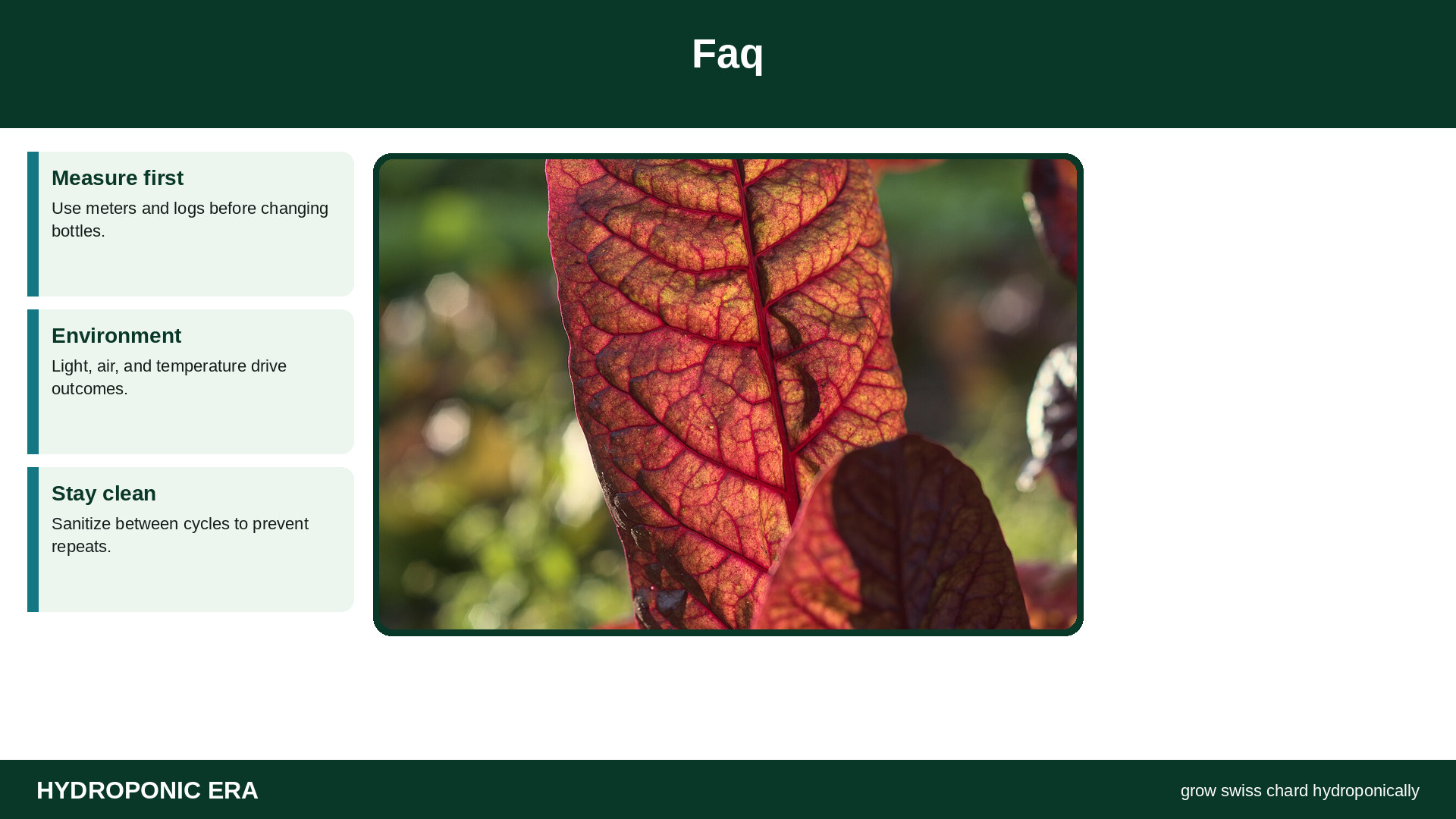
Rainbow chard mixes look striking in net pots, but manage them like any leafy crop: mild EC, airflow, and timely outer-leaf harvest. Colored petioles do not require special “color nutrients.” If tip burn appears on fast new leaves under strong LEDs, moderate intensity and salts before adding products.
Chard leaves cook down similarly to other cooking greens; baby leaves can go in salads. Harvest staggering keeps a perpetual kitchen supply. When plants get huge and shade their own crowns, remove older outer leaves more aggressively.
Compared with kale, chard is often slightly more heat-tolerant in home rooms; compared with spinach, it is usually the easier long-haul leafy plant. Still keep reservoirs oxygenated—heat tolerance is not root-rot immunity.
If you sell or gift bunches, harvest in the cool part of the day and rinse gently without bruising colorful stems.
Spacing and Canopy Management
Give chard enough lateral room for upright petioles. Crowding creates humid pockets and uneven light on inner leaves. If you grow rainbow mixes, harvest evenly across colors so one vigorous plant does not shade the rest. Trellis is unnecessary; leaf removal is the canopy tool.
Nutrient Strength and Tip Burn Watch
Chard under strong LEDs can tip-burn if EC and still air stack together. Moderate intensity before adding calcium products. Keep a weekly EC log and compare to leaf quality. Outer-leaf harvest removes older tissue and keeps the plant focused on new growth. If shared with fruiting crops, chard may show salt stress sooner—separate feed strengths when possible.
FAQs
Is Swiss chard easier than spinach in hydroponics?
Often yes in moderately warm rooms because chard is not as day-length sensitive (UMN). Cool conditions still improve tenderness.
Can I eat the colorful stems?
Yes—petioles are part of the vegetable. Manage the plant like any leafy hydroponic crop.
DWC okay?
Yes with aeration and moderate solution temperatures.
What pH?
About 5.5–6.5 for many soilless hydroponic crops; calibrate and observe.
Why tip burn on new leaves?
Fast growth under strong light with high EC and still air is a classic pattern. Moderate inputs before stacking supplements.
Sources
- University of Minnesota Extension — Growing spinach and Swiss chard in home gardens
- Wisconsin Horticulture / Extension — Swiss chard
- University of Florida IFAS — HS1279
- University of Florida IFAS — HS1422
- Oklahoma State University Extension — Hydroponics
- Oklahoma State University Extension — EC and pH Guide for Hydroponics
- Virginia Cooperative Extension — SPES-720 DLI