
How do you grow glossostigma in an aquarium? Plant glossostigma as tiny clumps a few centimeters (about 1 inch (2.5 cm)) apart in the foreground. Give it high light, CO2 of about 15 to 30 mg/L, soft to moderate water and regular fertilizer. Keep tall plants from shading it. In weak light it grows upward instead of carpeting.
Key takeaway: Glossostigma (Glossostigma elatinoides) is one of the smallest aquarium carpet plants, at about 1 to 2 inches (3 to 5 cm) tall. Tropica rates it high light and high CO2, and calls it difficult. Dennerle lists 68 to 79°F (20 to 26°C), pH 5 to 7.5 and 20 to 30 mg/L CO2. Without strong light it stretches upward rather than spreading flat.
| Need | What sources report | Source |
|---|---|---|
| Height | 2–3 cm; 3–5 cm after 2 months | Tropica; Dennerle |
| Light | High; high to medium | Tropica; Dennerle |
| CO2 | High, 15–25 mg/L; 20–30 mg/L | Tropica; Dennerle |
| Temperature | 68–79°F (20–26°C) | Dennerle |
| pH and water | pH 5–7.5; very soft to moderate | Dennerle |
| Planting | Small clumps (about 1/8 pot) a few cm apart | Tropica; Dennerle |
| Difficulty | Difficult; grows upward in poor light | Tropica |
What Is Glossostigma?
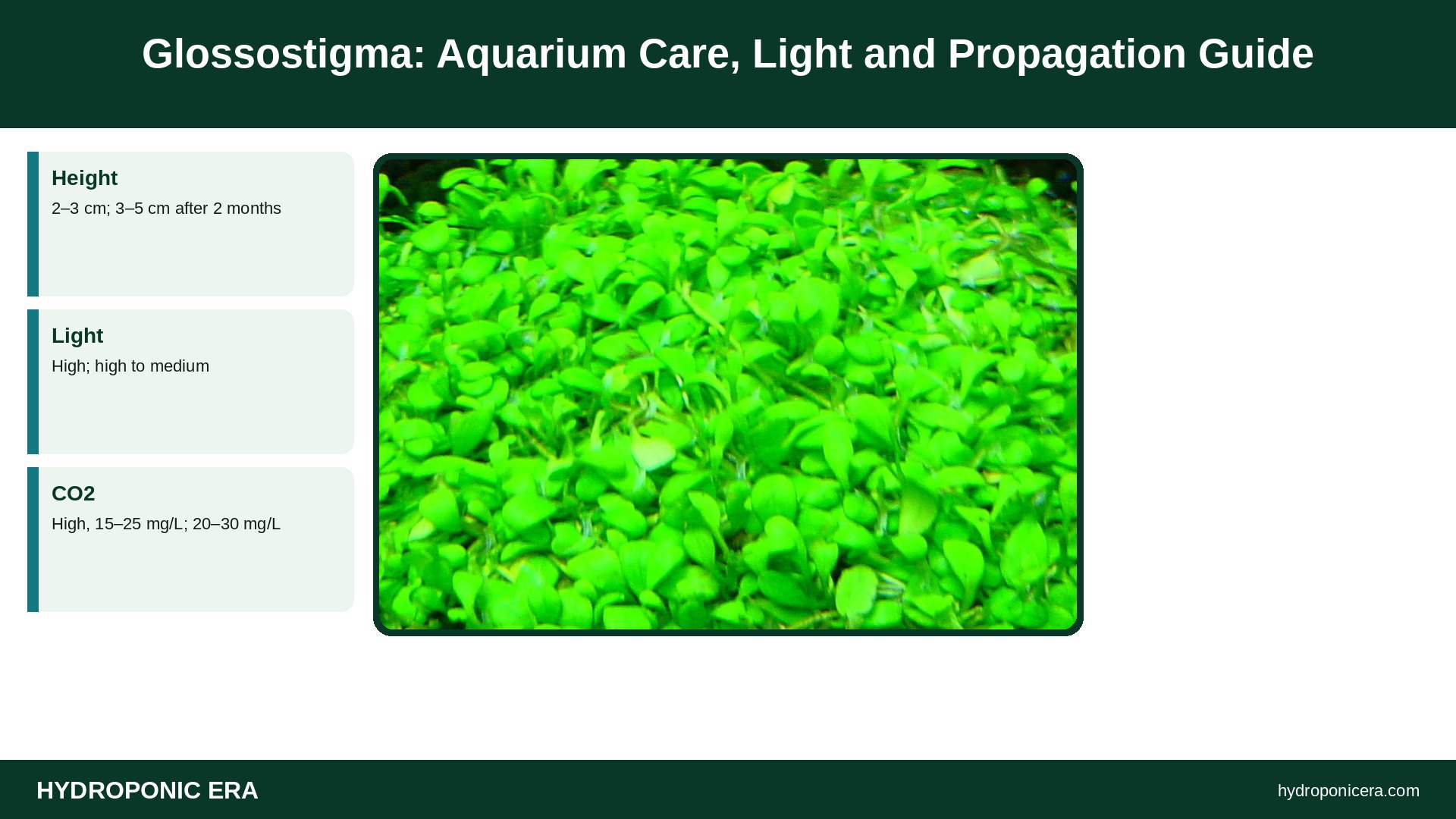
Glossostigma elatinoides is a creeping marsh plant with pairs of small, spoon-shaped leaves. Dennerle places it in the family Phrymaceae, gives its origin as Australia, and credits Takashi Amano with popularizing it in the 1980s. Tropica’s listing also names Australia, while its description mentions New Zealand. The New Zealand Plant Conservation Network lists it as a New Zealand native that is not endemic there, which fits the Australian origin given by Dennerle.
In nature aquascapes, the plant is used for bright green lawns in the front of the tank. Tropica calls it one of the smallest aquarium plants, about 1 inch (2 to 3 cm) tall. That size is why it is popular and also why it is demanding: it needs to sit in full light at the very bottom of the tank.
- Type: carpeting foreground plant.
- Growth rate: fast when its needs are met (Dennerle).
- Propagation: division of runners.
How Do You Grow Glossostigma in an Aquarium?
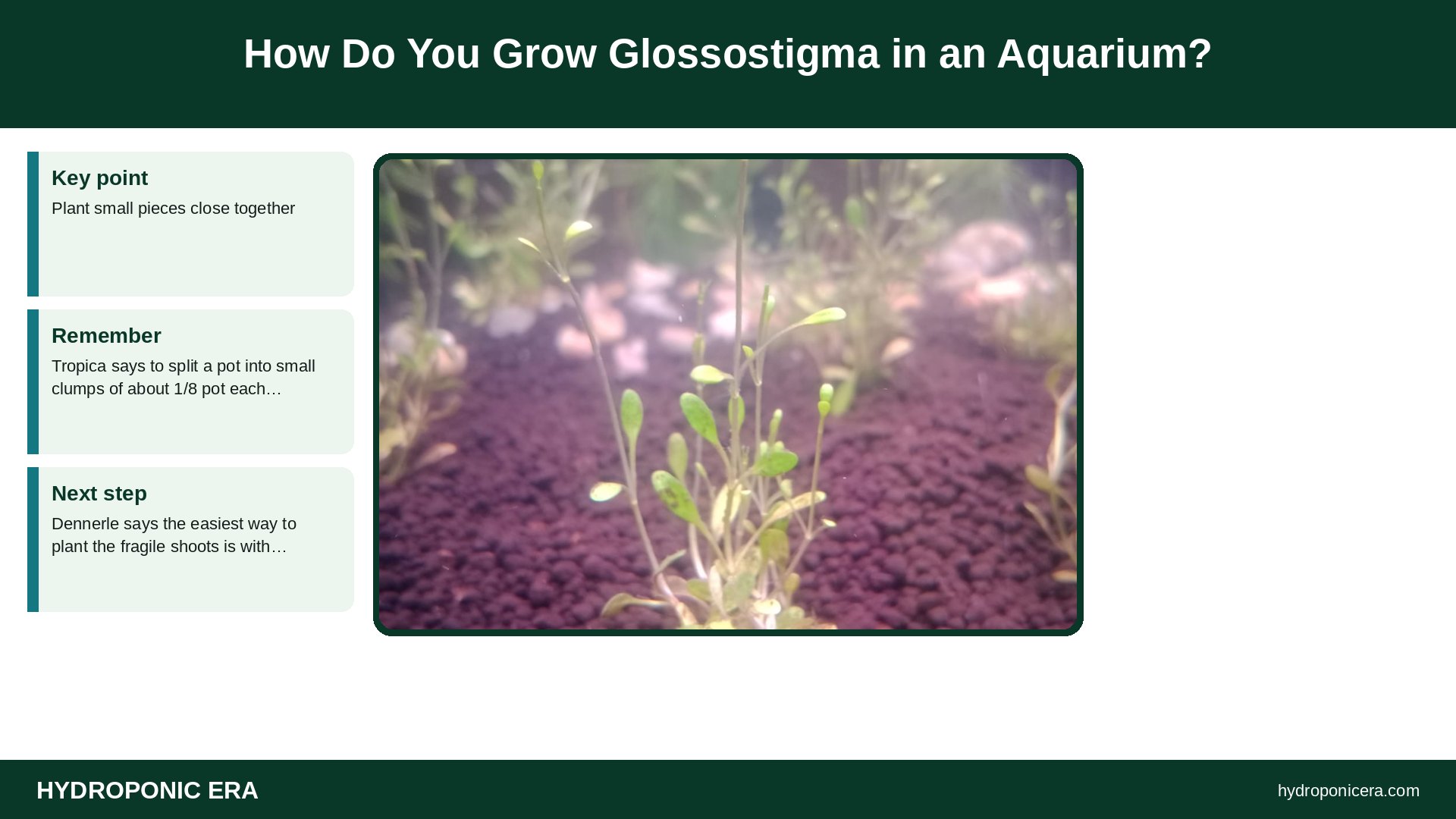
Plant small pieces close together. Tropica says to split a pot into small clumps of about 1/8 pot each and set them a few centimeters apart so they grow together quickly. Dennerle says the easiest way to plant the fragile shoots is with plant tweezers. Use a fine, nutrient-rich substrate so runners can root.
- Remove the pot and gently rinse off rock wool or gel.
- Divide the plant into about 8 small clumps.
- Push each clump into the substrate with tweezers, roughly 1 inch (2 to 3 cm) apart.
- Keep the water level low or the tank freshly filled so the light is strong at the bottom.
- Start CO2 and fertilizer from day one.
Some aquascapers start this carpet plant with the “dry start” method, growing it emersed on wet substrate before flooding. We have not found a primary source that measures how well this works, so treat it as optional.
What Light, CO2 and Fertilizer Does This Carpet Plant Need?
Strong light, injected CO2 and steady nutrients. Tropica rates it as high light and high CO2 (15 to 25 mg/L on its scale) and says CO2 addition and soft water promote growth significantly. Dennerle gives 20 to 30 mg/L CO2, pH 5 to 7.5, very soft to moderate water and 68 to 79°F (20 to 26°C). It is not a low-tech plant.
- Light: high; make sure nothing shades it.
- CO2: pressurized CO2 at 15–30 mg/L; see our aquarium CO2 guide.
- Fertilizer: complete liquid fertilizer plus root tabs in inert substrate.
- Water: soft to moderately hard; pH 5–7.5.
Our aquarium plant fertilizer guide explains dosing to avoid algae.
Why Is Glossostigma Melting or Not Growing?
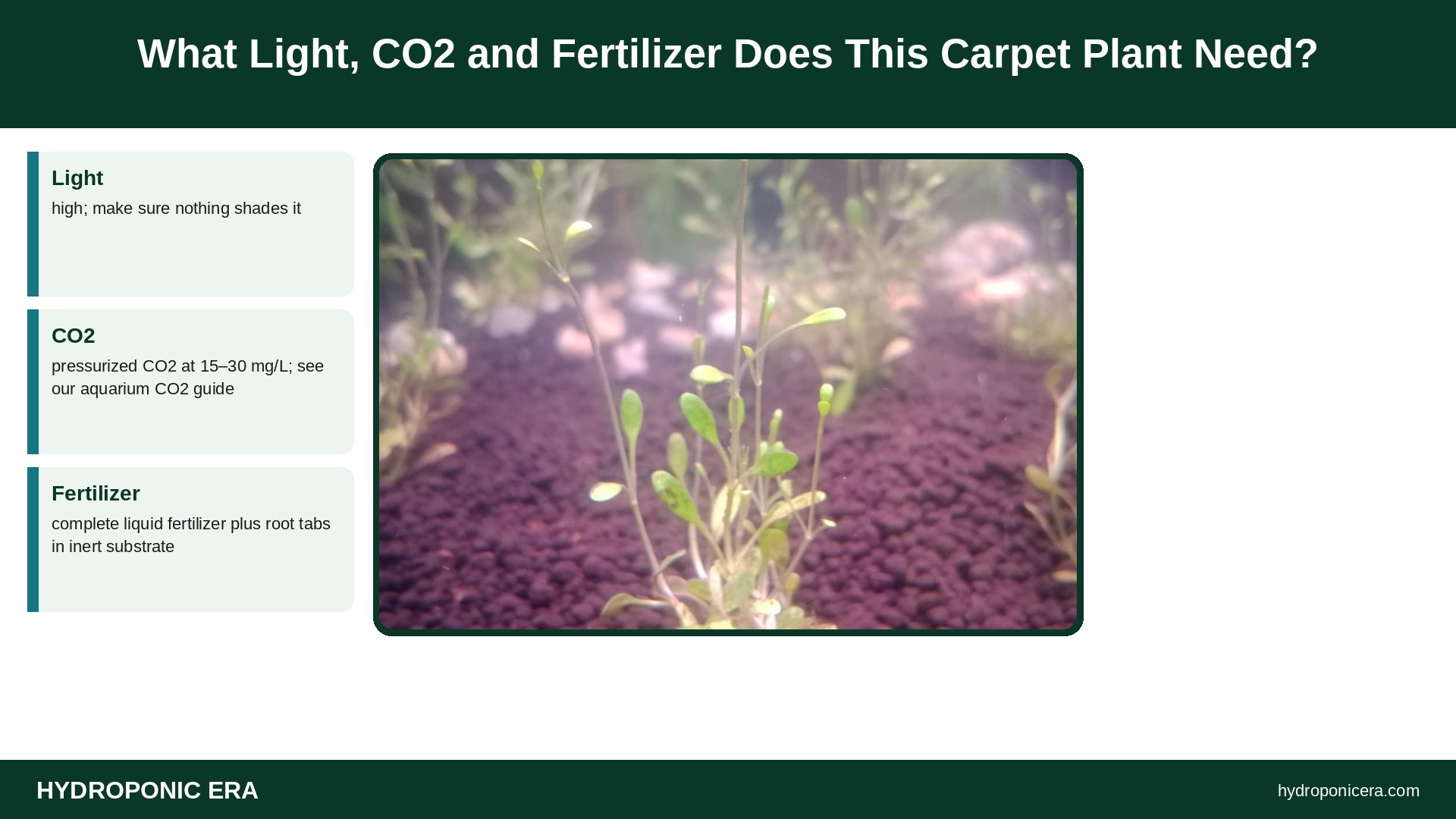
Usually because the light or CO2 is too low. Tropica says it grows upward if light is poor, and warns not to let larger plants overshadow it. Instead of a flat lawn, you get tall, thin stems. Weak CO2 slows it down and invites algae on the leaves. Very warm water above Dennerle’s 79°F (26°C) limit is another stress to check.
- Growing upward: raise light intensity or remove shade.
- Pale or slow: check CO2 and fertilizer.
- Algae on leaves: balance light, CO2 and nutrients together.
- Uprooting: plant smaller pieces deeper with tweezers.
If you cannot run high light and CO2, easier carpets include Monte Carlo, dwarf hairgrass, Lilaeopsis or Utricularia graminifolia, each with its own needs.
How Do You Trim Glossostigma?
Trim the carpet when the carpet gets thick, before the lower layers lose light and start to die. Use curved scissors to cut the top layer evenly, then remove the cut pieces from the tank. Thinning lets light reach the base again. Because it spreads by runners, you can also lift a few rooted pieces to fill bare spots.
- Trim a thick carpet down by about half its height.
- Net or siphon out loose cuttings.
- Replant rooted pieces in thin spots.
FAQ About Glossostigma
Is it hard to grow?
Tropica rates it difficult because it needs a lot of light.
Does it need CO2?
Yes, in practice; sources list 15–30 mg/L.
How tall does it grow?
About 1–2 in (3–5 cm) in good light.
Why is my carpet growing up?
Light is too weak or it is shaded.
What temperature suits it?
About 68–79°F (20–26°C).
How far apart should I plant it?
Small clumps about 1 in (a few cm) apart.
Sources
- Tropica Aquarium Plants — Glossostigma elatinoides plant details/4470)
- Dennerle Plants — Glossostigma elatinoides/23008)
- New Zealand Plant Conservation Network — Glossostigma elatinoides
- Photo credits (Wikimedia Commons, edited with titles): 矮珍珠 by Billtsai1518 (CC BY-SA 3.0); Glossostigma elatinoides by Miriam Serrano Álvarez (CC BY-SA 4.0)