
How do you grow a dwarf hairgrass carpet? Grow a dwarf hairgrass carpet by splitting each pot into 4–10 small portions, planting them evenly across the foreground, and giving open, unshaded light. Tropica says Eleocharis acicularis thrives in almost all aquarium conditions and its runners spread into a carpet 2.4–6 in (6–15 cm) tall, which you can trim shorter.
Key takeaway: Dwarf hairgrass is a common name for several Eleocharis species: E. acicularis at 2.4–6 in (6–15 cm), E. parvula, and the shorter E. pusilla ‘Mini’ at 1.2–2 in (3–5 cm). Plant small clumps close together, keep them in bright, unshaded light, and trim tall carpets. Runners fill gaps, so patience matters more than special gear.
| Species | Carpet height | Notes (Tropica) |
|---|---|---|
| Eleocharis acicularis | 2.4–6 in (6–15 cm) | Thrives in almost all conditions; trim if too tall |
| Eleocharis parvula | Low-growing | Runners close to parent; plant small bunches close together |
| Eleocharis pusilla ‘Mini’ | 1.2–2 in (3–5 cm) | Needs good light; very reliable carpet, nano-friendly |
What Is Dwarf Hairgrass?
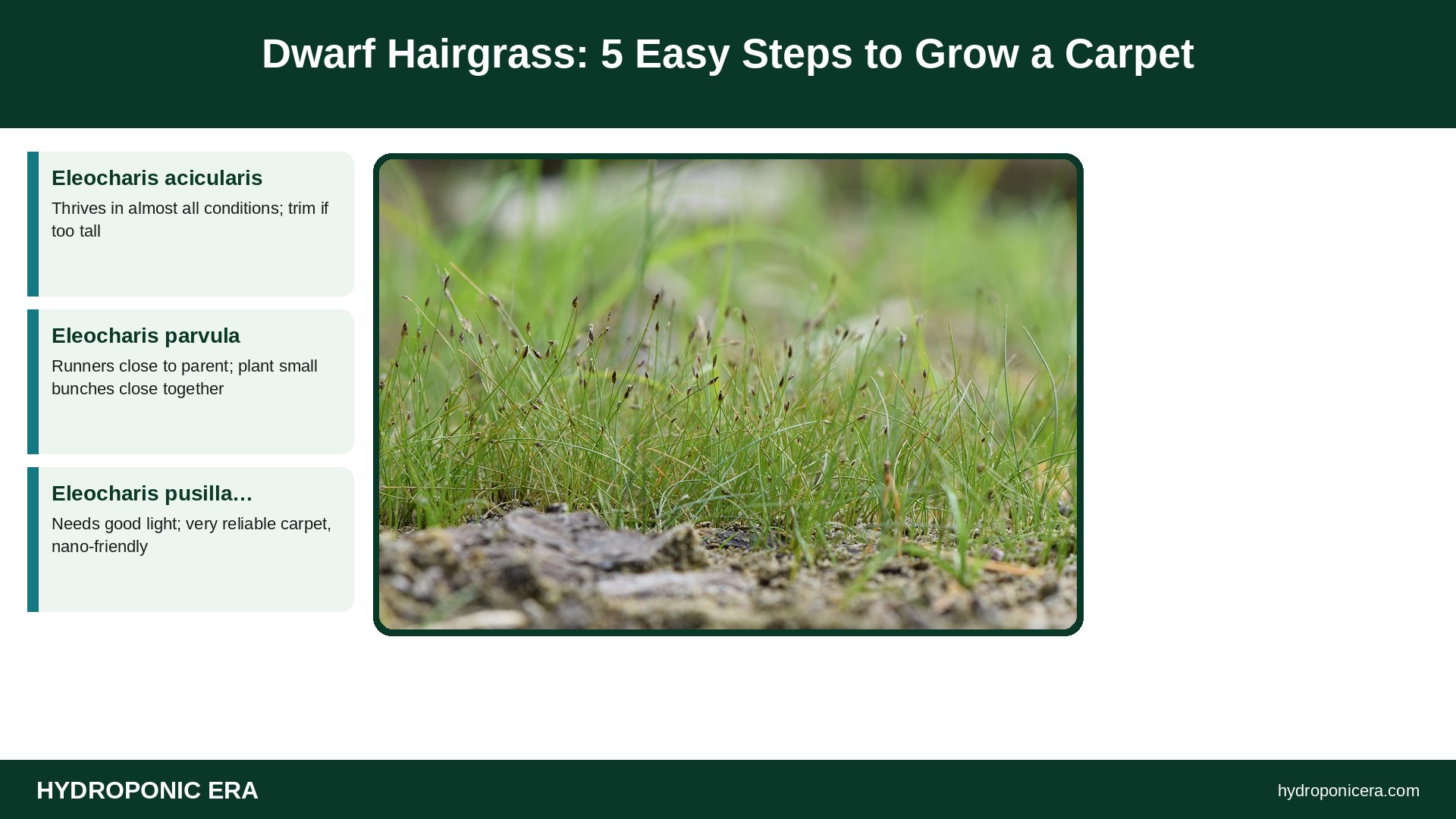
Dwarf hairgrass is a grass-like spike-rush in the sedge family (Cyperaceae) grown as a carpeting foreground plant. Washington State Department of Ecology says needle spike-rush, Eleocharis acicularis, often looks hair-like underwater and spreads by slender rhizomes and stolons. The RHS describes it as an evergreen perennial that forms a spreading carpet when submerged.
In the wild it grows in marshes and the shallow water of ponds and lakes, adapted to changing water levels, per Washington Ecology.
Which Dwarf Hairgrass Species Should You Choose?
Choose by the carpet height you want. Tropica says Eleocharis acicularis forms a carpet 2.4–6 inches (6–15 cm) tall, E. parvula stays low and forms runners close to the parent plant, and E. pusilla ‘Mini’ grows even lower, with leaves that stay 1.2–2 inches (3–5 cm), making it suitable for nano tanks.
- Easiest: E. acicularis, which Tropica says thrives in almost all conditions.
- Shortest: E. pusilla ‘Mini’, a low-maintenance carpet in good light.
- Pond edges: E. acicularis also grows as a marginal, in up to 16 in (40 cm) of water, per the RHS.

How Do You Plant Dwarf Hairgrass?
Plant dwarf hairgrass in small portions spaced evenly over the area. Tropica’s planting guide for carpeting plants such as Eleocharis says to remove the pot and excess mineral wool, cut the wool chunk about 0.8 inch (2 cm) below the plant to use as an anchor, divide into 4–10 portions and plant evenly. Tissue-culture cups divide the same way.
- Remove the pot and most of the rock wool.
- Split the clump into 4–10 small tufts.
- Push each tuft into the substrate with tweezers.
- Space tufts close together for a faster, even fill.
- Fill the tank slowly so tufts do not float up.
How Much Light Does Dwarf Hairgrass Need?
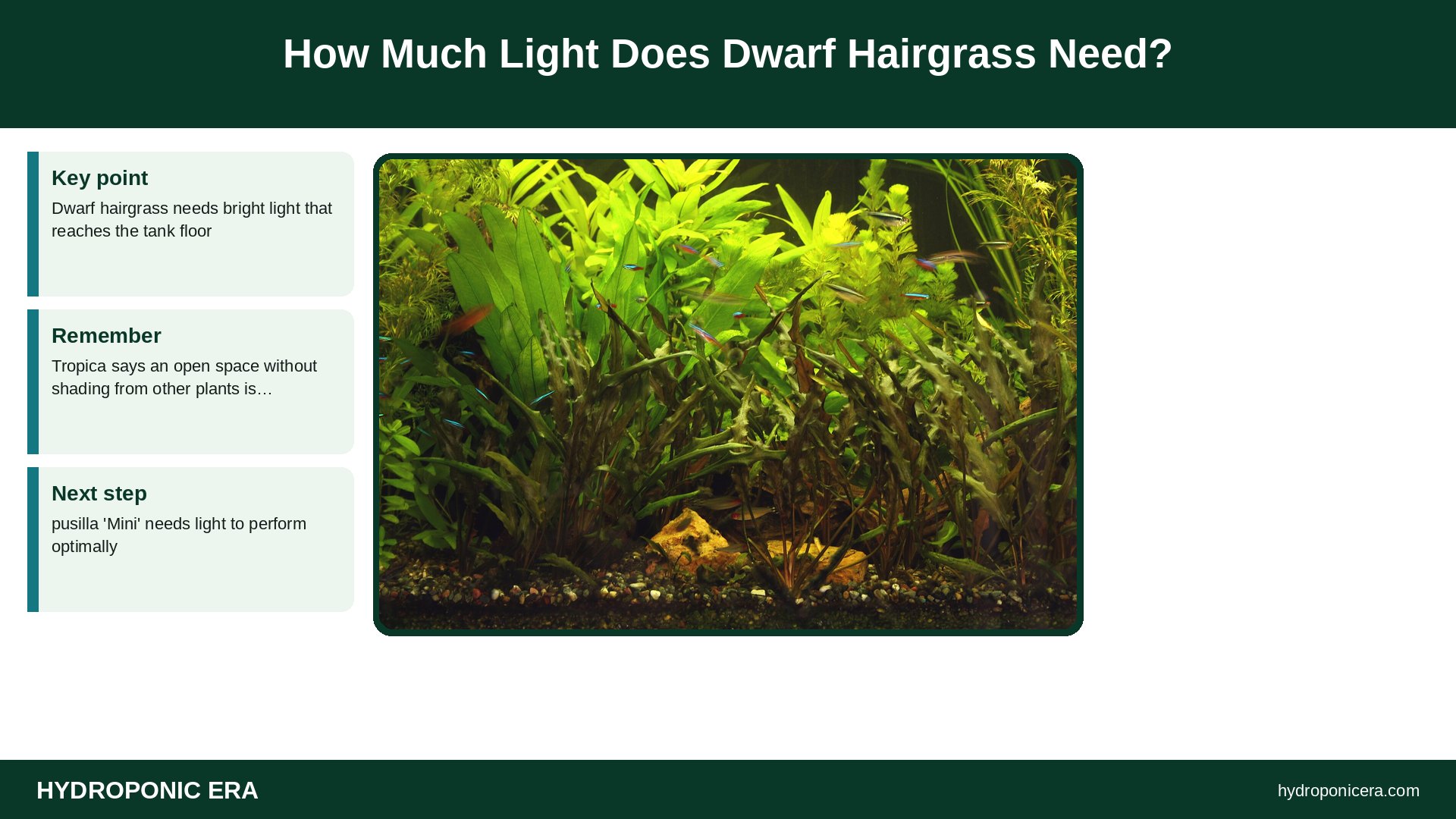
Dwarf hairgrass needs bright light that reaches the tank floor. Tropica says an open space without shading from other plants is preferable for E. acicularis and that E. pusilla ‘Mini’ needs light to perform optimally. Tall stem plants and floating plants that block light will thin the carpet, so keep the foreground clear.
See our grow light for aquarium guide, and remember that dense carpets also benefit from CO2 enrichment principles.
How Do You Trim Dwarf Hairgrass?
Trim dwarf hairgrass when it grows taller than you want. Tropica says that if the E. acicularis carpet grows too tall, you can carefully cut it back to the preferred height with scissors. The ‘Mini’ form rarely needs cutting because its leaves stay short. Siphon out clippings so they do not rot in the carpet.
- Use long, curved aquascaping scissors held flat.
- Cut in stages rather than shaving to the base.
- Remove runners that wander into rock or sand areas.
How Fast Does Dwarf Hairgrass Spread?
Dwarf hairgrass spreads by runners, so the carpet fills in over weeks rather than days. Tropica says the roots start colonizing the surroundings after planting, and that small bunches planted close together gradually form a solid mass. Washington Ecology notes it propagates by seeds and division of rhizome-connected plants, which is exactly how aquarists split it.
Grazers such as Amano shrimp help keep algae off the carpet; see our aquaponics algae control guide.

Can Dwarf Hairgrass Grow Without CO2?
Eleocharis acicularis can grow without injected CO2, since Tropica says it thrives in almost all aquarium conditions, but growth is slower. Aquarium Science notes that most algae problems in low-tech planted tanks come from too little CO2 and that even low-tech tanks do better with at least 10 ppm. Keep light moderate if you skip CO2.
- Low-tech: choose E. acicularis and accept a slower fill.
- High-tech: Aquarium Science suggests raising light gradually over three to six months.
- Nutrients: root-feeding carpets like a nutrient-rich substrate; see our fertilizer for plants in water guide.
Is Dwarf Hairgrass Good for Fish and Shrimp?
Yes. A dense carpet gives small fish, fry and shrimp places to forage and hide. Washington Ecology says spike-rushes provide habitat for amphibians and fish in the wild, and Tropica rates the ‘Mini’ form suitable for nano aquariums, where shrimp are popular. Bottom-digging fish may uproot new tufts, so add them after the carpet roots.
Small livebearers such as guppies suit a hairgrass foreground.
Is dwarf hairgrass easy for beginners?
Eleocharis acicularis is; Tropica says it thrives in almost all aquarium conditions.
How tall does dwarf hairgrass grow?
About 2.4–6 in (6–15 cm) for E. acicularis and 1.2–2 in (3–5 cm) for E. pusilla ‘Mini’, per Tropica.
Can dwarf hairgrass grow in a pond?
Yes. The RHS lists E. acicularis as a hardy marginal or submerged plant in up to 16 in (40 cm) of water.
Why is my hairgrass not spreading?
Shading is a common cause; Tropica says it prefers open space without shade.
Does dwarf hairgrass need pruning?
Only if too tall. The RHS says none is required outdoors; Tropica suggests trimming tall aquarium carpets.
Sources
- Tropica Aquarium Plants. Eleocharis acicularis/28401).
- Tropica Aquarium Plants. Eleocharis pusilla ‘Mini’/4571).
- Tropica Aquarium Plants. Eleocharis parvula/4572).
- Tropica Aquarium Plants. Planting.
- Aquarium Science. 16.2. Controlling Algae.
- Washington State Department of Ecology. Eleocharis acicularis and Eleocharis parvula.
- Royal Horticultural Society. Eleocharis acicularis (needle spike-rush).
- Photo credits (Wikimedia Commons, edited with titles): Eleocharis acicularis kz03 by Krzysztof Ziarnek, Kenraiz (CC BY-SA 4.0); Starr 081230-0543 Eleocharis calva by Forest & Kim Starr (CC BY 3.0); Planted Tank 03 – Flickr – The Wandering Angel by The Wandering Angel from Makati City, Philippines (CC BY 2.0); Caridina multidentata(Hamamatsu,Shizuoka,Japan,2007) by Seotaro (CC BY-SA 3.0)