
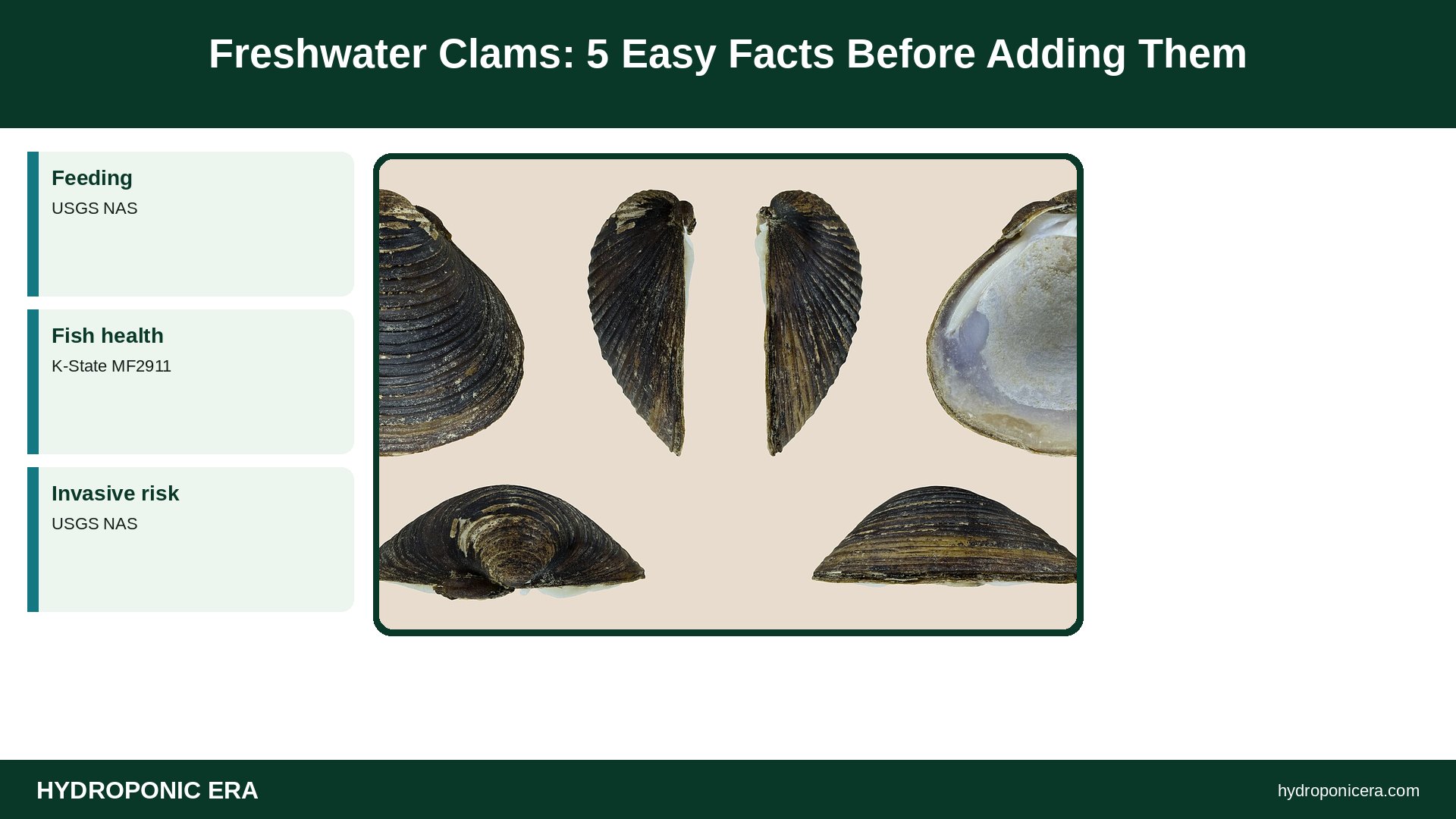
Should you add freshwater clams to an aquaponics system or pond? Usually no. Freshwater clams are filter feeders that eat plankton and fine particles, so clear, well-filtered systems offer them little food. Kansas State University advises against adding clams or snails to water gardens because they can host fish parasites, and invasive Asian clams spread easily once released.
Key takeaway: Freshwater clams filter plankton, diatoms and fine particles, but they do not replace a biofilter, and Kansas State says they can carry parasites that endanger fish. The common pet-trade “golden clam” (Corbicula fluminea) is invasive in 47 US states, and many native mussels are protected. Skip them in most aquaponics systems.
| Fact | Detail | Source |
|---|---|---|
| Feeding | Filter feeder: diatoms, cyanobacteria, microplankton | USGS NAS |
| Fish health | Can host parasites that endanger fish | K-State MF2911 |
| Invasive risk | Corbicula found in 47 states, DC and Puerto Rico | USGS NAS |
| Reproduction | One individual may start a population | USGS NAS |
| Native mussels | About 65% of North American species imperiled | USFWS |
What Do Freshwater Clams Eat?
Freshwater clams eat tiny particles they strain from the water. The USGS Nonindigenous Aquatic Species program says the Asian clam, Corbicula fluminea, filter-feeds on diatoms, flagellates, cyanobacteria and other microplankton, and can also use its foot to feed on soil microbes and periphyton. A clear, heavily filtered tank holds very little of that food.
That is the starvation risk: a system clean enough for fish and plants may not carry enough plankton to keep clams fed, so they slowly weaken.
Do Freshwater Clams Clean Aquaponics Water?
Freshwater clams can clear suspended particles, but they do not replace a biofilter. The USFWS notes that native mussels clean water as they feed by filtering food, sediment and pollutants. Aquaponics, however, depends on nitrifying bacteria to convert fish ammonia into nitrate for plants, which clams do not provide.
Read our aquaponics biofilter guide to size the bacteria side of your system instead.
Can Freshwater Clams Harm Fish?
Yes, they can. Kansas State University’s water gardening guide says it is not a good idea to add scavengers like snails or freshwater clams, because these bottom dwellers can host parasites that endanger fish health, even though they can help the ecosystem. A dead clam hidden in gravel also rots and adds waste to the water.
- Quarantine any new animals before they join fish.
- Watch for disease signs; see our aquaponics fish diseases guide.
- Remove any clam that gapes open and does not close.
Are Freshwater Clams Invasive?
Some freshwater clams are highly invasive. USGS says Corbicula fluminea, sold as golden or “good luck” clams, now lives in 47 US states, the District of Columbia and Puerto Rico. It clogs power plant condenser tubes and water pipes, is a functional hermaphrodite, and has such high reproductive potential that one individual may start a new population.
- Spread routes: bait buckets, imported aquaculture stock and food-market clams, per USGS.
- Life span: about 6 years, per USGS.
- Rule: never release aquarium or pond animals into the wild.
What Conditions Do Freshwater Clams Need?
Asian clams need soft sand or fine gravel to burrow in and water that is not too hot. USGS says Corbicula fluminea inhabits sandy or fine gravel bottoms, commonly buries itself in sediment, and prefers shallow water under about 10 ft (3 m). It tolerates a wide temperature range, but heat waves above 93°F (34°C) can kill nearly whole populations.
- Substrate: sand or fine gravel for burrowing.
- Temperature: USGS notes larvae are brooded in the gills when water is above 59°F (15°C).
- Food: plankton-rich water, which most aquaponics tanks lack.
Grow beds full of coarse gravel, such as pea gravel, are not a suitable home for burrowing clams.
How Do Freshwater Clams Reproduce?
Asian clams reproduce quickly and on their own. USGS describes Corbicula fluminea as a functional hermaphrodite that can self-fertilize, broods larvae in its gills in warm water, and spawns several times in a row when conditions suit it. That is why a few clams released from a tank or pond can seed an entire waterway.
Is It Legal to Collect Wild Freshwater Mussels?
Collecting wild native mussels is often restricted. The USFWS says about 65% of North American freshwater mussel species are imperiled, and listing a species under the Endangered Species Act prohibits harming, collecting or capturing it without a permit. USGS calls freshwater mussels the most imperiled group of animals in North America. Check state rules before taking any.
USGS also notes many native mussels rely on host fish to complete their life cycle, so they rarely breed in tanks.
What Are Better Cleanup Options Than Clams?
Better options are good filtration, plants and the right fish. Fine solids are best handled mechanically, nutrients by plants, and algae by shade and balanced feeding. Kansas State recommends 50–75% plant cover in water gardens for biological balance, which shades out algae without adding parasite risks from bottom dwellers.
- Choose hardy species from our best fish for aquaponics list.
- Use our aquaponics algae control steps for green water.
Can freshwater clams live in an aquaponics tank?
They can survive for a while, but filtered water carries little plankton, so starvation is likely.
Do freshwater clams reduce ammonia?
No. Nitrifying bacteria in the biofilter convert ammonia; clams only filter particles.
Are golden clams invasive?
Yes. USGS reports Corbicula fluminea in 47 US states.
Why does K-State say no clams in ponds?
Because clams and snails can host parasites that endanger fish.
Can I take mussels from a river?
Many species are protected; the USFWS says listed mussels cannot be collected without a permit.
Sources
- U.S. Geological Survey NAS. Corbicula fluminea fact sheet.
- Kansas State University. MF2911 Water Gardening: Biological Balance.
- U.S. Fish and Wildlife Service. Questions and answers about ESA protections for longsolid and round hickorynut mussels.
- U.S. Geological Survey. Native Mussels.
- Photo credits (Wikimedia Commons, edited with titles): Corbicula fluminea 02 by H. Zell (CC BY-SA 3.0); Pond-edge plants at Achamore Garden – geograph.org.uk – 5446824 by M J Richardson (CC BY-SA 2.0); Lymnaea stagnalis 01 by H. Zell (CC BY-SA 3.0); Deep Cut Gardens Koi Pond by FossilDS (CC0)