
Is parrot feather a good pond plant? Parrot feather (Myriophyllum aquaticum) is an attractive feathery oxygenator, but it is invasive. USGS says it escaped from ornamental ponds, forms dense mats that cut dissolved oxygen, and spreads from stem fragments. It is banned from sale in Great Britain and regulated in several US states, so check local rules before planting.
Key takeaway: Parrot feather grows feathery gray-green leaves up to 1 ft (30 cm) above the water on stems up to 5 ft (1.5 m) long. Only female plants occur outside South America, so it spreads by fragments, not seed. It is hardy in USDA zones 5–11, per Virginia Cooperative Extension. Never dump it into natural water.
| Fact | Detail | Source |
|---|---|---|
| Native range | Amazon basin and southern South America | USGS NAS |
| Stem length | Up to 5 ft (1.5 m) | USGS NAS |
| Emergent growth | Up to 1 ft (30 cm) above water | USGS NAS |
| Reproduction | Fragments only; female plants outside South America | USGS NAS |
| Hardiness | USDA zones 5–11 | Virginia Cooperative Extension |
| UK status | Banned from sale (Defra, 2013) | GOV.UK |

What Is Parrot Feather?
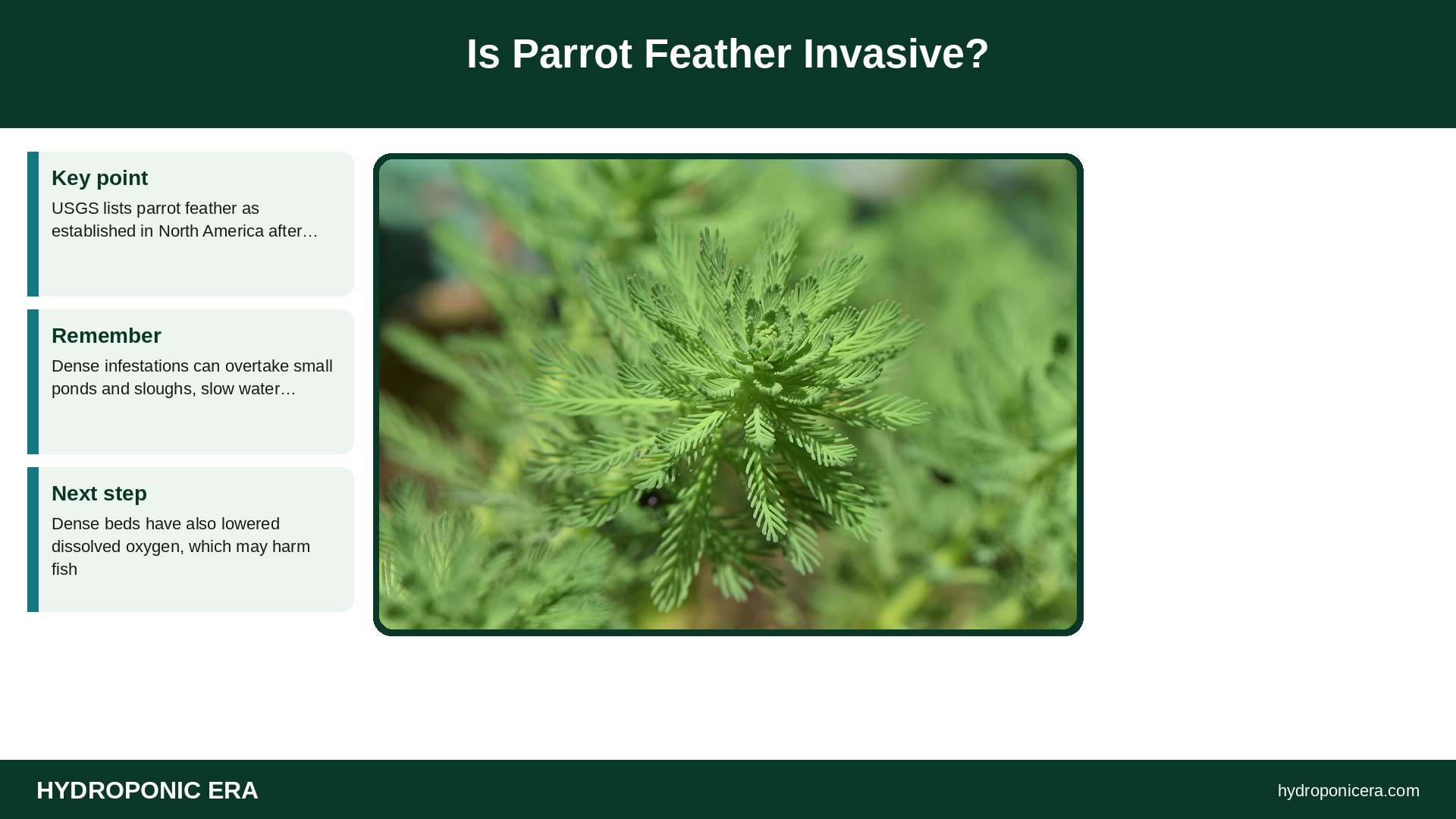
Parrot feather is a South American watermilfoil that grows both under and above water. USGS describes emergent leaves of about 10 leaflet pairs, 0.8–2 in (2–5 cm) long, grayish green, in whorls of four to six. Submerged leaves are reddish orange and 0.6–1.4 in (1.5–3.5 cm) long. Stems trail along the surface before turning upward.
Tiny white flowers about 1/16 inch (1.6 mm) long sit in the leaf axils, per USGS.
Is Parrot Feather Invasive?
Yes. USGS lists parrot feather as established in North America after escaping as an ornamental pond plant. Dense infestations can overtake small ponds and sloughs, slow water flow, raise flood duration, and crowd out native plants such as pondweeds and coontail that waterfowl eat. Dense beds have also lowered dissolved oxygen, which may harm fish.
USGS also notes a strong link between dense growth and mosquito eggs and larvae. If mosquitoes are a concern, see our mosquito fish guide.
How Does Parrot Feather Spread?
Parrot feather spreads only from pieces of stem. USGS says the species has separate male and female plants, but only female plants are found outside South America, so seed production is not known there. New plants grow from fragments of emergent or submersed shoots, and stolons act as its storage and dispersal organs.
- Every snapped stem can root into a new plant.
- Boats, nets and pond-cleaning tools can carry fragments.
- Composting is risky; Virginia Extension says never discard pond plants into lakes, ponds, ditches or streams.
What Water Conditions Does It Prefer?
This milfoil prefers shallow, nutrient-rich water with light reaching the bottom. USGS lists a tolerance range of 50–86°F (10–30°C), best growth at 61–73°F (16–23°C), pH 6.0–8.5 and hardness of 50–200 ppm. It must root in bottom sediment, survives winter in its submerged form, and restarts growth once water reaches about 45°F (7°C).
| Condition | Range (USGS) |
|---|---|
| Tolerated temperature | 50–86°F (10–30°C) |
| Best growth | 61–73°F (16–23°C) |
| pH | 6.0–8.5 |
| Hardness | 50–200 ppm |
| Depth | 0–33 ft (0–10 m) |
USGS adds that hard, prolonged frost can kill the emergent shoots, and invasions in regions with severe winters often fail because the rhizomes store little phosphorus and carbon. Test your water with our GH and KH water tests guide.
Is It Legal to Grow Parrot Feather?
It depends on where you live. In Great Britain, Defra banned the sale of parrot’s feather and four other invasive water plants in 2013, with retailers facing fines up to £5,000 and possibly six months in prison. In the United States, rules vary by state, so check your state agriculture or natural resources agency before buying or sharing it.
How Do You Care for Parrot Feather?
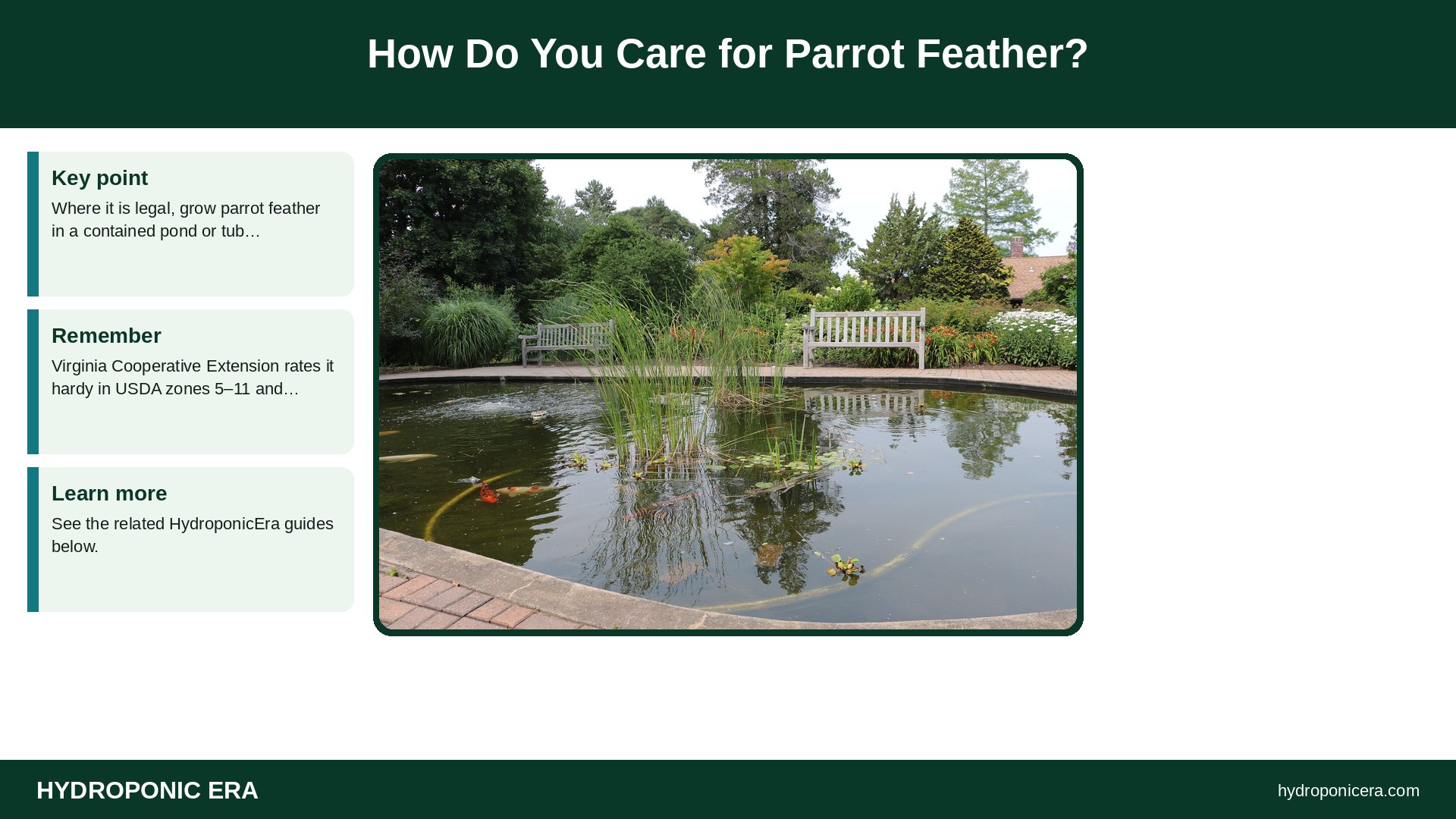
Where it is legal, grow parrot feather in a contained pond or tub with full sun and shallow water. Virginia Cooperative Extension rates it hardy in USDA zones 5–11 and says submerged oxygenators like parrot feather can be kept in an aquarium over winter, with frequent water changes to prevent rot and insect pests.
- Plant it in a pot, not loose in the pond, so it cannot run.
- Trim emergent stems often and bag the trimmings for the trash.
- Thin it before it covers more than the planting area.
- Overwinter tender stock indoors in colder zones.
What Can You Grow Instead of Parrot Feather?
Choose a non-invasive or native oxygenator suited to your region. Hornwort and anacharis are common choices for ponds and tanks, though anacharis is also regulated in some states, so check first. Floating plants such as frogbit add shade, and Kansas State advises covering 50–75% of a water garden’s surface with plants for balance.
- Read our hornwort guide for a rootless oxygenator.
- See our anacharis and koi pond plants guides.
Is parrot feather a submerged or floating plant?
It roots in shallow water and grows both submerged and emergent stems, up to 1 ft (30 cm) above the surface.
Does parrot feather produce seeds?
Not outside South America, says USGS, because only female plants occur there.
Is parrot feather illegal in the UK?
Its sale has been banned in Great Britain since Defra’s 2013 decision.
Can parrot feather survive winter?
It is hardy in USDA zones 5–11, per Virginia Cooperative Extension.
How do I get rid of parrot feather?
Remove all stems and roots, bag every fragment, and dispose of it in the trash.
Sources
- U.S. Geological Survey NAS. Myriophyllum aquaticum (parrot feather) fact sheet.
- GOV.UK, Defra. Sale of invasive water plants banned to protect wildlife.
- Virginia Cooperative Extension. Winterizing the Water Garden, SPES-781.
- Kansas State University. MF2911 Water Gardening: Biological Balance.
- Photo credits (Wikimedia Commons, edited with titles): Myriophyllum aquaticum – side (aka) by André Karwath aka Aka (CC BY-SA 2.5); Myriophyllum aquaticum kz01 by Krzysztof Ziarnek, Kenraiz (CC BY-SA 4.0); Deep Cut Gardens Koi Pond by FossilDS (CC0); Egeria densa (22205195903) by harum.koh from Kobe city, Japan (CC BY-SA 2.0)