
Pea gravel hydroponics uses small, rounded stones, usually about 1/4–3/8 inch (6–10 mm), as the growing medium. It’s one of the oldest and cheapest hydroponic media: gravel culture was the most widely used soilless method in Hawaii, according to a University of Hawaii extension circular. Gravel drains fast, never breaks down and anchors tall plants well. The downsides are weight, low water holding and the risk that limestone gravel will push your pH up. Use only washed, non-calcareous gravel and pick a flood-and-drain or drip system.
Key takeaway: Pea gravel works best in ebb and flow and media-bed systems with frequent floods. Test it for limestone with vinegar, wash it well and build sturdy beds for the weight.
| Feature | Pea gravel | Clay pebbles | Pumice |
|---|---|---|---|
| Cost | Very low | Higher | Low to medium |
| Weight | Heavy | Light | Light |
| Water holding | Poor | Medium–poor | Medium |
| pH effect | None if granite or quartz; raises pH if limestone | Neutral | Neutral |
| Lifespan | Permanent | Long | Long |
| Plant support | Excellent | Medium | Medium–poor |
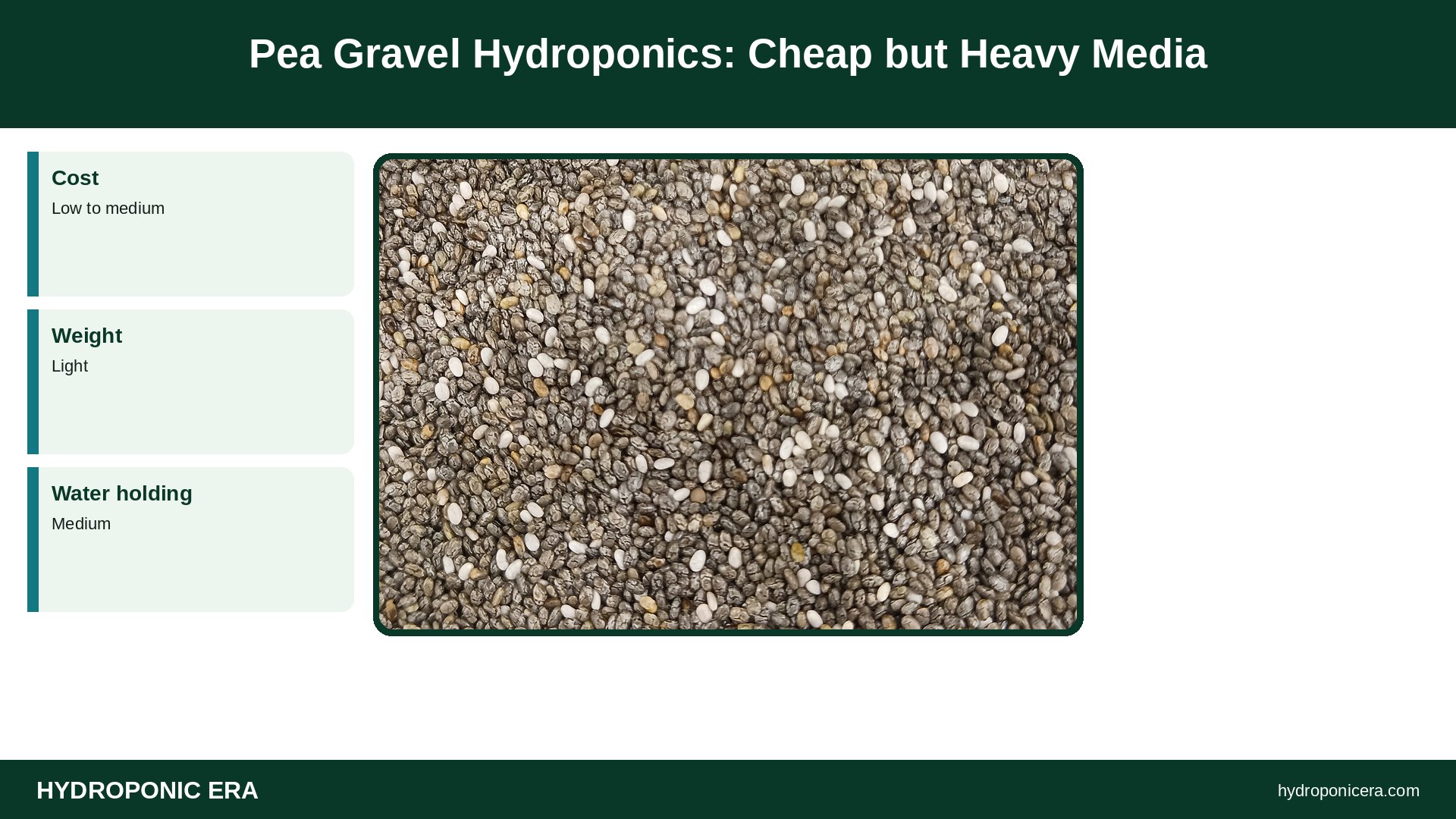
What Is Pea Gravel Hydroponics?
Pea gravel is a landscaping and construction stone named for its pea-sized, water-smoothed pieces. In pea gravel hydroponics, the gravel simply holds roots and plants upright while a nutrient solution flows through. The University of Hawaii circular Growing Plants Without Soil describes gravel culture as similar to sand culture, except that the medium is coarser and the way you add nutrient solution is more critical, because the solution must drain off so none remains in the container.
Gravel has deep roots in hydroponics history. Merle Jensen of the University of Arizona wrote that early researchers replaced soil with “chemically inert aggregates moistened with nutrient solutions,” and the Hawaii circular explains that gravel culture was developed to overcome the aeration problems of sand.
Why Pea Gravel Hydroponics Still Makes Sense
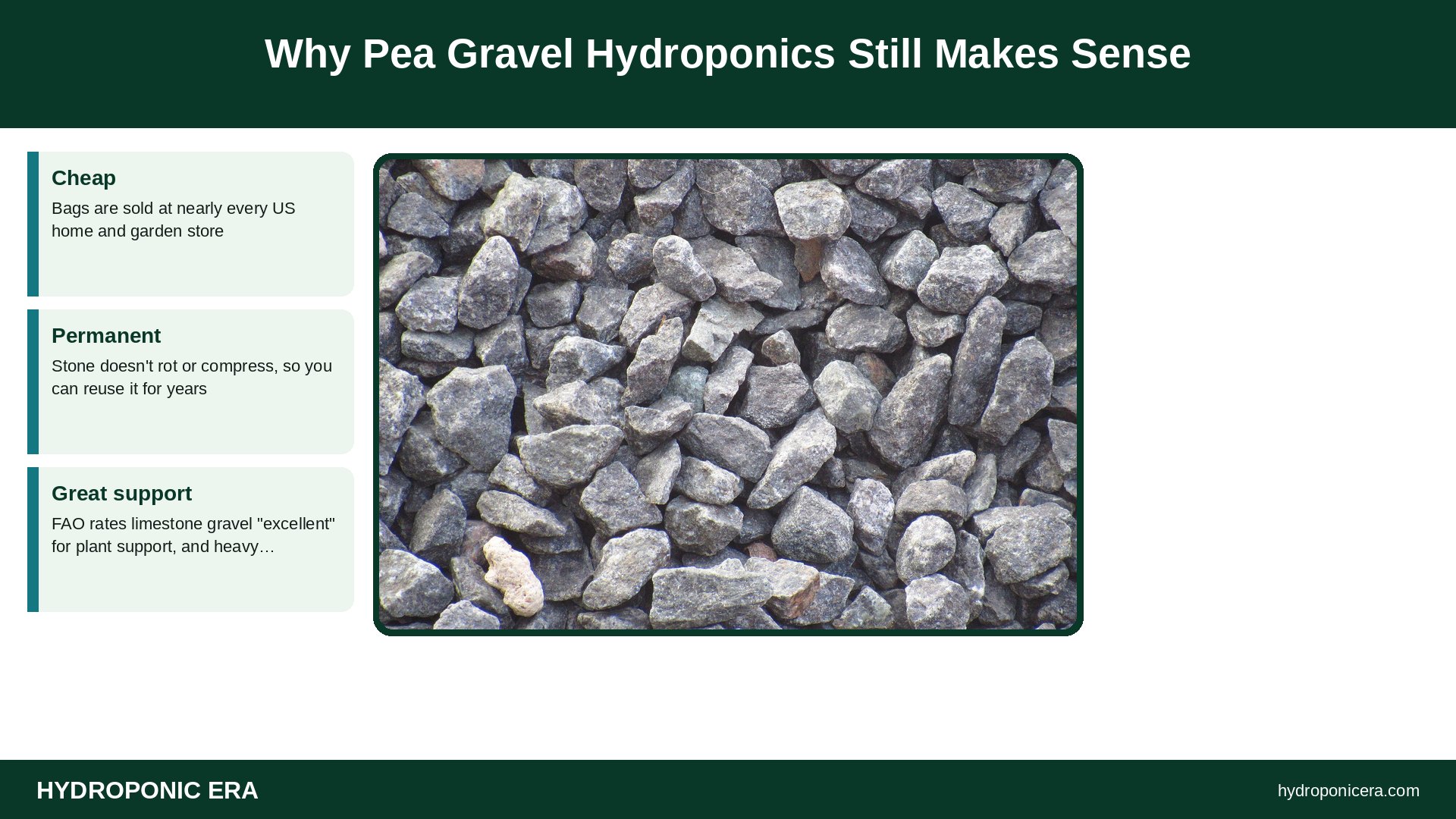
- Cheap: Bags are sold at nearly every US home and garden store.
- Permanent: Stone doesn’t rot or compress, so you can reuse it for years.
- Great support: FAO rates limestone gravel “excellent” for plant support, and heavy stone of any type holds tall tomatoes, peppers and cucumbers firmly.
- Good aeration: Large gaps between stones let air in each time solution drains.
- Biofilter surface: In aquaponics, the surface of each stone hosts nitrifying bacteria.
The Downsides of Pea Gravel
Weight
Gravel is heavy. A cubic foot weighs roughly 100 lb (about 1,600 kg per cubic meter), so a 4×8 foot (1.2×2.4 m) bed filled 6 inches (15 cm) deep holds about 16 cubic feet, or roughly 1,600 lb (725 kg) of stone before water. Build on a level, solid base and use strong containers.
Low water holding
Smooth stones hold only a thin film of water. FAO rates gravel’s water retention as “poor.” That means plants can wilt quickly if a pump fails, so pea gravel hydroponics needs frequent flood cycles in hot weather.
Limestone and pH
This is the big one. The Hawaii circular says gravel should be non-calcareous, free of harmful substances and chemically inert. FAO explains that limestone is mostly calcium carbonate, which dissolves, raises the water’s carbonate hardness (KH) and pushes pH up. FAO also notes that river-bed gravel is usually limestone, and it lists limestone as acceptable only if no other media are available.
How to Test Pea Gravel for Limestone
- Put a handful of dry gravel in a glass.
- Pour in plain white vinegar to cover.
- Watch for fizzing or bubbles. Carbonate rock reacts with acid and releases carbon dioxide.
- If it fizzes steadily, the gravel contains limestone or other carbonates. Choose a different source, or expect to add pH Down often.
- No fizz? Granite, quartz or basalt gravel is a good candidate.
A small amount of limestone isn’t all bad. FAO notes it can offset the acidifying effect of nitrifying bacteria in aquaponics, and a basket of pea gravel in a filter can buffer against acidification. In plain hydroponics, though, you usually want a neutral medium.
Setting Up Pea Gravel Hydroponics

- Wash thoroughly. Rinse until water runs clear to remove dust and grit that can clog pumps.
- Choose the system. Ebb and flow is the classic match. The Hawaii circular describes raising a solution container above the gravel to flood it, then lowering it to drain, or using pumps on larger setups. See ebb and flow hydroponics.
- Fill and drain fully. The circular notes that the solution must drain so none remains in the container. Standing water starves roots of oxygen.
- Time the floods. Because gravel holds little water, flood several times a day. See flood and drain cycle timing.
- Plant rooted starts. Tuck seedlings from plugs or cubes into the gravel and keep the top layer dry to limit algae.
- Clean between crops. The Hawaii circular advises removing old roots and debris, flushing out salts and replacing media as needed.
Avoid Dry Fertilizer in Pea Gravel Hydroponics
Some growers sprinkle dry fertilizer salts on gravel and water them in. The Hawaii circular warns this can cause uneven nutrient distribution, makes nutrient control harder and raises the risk of salt damage. Mix a complete nutrient solution instead.
Pea Gravel in Aquaponics Media Beds
Many backyard aquaponics beds use gravel. FAO prefers volcanic gravel for media beds, recommending pieces about 5/16–3/4 inch (8–20 mm), and warns that smaller gravel clogs with solid waste. Fine pea gravel can work but may need more frequent cleaning. If your system has a bell siphon, learn how it cycles in aquaponics bell siphon and see aquaponics media bed.
Best Crops for Pea Gravel Hydroponics
- Tomatoes, peppers and cucumbers, which benefit from strong anchoring
- Basil, mint and other bushy herbs
- Leafy greens in shallow beds
- Strawberries in flood trays
Root crops like carrots struggle in gravel. For other medium choices, compare growing media for hydroponics.
Pea Gravel Hydroponics Maintenance
Pea gravel hydroponics is low maintenance once it’s running. Check pH and EC a few times a week, especially in the first month, because a slow pH climb is the first sign of hidden carbonates. Top off with plain water between nutrient changes. Keep the top inch (2.5 cm) of stone dry so algae and fungus gnats have nowhere to live. Between crops, pull out roots, scrub or tumble the gravel in a bucket, soak it in a mild sanitizer and rinse well. Because the stone never wears out, one purchase can serve many seasons.
FAQs
Is pea gravel hydroponics good for beginners?
Yes, if it’s washed and non-limestone; it’s cheap, permanent and supports plants well.
Does pea gravel raise pH?
Limestone gravel does; granite or quartz gravel doesn’t.
How do I know if gravel is limestone?
Drop it in vinegar; steady fizzing means carbonates.
What size gravel is best?
About 1/4–3/4 inch (6–20 mm); finer gravel clogs and holds less air.
Can I use aquarium gravel?
Yes, if it’s inert and well rinsed; avoid crushed coral.
Is gravel better than clay pebbles?
It’s cheaper and steadier but much heavier and holds less water.
Sources
- University of Hawaii Cooperative Extension Service — Growing Plants Without Soil (Circular 440)
- FAO — Small-scale Aquaponic Food Production: Integrated Fish and Plant Farming
- Merle H. Jensen, University of Arizona (archived) — Hydroponics
- Photo credits (Wikimedia Commons, edited with titles): PEA GRAVEL by Ranjithkumar Murugesan (CC0); Gravel Stones by Saral Shots (CC0); AQUAPONIE by Hopeballa (CC BY-SA 4.0); AQUAPONIE by Hopeballa (CC BY-SA 4.0); Man turns drying chili peppers, Turkey by Rotadefterim (CC BY-SA 4.0)