
Sand culture hydroponics grows plants in clean, inert sand that is watered with a complete nutrient solution, which then drains away. The sand only anchors roots; all the food comes from the solution. It’s one of the oldest soilless methods, refined at US agricultural experiment stations in the 1920s and 1930s. Sand holds more water than gravel, so it suits drip and wick setups, but fine sand can block air. Use medium to coarse silica sand of about 0.01–0.08 inch (0.25–2 mm) that is free of lime, and let every watering drain fully.
Key takeaway: Pick washed, non-calcareous sand (never coral or beach shell sand), use drip or subirrigation, and flush the beds regularly so salts don’t build up.
| Feature | Sand culture | Gravel culture | Water culture |
|---|---|---|---|
| Medium | Silica sand, 0.01–0.08 inch (0.25–2 mm) | Coarser stone | None; roots in solution |
| Water holding | Moderate | Low | Constant |
| Aeration | Fair; poor if sand is fine | Good | Needs air pumps |
| Feeding method | Drip, flood or wick | Flood and drain or drip | Static or recirculating |
| Plant support | Good | Excellent | Needs rafts or cups |

How Sand Culture Hydroponics Works
The University of Hawaii’s extension circular Growing Plants Without Soil explains that sand culture is sometimes called slop culture, drip culture or intermittent renewal. Nutrients come from solution, as in water culture, but plants grow in silica sand or another inert material. The solution is applied to the sand and allowed to drain off. That supplies nutrients, lets air back into the root zone and supports the roots. Tall crops like tomatoes and cucumbers still need stakes or trellises for their tops.
The circular lists four ways to feed a sand bed: drip the solution onto the surface; add solution once a week and keep the sand moist with plain water in between; subirrigate by flooding from below and draining; or use a wick that draws solution up from a container below by capillary action.
A Short History of Sand Culture Hydroponics
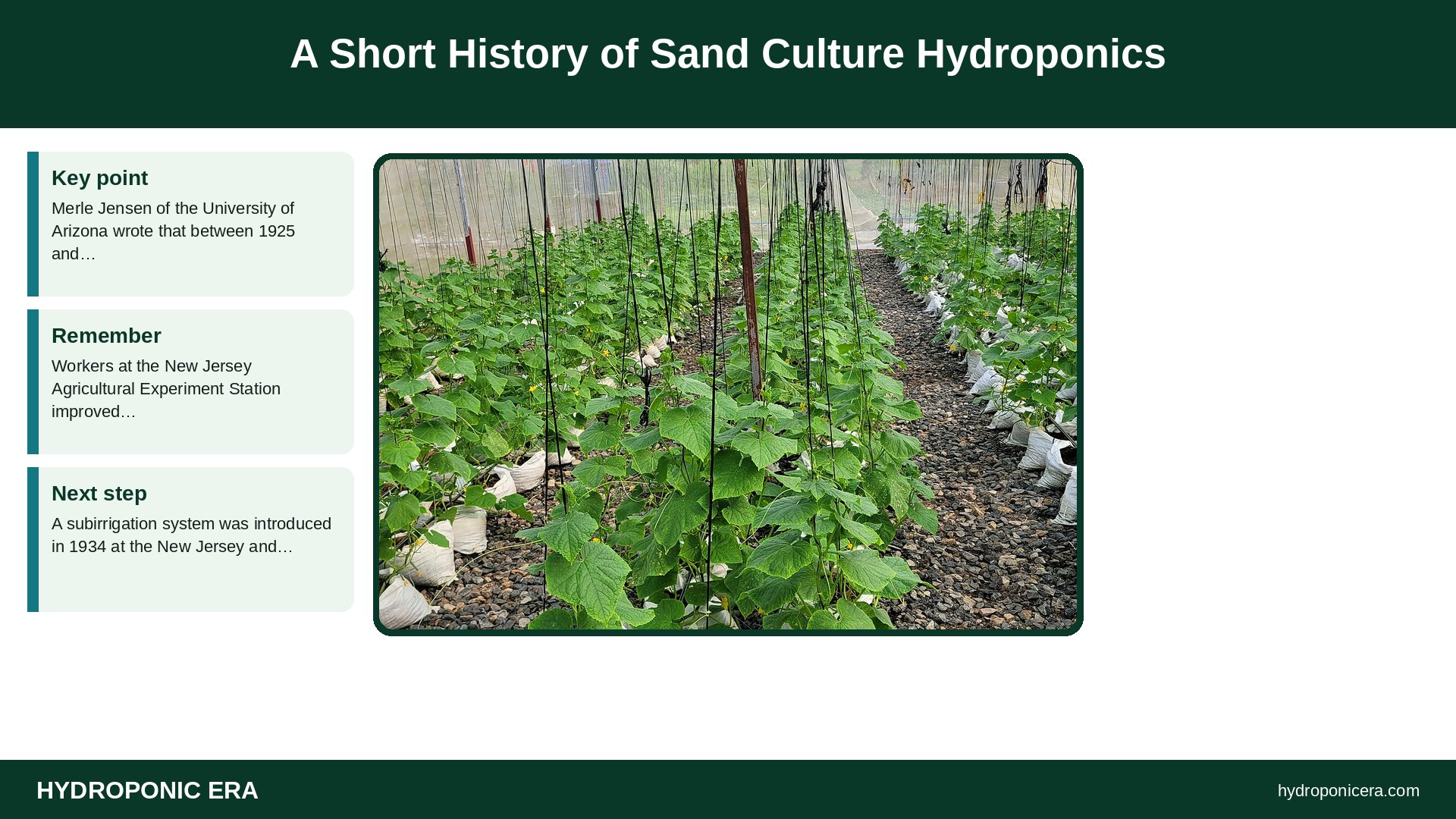
Merle Jensen of the University of Arizona wrote that between 1925 and 1935, researchers adapted plant physiologists’ lab methods to large-scale crop production. Workers at the New Jersey Agricultural Experiment Station improved the sand culture method (Shive and Robbins, 1937), and California researchers Hoagland and Arnon used both water and sand culture at large scale. A subirrigation system was introduced in 1934 at the New Jersey and Indiana stations to overcome some limits of both methods.
The USDA’s National Agricultural Library quotes a 1965 USDA bulletin: growing plants in water culture or sand culture without soil had been used by plant scientists for more than a century. At the US Regional Salinity Laboratory in Riverside, California, scientists built automated sand cultures in which nutrient solution was pumped onto the sand at hourly or other set intervals by time clocks, then drained back to a reservoir. For the bigger story, see who invented hydroponics.
Choosing Sand for Sand Culture Hydroponics
The right sand makes or breaks the system. The Hawaii circular gives clear rules:
- Size: Medium to coarse, about 0.01–0.08 inch (0.25–2 mm). Finer material drains too slowly and makes aeration hard.
- Lime-free: The sand should be non-calcareous. Coral sands are mostly calcium carbonate and not suitable.
- Clean and inert: Free of harmful materials and chemically inert. Volcanic cinders may work only if they meet the same standards, since some are too alkaline or tie up phosphorus.
In the US, look for washed silica or quartz sand sold for filters, masonry or horticulture. Avoid play sand with fine dust and beach sand with shell fragments. Test a sample with vinegar: steady fizzing means carbonates, which will push pH up. The same test is explained in our pea gravel hydroponics guide.
Setting Up Sand Culture Hydroponics at Home
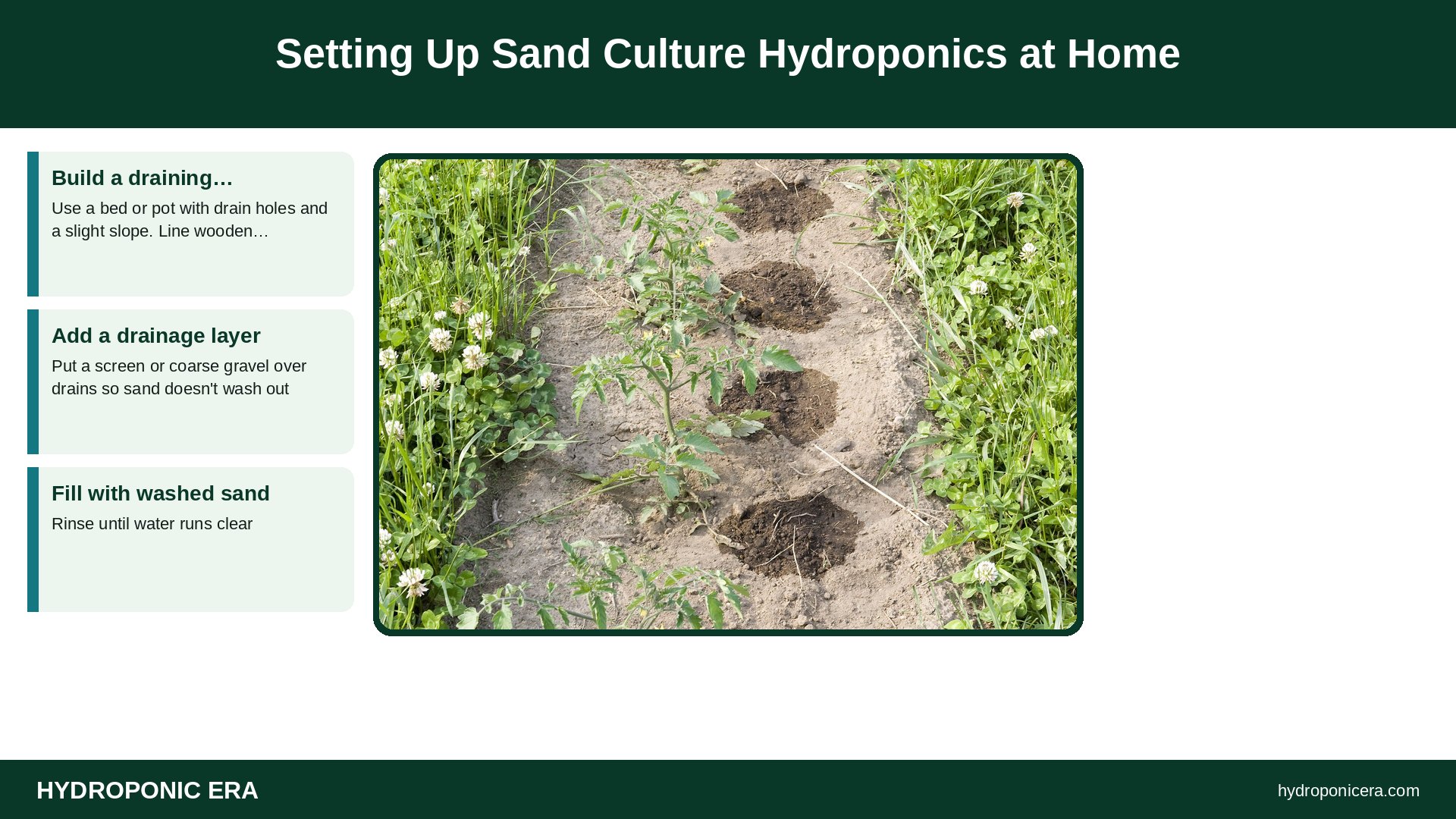
- Build a draining container. Use a bed or pot with drain holes and a slight slope. Line wooden beds with plastic; Jensen notes plastic replaced costly concrete beds and helped hydroponics spread.
- Add a drainage layer. Put a screen or coarse gravel over drains so sand doesn’t wash out.
- Fill with washed sand. Rinse until water runs clear.
- Choose a feeding method. Drip lines on a timer are the most common today. See drip emitters.
- Water to drain. Apply enough solution that some drains out each time; the runoff carries away excess salts.
- Flush regularly. The Hawaii circular says media should be flushed to remove accumulated salts and cleaned of old roots between crops.
Sand Culture Hydroponics Pros and Cons
| Pros | Cons |
|---|---|
| Cheap and widely available | Very heavy |
| Holds more water than gravel | Fine sand compacts and blocks air |
| Good root support | Salts build up without flushing |
| Permanent, reusable medium | Hard to sterilize in large beds |
Aeration: The Main Risk
The Hawaii circular calls good aeration the most frequent cause of failure in soilless growing. It notes that dripping solution on the surface at a set rate often gives poor aeration, which is why gravel culture was developed. In sand culture hydroponics, prevent waterlogging by using coarse sand, letting beds drain fully, and avoiding constant trickles that keep the sand saturated. If you want a bed that holds even more air, mix sand with perlite. See perlite and vermiculite.
Avoid Dry Fertilizer
Some growers spread dry fertilizer salts on the sand and water them in. The Hawaii circular warns this causes uneven nutrient distribution, makes nutrient control harder and increases the risk of salt damage. If you must use dry feeding, it advises applying salts every 10 days to 2 weeks and keeping the media moist. A dissolved nutrient solution is far easier to manage. For mixing, see nutrient mixing order.
Best Crops for Sand Culture Hydroponics
- Tomatoes and cucumbers, with support for the vines
- Peppers and eggplant
- Herbs and leafy greens
- Root crops like carrots and radishes, which can push through loose sand more easily than through gravel
Sand Culture Hydroponics in Hot, Sunny Climates
Jensen notes that large hydroponic systems were built in the deserts of California, Arizona, Abu Dhabi and Iran around 1970, where intense sunlight boosted photosynthesis. Sand is locally abundant in many such places, which is part of its appeal. If you garden in the US Southwest, a sand bed fed by drip lines can be a low-cost way to start. Shade the beds in the hottest weeks, water early in the day and check that runoff drains away so roots stay cool and aerated.
FAQs
Is sand culture hydroponics still used?
Yes, in research and some desert and small-scale systems, though rockwool and coir are more common now.
Can I use play sand?
It’s usually too fine and dusty; use washed, coarse silica sand.
Can I use beach sand?
Not if it contains shell or coral; carbonates raise pH.
How often should I water a sand bed?
Often enough to keep it moist, letting each watering drain fully.
Does sand need to be flushed?
Yes; flushing removes accumulated salts.
Is sand better than gravel?
Sand holds more water; gravel holds more air.
Sources
- University of Hawaii Cooperative Extension Service — Growing Plants Without Soil (Circular 440)
- Merle H. Jensen, University of Arizona (archived) — Hydroponics
- USDA National Agricultural Library — Hydroponics
- Plant Physiology (1941), US Regional Salinity Laboratory — Adaption and Use of Automatically Operated Sand-Culture Equipment
- Photo credits (Wikimedia Commons, edited with titles): Macrophotography of grains of sand in polarised ligth by Jojowikiscience (CC BY-SA 4.0); Cucumber in the greenhouse 3 by Pascal Kings (CC BY 4.0); Drip irrigation (2552390830) by Dwight Sipler from Stow, MA, USA (CC BY 2.0); Hydroponic g12 by Giancarlo Dessì (CC BY-SA 3.0); Pile of Carrots by Adimora chidinma (CC BY-SA 4.0)