
Kelp and seaweed extracts can be added to hydroponic nutrient solutions in small amounts as biostimulants, not as main fertilizers. Research shows that some seaweed extracts, especially from the brown alga Ascophyllum nodosum, can improve stress tolerance, root growth, or yield in certain crops, but results vary by product, dose, and crop. In recirculating systems, kelp products can also feed biofilm, cloud the solution, and clog pumps or emitters. For most home growers, kelp is optional: try it at low doses, monitor closely, and never rely on it to replace a complete nutrient.
Key takeaway: Kelp is a supplement with modest, inconsistent benefits. A complete hydroponic nutrient, correct pH and EC, good light, and cool, oxygenated water matter far more.
| Question | Short answer |
|---|---|
| Is kelp a fertilizer? | Mostly a biostimulant; NPK is low |
| Possible benefits | Stress tolerance, root growth, sometimes yield (crop-dependent) |
| Risks in hydroponics | Biofilm, cloudy solution, clogged emitters, pH shifts |
| Best form | Soluble extract or powder labeled for hydroponics |
| Dose | Start well below label rate; follow product directions |
| Best systems | Drain-to-waste, coco, media beds; use cautiously in DWC/NFT |

What Is in Kelp Extract?
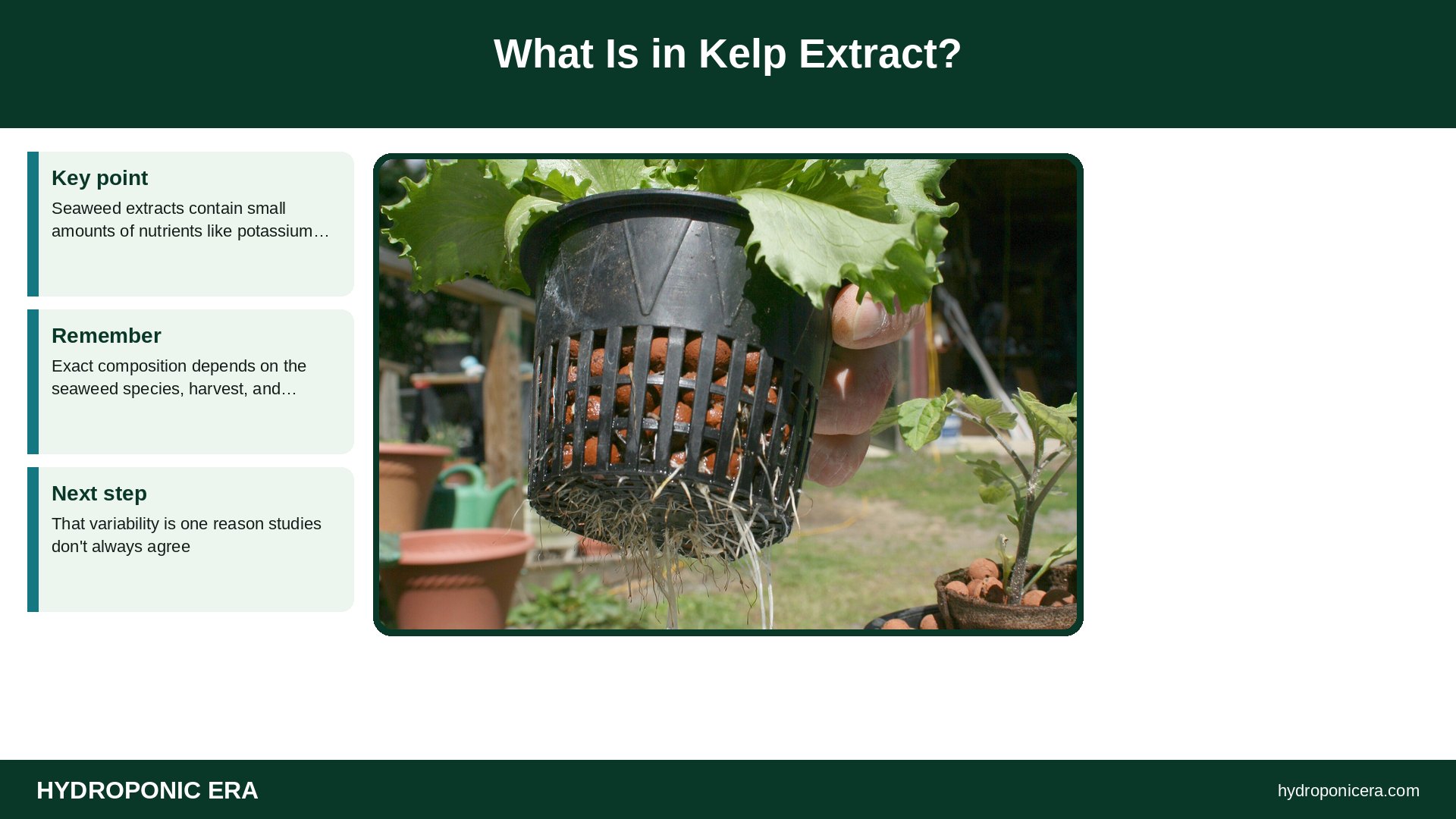
Seaweed extracts contain small amounts of nutrients like potassium plus a range of organic compounds: polysaccharides (such as alginates and laminarins), polyphenols, betaines, and trace amounts of compounds with plant hormone-like activity. Exact composition depends on the seaweed species, harvest, and extraction method (alkaline, acid, or cold processes). That variability is one reason studies don’t always agree.
Researchers classify these products as biostimulants: materials that improve plant processes such as nutrient uptake or stress tolerance, independent of their nutrient content.
What the Research Says
Reviews of seaweed extract research report benefits in many crops, including improved root development, chlorophyll content, tolerance of heat, salt, or drought stress, and in some trials yield. Hydroponic studies on lettuce and other greens have found positive effects at certain doses, no effect at others, and occasional negative effects at high doses. The honest summary: kelp can help, but it’s not guaranteed, and more is not better.
Because most studies test specific products under specific conditions, results from one brand or crop don’t automatically transfer to yours. Run your own side-by-side comparison if you want to know whether it helps your system.
Kelp in Recirculating Systems: The Downsides
- Biofilm and slime. Organic compounds feed microbes, which can coat roots, tubing, and reservoirs. See biofilm in reservoirs.
- Cloudy or foamy solution. See cloudy nutrient solution and foam and smells.
- Clogged emitters and pumps. Thick extracts or undissolved powder can block drip emitters and NFT channels.
- Oxygen demand. Microbes consuming organic matter use dissolved oxygen, which matters in warm DWC reservoirs. See dissolved oxygen.
- pH changes. Many kelp extracts are alkaline; recheck pH after adding.
How to Use Kelp Safely in Hydroponics
- Choose a product made for hydroponics, clearly labeled soluble, with dosing directions.
- Start low, at a quarter to half of the label rate.
- Add it after base nutrients and mix well. See nutrient mixing order.
- Recheck pH and EC. Kelp may raise pH slightly.
- Watch the reservoir. If you see slime, cloudiness, or bad smells, stop and clean the system.
- Keep the solution cool and aerated to reduce microbial problems.
Foliar Spray as an Alternative
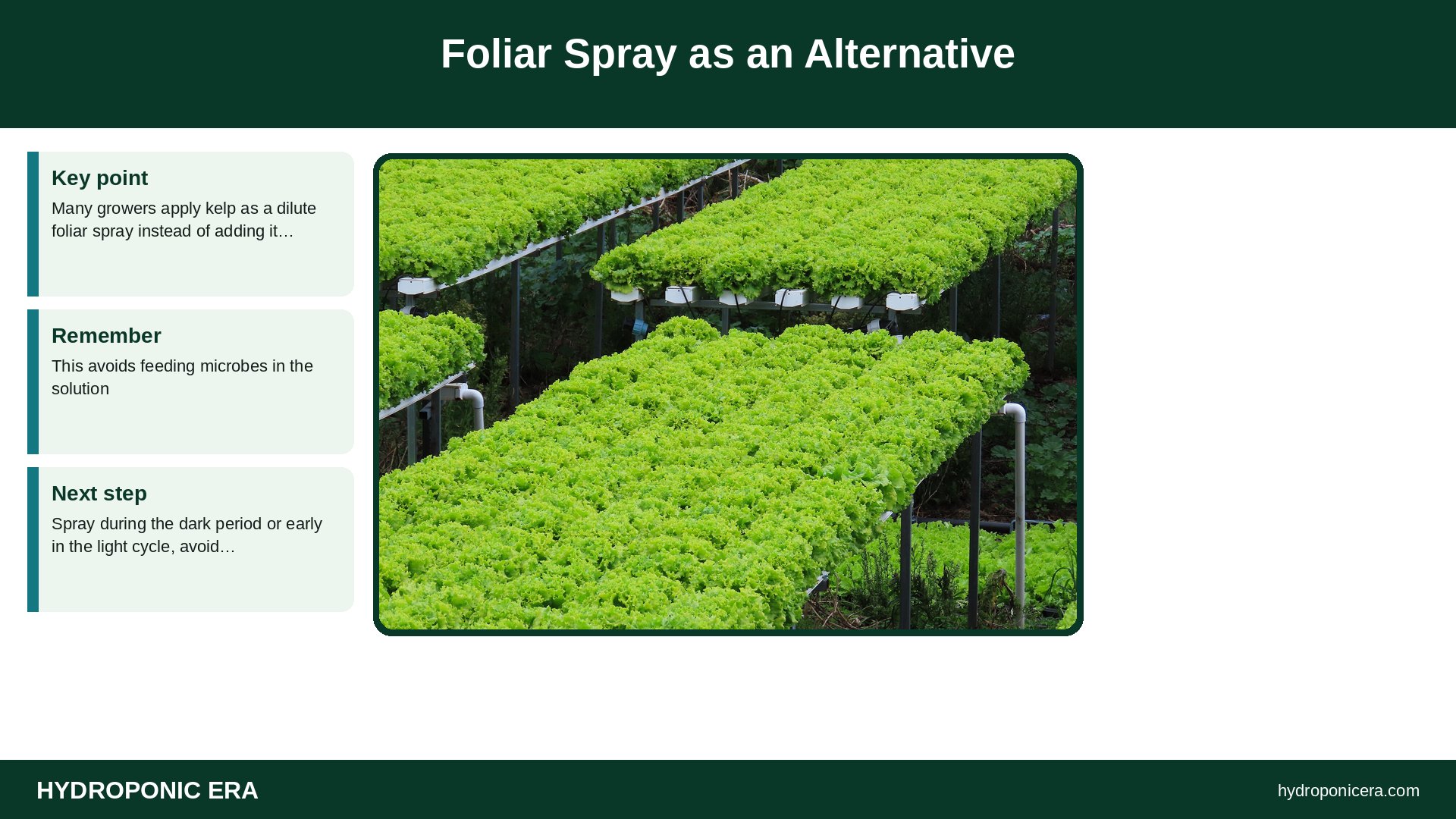
Many growers apply kelp as a dilute foliar spray instead of adding it to the reservoir. This avoids feeding microbes in the solution. Spray during the dark period or early in the light cycle, avoid spraying under hot lights, and test on a few leaves first. See foliar feeding in hydroponics for technique and cautions. Don’t spray leafy greens close to harvest.
Which Systems Tolerate Kelp Best?
| System | Kelp suitability |
|---|---|
| Coco or media, drain-to-waste | Good; organic residues are flushed out |
| Ebb and flow, Dutch buckets | Moderate; monitor for clogs and slime |
| DWC and RDWC | Use cautiously; warm, still water favors microbes |
| NFT and aeroponics | Risky; small channels and nozzles clog easily |
| Kratky | Low doses only; no circulation to keep things fresh |
For the trade-offs between these approaches, see recirculating vs drain-to-waste.
Kelp vs Other Additives

Seaweed extract is one of many optional additives. Silica can strengthen cell walls. Beneficial microbes may help root health. Products like SUPERthrive make various claims. None replace a complete nutrient. If you’re troubleshooting growth problems, start with pH, EC, light, and temperature before buying supplements. See slow growth in hydroponics.
Organic Hydroponics and Kelp
Seaweed extract is common in organic and bioponic nutrient programs, where microbes are expected to break down organic inputs. Those systems are managed differently from mineral-based hydroponics. See organic and bioponic nutrients and sterile vs living root zones.
A Simple Home Test
Want to know whether seaweed extract helps your setup? Grow two identical small reservoirs of the same lettuce variety side by side, under the same light. Add the extract at a low rate to one and nothing to the other. Weigh the heads at harvest and note root color and reservoir clarity. Repeat at least twice before deciding. This takes one or two crop cycles and gives you an answer for your own conditions.
Signs Kelp Is Causing Problems
- Roots turn brown and feel slimy rather than staying firm and white.
- The reservoir smells earthy or sour within a few days.
- Foam builds on the surface under air stones.
- Drip emitters slow down or stop.
If you see these, stop adding the extract, drain and clean the system, and restart with plain nutrient solution. See cleaning and sterilizing.
Kelp Meal vs Liquid Extract
Kelp meal is dried, ground seaweed meant for soil, where it breaks down slowly. It does not dissolve and will clog and foul a hydroponic reservoir, so keep it out of water-based systems. If you want to try seaweed in hydroponics, use a filtered liquid or fully soluble powder extract instead.
FAQs: Kelp in Hydroponics
Can I use liquid kelp in hydroponics?
Yes, at low doses, preferably a product labeled for hydroponics. Monitor for slime, cloudiness, and pH changes.
Does kelp replace hydroponic nutrients?
No. Kelp has low nutrient content. Use it only alongside a complete nutrient.
How much kelp should I add?
Start at a quarter to half of the product’s label rate and observe before increasing.
Is kelp safe for DWC?
It can be used cautiously, but warm, still DWC reservoirs are prone to microbial growth. Keep water cool and aerated.
Is foliar kelp better than adding to the reservoir?
For recirculating systems, foliar application avoids feeding microbes in the solution. Test on a few leaves first.
Sources
- Khan et al. (2009), Journal of Plant Growth Regulation — Seaweed Extracts as Biostimulants of Plant Growth and Development
- Penn State Extension — Hydroponics Systems: Nutrient Solution Programs and Recipes
- Photo credits (Wikimedia Commons, edited with titles): Deep water culture by ArcadiYay (CC BY-SA 4.0); 2009-03-30 Lettuce roots by Ildar Sagdejev (Specious) (CC BY-SA 4.0); Water droplets on a late cotoneaster (Cotoneaster coriaceus) leaf, Jardim da Fundação Calouste Gulbenkian, Lisbon, Portugal julesvernex2 by Jules Verne Times Two (CC BY-SA 4.0); Hydroponic lettuce @ Plaine des Cafres 03 by Rémih (CC BY-SA 4.0); Spathiphyllum wallisii hydroponically grown by Kephalian (CC BY-SA 4.0)