
Why is my hydroponic basil wilting? Hydroponic basil wilting most often comes from root rot. Pythium thrives in warm, low-oxygen water and turns roots brown and soft. Other causes are Fusarium wilt, cold injury below about 40°F (4°C), and plain heat or water stress. Check the roots first, then water temperature, aeration and stem tissue.
Key takeaway: Hydroponic basil wilting usually starts at the roots. Colorado State University Extension says Pythium root rot is the most common root disease in hydroponics, first noticed as wilting, with brown roots and few root hairs. Keep the nutrient solution at 68 to 72°F (20 to 22°C) and well aerated. If roots look clean, check stems for Fusarium wilt’s brown streaks.
| Cause | Key sign | Source |
|---|---|---|
| Pythium root rot | Wilting; brown, soft roots with few root hairs | Colorado State Extension; e-GRO |
| Warm, low-oxygen water | Favors Pythium; aim for 68–72°F (20–22°C) | Colorado State; Univ. of Kentucky |
| Dissolved oxygen | Near saturation (about 8 ppm) reduces Pythium survival | Univ. of Kentucky |
| Fusarium wilt | Stunting and wilting at 8–12 in (20–30 cm) tall; brown stem streaks | Univ. of Maryland Extension |
| Fusarium resistance | ‘Nufar’ and other resistant sweet basils | Rutgers; Univ. of Maryland |
| Cold injury | Leaves blacken at or below about 40°F (4°C) | Rutgers NJAES |
| Downy mildew | Yellowing with gray-purple spores under leaves | Rutgers; e-GRO |
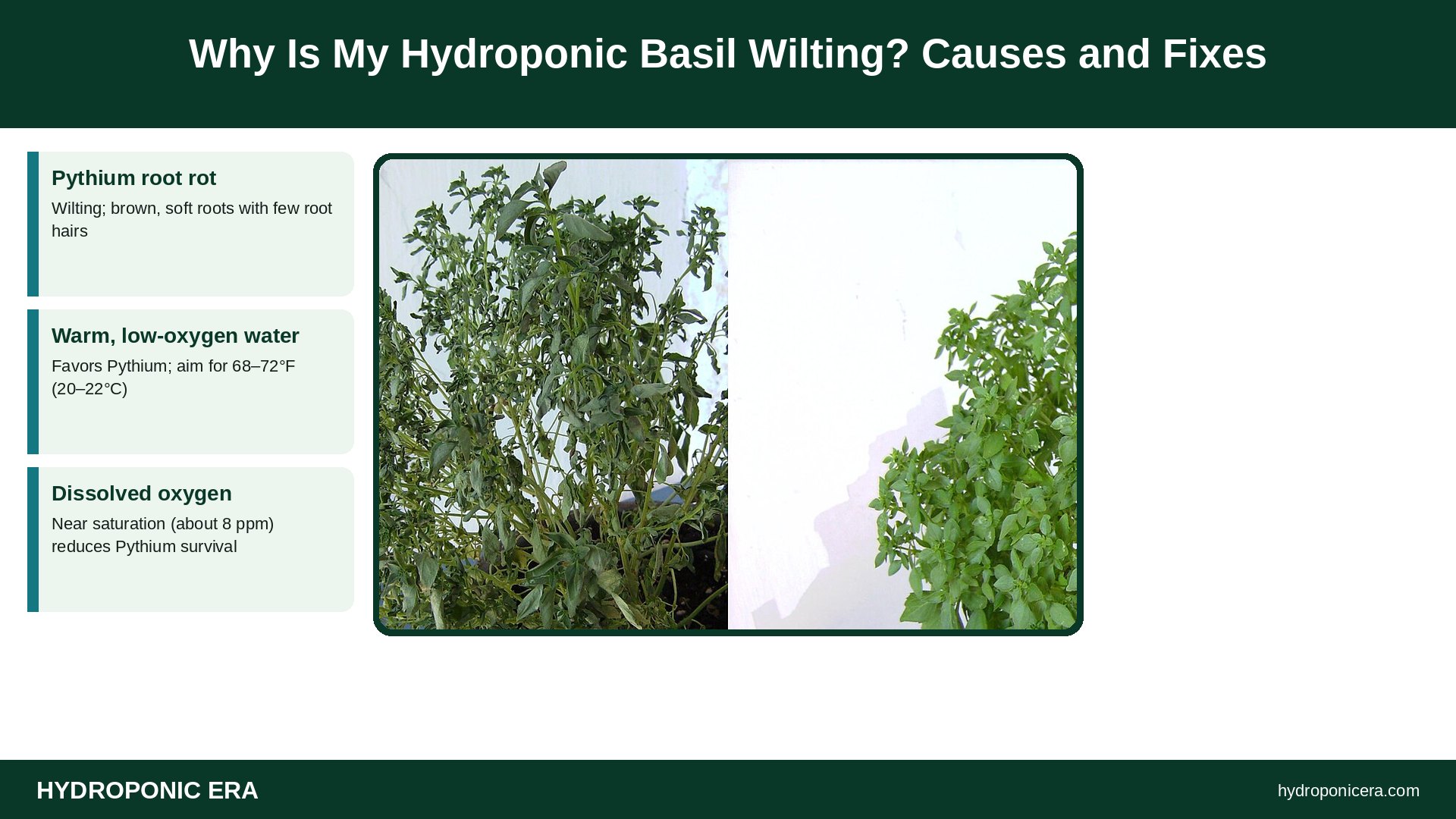
Why Is My Hydroponic Basil Wilting?
Most of the time, the roots are failing. Colorado State University Extension says the most common hydroponic root disease is root rot caused by Pythium, and its symptoms are “usually first noticed as wilting or tip burn.” Roots turn brown with sparse root hairs. Because sick roots cannot move water, hydroponic basil wilting can appear even though the plant sits in water.
Other causes are less common but important. Fusarium wilt blocks water flow inside the stem. Cold drafts and warm, stagnant air also make basil droop. Use the steps below to narrow down hydroponic basil wilting before you change your nutrients.
- Lift a plant and look at the roots.
- Measure the water temperature.
- Check aeration: is the air pump running and the solution moving?
- Look at the lower stem for brown streaks.
- Check the room temperature, especially at night.
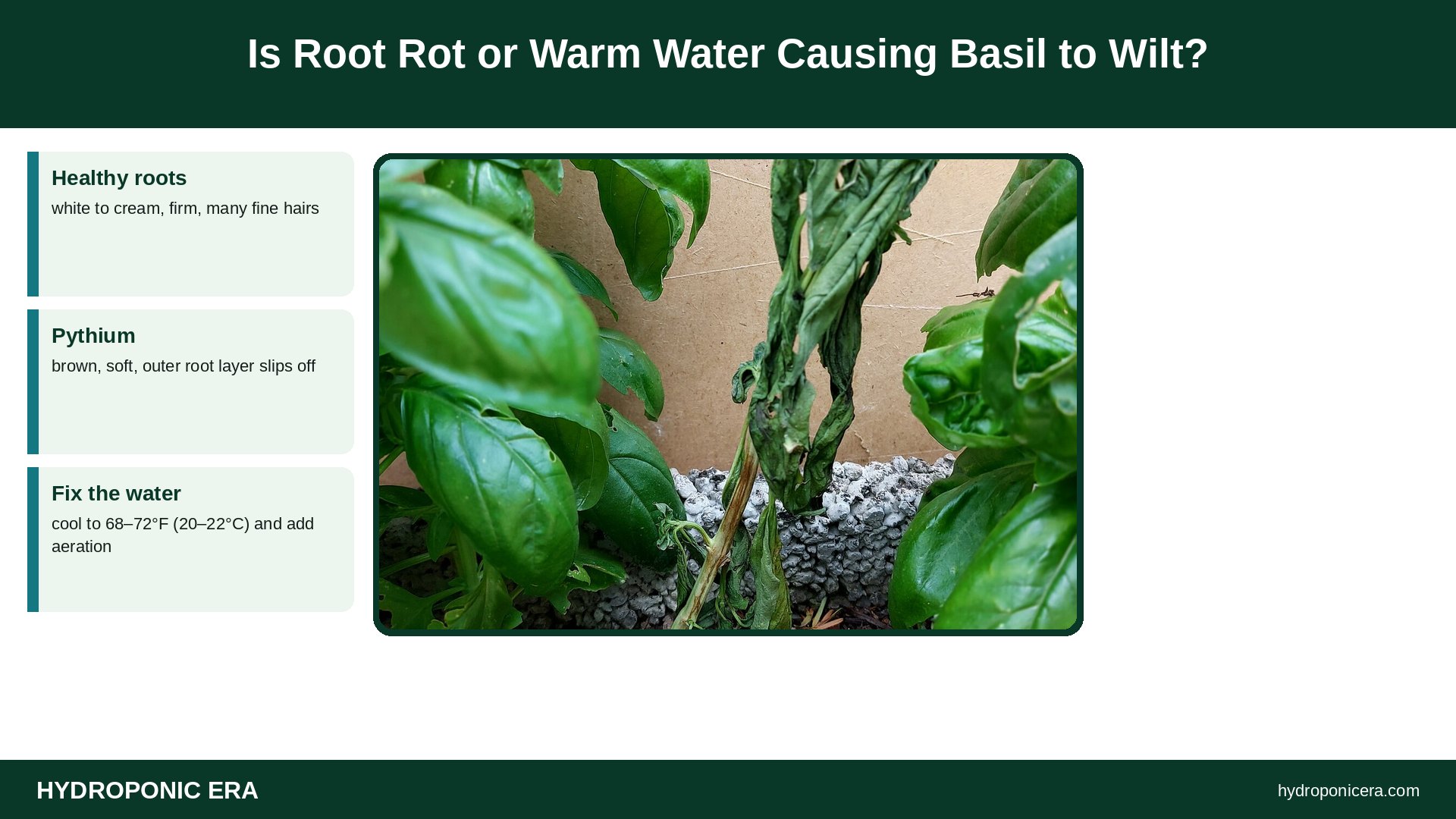
Is Root Rot or Warm Water Causing Basil to Wilt?
Often both, since warm water feeds root rot. The University of Kentucky says Pythium infects root tips, especially roots damaged by low oxygen or high EC, and spreads upward. Infected roots are soft and honey-brown. It adds that keeping dissolved oxygen near saturation, about 8 ppm, and water at 68 to 72°F (20 to 22°C) can slow Pythium, while low oxygen and warmer root zones increase it.
- Healthy roots: white to cream, firm, many fine hairs.
- Pythium: brown, soft, outer root layer slips off.
- Fix the water: cool to 68–72°F (20–22°C) and add aeration.
- Check EC: avoid overfeeding, which Colorado State links to disease.
e-GRO, a university greenhouse network, notes that basil roots infected with Pythium show poor shoot growth and yellowing from poor water and nutrient uptake. See our Pythium root rot guide and basil yellow leaves for related symptoms.
Could Fusarium Wilt Be the Problem?
If roots look healthy, check the stem. University of Maryland Extension says sweet basil with Fusarium wilt usually grows normally until it is 8 to 12 inches (20 to 30 cm) tall, then becomes stunted and wilts. Early signs are brown streaks on lower stems and discolored internal stem tissue. Leaves turn yellow, deformed and drop. The fungus can be seedborne.
- Cut the stem: brown inner tissue points to Fusarium.
- Remove: discard infected plants; do not compost them.
- Clean: disinfect the system before replanting.
- Replant smart: Rutgers lists ‘Nufar’ as resistant; Maryland names Aroma-2, Prospera and Obsession.
Maryland adds that specialty basils such as lemon or purple basil show resistance. Hydroponic basil wilting from Fusarium is rare in clean indoor systems, but the seedborne route means it can happen.
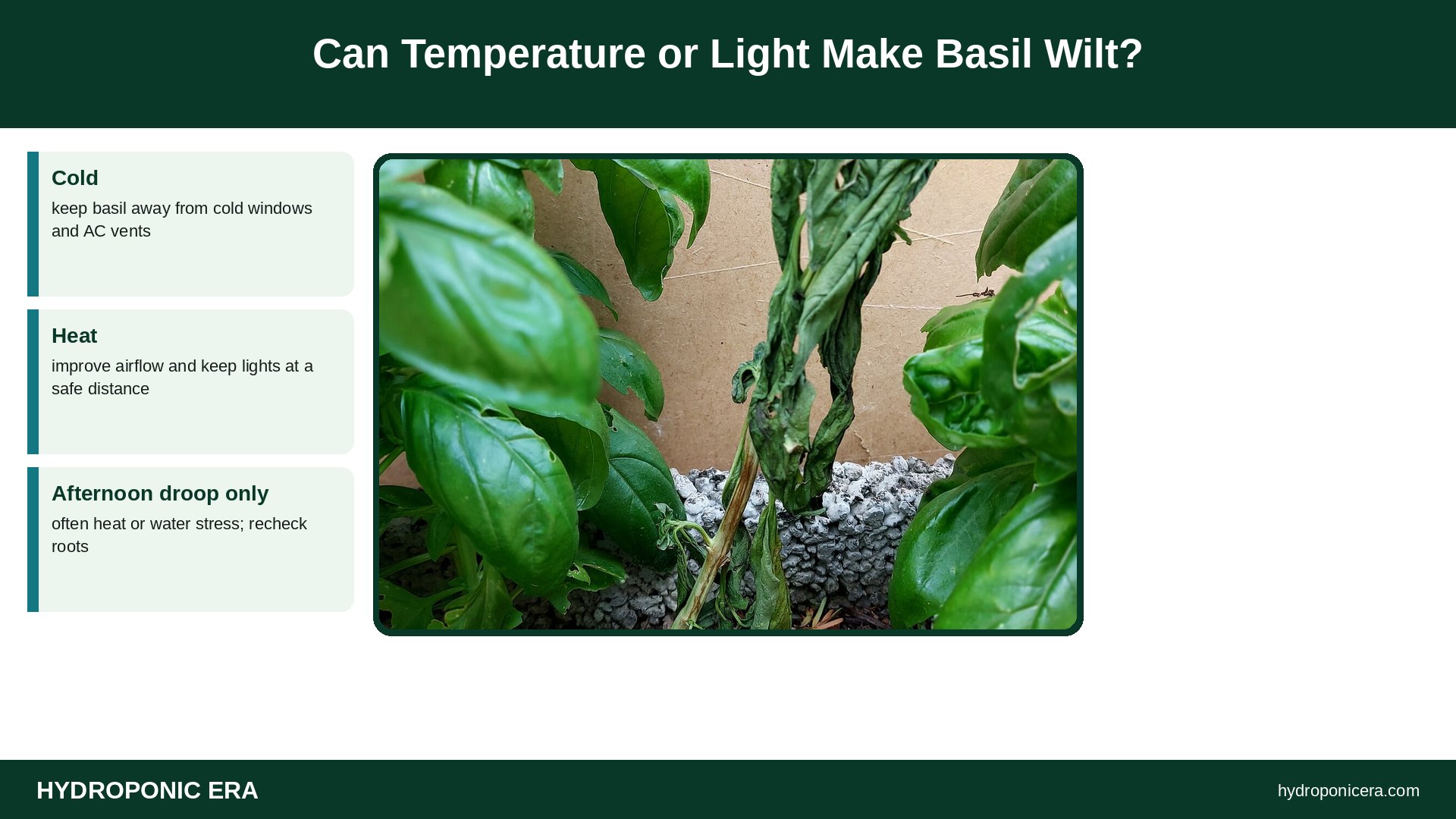
Can Temperature or Light Make Basil Wilt?
Yes. Basil is a warm-season plant that dislikes cold. Rutgers NJAES says basil shows cold injury and turns black if temperatures drop below about 40°F (4°C), and it prefers warm conditions. In a hot grow tent, the opposite problem can happen: leaves lose water faster than stressed roots can replace it, so hydroponic basil wilting shows up in the afternoon.
- Cold: keep basil away from cold windows and AC vents.
- Heat: improve airflow and keep lights at a safe distance.
- Afternoon droop only: often heat or water stress; recheck roots.
For the cold-damage look, see basil leaves turning black.
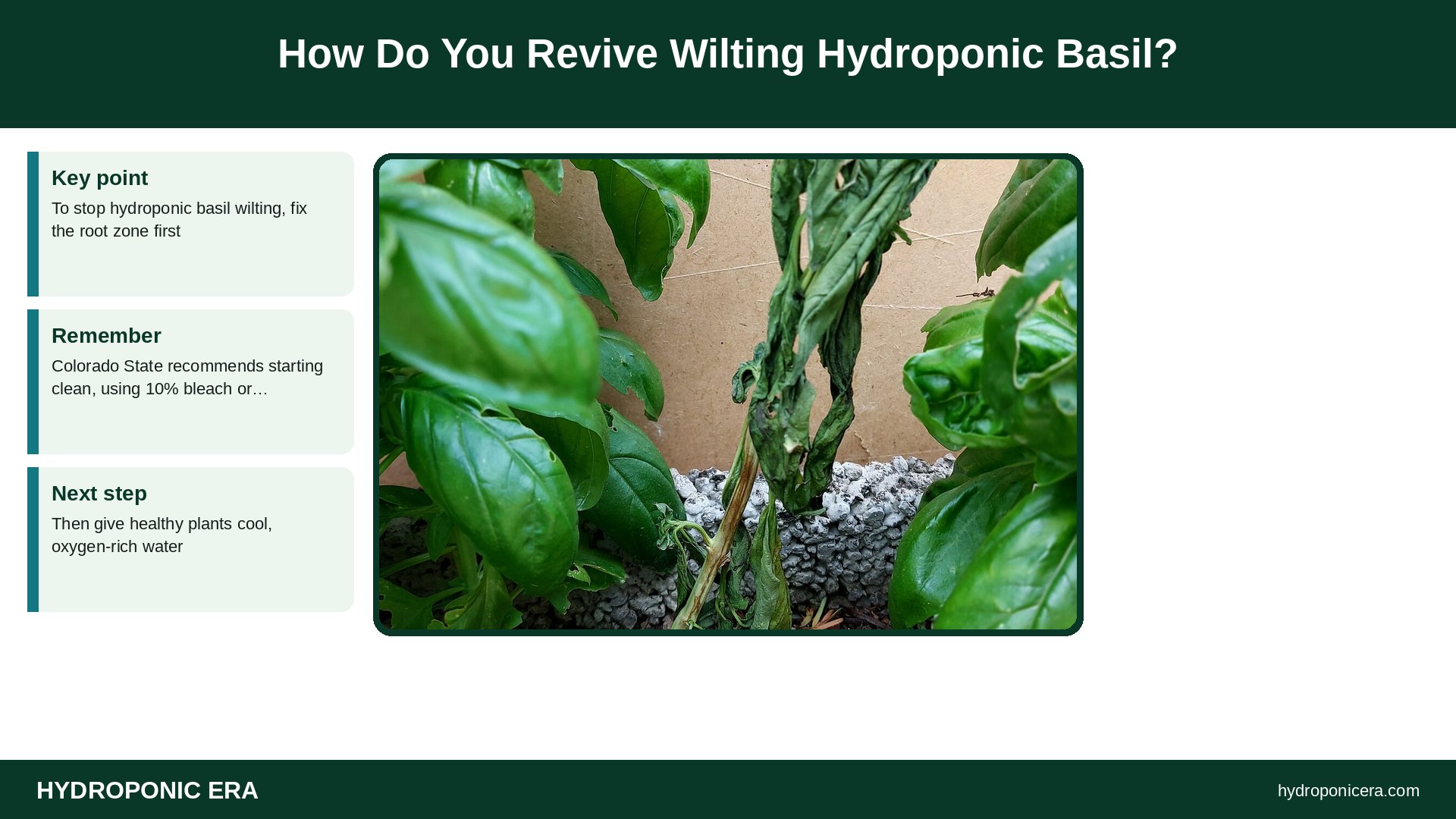
How Do You Revive Wilting Hydroponic Basil?
To stop hydroponic basil wilting, fix the root zone first. Colorado State recommends starting clean, using 10% bleach or hydrogen peroxide products made for hydroponics to disinfect trays and rafts, following labels. Then give healthy plants cool, oxygen-rich water. Plants with a few white roots left can recover; plants with completely brown roots rarely do.
- Remove plants with fully brown, mushy roots.
- Trim dead roots on plants that still have white ones.
- Drain, clean and disinfect the reservoir and channels.
- Refill with fresh solution at your normal EC.
- Cool the water to 68–72°F (20–22°C) and run an air stone.
- Lightly prune tops so damaged roots support less leaf area.
Cuttings from healthy tips will root in water; see rooting basil in water and our basil hydroponics guide.
FAQ About Hydroponic Basil Wilting
What causes hydroponic basil wilting?
Usually Pythium root rot linked to warm, low-oxygen water.
What water temperature does basil need?
About 68–72°F (20–22°C) helps slow root rot.
Can wilted basil recover?
Yes, if some roots are still white and firm.
How do I know if it is Fusarium?
Look for brown streaks and brown inner stem tissue.
Can cold make basil wilt?
Yes; it is damaged at about 40°F (4°C).
Should I add hydrogen peroxide?
Use labeled hydroponic products to clean systems.
Sources
- Colorado State University Extension — Root Disease Problems & Management in Hydroponic Systems
- University of Kentucky (e-GRO) — Root disease management in hydroponic systems
- e-GRO — Common diseases of hydroponic leafy greens and herbs
- University of Maryland Extension — Fusarium Wilt in Basil
- Rutgers NJAES — Ultra-Niche Crops Series: Fresh-Market Basil
- Photo credits (Wikimedia Commons, edited with titles): Basil marcida56-horz by Victor M. Vicente Selvas (Public domain); Basilikum Fusarium-Schlaghecken by Schlaghecken Josef (CC BY-SA 4.0)