
Why is my parsley turning yellow? Parsley turning yellow usually means one of four things: a second-year plant finishing its life cycle, nitrogen shortage (older leaves yellow first), soggy roots, or a leaf disease such as Septoria leaf spot. Check the plant’s age, which leaves are yellow, the roots, and whether there are brown spots.
Key takeaway: Parsley turning yellow is most often age, hunger or wet roots. University of Minnesota Extension says parsley is biennial: in its second year it sends up a seed stalk and dies. UNH Extension says nitrogen deficiency yellows the whole leaf on older leaves first, while iron deficiency starts on the youngest leaves. Brown spots point to Septoria leaf spot.
| Clue | Likely cause | Source |
|---|---|---|
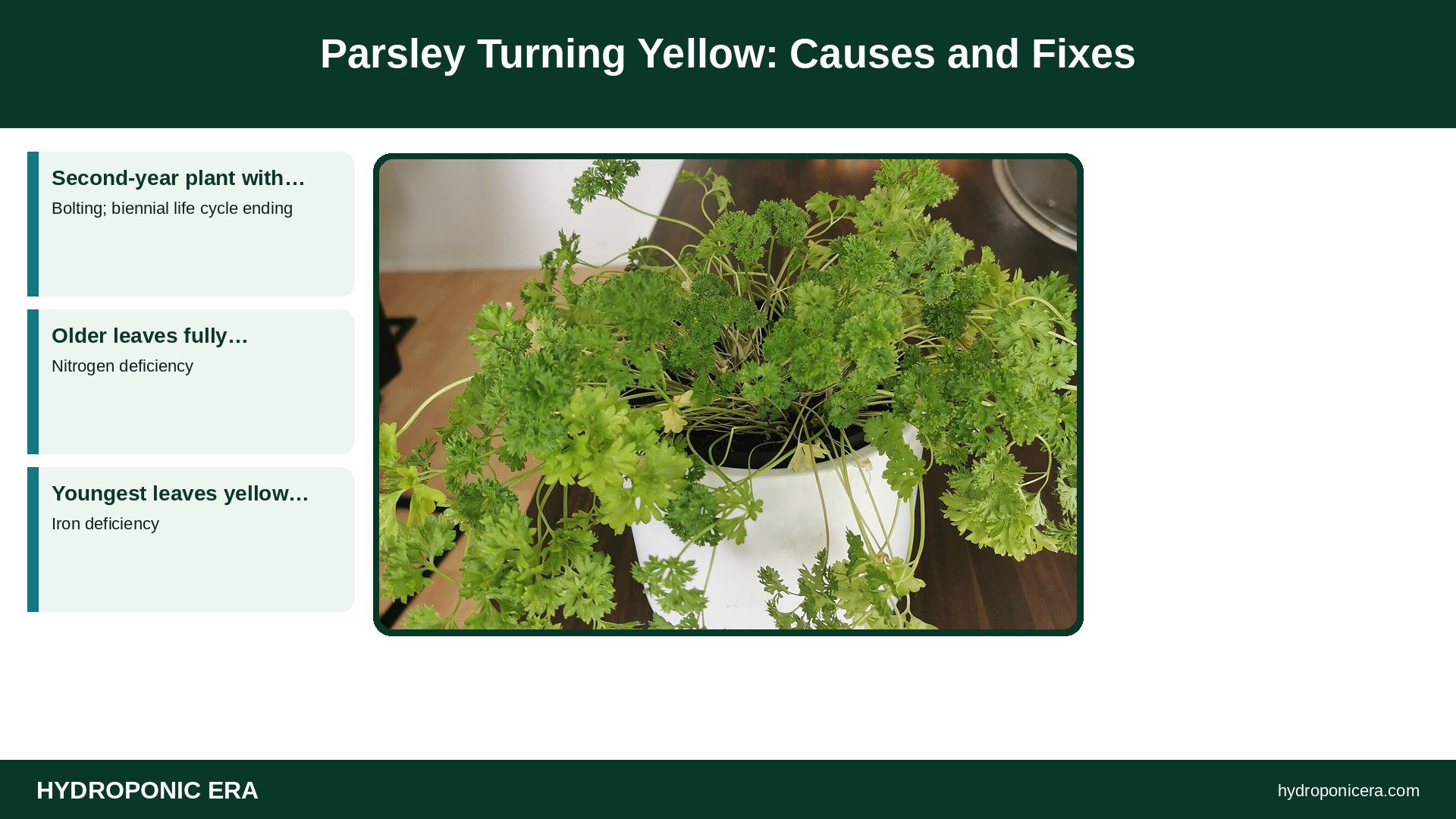
| Second-year plant with a flower stalk | Bolting; biennial life cycle ending | UMN Extension |
| Older leaves fully yellow | Nitrogen deficiency | UNH Extension |
| Youngest leaves yellow between veins | Iron deficiency | UNH Extension |
| Small gray-brown angular spots | Septoria leaf spot (seedborne fungus) | PNW Disease Handbook |
| Spreads in | Moist conditions, 50–86°F (10–30°C) | PNW Disease Handbook |
| Indoor feeding | Half-strength liquid fertilizer every 4–6 weeks | UMN Extension |
| Light | 6–8 hours of direct light | UMN Extension |
Why Is My Parsley Turning Yellow?
Start by asking which leaves are yellow and how old the plant is. Parsley turning yellow all over in its second spring, while it sends up a tall stalk, is normal aging. Yellow lower leaves on a young plant suggest hunger. Yellow leaves with brown spots suggest disease. Wilting yellow plants with dark, mushy roots point to root rot.
- Check age: did the plant overwinter or is it more than a year old?
- Check position: are the old outer leaves or the new center leaves yellow?
- Check for spots or specks on leaves and stems.
- Check roots and drainage.
- Check light: indoor parsley often gets too little.
Is Parsley Bolting in Its Second Year?
Very likely, if it is older than a year. University of Minnesota Extension says parsley has a biennial life cycle, though most gardeners grow it as an annual. You can harvest until the plant sends up a seed stalk and dies, and second-year leaves taste more bitter. Parsley turning yellow during flowering cannot be reversed.
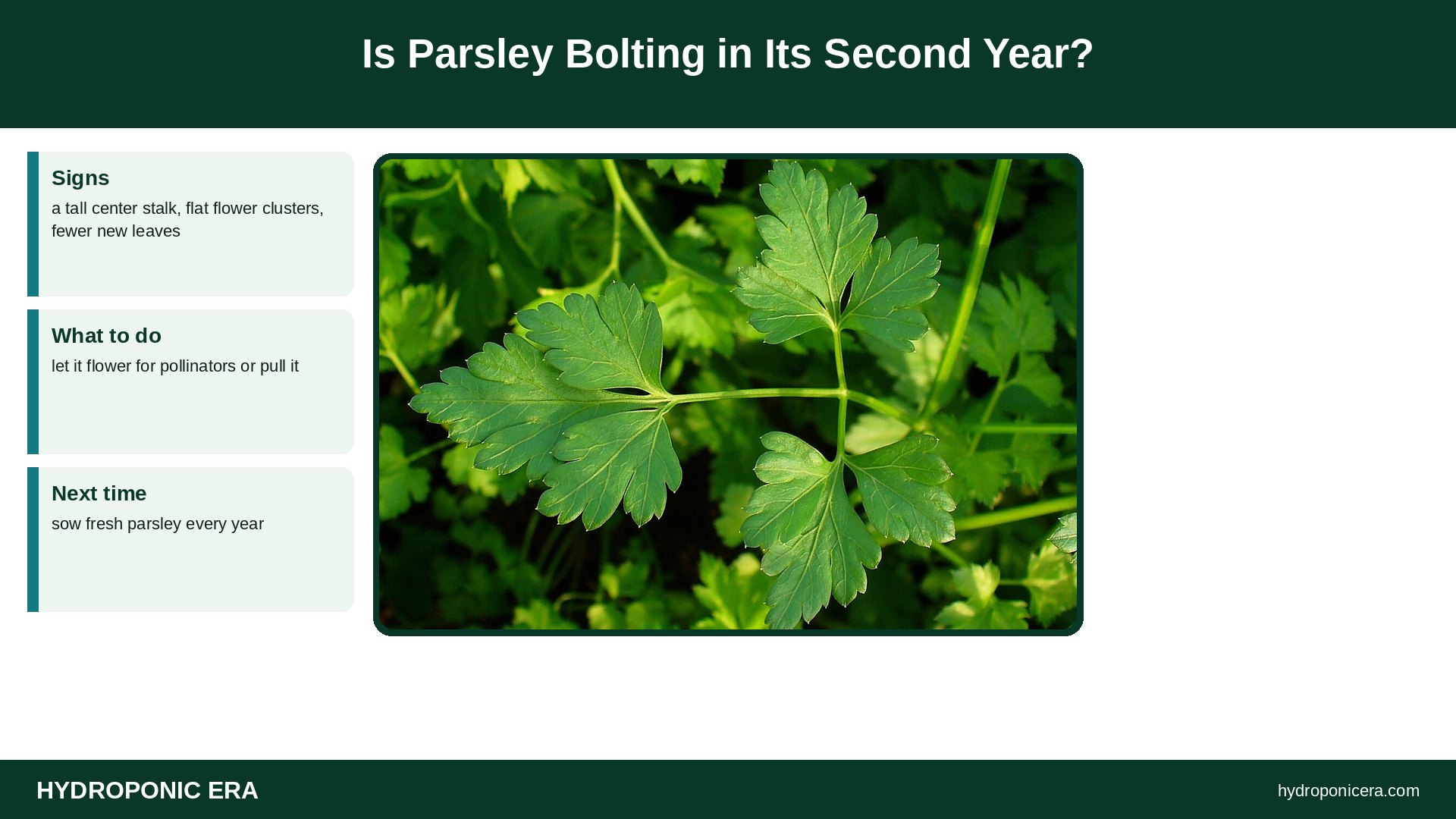
- Signs: a tall center stalk, flat flower clusters, fewer new leaves.
- What to do: let it flower for pollinators or pull it.
- Next time: sow fresh parsley every year.
UMN notes that seed is slow, taking two to five weeks to sprout, and that soaking it in warm water for up to 24 hours helps. Fresh hydroponic parsley is easy to restart; see how to grow parsley hydroponically. For another herb that bolts, see cilantro bolting.
How Do You Fix Nutrient Yellowing?
Match the pattern to the nutrient. UNH Extension says nitrogen deficiency makes older leaves turn yellow over the whole leaf, and recommends checking fertilizer strength. Iron deficiency shows first on the youngest leaves as yellowing between green veins and is tied to high pH. Parsley turning yellow from the bottom up on a young plant is usually nitrogen.
- Old leaves yellow: feed with a balanced fertilizer; in hydroponics, check EC.
- New leaves yellow, green veins: check pH and add chelated iron.
- Pots indoors: UMN suggests half-strength liquid fertilizer every 4 to 6 weeks.
- Pots outdoors: half strength every 3 to 4 weeks.
See our iron deficiency guide and chelated iron for hydroponics for the iron fix.
Could Overwatering or Root Rot Be the Cause?
Yes, especially in pots. UMN says parsley grows best in well-drained soil and indoors needs pots with drainage holes. Roots sitting in water lose oxygen and rot, so parsley turning yellow and wilting together is a warning sign. Healthy roots are pale and firm; rotten ones are brown and soft.
- In soil: water deeply but let the top dry slightly; never let pots sit in water.
- In hydroponics: keep the solution aerated and cool.
- Badly rotted: replace the plant and clean the pot.
Our Pythium root rot guide covers the hydroponic version.
Is It Septoria Leaf Spot?
If yellow leaves also have spots, it may be. The Pacific Northwest Plant Disease Management Handbook says Septoria petroselini causes small, grayish-brown, angular spots, sometimes with tiny dark specks. The fungus can be seedborne, survives on plant debris, and spreads in moist conditions from 50 to 86°F (10 to 30°C). It also warns that infected plants can cause skin rashes, so wear gloves.
- Remove: pick off and bag spotted leaves.
- Keep leaves dry: water the soil, not the foliage.
- Clean seed: buy from a reputable source.
- Resistant types: the handbook lists ‘Plain Dark Green Italian’ and ‘Improved Market Gardener’ as resistant.
Does Low Light Make Parsley Turn Yellow?
Low light makes parsley weak and pale. UMN recommends six to eight hours of direct light and notes that indoor parsley may be spindly because light is lower. Pale, stretched growth with yellowing lower leaves indoors often improves under a grow light. Harvest outer stalks at the base, as UMN advises, so the plant keeps producing.
- Indoors: a bright south window or a grow light.
- Harvest: cut outer stems near the base.
See grow lights for indoor plants to pick a fixture.

FAQ About Parsley Turning Yellow
Why is my parsley turning yellow at the bottom?
Usually nitrogen deficiency or normal loss of old leaves.
Can yellow parsley turn green again?
Yellow leaves will not; new growth recovers once the cause is fixed.
Is parsley turning yellow in spring normal?
Yes, if it is a second-year plant starting to flower.
Should I cut off yellow leaves?
Yes, cut them at the base.
Can I eat yellow parsley?
Avoid spotted or diseased leaves.
How often should I feed indoor parsley?
Half-strength liquid fertilizer every 4–6 weeks (UMN).
Sources
- University of Minnesota Extension — Growing parsley in home gardens
- University of New Hampshire Extension — Scouting & Managing Greenhouse Nutrient Problems
- Pacific Northwest Plant Disease Management Handbook — Parsley: Septoria Leaf Spot
- Photo credits (Wikimedia Commons, edited with titles): Parsley plant in a pot 04 by Netha Hussain (CC BY-SA 4.0); Petroselinum crispum 003 by H. Zell (CC BY-SA 3.0)