
How do you get rid of duckweed? To get rid of duckweed, net or rake it off often, dispose of it away from the water, and cut the nutrients that feed it. Penn State Extension says aeration that ruffles the surface pushes it to the edges for easier removal. Treat early, before it covers the whole pond.
Key takeaway: The fastest way to get rid of duckweed is steady physical removal plus less nutrient input. Penn State Extension says duckweed thrives in nutrient-rich, still water and can cover a pond and lower oxygen when it dies. Texas A&M AquaPlant lists raking or seining, tilapia in warm months, and several labeled herbicides as options.
| Method | What it does | Source |
|---|---|---|
| Net, rake or skim | Removes plants and the nutrients in them | Penn State Extension |
| Surface aeration or fountain | Pushes duckweed to the edges; it prefers still water | Penn State Extension |
| Cut nutrient runoff | Long-term prevention | Penn State Extension |
| Limit ducks and geese | They carry duckweed between ponds | Penn State Extension |
| Tilapia (warm months only) | Eat duckweed; die below 55°F (13°C) | Texas A&M AquaPlant |
| Koi and goldfish | Eat some, but not enough to control it | Ask Extension (MSU) |
| Grass carp | Weak duckweed feeders | Penn State; Ask Extension |

Why Is Duckweed Taking Over My Tank or Pond?
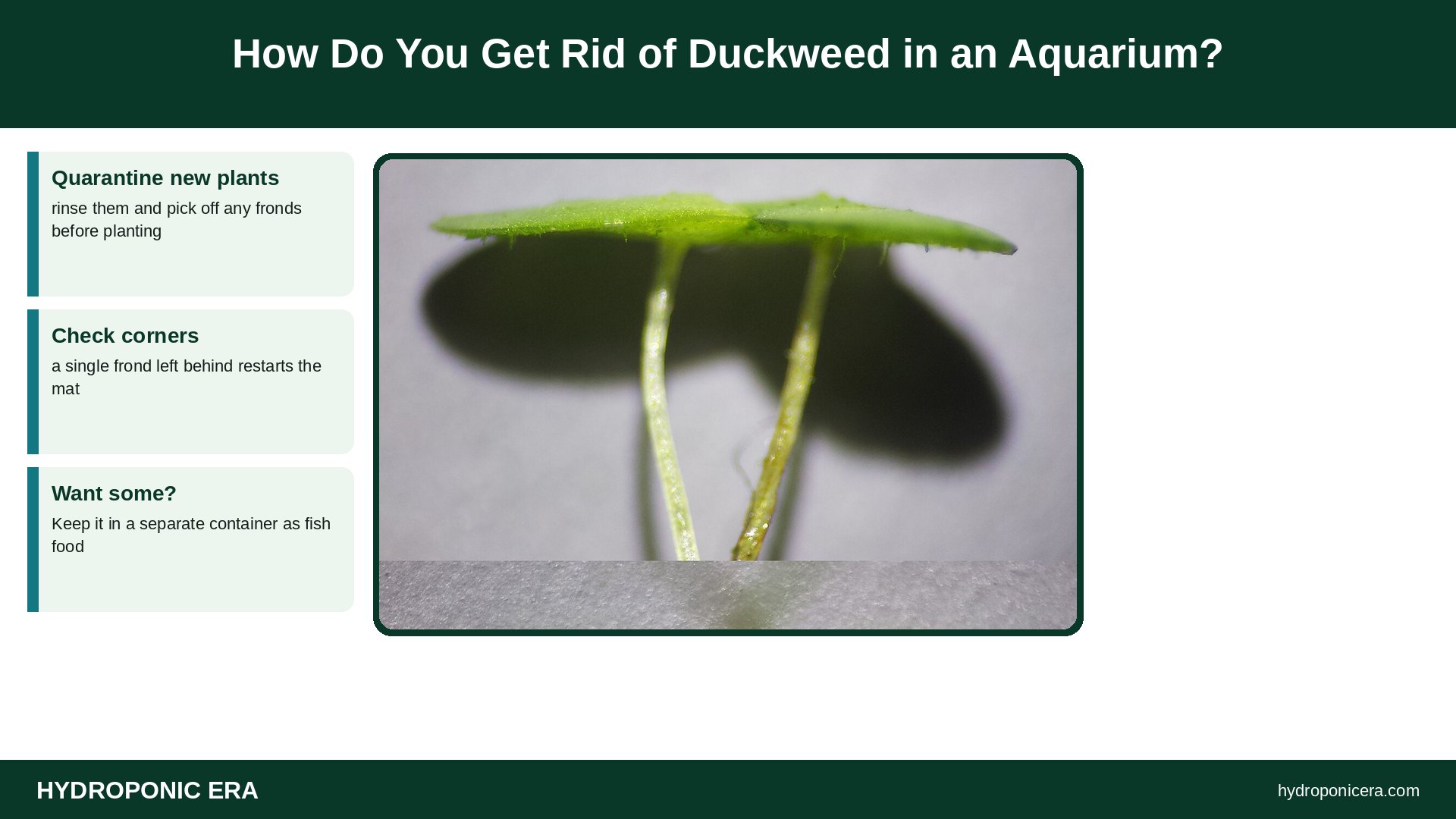
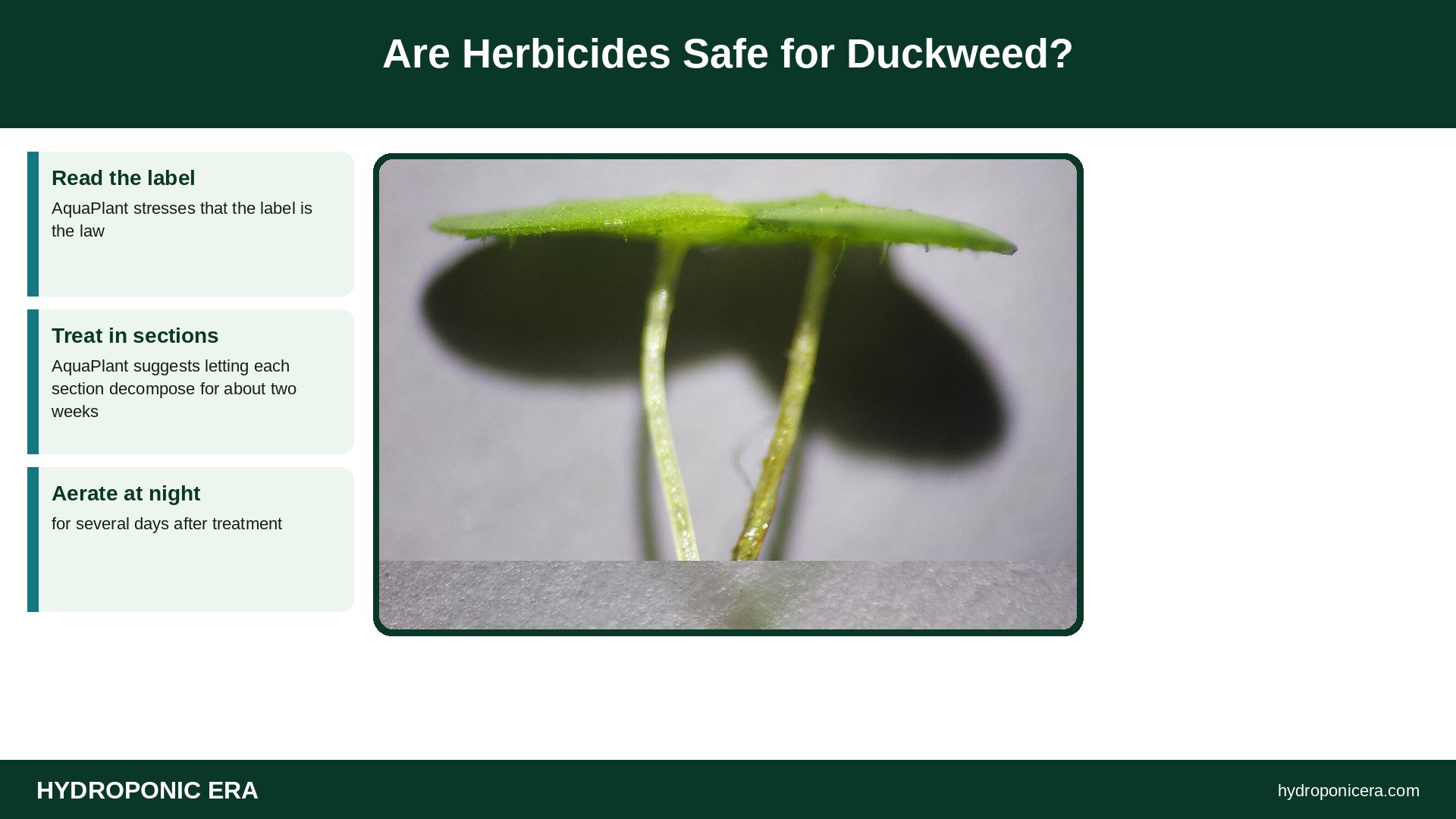
Duckweed explodes when water is still and rich in nutrients. Penn State Extension says it is common in nutrient-rich ponds with little flow and reproduces by budding and fragmentation, so a few plants quickly become a mat. Each frond is only about 2 to 6 mm, roughly the size of a pencil eraser.
- Excess nutrients: runoff from lawns, fields or septic systems; in tanks, overfeeding.
- Still water: no surface movement.
- Hitchhikers: ducks and geese carry it on feathers, and it rides in on new plants.
Penn State warns that a full mat blocks sunlight, cuts oxygen exchange and lowers dissolved oxygen when plants die and decay. See our pond aeration guide for adding surface movement.

How Do You Get Rid of Duckweed for Good?
To get rid of duckweed, combine methods. Penn State says using several management methods together usually works best, and it is better to act before duckweed covers most of the pond. To get rid of duckweed in a small pond, physical removal is very effective because it also takes out the nutrients stored in the plants.
- Skim with a fine net, pool skimmer or rake every few days.
- Dump it well away from the pond so rain and wind cannot carry it back. It makes good compost.
- Add a fountain or aerator to break the surface.
- Reduce nutrients: no fertilizer near the edge, keep buffer strips, fix runoff.
- Keep up removal; regrowth from a few fronds is fast.
A Michigan State Extension educator on Ask Extension also suggests floating black plastic over a heavy patch for 10 to 14 days to shade it out. For muck that feeds it, see pond muck removal and our pond skimmer guide.
How Do You Get Rid of Duckweed in an Aquarium?
In a tank, get rid of duckweed by hand and starve it. Scoop it with a fish net during each water change, and turn the filter outlet so it ripples the surface. Duckweed feeds on dissolved nutrients, so cutting extra fish food and keeping up water changes slows it. This is general aquarium practice rather than a published study.
- Quarantine new plants: rinse them and pick off any fronds before planting.
- Check corners: a single frond left behind restarts the mat.
- Want some? Keep it in a separate container as fish food.
If you want to grow it on purpose, see how to grow duckweed and duckweed as fish food.
Which Fish Eat Duckweed?
Some fish eat it, but few control it. Texas A&M AquaPlant says tilapia consume duckweed but cannot survive below 55°F (13°C), so they work only in warm months and need state approval in some places. An Ask Extension answer from Michigan State says koi and goldfish feed on duckweed but not extensively.
- Tilapia: effective in warm water; check your state’s rules first.
- Koi and goldfish: nibble it; helpful in small ponds, not a cure.
- Grass carp: Penn State says they usually cannot eat enough and prefer other plants; they also need a state permit.
- Ducks: AquaPlant says they eat it but seldom control it.
See goldfish aquaponics if you keep goldfish in a pond system.
Are Herbicides Safe for Duckweed?
Herbicides can get rid of duckweed, but use them carefully. AquaPlant rates carfentrazone, fluridone, flumioxazin and penoxsulam as excellent and diquat as good on duckweed, based on U.S. Army Corps of Engineers trials. Penn State notes that Pennsylvania requires a state permit, and AquaPlant warns that decaying plants can deplete oxygen and kill fish.
- Read the label: AquaPlant stresses that the label is the law.
- Treat in sections: AquaPlant suggests letting each section decompose for about two weeks.
- Aerate at night for several days after treatment.
- Never in aquariums or ponds that drain into other waters without checking rules.
FAQ About How to Get Rid of Duckweed
What kills duckweed naturally?
Steady netting, surface movement and fewer nutrients.
Will duckweed go away on its own?
Rarely while nutrients stay high; it often dies back in winter.
Does a fountain help get rid of duckweed?
Yes; it pushes duckweed to the edges for removal.
Do koi eat duckweed?
Some, but not enough to control it.
Is duckweed bad for fish?
A full mat can lower oxygen when it dies.
How fast does duckweed spread?
Quickly in warm, still, nutrient-rich water.
Sources
- Penn State Extension — Duckweed and Watermeal
- Texas A&M AgriLife AquaPlant — How to Control Duckweed
- Ask Extension (Michigan State University) — Duckweed on a pond
- Photo credits (Wikimedia Commons, edited with titles): Pond covered with Duckweed, near Westcroft, Staffordshire – geograph.org.uk – 391877 by Roger Kidd (CC BY-SA 2.0); Lemna minor sl7 by Stefan.lefnaer (CC BY-SA 4.0)