
How do you add pond aeration? Pond aeration adds or mixes oxygen so fish and beneficial bacteria do not run short. Small ponds use a surface fountain or aerator for emergency oxygen. A diffuser, which pumps air to the bottom through an air stone, is the most efficient way to mix the water and prevent low-oxygen layers.
Key takeaway: Pond aeration matters most in hot summer weather, after storms and when algae or plants die off. If fish gasp at the surface at sunrise, aerate immediately. Install circulation before the pond stratifies, run it day and night, and cut nutrient runoff.
| Method | Best use | Limits |
|---|---|---|
| Diffuser (air stone and compressor) | Circulating the whole pond, preventing layers | Needs electricity and an air line |
| Surface fountain | Looks, limited circulation | Least efficient at preventing layers |
| Surface aerator | Emergency oxygen | Does not mix deep water well |
| Water pump | Moving water over the surface | Clogs, uses more energy |
| Emergency mixing | Splash water into the air | Temporary only |

Why Does a Pond Need Aeration?
Oxygen enters ponds from the air and from algae and plants, and fish, plants and microbes use it up. Mississippi State University Extension says low oxygen is by far the most frequent cause of fish kills in farm ponds. Hot weather, cloudy days, dense plant growth, a sudden die-off of plants or algae, overfeeding and heavy rain can all make oxygen drop.
Warm water also holds less oxygen, which is why problems peak in July through September.
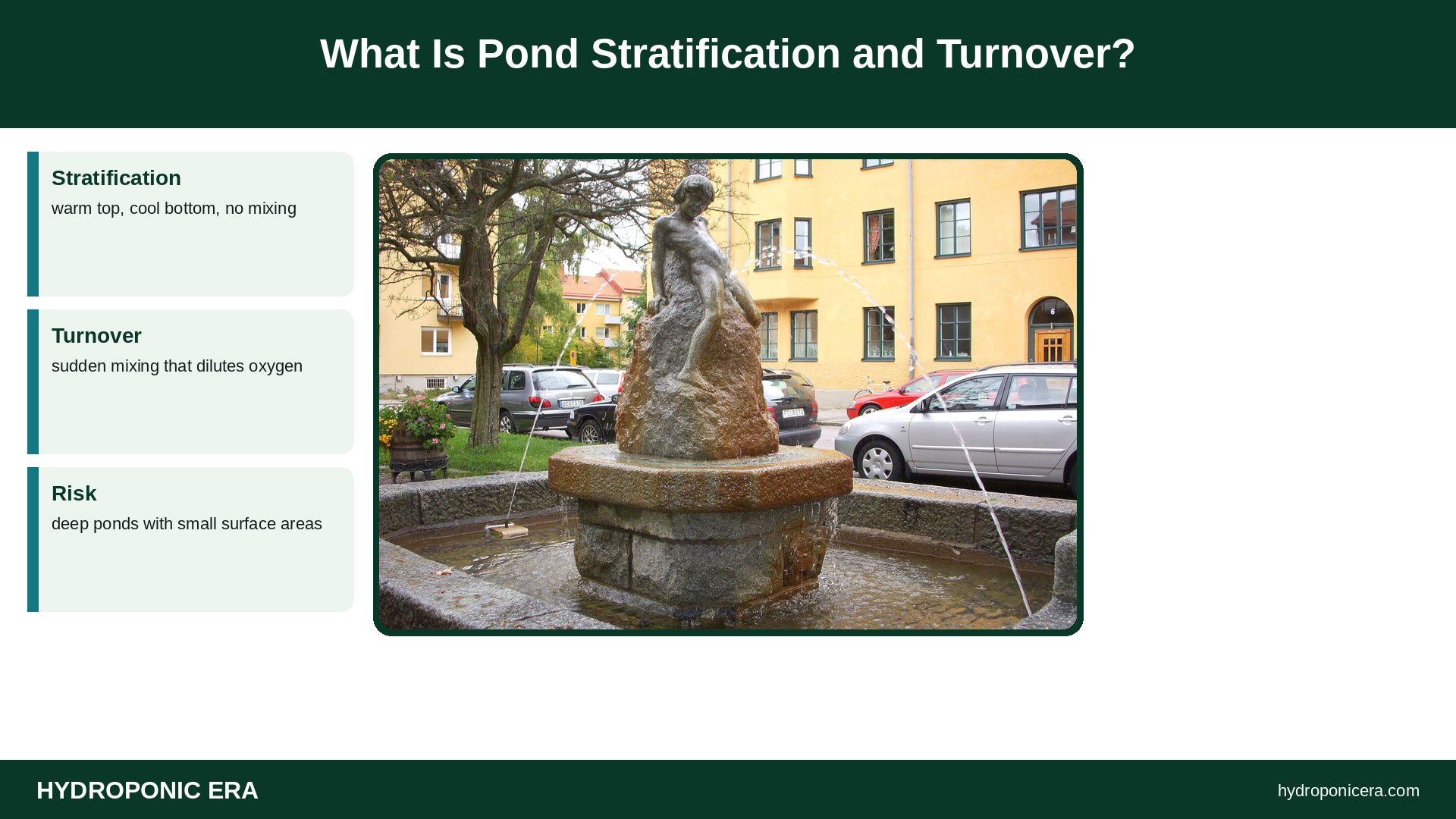
What Is Pond Stratification and Turnover?
On calm, hot days, the sun warms the surface, and the warm water floats on cool water below. These layers do not mix, so the bottom layer slowly loses oxygen. A heavy, cold rain or strong wind can mix the layers suddenly, and oxygen drops through the whole pond. Clemson Extension says rapid turnovers often coincide with storms.
- Stratification: warm top, cool bottom, no mixing.
- Turnover: sudden mixing that dilutes oxygen.
- Risk: deep ponds with small surface areas.
How Do You Know You Need Pond Aeration Now?
Look for fish at the surface at sunrise, appearing to gasp for air. Mississippi State says that is an early symptom, and by the time most owners notice, it may be too late. Other signs are a rotten-egg smell, a bright green bloom or recent die-off of weeds after treatment. Start emergency aeration at once.
- Run a fountain, aerator or pump to move air and water.
- Add a diffuser if you have one, and turn it on gradually.
- Stop feeding fish, and stop adding organic matter.
- Call a fisheries biologist after a severe kill.
As an emergency step, Mississippi State suggests tilting a boat outboard motor to throw a spray of water through the air. Any technique that mixes water and air helps.
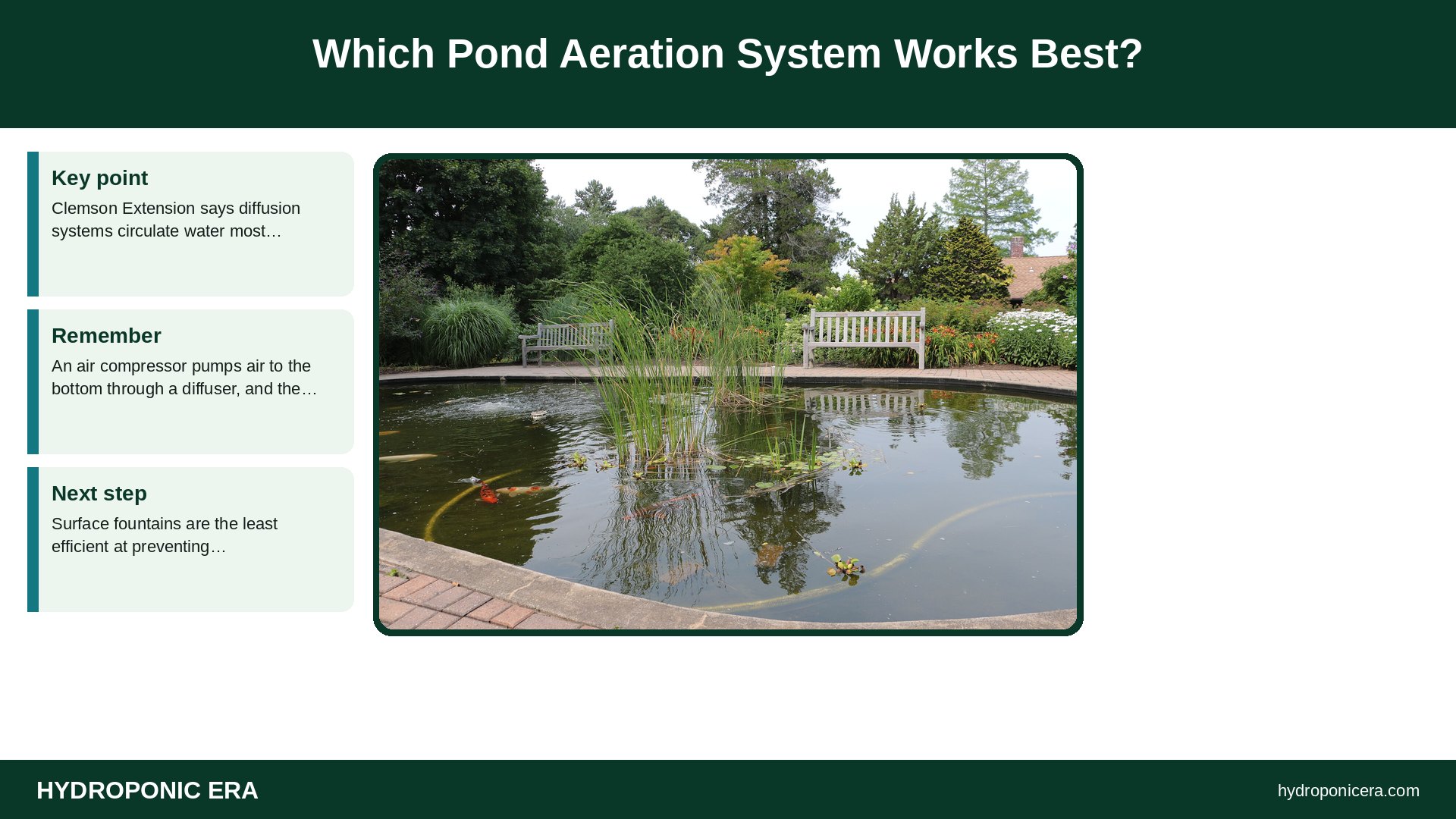
Which Pond Aeration System Works Best?
Clemson Extension says diffusion systems circulate water most efficiently. An air compressor pumps air to the bottom through a diffuser, and the rising bubbles lift deep water to the surface. Surface fountains are the least efficient at preventing stratification, since they mostly circulate surface water that is already oxygenated. Water pumps work but clog and use more energy.
Always follow the manufacturer’s sizing advice. Clemson notes that one diffuser unit can circulate a one to two acre pond, and that shallow or oddly shaped ponds may need more. For a small backyard pond, a small compressor and air stone is often enough.
When Should You Run Pond Aeration?
Install circulation before the pond stratifies, from late fall through early spring, Clemson says. If you start in summer, begin with short runs, such as 10 minutes a day for two weeks, to avoid causing a turnover. To prevent stratification, run the unit day and night, and avoid stop-start schedules. Most ponds mix naturally in fall and may not need it from November to March in mild climates.
Does Pond Aeration Reduce Algae?
It helps, but nutrient control matters more than pond aeration alone. Circulation can disrupt blue-green algae blooms that need still water, and oxygenating the bottom reduces rotten-egg gas and slows nutrient release from muck. It does not stop algae when nutrients keep coming in. Clemson recommends no fertilizer on bank slopes, keeping weeds below 20% of the surface and not feeding fish, ducks or turtles.
Does Pond Aeration Help in Winter?
It can. Kentucky Department of Fish and Wildlife says that when ice and snow cover a pond for a long time, sunlight cannot reach the algae, which can die and cause a winter kill. An aerator mixes oxygen into the water and keeps the area around it from freezing over. Ponds that winter-kill often may benefit from pond aeration.
Keep the unit away from thin ice near the edges, and never walk on ice around it.
Should You Aerate Before Using Herbicide?
Plan for oxygen first. Kentucky advises never treating more than one-third of a pond’s vegetation at once, and waiting at least two weeks between treatments, because decaying plants use up oxygen. Pond aeration in the days after treatment gives fish a safer margin. Use only products labeled for aquatic use, and read the label for restrictions.
Fountain-style units can increase evaporation, which matters in ponds with low summer water levels, while bubble-style units do not splash as much. For help with stocking and oxygen needs, see our fish farming for beginners guide.
What Are the Drawbacks of Pond Aeration?
Pond aeration can stir sediment and cloud the water, increase shoreline erosion if placed too close to the bank, and cost electricity. It also does not control existing weeds. Plan for power, placement and maintenance before you buy. For temperature and oxygen links, see our guide to reservoir temperature, and for plant cover see water lilies in containers.
FAQ About Pond Aeration
Do small ponds need aeration?
Not always, but ponds with fish, heavy plants or algae often benefit.
What is the best aerator for a pond?
A diffuser is the most efficient at circulating the whole pond.
Should I run it all the time?
To prevent stratification, yes, day and night.
Can aeration cause fish kills?
If started suddenly in a layered pond, it can cause a turnover. Start gradually.
Do fountains aerate ponds?
Only a little. They mostly move surface water.
Sources
- Clemson Cooperative Extension — Aeration, circulation and fountains
- Mississippi State University Extension — Fish kills
- Kentucky Department of Fish & Wildlife — Farm pond management: troubleshooting common pond problems
- Photo credits (Wikimedia Commons, edited with titles): Small pond with aerating fountain – geograph.org.uk – 6559394 by Christine Johnstone (CC BY-SA 2.0); Fontändamm Aspudden 2012 by Holger.Ellgaard (CC BY-SA 3.0); Deep Cut Gardens Koi Pond by FossilDS (CC0); Koi in a garden pond in Tuntorp 3 by W.carter (CC BY-SA 4.0)
1 thought on “Pond Aeration: 6 Easy Ways to Add Oxygen to a Small Pond”