
Can you grow a taro plant in water? Yes. A taro plant (Colocasia esculenta) grows in wet soil or shallow standing water, and its large leaves suit container water gardens. But wild taro is invasive in Florida, and raw plant parts cause irritation. Check your state’s rules, keep it in a pot and never release it.
Key takeaway: A taro plant thrives with wet roots and warm weather but is invasive in Florida and spreads where it escapes. Grow it in a contained pot, wear gloves when handling, never eat it raw and bring it indoors when temperatures fall below 59°F (15°C).
| Question | Answer | Source |
|---|---|---|
| Invasive status in Florida | Invasive, found statewide | UF/IFAS |
| Share of Florida public waters | About 55% | UF/IFAS |
| Dormancy temperature | Below 59°F (15°C) | ECHO |
| Raw plant safety | Irritating, cook edible varieties | USDA, ECHO |
| Control of escaped plants | Remove the whole rhizome | UF/IFAS |
What Is a Taro Plant?
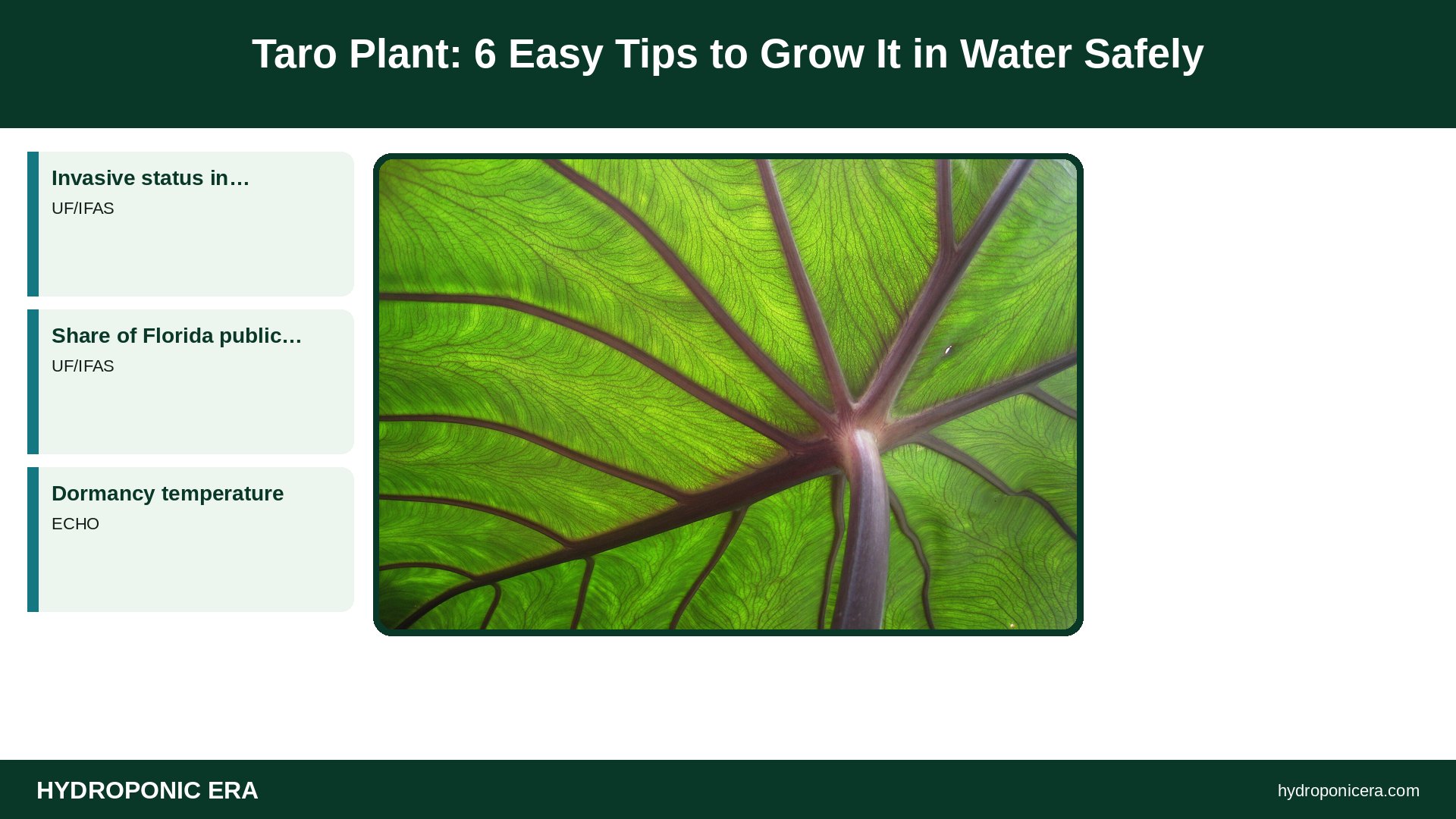
A taro plant is a tropical perennial in the arum family, grown for its heart-shaped “elephant ear” leaves and starchy corms. USDA describes it as a wetland herbaceous perennial that can reach 8 feet (2.4 m) tall under ideal conditions, with more than 200 cultivars selected for food or ornamental foliage.
It grows from corms, which are swollen underground stems, and the foliage emerges once the weather warms. That same vigor is why it is invasive in some places.
Is a Taro Plant Invasive?
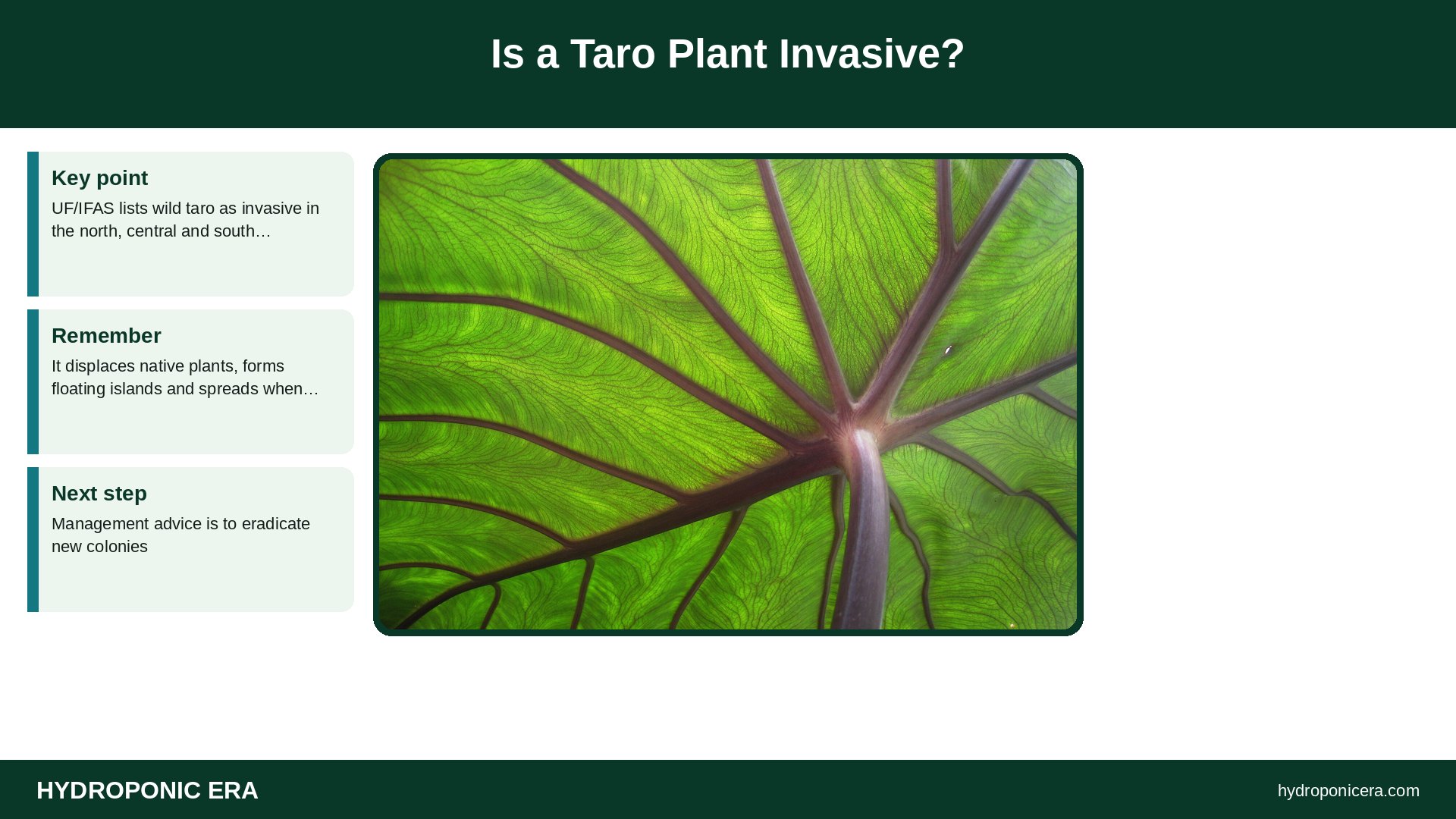
In Florida, yes. UF/IFAS lists wild taro as invasive in the north, central and south regions and says it is present in about 55% of the state’s public waters. It displaces native plants, forms floating islands and spreads when roots fragment. Management advice is to eradicate new colonies. Check your state’s invasive plant list before planting.
- Assessed as invasive in all three Florida zones, per UF/IFAS.
- Spread by shoreline fragments and floating mats.
- Always keep it contained and discard trimmings in the trash.
How Do You Grow a Taro Plant in Water?
- Pick a large pot or tub with no leaks.
- Set the corm in the soil with the top upward.
- Use heavy soil, and keep it saturated, or stand the pot in a few inches of water.
- Place it in full sun to part shade, and keep the water moving or fresh.
- Feed lightly, since taro is often grown without fertilizer.
Taro’s high water need makes it a good fit for water gardens, according to USDA. Water supply matters most in the first months, when most of the shoot grows, ECHO notes.
What Temperature Does a Taro Plant Need?
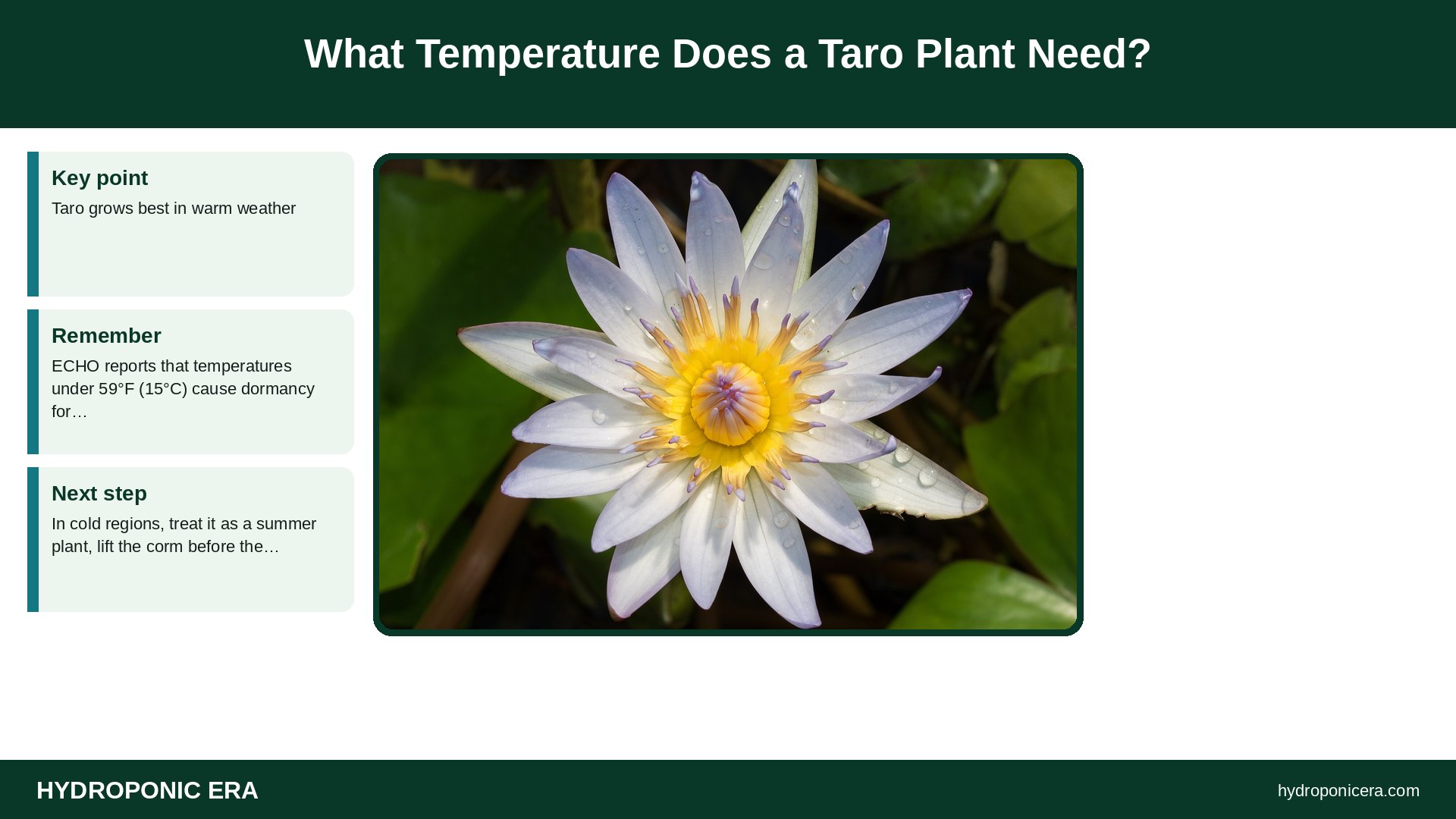
Taro grows best in warm weather. ECHO reports that temperatures under 59°F (15°C) cause dormancy for most cultivars, and frost kills the plants. In cold regions, treat it as a summer plant, lift the corm before the first frost and store it in a cool, frost-free place. Plant again only after the last frost.
Is a Taro Plant Safe to Touch or Eat?
Handle it with care. USDA says all parts of taro can cause stomach aches if eaten uncooked, and contact with the sap can irritate sensitive skin. ECHO explains that edible aroids must be processed because of calcium oxalate crystals. UF/IFAS notes the oxalic acid in the plant can irritate when you hand-pull it.
- Wear gloves when dividing or pulling plants.
- Never eat ornamental taro raw.
- Keep plants away from pets and young children.
- Wash hands and tools after handling.
How Do You Remove or Control a Taro Plant?
Remove the whole rhizome. UF/IFAS says hand pulling works if you take out the entire rhizome, since leftover pieces regrow. Floating mats can be harvested, but roots fragment into new plants. Escaped colonies in public waters may need professional management and herbicides labeled for aquatic use.
What Are the Two Types of Taro Plant?
ECHO divides taro into lowland varieties, grown in flooded paddies, and upland varieties, grown in regular beds. USDA says wetland taros are the source of poi, while upland taros produce many small corms used like potatoes. Not all kinds tolerate flooding, so ask the seller whether your plant is a wetland type before you stand the pot in water.
Ornamental cultivars with purple-black or speckled leaves are usually sold as elephant ears. They share the same needs and the same invasive risk.
What Pests and Diseases Affect a Taro Plant?
Few pests bother it, but ECHO lists aphids, leafhoppers, beetles and apple snails as concerns on crop plants, with bacterial soft rot and leaf blight as the main diseases. In a home pot, watch for aphids and yellow, collapsing stems. Remove affected leaves, improve airflow and replace soil that stays foul. See our aphid control guide for options.
Using clean, healthy planting material is the best protection, ECHO says. Avoid planting soft or damaged corms, and keep tools clean when you divide a clump.
How Do You Overwinter a Taro Plant?
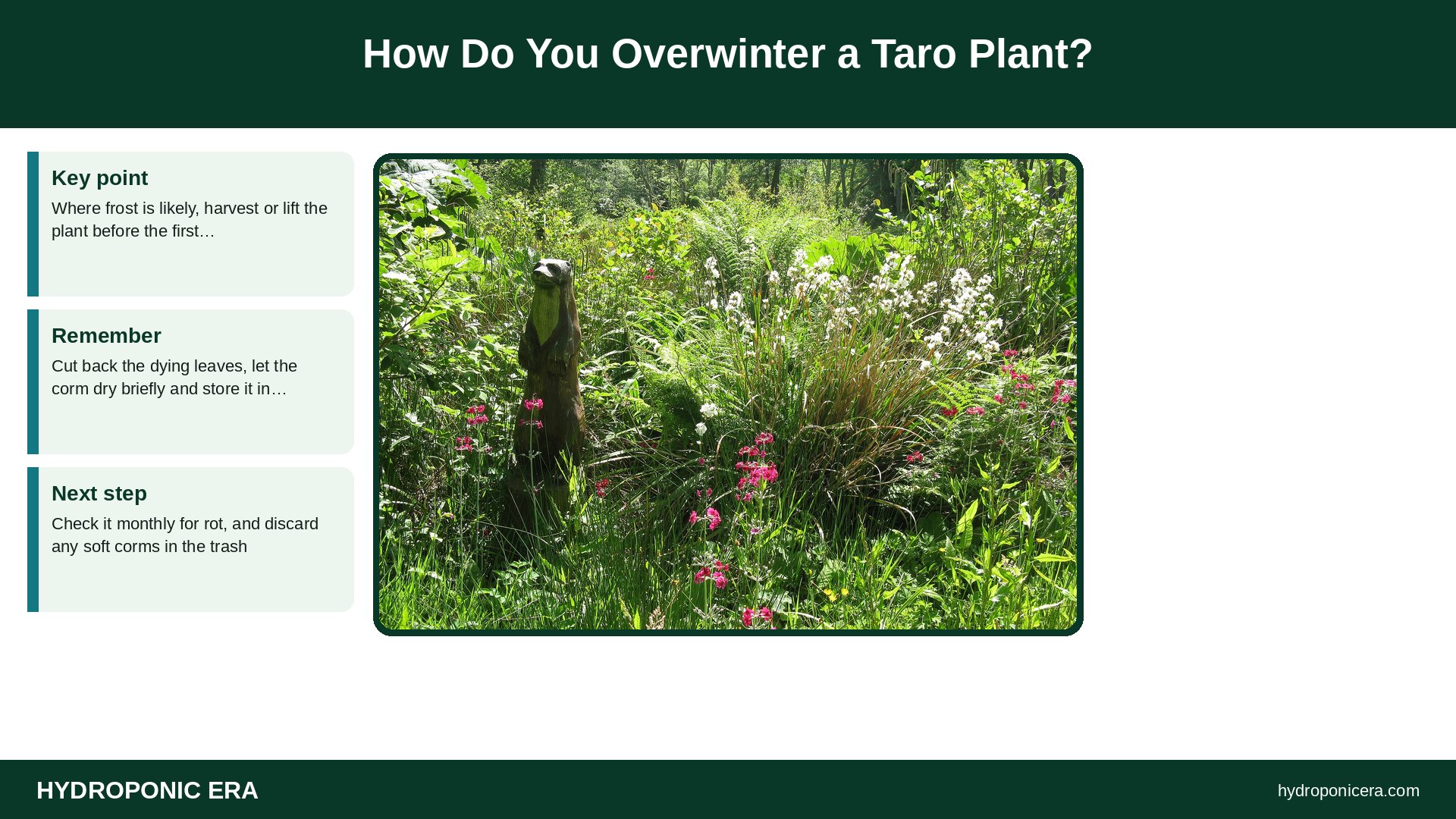
Where frost is likely, harvest or lift the plant before the first frost, as ECHO advises for taro crops, and keep it somewhere frost-free. Cut back the dying leaves, let the corm dry briefly and store it in slightly damp, cool material, such as peat or sand, away from freezing. Check it monthly for rot, and discard any soft corms in the trash.
Alternatively, bring the whole taro plant pot into a bright room and keep the soil wet. Growth will slow when temperatures fall, and the plant may drop leaves and go dormant. Replant in spring after the last frost, once the weather is warm again.
What Can You Plant Instead of a Taro Plant?
If you live in Florida or another state that restricts it, choose well-behaved plants. Potted water lilies and native marginal plants add structure without taking over. See our guides to water lilies in containers and azolla, and check local lists first. For plant nutrition basics, read our hydroponics for beginners guide.
FAQ About Taro Plant
Is a taro plant a good pond plant?
It looks tropical, but it is invasive in Florida, so check local rules.
Can a taro plant grow in just water?
It needs soil or a growing medium, with the roots in wet soil or shallow water.
Is it poisonous?
It irritates if eaten raw and the sap can irritate skin.
When should I bring it indoors?
Before temperatures fall below 59°F (15°C).
How do I remove it?
Pull the entire rhizome and put it in the trash.
Sources
- UF/IFAS Center for Aquatic and Invasive Plants — Wild taro
- UF/IFAS Assessment — Colocasia esculenta
- USDA NRCS — Taro plant guide
- ECHO — Taro (Colocasia esculenta)
- Photo credits (Wikimedia Commons, edited with titles): Taro leaf underside, backlit by sun – edit by Taro_leaf_underside,_backlit_by_sun.jpg: Avenue Derivative work: Avenue (talk) (CC BY-SA 3.0); Taro leaf underside, backlit by sun – edit by Taro_leaf_underside,_backlit_by_sun.jpg: Avenue Derivative work: Avenue (talk) (CC BY-SA 3.0); Daubeny’s water lily at BBG (50824) by Rhododendrites (CC BY-SA 4.0); Pond-edge plants at Achamore Garden – geograph.org.uk – 5446824 by M J Richardson (CC BY-SA 2.0)
1 thought on “Taro Plant: 6 Easy Tips to Grow It in Water Safely”