
Can you grow hydroponic pandan? Yes. Pandan tolerates waterlogged ground, so a rooted offshoot can grow in deep water culture, Kratky or a wet soilless pot. Give it warmth, bright indirect light or under 4 hours of direct sun, and harvest older leaves from the bottom. Divide offshoots to make new plants.
Key takeaway: Hydroponic pandan works because Pandanus amaryllifolius is a tropical, waterlog-tolerant plant. Singapore’s NParks says it does well with less than 4 hours of direct sun or 6–8 hours of indirect light and spreads by offshoots. Start from a rooted offshoot, keep it warm and indoors in cold months, and harvest the older lower leaves cut-and-come-again style.
| Fact | What sources report | Source |
|---|---|---|
| Species | Pandanus amaryllifolius, native to Southeast Asia | NParks |
| Water tolerance | Waterlog-tolerant; thrives in waterlogged areas | NParks GardeningSG |
| Light | Under 4 h direct sun or 6–8 h indirect | NParks GardeningSG |
| Size | Shrub 3.3–5.2 ft (1–1.6 m) or small tree to 14.8 ft (4.5 m) | NParks Flora & Fauna Web |
| Leaves | 0.8–2 in (2–5 cm) wide, 10–30 in (25–75 cm) long on shrubs | NParks Flora & Fauna Web |
| Propagation | Division of rooted offshoots | NParks GardeningSG |
| Pests | Aphids, mealybugs, whiteflies, spider mites when stressed | NParks GardeningSG |
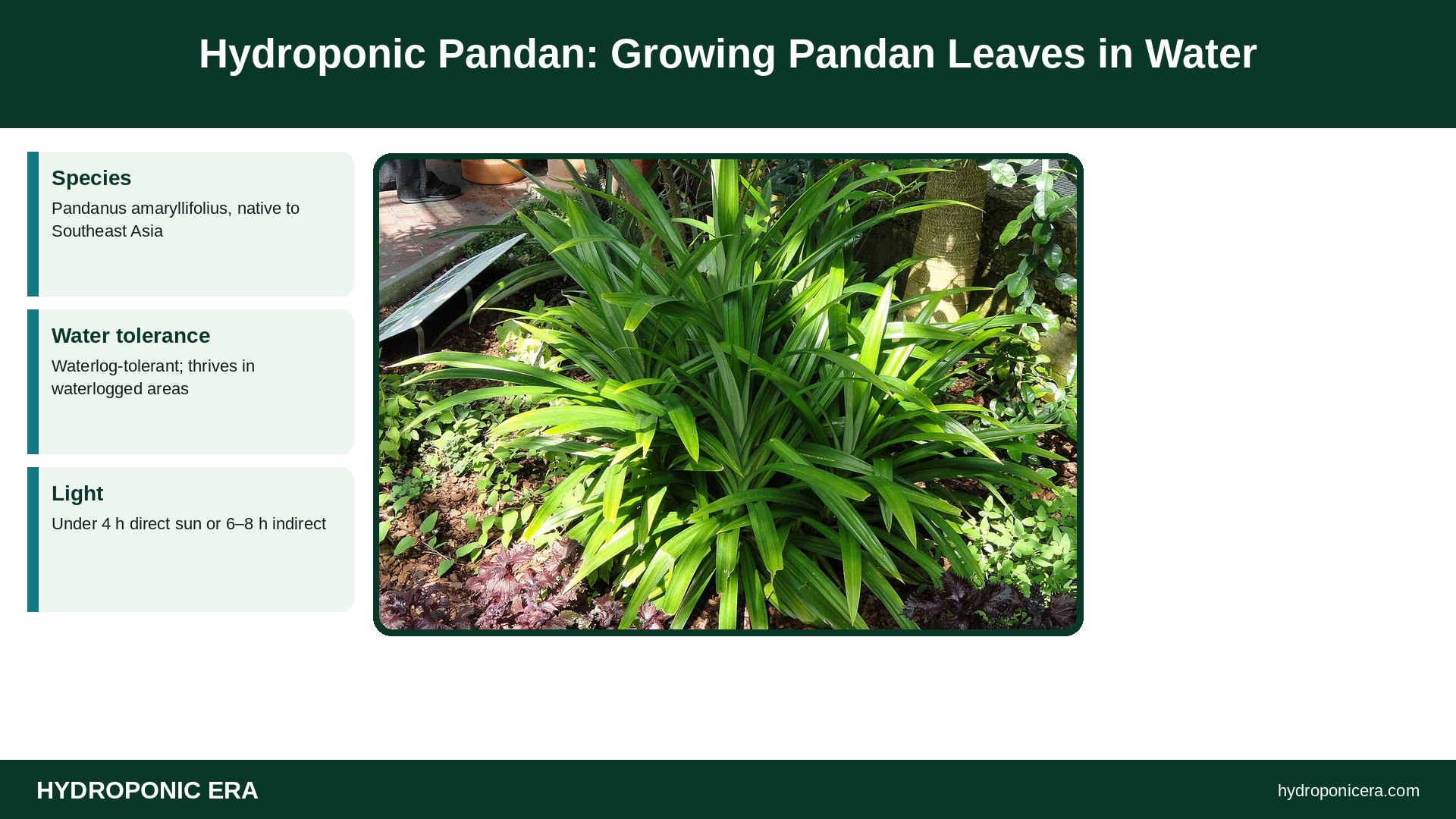
Can You Grow Pandan Hydroponically?
Yes. NParks lists pandan as waterlog-tolerant and says it thrives in heavily waterlogged areas and along large waterbodies. A plant that handles wet ground is a good match for water culture. It also has a shallow root system and grows well in pots, which suits a bucket, tote or large jar.
No published hydroponic trial for pandan turned up in our research, so the setup below is our own method built from its known needs. Treat hydroponic pandan like other tropical leaf crops such as hydroponic lemongrass.
- Simplest: Kratky method in a 1–2 gallon (4–8 L) container.
- Fastest growth: deep water culture with an air stone.
- Semi-hydro: a pot of clay pebbles sitting in a nutrient reservoir.
How Do You Start Hydroponic Pandan From an Offshoot?
Hydroponic pandan starts with a rooted offshoot, or sucker, from a mature plant. NParks says offshoots can be taken once they have roots and cut at the base or twisted off the parent. Store-bought pandan leaves will not root; you need the base of a shoot. Asian grocery stores and online nurseries in the US sometimes sell live plants.
- Twist or cut a rooted offshoot from the parent plant.
- Rinse soil from the roots and trim any rotten bits.
- Stand the base in plain water until fresh white roots appear.
- Move it to a net pot with clay pebbles above the reservoir.
- Keep the water line just under the base so the crown stays dry.
- Switch to a weak nutrient solution once new roots are a few inches long.
What pH, EC and Temperature Does Hydroponic Pandan Need?
No source gives pandan-specific pH or EC, so use general leafy-crop ranges: pH 5.8 to 6.5 and a mild EC near 1.0 to 1.6 mS/cm. Keep it warm, because NParks lists its climate zone as tropical. Indoors, keep room and water above 65°F (18°C) and move outdoor plants inside well before frost.
- pH: 5.8–6.5 (our general target).
- EC: 1.0–1.6 mS/cm; raise slowly if leaves pale.
- Water temperature: about 68–75°F (20–24°C) for healthy roots.
- Aeration: an air stone helps in deep water; Kratky needs an air gap.
Check pH and EC weekly; our mixing nutrient solution guide covers the steps.
How Much Light Does Hydroponic Pandan Need?
Moderate light is enough for hydroponic pandan. NParks GardeningSG says pandan does well in less than 4 hours of direct sun or 6 to 8 hours of indirect sun, and lists it as shade-tolerant. An east window, a bright room or a basic LED grow light works. Very strong, hot sun can scorch leaves in a small water container that heats up.
How Long Does Hydroponic Pandan Take to Harvest?
You can harvest once the plant is established and making new leaves; NParks says leaves can be harvested at any time. Take the older leaves from the bottom and leave the new center leaves, the cut-and-come-again method. NParks adds that steady leaf harvests keep pandan a shrub instead of a small tree with aerial roots.
- Harvest: older outer leaves, cut at the base.
- Leave: the newest leaves in the center.
- Bloom: grown for leaves, not flowers; flowering is not the goal.
- Safety: NParks warns older leaves have sharp edges, so wear gloves.
What Problems Affect Hydroponic Pandan?
Most issues with hydroponic pandan come from a root-bound or stressed plant. NParks says pandan resists pests when healthy, but aphids, mealybugs, whiteflies and spider mites infest stressed plants, especially root-bound ones. In water culture, also watch for root rot from warm, still water and a crown that sits wet.
- Pests: prune infested parts, as NParks recommends.
- Brown, mushy roots: add aeration and cool the reservoir.
- Stunted growth: NParks notes lack of water stunts pandan; keep the reservoir topped up.
- Crowding: divide offshoots when the container fills.
Other tropical crops that like warm water include ginger and taro in water.

FAQ About Hydroponic Pandan
Can pandan grow in just water?
Yes, it is waterlog-tolerant; add nutrients for steady growth.
Can you root pandan leaves bought at a store?
No; you need a rooted offshoot or the base of a shoot.
How much light does pandan need?
Under 4 hours of direct sun or 6–8 hours of indirect light.
Can pandan grow outdoors in the US?
Only in warm, frost-free areas; elsewhere grow it indoors in winter.
How do you propagate pandan?
By dividing rooted offshoots from the parent plant.
Which pandan leaves should you harvest?
The older lower leaves, leaving new center leaves.
Sources
- National Parks Board (NParks) Singapore — Pandan, GardeningSG
- National Parks Board (NParks) Singapore — Pandanus amaryllifolius, Flora & Fauna Web
- Photo credits (Wikimedia Commons, edited with titles): Pandanus amaryllifolius – United States Botanic Garden – DSC09526 by Daderot (CC0); Leaves of Pandanus amaryllifolius by MKankesh (CC BY-SA 4.0)