
Can you grow hydroponic cranberries? Yes, in research: cranberry ‘Stevens’ plants have been grown in nutrient solutions and aeroponics. For home fruit it is hard, because cranberries need acidic conditions below pH 5, ammonium nitrogen, good drainage and about 3 months of winter chill at 32 to 45°F (0 to 7°C).
Key takeaway: Hydroponic cranberries are possible but are a niche project. Studies grew cranberry in nutrient solutions and aeroponics and found it prefers ammonium nitrogen. UMass Extension says cranberry vines grow best at a pH below 5, dislike wet feet and need about 3 months at 32–45°F (0–7°C). Expect about 1 lb (0.45 kg) of fruit per 4 sq ft (0.37 m²) of established vines.
| Fact | What sources report | Source |
|---|---|---|
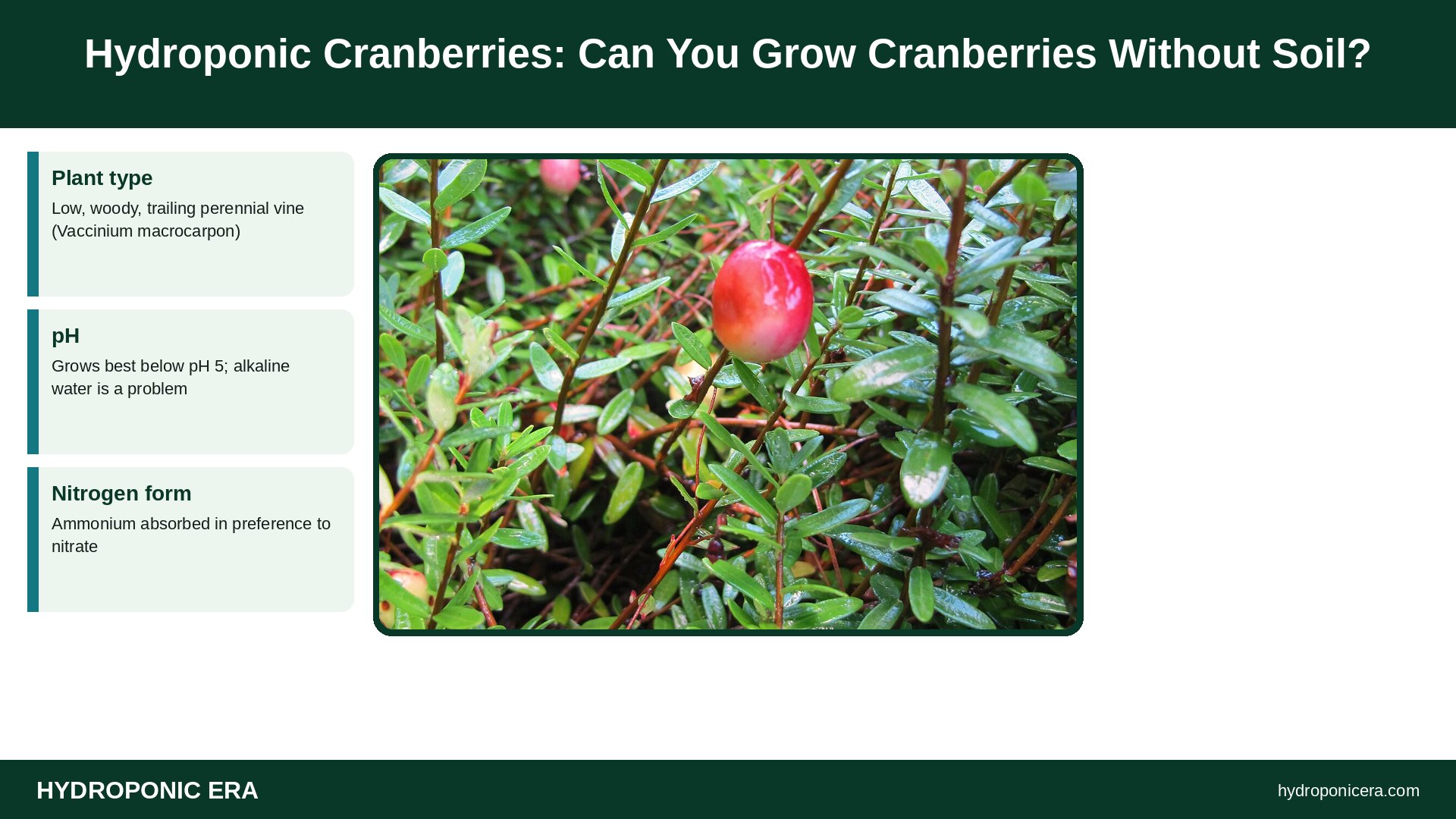
| Plant type | Low, woody, trailing perennial vine (Vaccinium macrocarpon) | UMass Extension |
| pH | Grows best below pH 5; alkaline water is a problem | UMass Extension |
| Nitrogen form | Ammonium absorbed in preference to nitrate | J. Amer. Soc. Hort. Sci. (1972) |
| Soilless proof | ‘Stevens’ cranberries cultured aeroponically | Plant, Cell & Environment (1996) |
| Chilling | About 3 months at 32–45°F (0–7°C) | UMass Extension |
| Too little chill | Under 1,500 hours below 45°F (7°C) led to “umbrella bloom” in Massachusetts | UMaine Extension |
| Yield guide | About 1 lb (0.45 kg) per 4 sq ft (0.37 m²) of vines | UMass Extension |
Can You Grow Cranberries Hydroponically?
Yes, and researchers have done it. A 1996 study in Plant, Cell & Environment grew ‘Stevens’ cranberry plants aeroponically, with nutrient solution misted onto the roots. An older study in the Journal of the American Society for Horticultural Science grew ‘Stevens’ in nutrient solutions with different nitrogen forms. Both show the plant can live on a nutrient solution alone.
Home fruit is the hard part. Cranberry vines are slow, need a winter rest and must be pollinated. Hydroponic cranberries make more sense as a learning project or for rooted cuttings than as a cheap source of berries.
- Best home method: a soilless pot of peat and sand or perlite with drip or hand feeding.
- Riskier method: deep water culture; cranberry roots dislike sitting wet.
- Research method: aeroponics, as in the 1996 study; see aeroponics for beginners.
Why Do Hydroponic Cranberries Need Acidic, Well-Drained Roots?
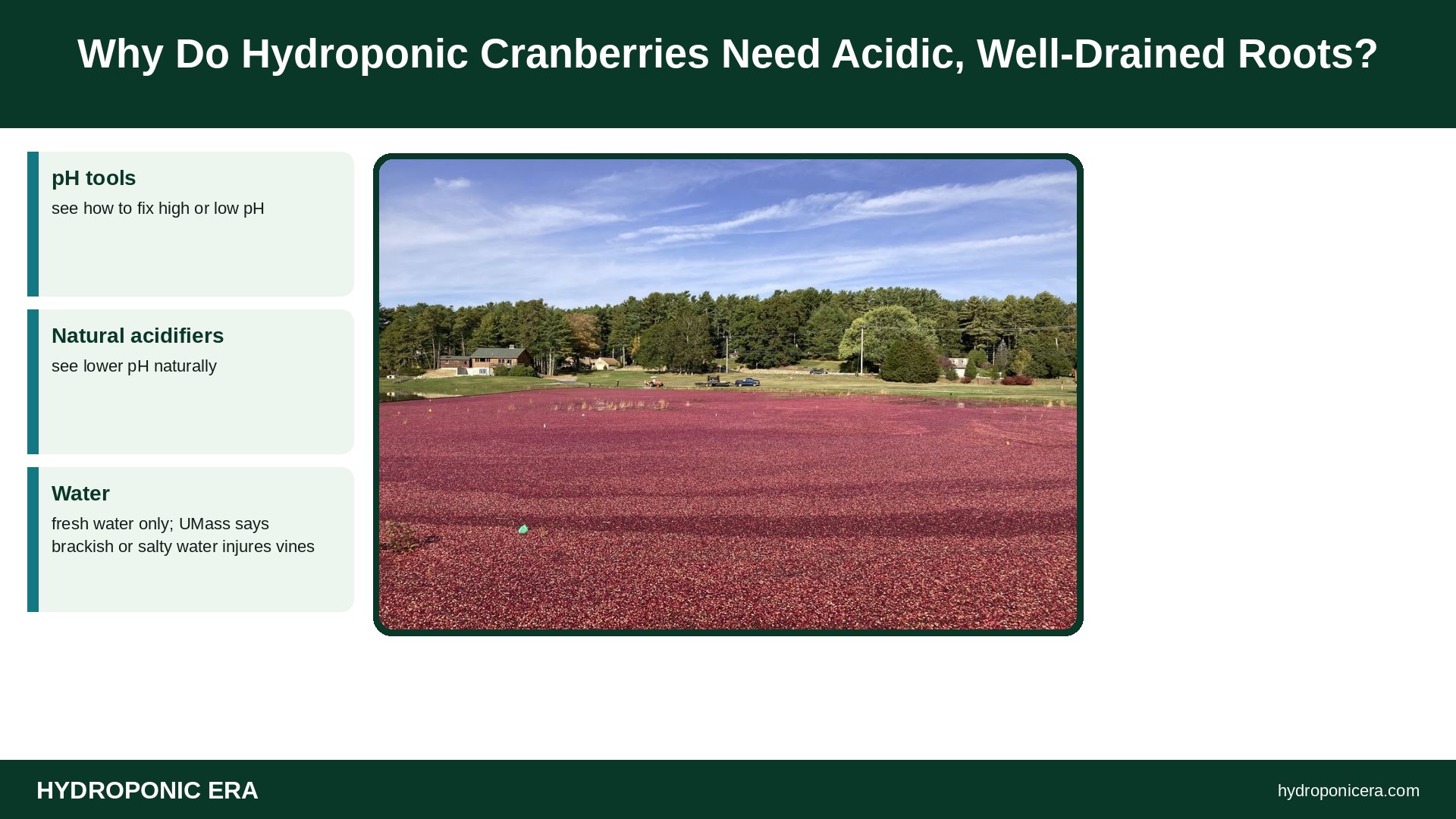
Cranberry is in the heath family with blueberries, and UMass Extension says the vines grow best at a soil pH below 5. It also warns that, contrary to popular belief, cranberries grow best out of the water on dry land and do not like wet feet. Bogs are flooded for harvest and winter protection, not for daily growth.
For hydroponic cranberries this means a peat-based mix with lots of drainage and a nutrient solution held low in pH. Our working target is pH 4.5 to 5.0, inside the UMass guidance; check it often with a pH and EC meter. UMass warns that alkaline water keeps pushing pH back up, so test your tap water before you start.
- pH tools: see how to fix high or low pH.
- Natural acidifiers: see lower pH naturally.
- Water: fresh water only; UMass says brackish or salty water injures vines.
What Nutrients Do Hydroponic Cranberries Need?
Feed hydroponic cranberries a nutrient mix with ammonium nitrogen. In the 1972 nutrient-solution study, cranberry plants took up ammonium before nitrate. Dry weight and new shoots were strongly favored by ammonium, and plants fed only nitrate were nitrogen-deficient. That matches what blueberry growers see, as covered in our hydroponic blueberries guide.
For container vines and hydroponic cranberries, UMass suggests slow-release fertilizer such as Osmocote plus periodic liquid feeding with an acid-plant food like Miracid, every 3 to 4 weeks in the first year. A 2015 nursery study in the Journal of Horticultural Research found that adding Vaccinium mycorrhizal fungi raised shoot weight and nutrient content of potted cranberries.
- Nitrogen: ammonium-based, acid-plant formula.
- Feeding: light and regular rather than strong.
- Too much nitrogen: UMass notes it favors vines over fruit.
How Much Winter Chill Do Hydroponic Cranberries Need?
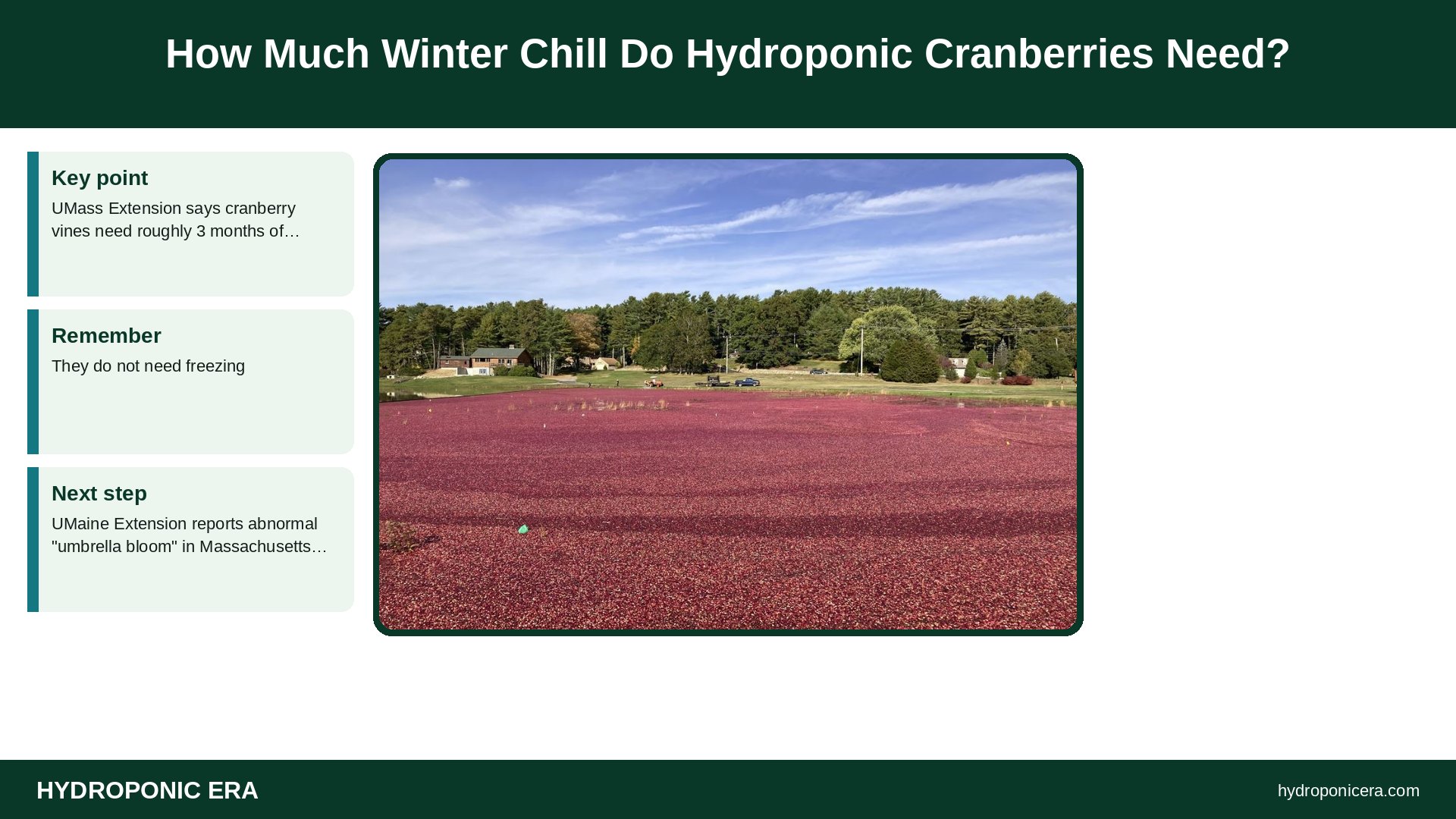
UMass Extension says cranberry vines need roughly 3 months of temperatures that consistently fall between 32 and 45°F (0 and 7°C). They do not need freezing. UMaine Extension reports abnormal “umbrella bloom” in Massachusetts when plants got fewer than 1,500 hours (about 62 days) below 45°F (7°C). Indoor growers of hydroponic cranberries have to supply this rest.
- Let the plants slow down in fall.
- Move them to a cold garage, porch or spare fridge zone that stays 32–45°F (0–7°C).
- Water lightly so roots do not dry out; do not feed.
- Bring them back to light and warmth after about 3 months.
Hard freezes with drying wind injure the vines, so UMass protects them with mulch or flooding outdoors. Indoors, a stable cool space avoids this.
How Long Do Hydroponic Cranberries Take to Fruit?
Plan on 1 to 2 years from a rooted cutting for hydroponic cranberries. UMass says you will likely see flowers and a few berries the year after planting and should see some fruit by the second year. Fruit set depends on pollinators visiting the flowers, so indoor plants need hand pollination or a time outdoors in bloom.
- Start: buy rooted cuttings; UMass calls growing from seed an exercise in extreme patience.
- Spacing: UMass plants 1 rooted cutting per sq ft (0.09 m²).
- Yield: about 1 lb (0.45 kg) of fruit per 4 sq ft (0.37 m²) at 400–600 uprights per sq ft.
- Pruning: keep the canopy open for light and fruit color.
What Are the Main Problems With Hydroponic Cranberries?
Most failures come from high pH, wet roots, nitrate-only food or missing winter chill. Yellow new leaves often point to pH drift. Weak, flowerless growth points to too little cold rest. Root rot follows a mix that stays soggy. Watch for pests too; UMass lists fruitworms, cranberry weevil and fruit rot fungi.
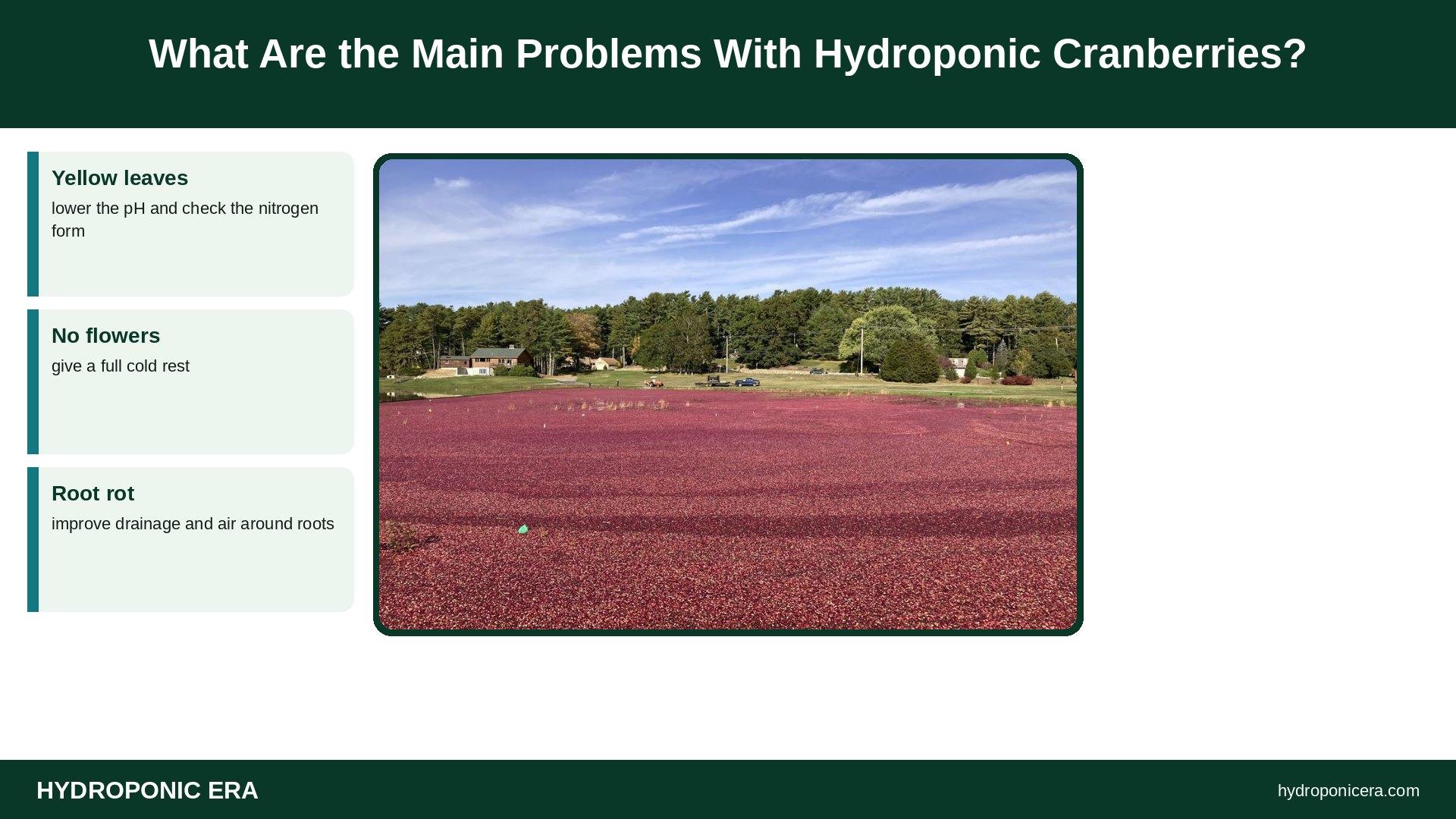
- Yellow leaves: lower the pH and check the nitrogen form.
- No flowers: give a full cold rest.
- Root rot: improve drainage and air around roots.
- Few berries: improve pollination and light.
FAQ About Hydroponic Cranberries
Do cranberries grow in water?
No; UMass says vines grow best on dry land and dislike wet feet.
What pH do cranberries need?
Below pH 5, according to UMass Extension.
Can you grow cranberries indoors?
Yes, if you give them a cold rest of about 3 months at 32–45°F (0–7°C).
What nitrogen do cranberries prefer?
Ammonium; nitrate-only plants were nitrogen-deficient in a 1972 study.
How long until cranberries fruit?
A few berries in year 1–2 after planting rooted cuttings.
Can you grow cranberries from seed?
UMass does not recommend it; start from rooted cuttings.
Sources
- UMass Amherst Cranberry Station — Homeowners’ Guide to Cranberry Vine Propagation
- University of Maine Cooperative Extension — Cranberries and a Changing Climate
- Barak et al., Plant, Cell & Environment (1996) — Measurement of short-term nutrient uptake rates in cranberry by aeroponics
- Journal of the American Society for Horticultural Science (1972) — Essentiality of Ammonium for Cranberry Nutrition
- Journal of Horticultural Research (2015) — Effect of fertilization and mycorrhization on cranberry in the nursery
- Photo credits (Wikimedia Commons, edited with titles): Vaccinium macrocarpon (15054125499) by Kristine Paulus (CC BY 2.0); Cranberry harvest, Kingston Massachusetts by Mathcar (CC BY-SA 4.0)