
How do you grow pearlweed in an aquarium? Plant small stem bunches in the midground, give medium to high light and add CO2 for dense growth. Dennerle lists 64 to 79°F (18 to 26°C), pH 5 to 8 and 20 to 30 mg/L CO2. Trim the tops often; each cut makes side shoots and a fuller bush.
Key takeaway: Pearlweed is Hemianthus glomeratus (also sold as Micranthemum glomeratum), a small bright-green stem plant from Florida. It is often mislabeled Hemianthus micranthemoides. Dennerle lists high light, 64–79°F (18–26°C), pH 5–8, 20–30 mg/L CO2 and propagation by tip cuttings. Tropica rates light and CO2 as medium and notes it can trail like a foreground carpet in strong light.
| Fact | What sources report | Source |
|---|---|---|
| Accepted name | Hemianthus glomeratus (Micranthemum glomeratum) | Flowgrow, Dennerle, Tropica |
| Native range | Florida endemic (Flowgrow); east coast of North America (Dennerle) | Flowgrow, Dennerle |
| Height | Up to 12 in (30 cm); 2–6+ in (5–15+ cm) after two months | Dennerle, Tropica |
| Light | High (Dennerle); medium (Tropica) | Dennerle, Tropica |
| CO2 | 20–30 mg/L (Dennerle); medium, 6–14 mg/L (Tropica) | Dennerle, Tropica |
| Water | 64–79°F (18–26°C); pH 5–8; soft to very hard | Dennerle |
| Propagation | Tip (head) cuttings | Dennerle |

What Is Pearlweed?
It is a fine-leaved stem plant with small, light-green leaves. Flowgrow lists its accepted name as Hemianthus glomeratus, with Micranthemum glomeratum as a synonym, and common names manatee mudflower and baby tears. Tropica sells it as Micranthemum glomeratum, and Dennerle as Hemianthus glomeratus. Same plant, different labels.
Many stores still call it Hemianthus micranthemoides. Flowgrow lists that as a misapplied name: the true H. micranthemoides, or Nuttall’s mudflower, grew in tidal rivers from Virginia to New York and is a different species. The sources differ on range: Flowgrow says pearlweed is endemic to Florida, while Dennerle describes the east coast of North America.
- Leaves: in whorls of 3 to 4, about 0.1–0.35 in (3–9 mm) long underwater, per Flowgrow.
- Use: midground bush, or a trailing foreground in strong light.
- Look-alike: Monte Carlo, which is a true creeping carpet plant.
How Do You Plant and Grow Pearlweed in an Aquarium?
Plant it in small bunches of a few stems each, pushed into nutrient-rich substrate with tweezers. Space the bunches so light reaches the lower leaves. Dennerle places it in the middleground with a height up to 12 inches (30 cm), while Tropica measures 2 to 6 inches (5 to 15 cm) after two months.
- Rinse the plant and remove the pot and rock wool.
- Split it into bunches of 3 to 5 stems.
- Strip the lowest leaves and plant about 1 inch (2.5 cm) deep.
- Leave a little space between bunches.
- Run lights 7 to 8 hours a day while it settles.

What Light, CO2 and Fertilizer Does Pearlweed Need?
Medium to high light, steady CO2 and regular feeding give the densest growth. Dennerle rates its light need as high with 20 to 30 mg/L CO2. Tropica rates both light and CO2 as medium, defining medium CO2 as 6 to 14 mg/L. In low-tech tanks this plant grows, but it stretches and looks thin.
- CO2: see aquarium CO2 for plants.
- Fertilizer: dose a liquid all-in-one; see aquarium plant fertilizer.
- Root tabs: useful in plain sand or gravel; see aquarium root tabs.
Tropica notes that in intense light the plant takes on a trailing habit, so it can be kept low in the foreground.
What Water Parameters Does Pearlweed Like?
It is adaptable. Dennerle lists 64 to 79°F (18 to 26°C), pH 5 to 8 and water from soft to very hard. That range fits most community and planted tanks. Keep it out of very warm tanks above about 80°F (27°C), where growth tends to get thin and leggy.
- Temperature: 64–79°F (18–26°C).
- pH: 5–8.
- Hardness: soft to very hard.

How Do You Trim and Propagate Pearlweed?
Cut it often with sharp scissors. Dennerle says that after pruning the plant produces a number of new side shoots, so the stand becomes denser and more compact. It lists tip, or head, cuttings as the way to propagate it. Replant the cut tops to fill gaps or start a new tank.
- Trim the stand when it reaches the height you want.
- Cut just above a leaf node.
- Replant healthy tops in front of or between older stems.
- Every few months, remove old bare stems and replant fresh tops.
Dennerle suggests pairing its light green with red plants such as Alternanthera reineckii.
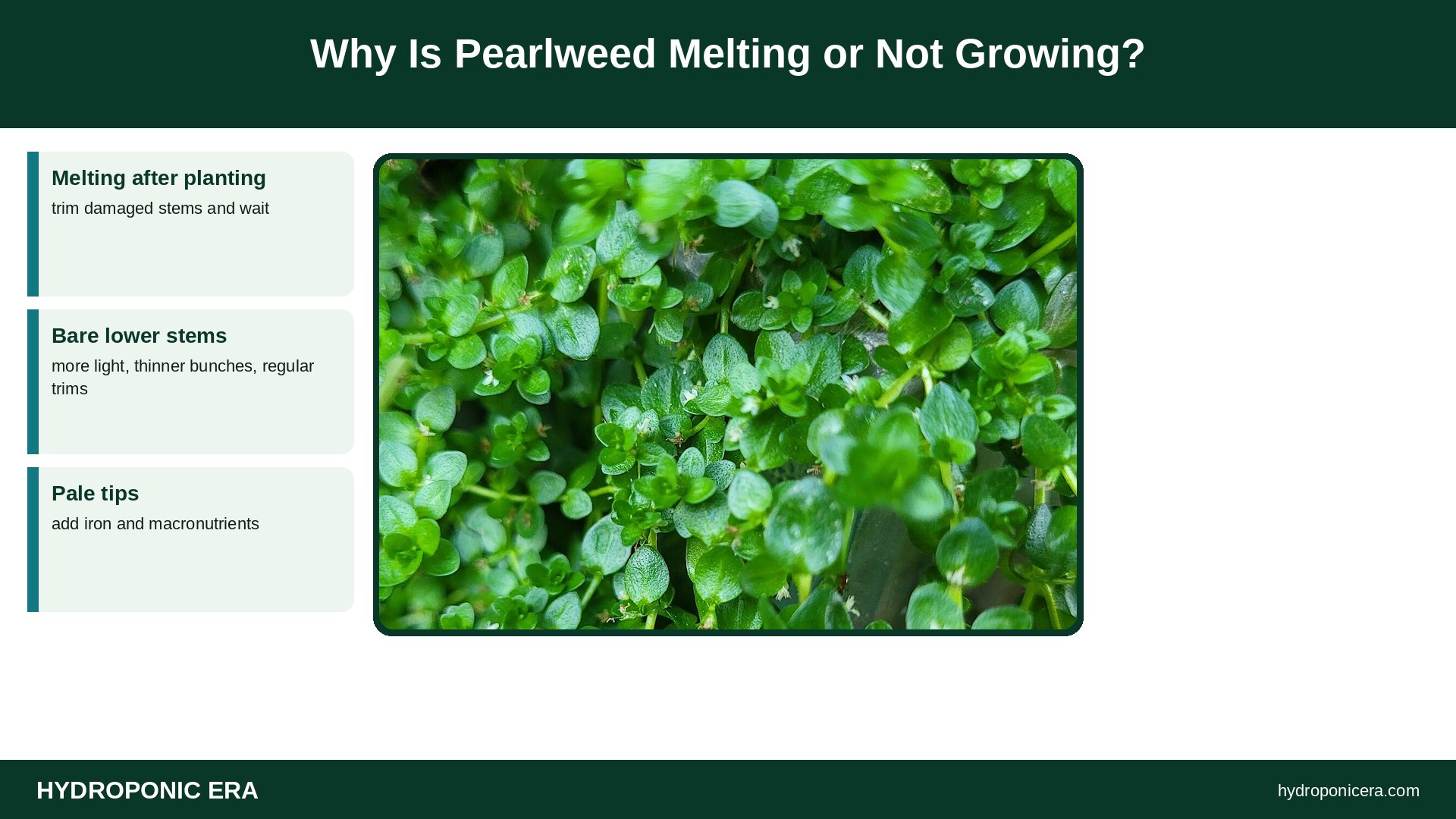
Why Is Pearlweed Melting or Not Growing?
Melting after planting usually comes from the switch from emersed to submerged growth. Flowgrow notes the emersed form has smaller, elliptical leaves and creeps, so nursery plants must grow new underwater leaves. Thin, bare lower stems point to too little light or crowding. Pale new growth points to low CO2 or nutrients.
- Melting after planting: trim damaged stems and wait.
- Bare lower stems: more light, thinner bunches, regular trims.
- Pale tips: add iron and macronutrients.
- Algae on leaves: balance light against CO2 and nutrients.
FAQ About Pearlweed
Is pearlweed the same as Hemianthus micranthemoides?
Usually not; that name is misapplied to Hemianthus glomeratus, per Flowgrow.
Does pearlweed need CO2?
It grows best with it; Dennerle lists 20–30 mg/L.
Can pearlweed be a carpet?
In strong light it can trail low, Tropica notes, but it is a stem plant.
What temperature does it need?
64–79°F (18–26°C), according to Dennerle.
How fast does it grow?
Medium to moderate, per Tropica and Dennerle.
How do you propagate it?
Replant tip cuttings after trimming.
Sources
- Dennerle Plants — Hemianthus glomeratus plant profile/27873)
- Tropica Aquarium Plants — Micranthemum glomeratum plant info
- Flowgrow Aquatic Plant Database — Hemianthus glomeratus, manatee mudflower
- Photo credits (Wikimedia Commons, edited with titles): Micranthemum glomeratum (pearlweed) 01 by Obsidian Soul (CC0); Flowering pearlweed (Micranthemum glomeratum) growing emersed (Philippines) by Obsidian Soul (CC0)