
Is ube hydroponics possible? Partly. IITA researchers rooted vine cuttings of Dioscorea alata, the purple yam, in aeroponics within 2 weeks and harvested small seed tubers. Full-size ube tubers need months of growth and deep room, so water culture is best for starting plants. Florida lists D. alata as a noxious weed.
Key takeaway: Ube hydroponics works for propagation, not for big harvests. Ube is a purple-fleshed form of Dioscorea alata. A 2014 IITA study rooted D. alata vine cuttings in aeroponics within 2 weeks; mini-tubers weighed 0.2–2.7 g at 4 months and up to 110 g at a later harvest. Florida lists winged yam as a noxious weed, so check state rules first.
| Fact | What sources report | Source |
|---|---|---|
| Species | Dioscorea alata (winged, water or greater yam) | UF/IFAS, UH CTAHR |
| Flesh color | White, off-white, orange or purple | UH CTAHR Pacific Food Guide |
| Aeroponic rooting | Vine cuttings rooted within 2 weeks; up to 98% for one D. alata line | Maroya et al. 2014 |
| Aeroponic tubers | 0.2–2.7 g at 4 months; up to 110 g at a second harvest | Maroya et al. 2014 |
| Vine length | To 30 ft (9 m) per UF/IFAS; 50 ft (15 m) or more per FDACS | UF/IFAS, FDACS |
| Aerial tubers | Up to 4 in (10 cm); grow into new plants | FDACS, UF/IFAS |
| Florida status | Florida Noxious Weed List; FISC Category I invasive | UF/IFAS, FDACS |
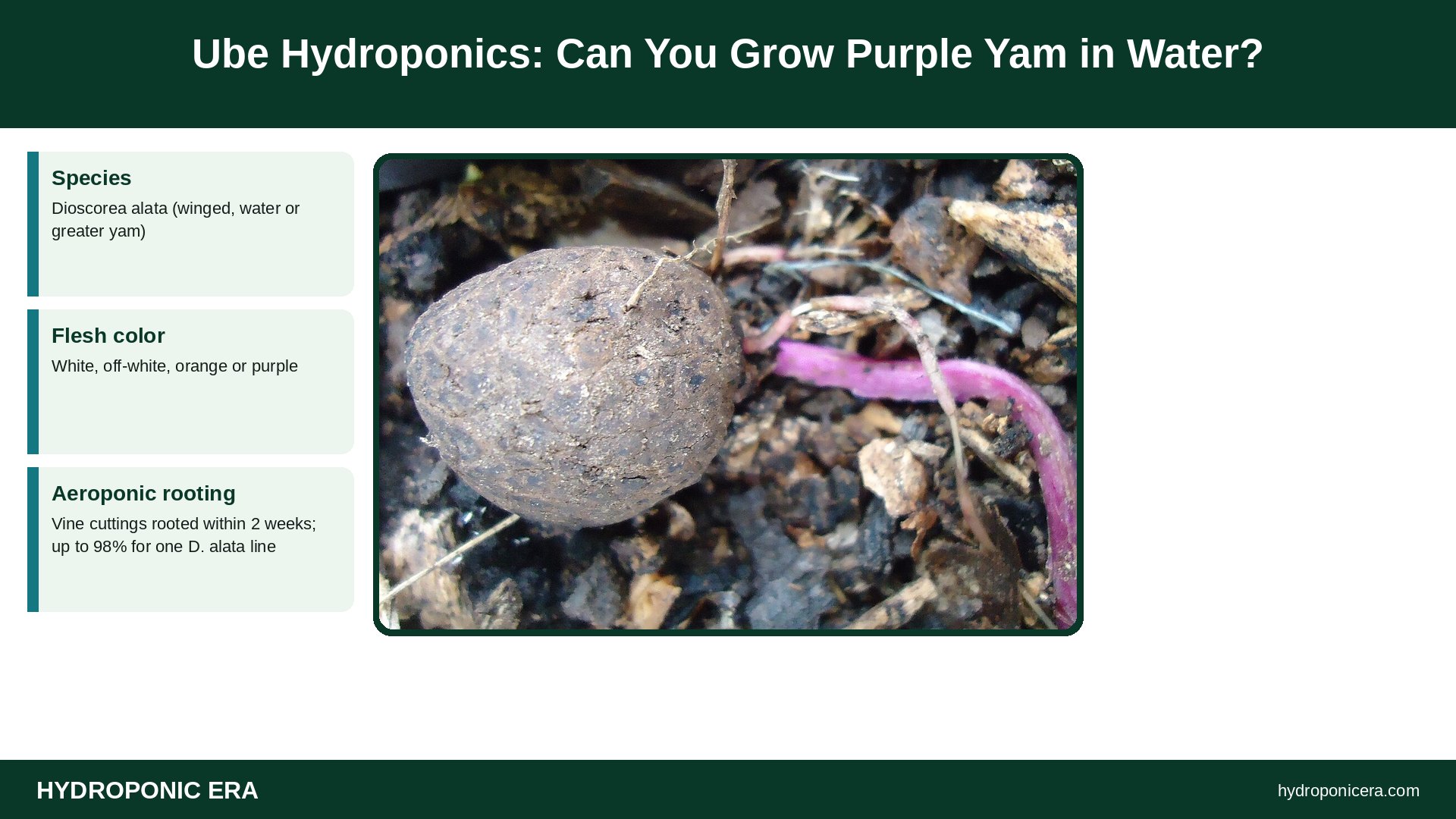
Can You Grow Ube Hydroponically?
With ube hydroponics you can root and grow vines in a soilless system, and researchers have made small tubers that way. In a 2014 study from the International Institute of Tropical Agriculture (IITA), vine cuttings of D. alata and D. rotundata rooted within 2 weeks in aeroponics. Rooting reached 98% for the best D. alata line.
The tubers were small. Mini-tubers harvested after 4 months weighed 0.2 to 2.7 g, and a second harvest 6 months later gave tubers up to 110 g. That is seed-yam size, not a kitchen ube, which sets the limit of ube hydroponics. Large tubers need a deep, loose root zone, so ube hydroponics is best used for starting plants, as with sweet potatoes in water.
- Good use: rooting vine cuttings or sprouting a tuber piece.
- Possible: small seed tubers in aeroponics; see aeroponics for beginners.
- Poor fit: full-size tubers in a bucket of water.
Is the Ube in Ube Hydroponics the Same as Dioscorea Alata?
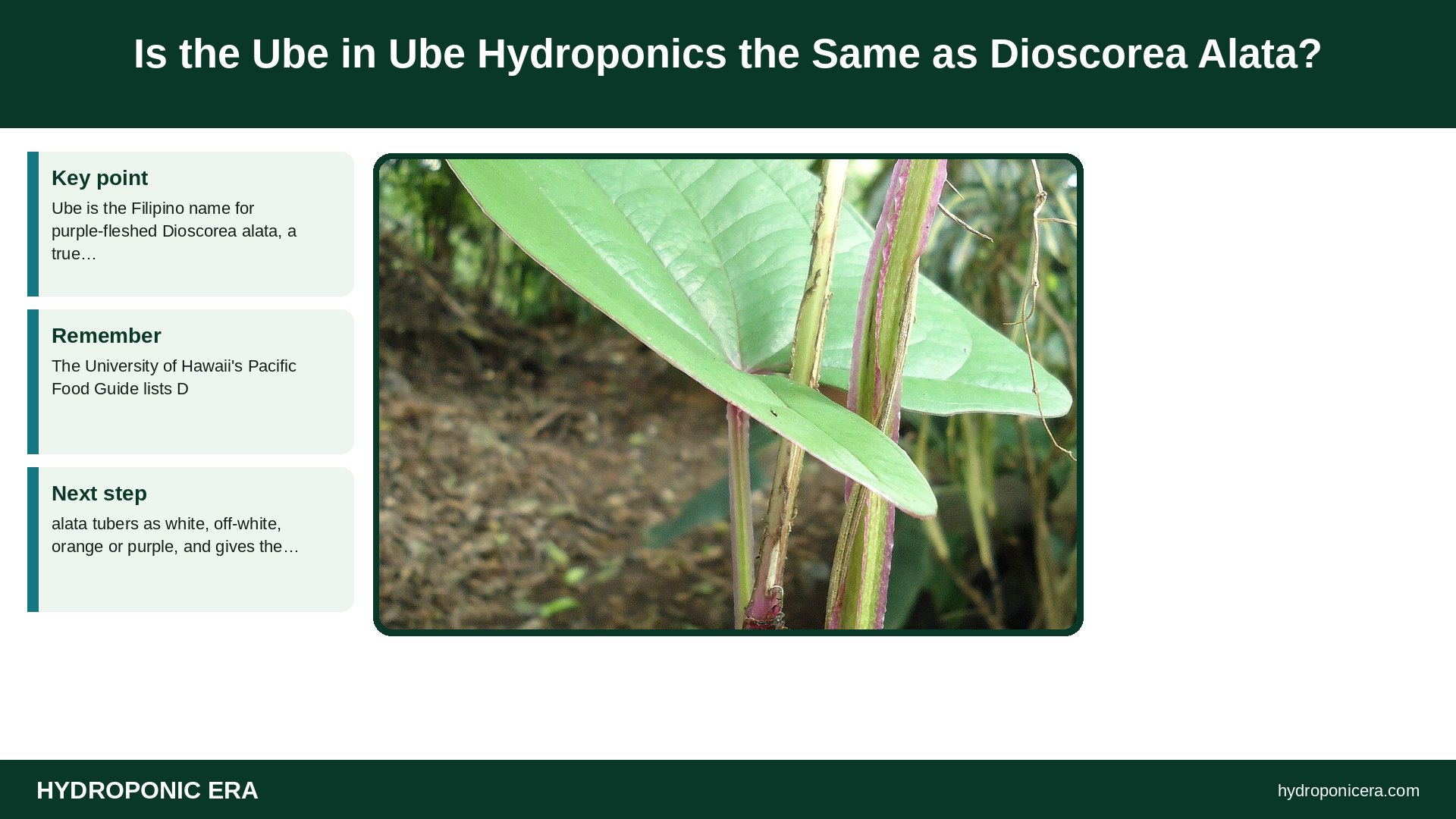
Yes. Ube is the Filipino name for purple-fleshed Dioscorea alata, a true yam. The University of Hawaii’s Pacific Food Guide lists D. alata tubers as white, off-white, orange or purple, and gives the Hawaiian name uhi. UF/IFAS lists it as winged yam, native to Southeast Asia, with a winged, squarish stem.
Check what you buy before trying ube hydroponics. Purple sweet potatoes are a different crop, and the method on this page is for true yams.
Can You Grow Ube in Florida and Other States?
Not in Florida without a permit. UF/IFAS lists Dioscorea alata on the Florida Noxious Weed List and as a FISC Category I invasive, and FDACS describes it as naturalized in Florida, Georgia and Louisiana with a range that could expand across the Southeast. FDACS regulates plants on that list, so a permit question comes first.
UF/IFAS says winged yam smothers native plants and can cover mature trees. It spreads by aerial tubers, or bulbils, which grow into new plants. In warm states, keep ube hydroponics indoors or in a contained pot, remove every bulbil and never compost them. Check with your state department of agriculture before planting.
- Florida: listed noxious weed; do not plant.
- Gulf Coast states: grow contained and remove bulbils.
- Cold states: frost kills the vine back; it is easier to contain.
How Do You Start Ube Hydroponics From a Tuber or Vine?
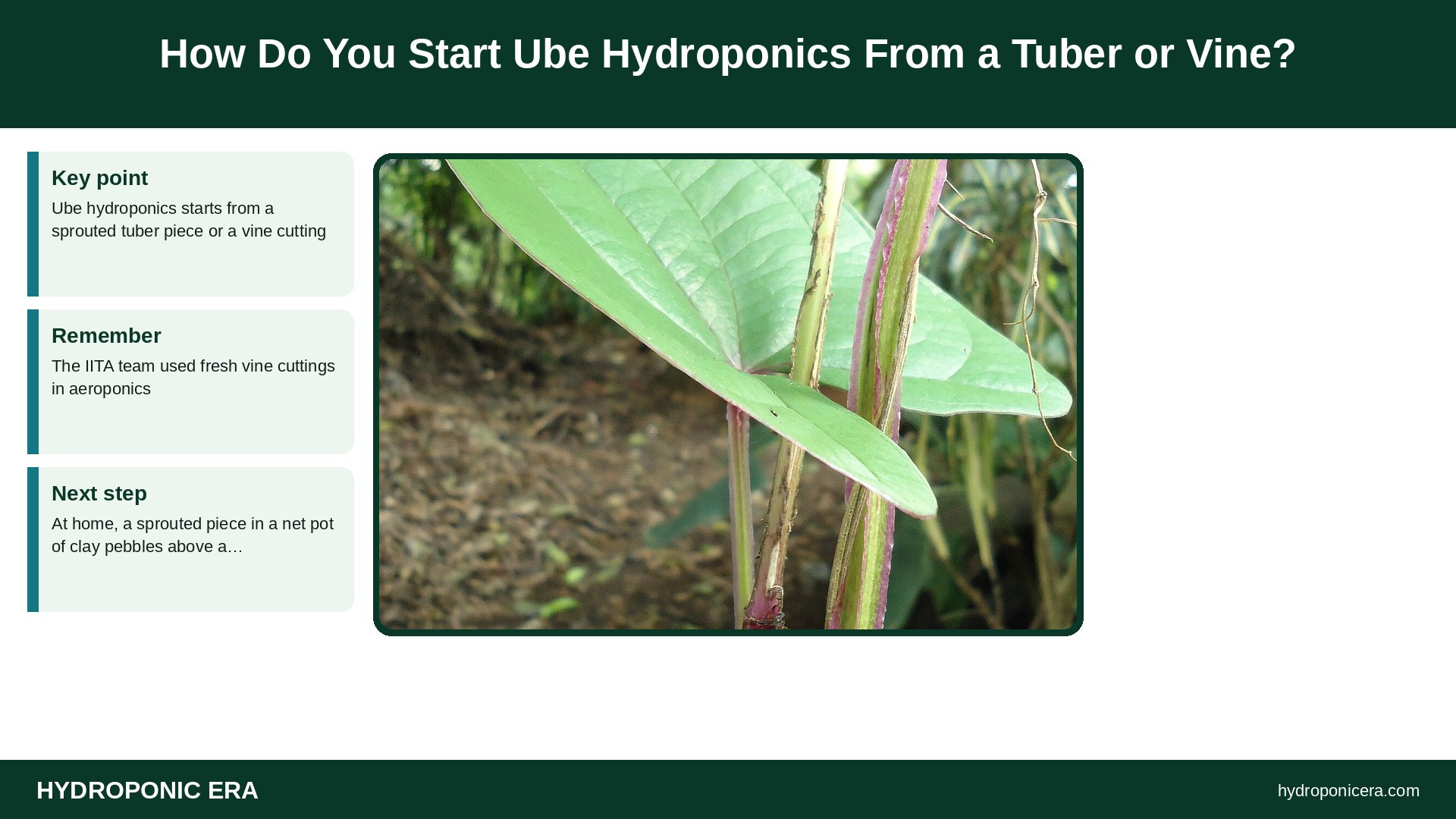
Ube hydroponics starts from a sprouted tuber piece or a vine cutting. The IITA team used fresh vine cuttings in aeroponics. At home, a sprouted piece in a net pot of clay pebbles above a nutrient reservoir, or a vine cutting in water, is the simple version. Keep it warm and give the vine something to climb.
- Cut a tuber piece with a sprout, or take a vine cutting with 1 to 2 nodes.
- Let a cut tuber piece dry for a day to seal it.
- Set it in clay pebbles with the base just above the water line.
- Use a mild nutrient solution once roots form.
- Add a trellis; the vine climbs fast.
- Move to a large soilless container, at least 15–20 gallons (57–76 L), for tuber growth.
What pH, EC and Temperature Does Hydroponic Ube Need?
No published hydroponic recipe for ube exists that we could confirm, so ube hydroponics needs general root-crop targets: pH 5.8 to 6.5 and EC around 1.2 to 2.0 mS/cm. It is a tropical vine, and UF/IFAS notes it goes dormant in winter, with stems dying back. Keep the room warm, ideally above 70°F (21°C) during active growth.
- pH: 5.8–6.5 (general root-crop target).
- EC: 1.2–2.0 mS/cm; lower for cuttings.
- Warmth: above 70°F (21°C) for growth; keep frost away.
- Air: aerate the reservoir to prevent root rot.
How Long Does Hydroponic Ube Take to Harvest?
Ube hydroponics takes months, not weeks. In the IITA aeroponics study, the first mini-tubers came at 4 months and larger ones 6 months after that. Harvest when the vine yellows and dies back, then cook the tuber; UF/IFAS notes most yams contain an acrid compound that cooking removes.
- Roots: about 2 weeks from a vine cutting, per IITA.
- Small tubers: about 4 months in aeroponics.
- Larger tubers: many more months in a big container.
- Safety: wild forms are bitter and can be poisonous, UF/IFAS warns; eat only cooked, cultivated ube.
For other warm-season root crops, see turmeric and taro in water.
FAQ About Ube Hydroponics
Can ube grow in water?
Vine cuttings and sprouted pieces root in water; big tubers need a deep container.
Is ube illegal in Florida?
Dioscorea alata is on Florida’s Noxious Weed List; do not plant it there.
How long do ube cuttings take to root?
Within about 2 weeks in aeroponics, per IITA.
Is ube the same as purple sweet potato?
No; ube is Dioscorea alata, a true yam.
Can you eat raw ube?
No; cook it, as most yams contain an acrid compound.
What are ube bulbils?
Aerial tubers on the vine that grow into new plants.
Sources
- Maroya et al., Annual Research & Review in Biology (2014), via CGSpace — Yam Propagation Using Aeroponics Technology
- UF/IFAS Center for Aquatic and Invasive Plants — Dioscorea alata, winged yam
- Florida Department of Agriculture and Consumer Services — Dioscorea alata, winged yam
- University of Hawaii CTAHR — Pacific Food Guide: Yam
- Photo credits (Wikimedia Commons, edited with titles): Dioscorea alata – Purple yam tuber – Mindanao, Philippines by Obsidian Soul (CC BY-SA 3.0); Dioscorea alata – leaf and vine stems – Mindanao, Philippines by Obsidian Soul (CC BY-SA 3.0)