
Quick Answer
uneven growth shared reservoir means plants sharing one tank can still diverge when light, flow, genetics, transplant age, or local microclimates differ—even when bulk EC/pH look “fine.” Diagnose position and plant factors before rewriting the whole recipe. Pair with slow growth, multi-crop compatibility, PPFD, spacing, canopy mapping, and logs.
Key takeaways for uneven growth shared reservoir
- Uneven growth hydroponics same reservoir is a practical home-hydro workflow—not filler.
- Shared EC does not guarantee shared light or flow at each site.
- Map PPFD and check emitters/air stones per plant before blaming nutrients.
- Transplant age and cultivar vigor create “same recipe, different plants.”
- Prefer university/extension sources over forum myths.
- Change one variable at a time; log positions so patterns show.
- Original ops card keeps Uneven growth hydroponics same reservoir decisions consistent.
- Uneven growth hydroponics same reservoir fails when growers skip the boring checks.
Related HydroponicEra guides
Why This Matters
uneven growth shared reservoir confuses growers who trust a single meter reading. Bulk solution chemistry is one shared input. Canopy light, local dissolved oxygen, emitter flow, root-zone temperature under lids, and genetics are not. Oklahoma State and Penn State extension hydroponic nutrition materials emphasize measuring and managing solution correctly—but home diagnosis also needs spatial checks.
This page is a same-crop unevenness tree: same cultivar in one tank, some plants racing while neighbors stall. Multi-crop incompatibility is a related but separate problem.
Comparison / Decision Table

| Cause class | Clue | First check |
|---|---|---|
| Light gradient | Edge/corner plants pale or stretch | PPFD map center vs edge |
| Flow / DO local | One net pot warmer, quieter bubbles, dry media collar | Emitter, air stone, NFT film |
| Plant history | Late transplant or weak seedling | Label dates; compare root mass |
| Genetics / off-type | One plant always different Across cycles | Cull or segregate; do not chase EC forever |
Step-by-Step Workflow
- Photograph the canopy from above; mark underperformers on a sketch.
- Measure PPFD at each underperformer and at a vigorous neighbor.
- Confirm equal water/air delivery: drip rate, NFT film, DWC stone placement.
- Compare transplant dates and seedling quality from labels.
- Smell and inspect roots on one weak and one strong plant.
- Check for shade from taller neighbors or equipment.
- Verify lids/net pots are level—tilted channels starve ends.
- Only after spatial checks, consider EC/pH tweaks for the whole tank.
- Cull chronic runts that steal space if production matters.
- Log position IDs so the same corner does not fool you twice.
Key Variables
| Variable | Effect | Link |
|---|---|---|
| PPFD uniformity | Growth rate divergence | PPFD, canopy |
| Emitter/air delivery | Local drought or hypoxia | emitters, DO |
| Spacing / height | Mutual shading | spacing |
| Crop mix | Wrong shared EC class | multi-crop |
Common mistakes with uneven growth shared reservoir
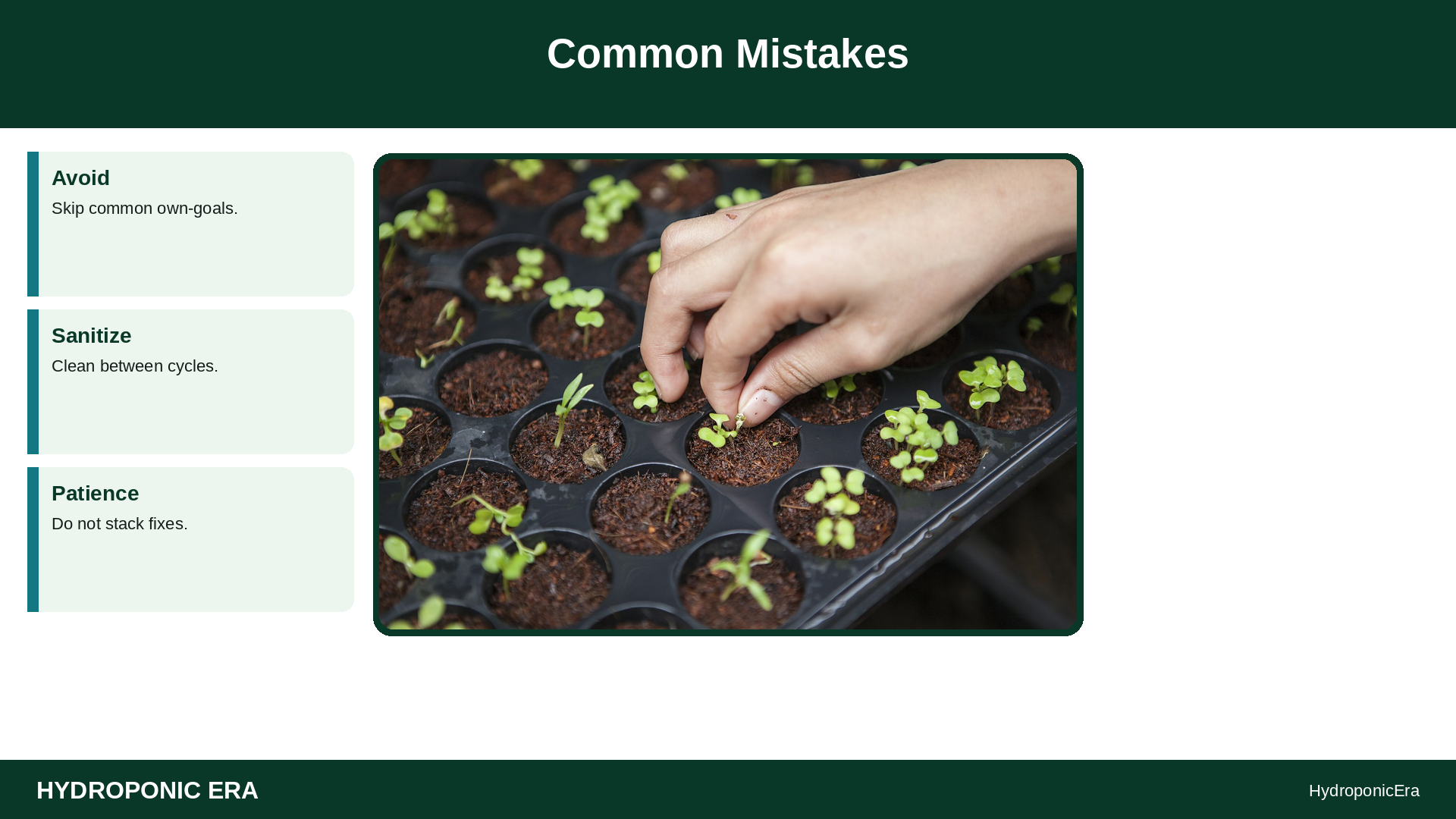
- Raising EC globally because one plant is slow
- Ignoring a clogged drip while rewriting the nutrient brand
- Mixing lettuce and tomato in one tank then blaming “uneven genetics”
- No labels—so you cannot tell late transplants from true runts
- Measuring only the reservoir, never the canopy
- Leaving a tall plant shading three neighbors for weeks
Troubleshooting
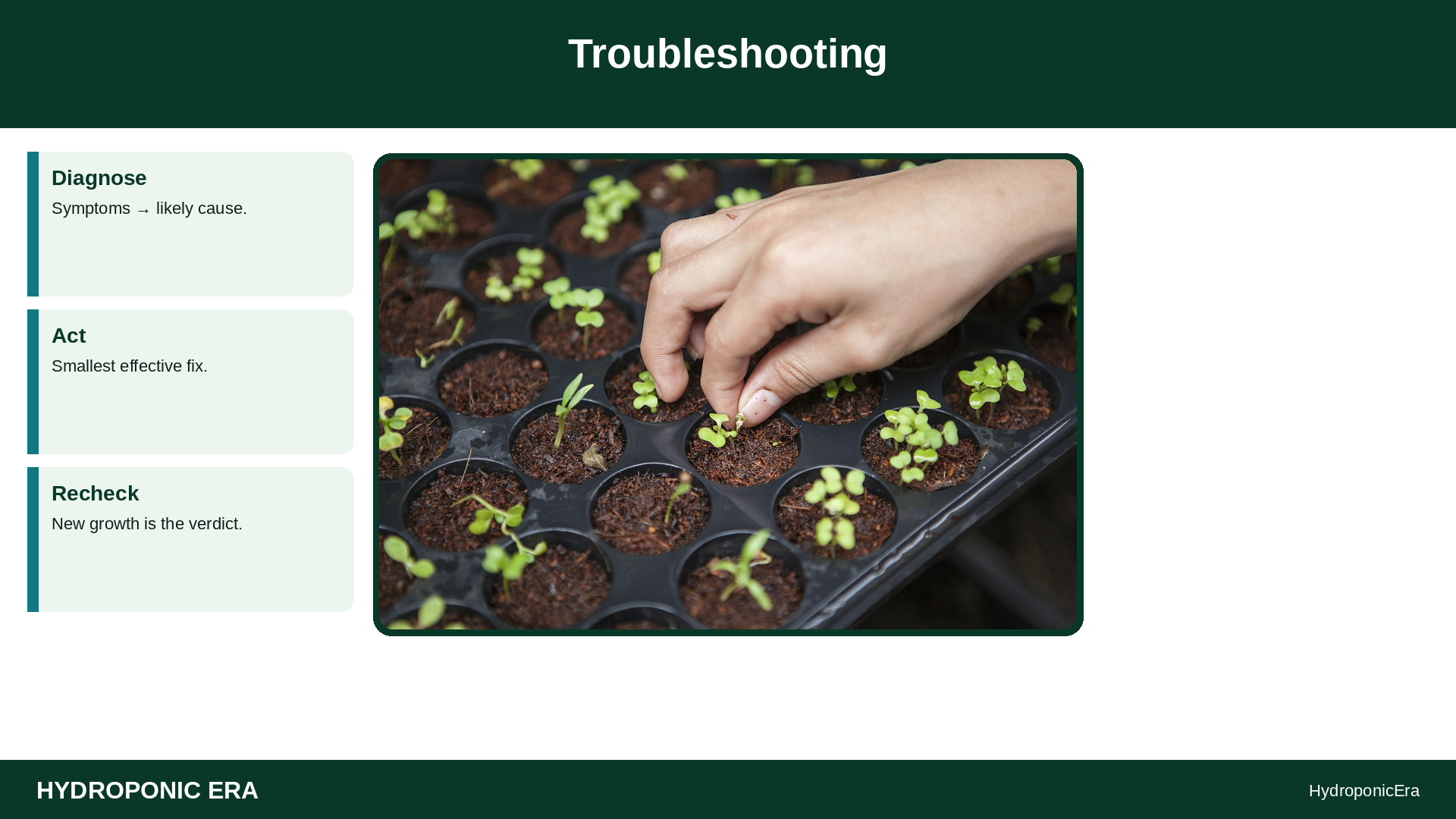
| Signal | Action |
|---|---|
| Only edges lag | Raise/move light or add reflection; re-map PPFD |
| One lane dry in NFT | Clear clog; verify slope and flow |
| Weak roots, sour smell | Oxygen/temp triage—not more feed |
| Same pot position fails every cycle | Fix plumbing/light at that site |
Practical Framework
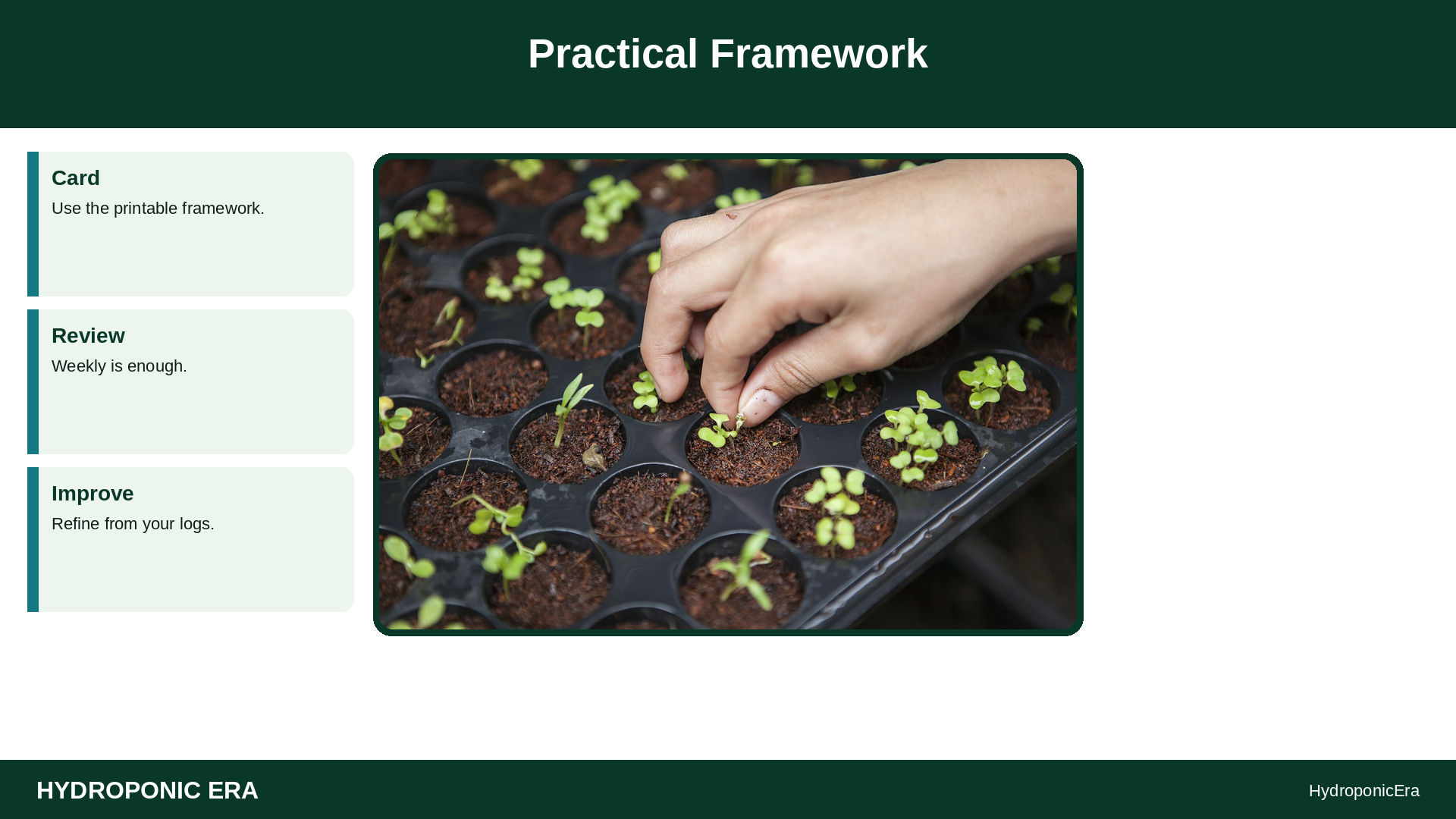
Unevenness card: Map light | Check flow/DO at site | Compare plant age | One change | Log positions.
Closing practice for uneven growth hydroponics same reservoir: the meter reads the tank—your eyes and a light meter read the plants.
What to Check Before You Rewrite a Shared Recipe for Uneven Plants
- Canopy photo + sketch done?
- PPFD at weak vs strong site?
- Emitter/air stone verified?
- Transplant dates compared?
- Roots sampled?
- Only then whole-tank chemistry?
Worked Position Audits
Walk three roles on purpose: a center plant under peak PPFD, an edge plant, and a plant at the end of a drip line or NFT lane. Measure light, confirm wet media or film flow, and compare root color. If the weak plant is always the same physical seat across cycles, fix the seat—do not keep changing bottles for a clogged barb.
When several cultivars share a raft, unevenness is expected. Split reservoirs by crop class when EC and climate targets diverge. Labels with transplant dates stop you from calling a late seedling a “mystery deficiency.”
Genetics Versus Ops
True off-types happen. If one plant is chronically different while neighbors of the same seed lot thrive under equal light and flow, cull or isolate. Production canopies are not breeding nurseries. Keep a photo log so you do not relearn the same corner failure every month.

Practice & Field Notes
Build a one-page map of every net-pot ID. After each week, circle underperformers and write one cause class beside them: light, flow, age, or genetics. Patterns appear faster than memory. If the same corner fails three cycles, rebuild that corner’s plumbing or lighting before you change the shared recipe again.
For NFT, walk lanes with a flashlight and confirm a continuous film—dry patches create “uneven growth” that looks nutritional. For DWC, confirm stones are not clustered under only the vigorous half of the tote. Equal seats require equal delivery.
Related reading stays practical: slow growth, canopy mapping, NFT clogs, and multi-crop compatibility when crop classes differ.
Scenario Walkthrough
You run twelve butterhead lettuces in one raft. Eight look perfect; four along the back wall are pale and small. Bulk EC and pH are textbook. Before buying a new nutrient line, map PPFD at the back wall—often it is half the front. Move lights, add reflection, or rotate the raft weekly. Recheck in five days of new growth. If light matches but two net pots sit above weak bubbles, relocate the air stone. Only if spatial checks pass should you question shared chemistry or seedling age labels.
Write the outcome in your log: back-wall light was half the front; reflection fixed unevenness. That sentence teaches more than any forum thread.
FAQs about uneven growth shared reservoir

EC is perfect—why uneven?
Because light, flow, and plant history are not shared equally.
Should I give weak plants extra foliar feed?
Fix the local cause first; foliar band-aids hide clogged drips.
Different cultivars in one raft?
Expect unevenness—see multi-crop compatibility.
Cull or wait?
Cull chronic runts if they shade or waste seats.
Is it always nutrients?
Rarely first—spatial checks usually win.
Meter at one end of a long NFT?
Bulk EC can hide dry channel ends—walk the lanes.
Extended Home-Grower Walkthrough
Use this extended walkthrough as a second pass after the Quick Answer. Walk the system with a notebook: write the date, crop, EC, pH, reservoir temperature, and one observation about roots or leaves. Change only one control at a time when a problem appears. If last week’s fix did not show in new growth, revert and try the next smallest lever. Keep university and extension principles in mind—oxygen, sanitation, and measured nutrition beat product stacking.
Photograph the canopy and the reservoir surface weekly. Dated photos settle arguments about algae, tip burn, or stretch faster than memory. When a helper waters for you, leave a one-page card with do-not-touch items and the exact top-off rule. Store calibration sachets next to the meters so “I will calibrate later” stops being the default. Review timers after any power event. Confirm air stones still roar. Confirm drains still drain.
At the end of the week, score the cycle 1–5 for ease and plant quality. Low scores should trigger a sanitation or climate review before you buy new hardware. Link neighboring HydroponicEra guides when the symptom matches a cluster page. Prefer labeled procedures over improvisation under stress. Healthy boring routines are the real upgrade path for home hydroponics.
Keep uneven growth shared reservoir on your ops card so helpers follow one standard.
Keep uneven growth shared reservoir on your ops card so helpers follow one standard.
Keep uneven growth shared reservoir on your ops card so helpers follow one standard.
Keep uneven growth shared reservoir on your ops card so helpers follow one standard.
Keep uneven growth shared reservoir on your ops card so helpers follow one standard.
Keep uneven growth shared reservoir on your ops card so helpers follow one standard.
Keep uneven growth shared reservoir on your ops card so helpers follow one standard.
Keep uneven growth shared reservoir on your ops card so helpers follow one standard.
Keep uneven growth shared reservoir on your ops card so helpers follow one standard.
Keep uneven growth shared reservoir on your ops card so helpers follow one standard.
Keep uneven growth shared reservoir on your ops card so helpers follow one standard.
Keep uneven growth shared reservoir on your ops card so helpers follow one standard.
Keep uneven growth shared reservoir on your ops card so helpers follow one standard.
Keep uneven growth shared reservoir on your ops card so helpers follow one standard.
Keep uneven growth shared reservoir on your ops card so helpers follow one standard.
Sources
- Oklahoma State University Extension — Electrical Conductivity and pH Guide for Hydroponics
- Penn State Extension — Hydroponics Systems and Principles of Plant Nutrition
- Oklahoma State University Extension — Hydroponics
- Michigan State University Extension — Hydroponics as an agricultural production system
- Virginia Cooperative Extension — SPES-720: Calculating and Using Daily Light Integral (DLI)
- University of Florida IFAS — HS1279: Leafy Greens in Hydroponics and Protected Culture for Florida