
Tomato brown rugose fruit virus (ToBRFV) is a highly contagious tobamovirus of tomatoes and peppers. It spreads mainly on hands, tools, clothing and seed, and there’s no cure. Infected plants show mottled, crinkled leaves and brown, rough patches on fruit. Bag and destroy infected plants, disinfect everything they touched, and replant with clean seed. It doesn’t harm people.
| Question | Quick answer |
|---|---|
| Hosts | Tomato and pepper mainly (APHIS); some reports in other nightshades (UVM) |
| Spread | Contact: hands, tools, clothing, seed; bumble bees can carry it (UF, Rutgers) |
| Survival | More than 10 years in plant debris; months to years on surfaces (UF) |
| Cure | None; destroy plants and disinfect (APHIS, Cornell) |
| Disinfectants tested | 10% bleach, 20% nonfat dry milk, 50% Lysol (Rutgers, citing UMass) |
| Human health | No health threat to people or animals (UVM) |

What Is Tomato Brown Rugose Fruit Virus?

ToBRFV belongs to the same tobamovirus group as tobacco mosaic virus. APHIS says it was first identified in Israel in 2014 and is primarily a problem in greenhouses. Cornell Cooperative Extension says it was first detected in the U.S. in 2018 and is considered more serious than other tomato viruses because it spreads so easily through handling and survives so long.
Its biggest threat is that it overcame the Tm-2² resistance gene that protects many tomato varieties against other tobamoviruses, according to Rutgers and UF/IFAS. Rutgers cites yield losses of 30–70% on young plants. APHIS puts it bluntly: once tomato brown rugose fruit virus is in a production system, it can’t be controlled; the only options are destroying the plants and disinfecting the greenhouse.
What Are the Symptoms on Tomatoes and Peppers?
A UMass fact sheet hosted by UVM lists deformed, crinkled leaves, mosaic, mottling, flecking, yellowing and browning on leaves. Fruit can show discoloration, rough brown patches or ringspots, irregular shape and uneven ripening. Browning of the veins in the calyx during early ripening may also appear. Cornell adds bubbling of the leaf blade and a “fern leaf” look, and notes that symptoms often appear about 4–6 weeks after seeding.
Some infected plants show no symptoms at all. Symptoms also overlap with other viruses, nutrient problems and herbicide drift, so testing is the only way to confirm tomato brown rugose fruit virus. Cornell recommends photographing suspicious plants and sending a sample to your local plant diagnostic clinic.
How Does Tomato Brown Rugose Fruit Virus Spread?

- Contact. UF says tobamoviruses are efficiently transmitted by contact, especially in protected culture where plants are pruned and tied often. Rutgers calls human activity the primary vector in greenhouses.
- Seed. In 2023 Cornell reported infected seed lots of two varieties, Sweet Prince and Brandywise. UF says the virus contaminates the seed coat.
- Surfaces and debris. UF says it survives more than 10 years in plant debris and months to years on benches, ropes, containers and equipment.
- Bumble bees. UF and Rutgers note that greenhouse bumble bees can carry it.
- Water. Seed company Hazera says there are some reports that tobamoviruses can spread in irrigation water. Cornell says watering seedlings doesn’t have enough force to transfer it.
Cornell also warns that brushing seedlings to toughen stems can move tomato brown rugose fruit virus from plant to plant.
How Do You Contain Tomato Brown Rugose Fruit Virus? 7 Steps
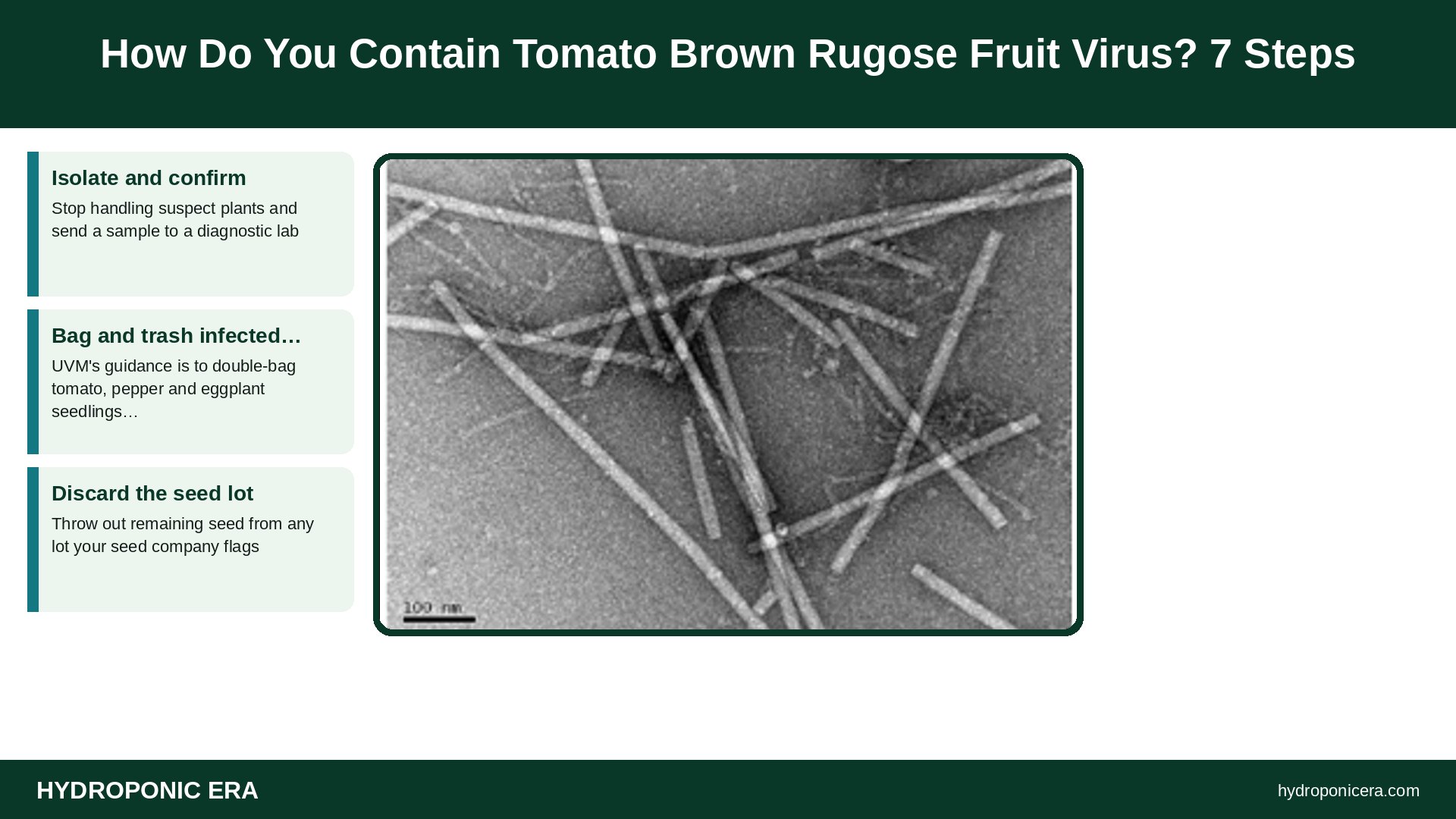
- Isolate and confirm. Stop handling suspect plants and send a sample to a diagnostic lab.
- Bag and trash infected plants. UVM’s guidance is to double-bag tomato, pepper and eggplant seedlings with their media and put them in the trash. Cornell says don’t compost, bury or cull-pile them.
- Discard the seed lot. Throw out remaining seed from any lot your seed company flags.
- Dump the system. In hydroponics, discard nutrient solution, media and roots from affected units.
- Disinfect everything. UVM recommends 10% bleach (1 part bleach to 9 parts water) after removing debris. Cornell gives an example of 8.2 fl oz of 8.25% bleach per gallon of solution, adjusted to your bleach strength.
- Protect hands and clothes. Wear disposable gloves and shoe covers while cleaning, as UVM advises; Cornell suggests hand sanitizer on gloved hands between plants during transplanting.
- Pause tomatoes and peppers. UVM’s home-garden advice is not to start a new batch of tomato, pepper or eggplant seed that year after a positive seed notice.
These steps don’t cure anything; they stop tomato brown rugose fruit virus from moving to the next crop. Our cleaning and sterilizing guide covers system parts.
Which Disinfectants Work Against ToBRFV?
Rutgers, citing UMass research, lists 10% bleach, 50% Lysol and 20% nonfat dry milk as the most effective disinfectants tested. Hazera notes that soap alone won’t destroy the virus, so handwashing helps less than you’d think; gloves and disinfectant matter. Bleach is corrosive and loses strength in solution, so mix it fresh, clean off organic debris first, and rinse metal parts after the contact time.
Are There Resistant Tomato Varieties?
It’s changing. A 2023 UMass fact sheet on UVM’s site said there were no ToBRFV-resistant tomato varieties at the time. Since then, seed companies have released varieties with intermediate resistance (IR). Hazera, for example, says its first generation of ToBRFV-resistant hybrids is being commercialized. Intermediate resistance limits the virus but doesn’t make plants immune; Hazera notes resistant varieties may still show symptoms under high pressure. Check seed catalogs for “ToBRFV IR” and keep sanitizing anyway.
Peppers are different. UVM says the L genes that give peppers resistance to TMV and pepper mild mottle virus appear to protect against tomato brown rugose fruit virus too, while peppers without them are highly susceptible.
Is Fruit From Infected Plants Safe to Eat?
UVM says the virus poses no health threat to animals or humans. On June 17, 2024, APHIS deregulated ToBRFV-positive tomato and pepper fruit for consumption, while keeping safeguards on seed and other propagative material. Fruit may look poor, but it’s safe to eat; don’t save its seed.
Common Mistakes
| Mistake | Why it’s risky | Better approach |
|---|---|---|
| Composting infected plants | Virus survives in debris for years | Double-bag and trash |
| Relying on soap | Soap won’t destroy it (Hazera) | Gloves plus disinfectant |
| Saving seed from suspect fruit | Seed coat can carry the virus | Buy clean seed |
| Brushing seedlings by hand | Moves virus between plants | Use a fan for sturdier stems |
| Reusing ropes, clips and media | Survives months to years on surfaces | Replace or disinfect |
FAQs: Tomato Brown Rugose Fruit Virus
Can plants recover from tomato brown rugose fruit virus?
No. There’s no cure for plant viruses, according to Cornell. Remove infected plants.
Can I grow tomatoes again after tomato brown rugose fruit virus?
Yes, after thorough disinfection and with clean seed. Consider IR varieties and waiting a season.
Does it affect hydroponic tomatoes?
Yes. It’s primarily a greenhouse problem, and frequent handling helps it spread.
Can tomato brown rugose fruit virus spread to peppers?
Yes. UVM says it can move between peppers and tomatoes.
How do I test for it?
Send a sample to your state’s plant diagnostic clinic. UF notes immunostrips can screen, but lab confirmation is needed.
Related HydroponicEra Guides
- How to grow hydroponic tomatoes
- How to grow cherry tomatoes hydroponically
- Fusarium wilt in hydroponics
- Broad mites vs russet mites
Sources
- USDA APHIS — APHIS Deregulates ToBRFV in Fruit for Consumption (June 17, 2024)
- UF/IFAS — Tomato brown rugose fruit virus (PP360)
- Rutgers Plant & Pest Advisory — Understanding and Controlling Tomato Brown Rugose Fruit Virus
- Cornell Cooperative Extension Allegany County — Pest Alert: ToBRFV in NYS
- University of Vermont (UMass Extension fact sheet) — ToBRFV: Information for Home Gardeners
- Hazera Seeds — ToBRFV IR Resistance
- Photo credits (Wikimedia Commons, edited with titles): ToBRFV Particles02 by Luria N, Smith E, Reingold V, Bekelman I, Lapidot M, Levin I, et al. (CC BY 4.0); Greenhouse filled with tomato plants and a bucket on the path by Shixart1985 (CC BY 2.0); Pepper and tomato seedling trays at Boğaziçi University 2026 by Furkan Akkurt (CC BY-SA 4.0); PepperFlower4K by Bst9jkj (CC0)