
Container farming cost starts at roughly $215,000 to buy a turnkey hydroponic shipping-container farm in 2026, or about $3,000 a month to lease through a farm-as-a-service plan. Then add power (tens of thousands of kWh a year), about 25 labor hours a week, seeds, packaging and delivery. Profit depends far more on your selling price than on the box.
| Cost item | Example figure | Source |
|---|---|---|
| Buy a Freight Farm (now sold by Growcer) | $215,000 | grow.freightfarms.com |
| Lease via Growcer Fund | $3,000/month (US); $4,000 CAD/month (Canada) | Freight Farms; Growcer FAQ |
| Buy a Growcer farm (Canada) | $289,000 CAD | Growcer FAQ |
| Electricity use | About 76,000–80,305 kWh/year | Growcer FAQ |
| Labor | About 25 hours/week | Growcer FAQ |
| Output | 2–6 tons of produce/year | Freight Farms |

What Is the Upfront Container Farming Cost?

On October 8, 2026, the Freight Farms website, now operated by Growcer, listed its container farms at “$215,000 as an outright purchase or for $3,000 USD/month through the Growcer Fund,” a farm-as-a-service model it says includes installation, maintenance and support. Growcer’s own FAQ lists a Growcer farm at $289,000 CAD, or $4,000 CAD a month through Growcer Fund.
Older numbers you’ll see online are lower. The Boston Globe reported that Freight Farms’ Greenery carried a price tag of more than $160,000 before the company shut down. Prices rose, the market changed, and the seller changed, so always get a current written quote. Budget extra for site prep, a level pad, water, permits and shipping. Growcer says its farm needs a 200A, 240-volt single-phase power supply, which can be a significant electrical job on its own.
What Happened to Freight Farms?
This is the most important lesson in container farming cost. Freight Farms ceased operations on April 30, 2025 and filed for Chapter 7 bankruptcy the same day, according to the Boston Globe and CEAg World. The Globe reported about $7 million in liabilities against $600,000 in assets, and noted the company had built a network of more than 800 container farms. Customers were warned that cloud monitoring and other services might stop.
Growcer, an Ottawa-based company, then won the bid for Freight Farms’ assets in a $2.6 million deal, AgFunderNews reported in July 2025. The takeaway: when you buy a container, you’re also betting on the vendor’s software, parts and support. For the wider story, read why vertical farms fail.
What Is the Ongoing Container Farming Cost?
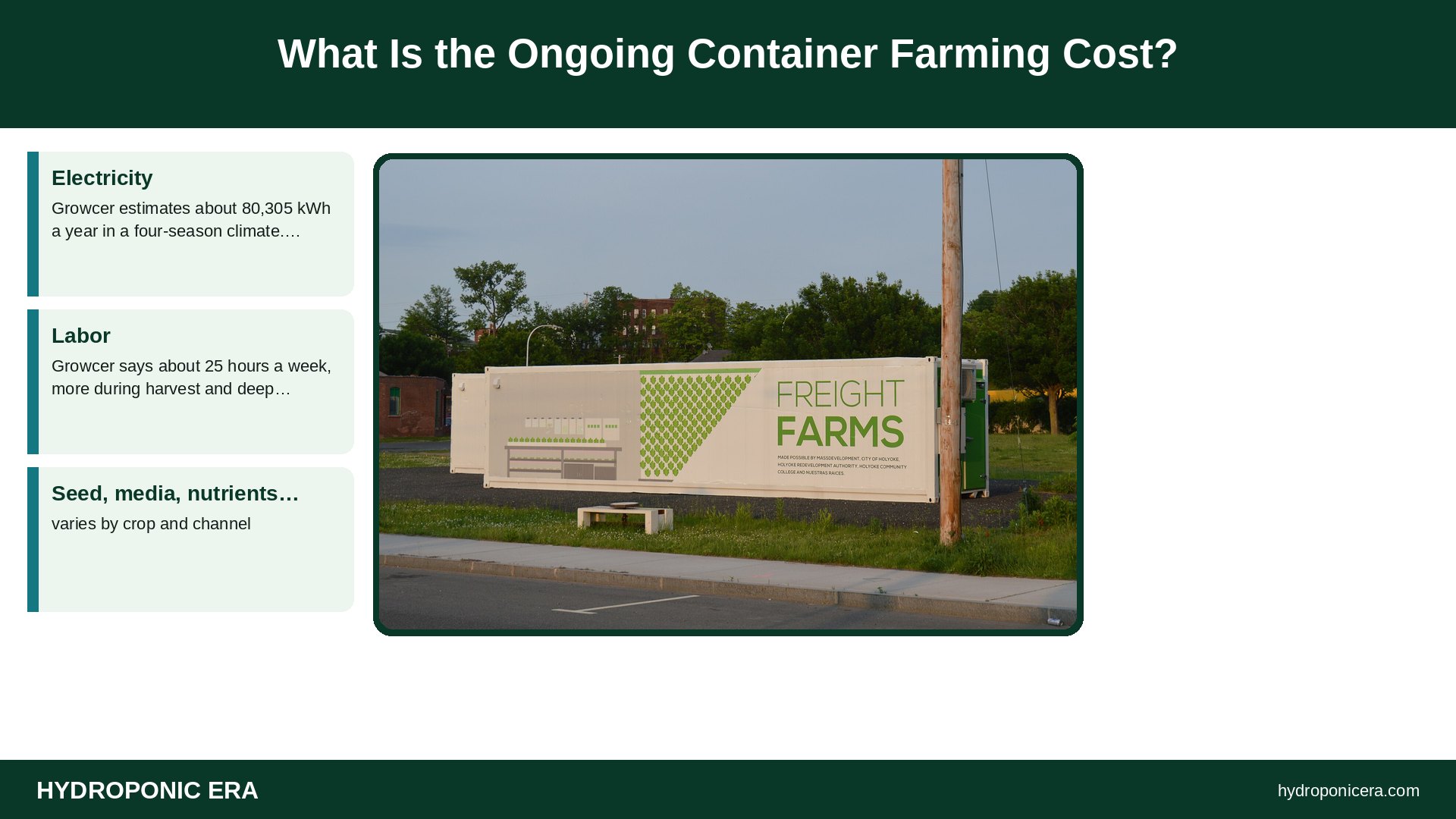
A USDA-funded OptimIA study at Michigan State University, reported by Urban Ag News, found labor was the largest variable cost for indoor leafy-green farms at 41%, followed by electricity at 29%, seed and substrates at 22%, and packaging at 7%. Those shares are a useful map for container farming cost planning:
- Electricity: Growcer estimates about 80,305 kWh a year in a four-season climate. At an example rate of $0.15/kWh, that’s about $12,000 a year; at $0.10, about $8,000. Growcer’s own example, at Ottawa’s $0.12 rate, is about $630 a month.
- Labor: Growcer says about 25 hours a week, more during harvest and deep cleaning. At an example $18 an hour, that’s about $23,400 a year.
- Seed, media, nutrients and packaging: varies by crop and channel.
- Software, insurance, water, repairs and delivery: often forgotten.
Container Farming Cost: 7 Numbers to Check First

- Total installed price, including shipping, site work and power hookup.
- Monthly lease or loan payment, if you finance.
- Your real electricity rate, including demand charges, times the vendor’s kWh estimate.
- Labor hours and wage, including your own time.
- Realistic yield per week for your crop, not the brochure maximum.
- Your selling price per head or pound, backed by buyer conversations.
- Vendor stability: who supports the software and parts in five years?
Put all seven in a spreadsheet before you sign. Our hydroponic farm business plan guide shows how to turn them into projections.
Container Farming Cost Example: One Year
Here’s a simple illustration using the published figures above and example rates. It’s not a quote or a forecast; swap in your own numbers.
| Line item | Assumption | Yearly cost |
|---|---|---|
| Lease (Growcer Fund) | $3,000/month | $36,000 |
| Electricity | 80,305 kWh at $0.15 | About $12,000 |
| Labor | 25 hours/week at $18 | About $23,400 |
| Seed, media, nutrients, packaging, delivery, insurance | Varies widely | Get quotes |
Even before supplies, that example container farming cost is over $71,000 a year, so your sales need to clear that comfortably. Divide it by your realistic weekly output to find the minimum price you must charge per head or pound.
Why Does Price Matter More Than Cost?
The OptimIA economists found that a 1% increase in the price of a head of lettuce could raise profit by 60 cents per square meter per day, while a 1% rise in wages cut profit by 6 cents and a 1% rise in electricity cut it by 5 cents. In their words, “a revenue maximizing strategy is superior to a cost minimizing strategy.” For container farming cost decisions, that means finding buyers who pay for local, fresh, consistent produce matters more than shaving a few dollars off power.
Is a Container Farm Worth It?
It can be, for the right buyer. Schools, food banks, remote communities, restaurants and grocers with year-round demand are common fits. It’s harder as a stand-alone commodity lettuce business, where container farming cost competes with large greenhouses. Growcer’s FAQ says its return on investment “varies based on factors such as your local price of produce, the cost of electricity, the business model you adopt,” and it won’t give a single number. Neither will we.
Alternatives worth pricing include a used container, a small greenhouse, or a room build-out. Compare options in how to start a small hydroponic farm, and check grants for hydroponic farming for USDA funding and loans.
Common Container Farming Cost Mistakes
| Mistake | Better move |
|---|---|
| Using old price quotes | Get a current written quote |
| Ignoring vendor risk | Ask about software, parts and support if the company changes |
| Assuming maximum yield | Plan on conservative yields in year one |
| Not costing your own labor | Pay yourself in the model |
| No buyers lined up | Secure letters of intent before buying |
FAQs: Container Farming Cost
How much does a container farm cost in 2026?
About $215,000 to buy a Freight Farm from Growcer, or $3,000 a month through Growcer Fund, as listed on October 8, 2026.
What does a container farm cost to run?
Mainly labor and electricity. Growcer estimates about 80,305 kWh a year and 25 labor hours a week.
How much can a container farm produce?
Freight Farms says 2–6 tons of produce a year, depending on crop.
Is container farming cost lower than a greenhouse?
Not usually per square foot, but containers can work where land, climate or space rules out a greenhouse.
Related HydroponicEra Guides
- Why vertical farms fail
- Hydroponic farm business plan
- Grants for hydroponic farming
- Vertical farming for beginners
Sources
- Freight Farms (Growcer) — Start container farming
- Growcer — FAQ
- Boston Globe (May 12, 2025) — Freight Farms shuts down, files for bankruptcy
- CEAg World (May 1, 2025) — Freight Farms Shutters and Files for Chapter 7 Bankruptcy
- AgFunderNews (July 2025) — Freight Farms customers find a new home
- Urban Ag News / OptimIA (June 6, 2023) — Can Leafy Greens Be Profitably Grown In Indoor Farms?
- Photo credits (Wikimedia Commons, edited with titles): Freight Farms project, Holyoke, Massachusetts by Simtropolitan (CC BY-SA 4.0); Greenhub, Agritechnica 2023, Hanover (P1140976) by Matti Blume (CC BY-SA 4.0); Lettuce Mini Heads (7331119710) by Dwight Sipler from Stow, MA, USA (CC BY 2.0); 20220525-FPAC-PJK-1302 TONED by USDAgov (Public domain)