
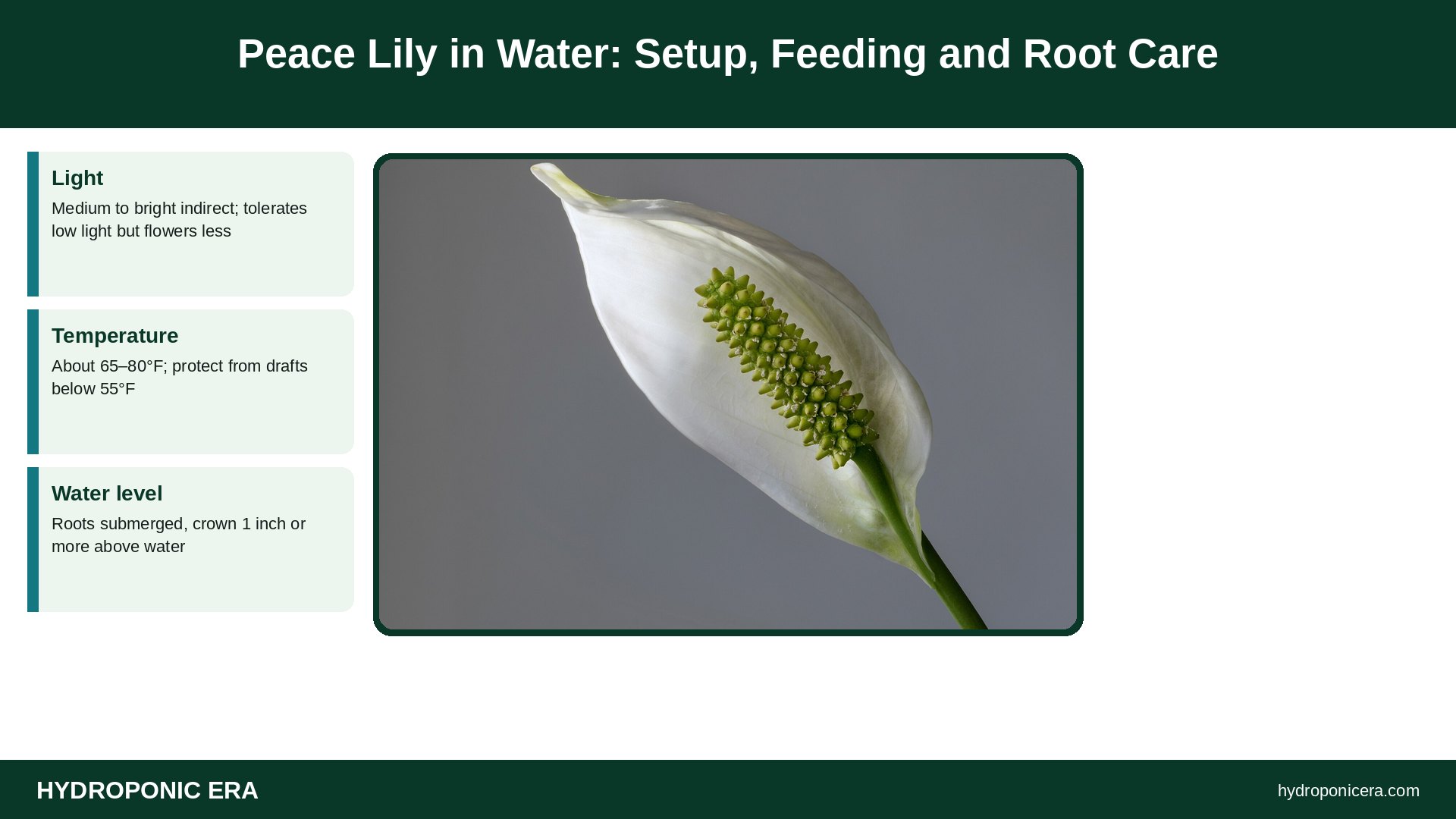
Peace lily in water is one of the easiest soil-free houseplant setups: keep the crown and leaves above the waterline, let only the roots sit in clean water, feed with a very dilute complete fertilizer, and refresh the water every one to two weeks. Peace lilies (Spathiphyllum) tolerate lower light than most flowering houseplants, which makes a peace lily in water a good fit for offices and north-facing rooms, as long as you watch for stagnant water and root rot.
Key takeaway: The crown must stay dry. Roots in water, leaves in air, weak nutrients, fresh water. That is the whole system.
| Factor | Target for a peace lily in water |
|---|---|
| Light | Medium to bright indirect; tolerates low light but flowers less |
| Temperature | About 65–80°F; protect from drafts below 55°F |
| Water level | Roots submerged, crown 1 inch or more above water |
| Water change | Every 1–2 weeks |
| Fertilizer | Quarter-strength complete liquid fertilizer, monthly or with water changes |
| Pets | Toxic to cats and dogs (ASPCA) |
Why a Peace Lily in Water Works

Peace lilies grow naturally in moist, shaded tropical understories. Their roots tolerate wet conditions better than many houseplants, which is why you often see them sold in vases or in “hydroculture” displays. The plant still needs oxygen at the root zone, so the water has to stay fresh and the crown must stay out of it.
Another reason the setup is popular: you can see the roots. White, firm roots tell you things are fine; brown, slimy roots warn you early. In soil, you only find rot after the leaves collapse.
Moving a Peace Lily From Soil to Water
- Pick a healthy plant with several leaves and firm roots. Avoid a stressed plant that is already wilting.
- Remove the soil gently. Soak the root ball in a bucket of room-temperature water and loosen the mix with your fingers.
- Rinse thoroughly. Leftover soil decays in water and clouds it.
- Trim damaged roots. Cut off any brown, hollow, or mushy roots with clean scissors.
- Support the crown. Use a narrow-necked vase, a vase insert, or a layer of clay pebbles so the crown sits above the water.
- Fill to cover the roots, not the base of the stems.
- Expect an adjustment period. Soil roots are not identical to water roots, and a leaf or two may yellow while new water roots form.
Dividing a large pot first gives you smaller crowns that fit a vase better. Our guide to converting soil plants to hydroponics covers the process in more depth.
Feeding and Water Quality for a Peace Lily in Water
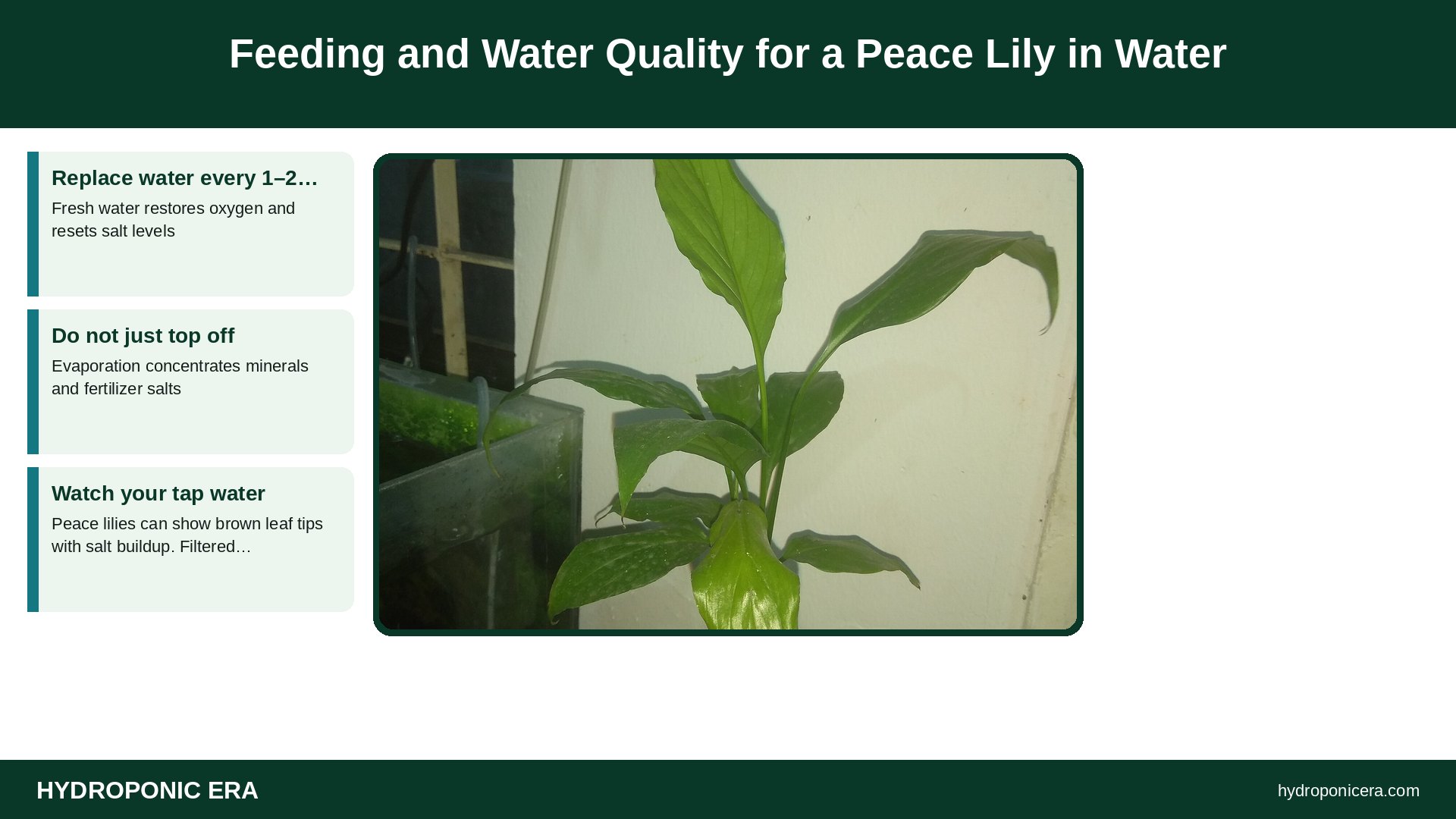
Water carries almost no nutrition, so a peace lily in water needs a light feed to stay green and flower. Use a complete liquid fertilizer that includes micronutrients, diluted to about a quarter of the houseplant label rate. A hydroponic base nutrient at low strength also works.
- Replace water every 1–2 weeks. Fresh water restores oxygen and resets salt levels.
- Do not just top off. Evaporation concentrates minerals and fertilizer salts.
- Watch your tap water. Peace lilies can show brown leaf tips with salt buildup. Filtered, rain, or distilled water can help where tap water is very hard. See our hard water guide.
- Keep it room temperature. Very cold water shocks roots.
A cheap TDS meter makes feeding easier. Our EC and TDS guide explains what the numbers mean.
Light, Flowers, and Placement
Peace lilies survive in low light, which is why they are office favorites, but the white spathes (the “flowers”) form more reliably with medium to bright indirect light. Direct hot sun scorches the leaves and warms the vase, which encourages algae and lowers oxygen in the water.
- Good spots: a few feet from an east or north window, or near a bright window with a sheer curtain.
- Grow lights: a small LED fixture works in dark rooms. Our grow light guide explains options.
- Opaque containers reduce algae compared with clear glass.
Peace Lily in Water Problems and Fixes

| Symptom | Likely cause | Fix |
|---|---|---|
| Drooping leaves | Root rot, very cold water, or shock after transfer | Inspect roots, trim rot, fresh water |
| Brown leaf tips | Salt buildup or low humidity | Change water more often, dilute fertilizer |
| Yellow lower leaves | Normal aging or low nutrients | Remove old leaves, start dilute feeding |
| No flowers | Too little light or young plant | Move to brighter indirect light |
| Slimy roots, sour smell | Low oxygen, decaying matter | Clean vase, trim roots, change water weekly |
| Green film on glass | Algae from light exposure | Clean and switch to opaque container |
Persistent slimy roots in any water setup point to root rot pathogens. Our pythium root rot guide explains the biology and prevention.
Common Mistakes

- Submerging the crown. The base of the stems rots quickly under water.
- Leaving soil on roots. It breaks down and fouls the water.
- Full-strength fertilizer. Water culture has no buffer; burnt root tips follow.
- Ignoring the water for a month. Stale water is the top cause of failure.
- Keeping a vase where pets can reach. Peace lily contains calcium oxalate crystals.
Weekly Routine for a Peace Lily in Water
A peace lily in water is low effort, not no effort. Five minutes a week keeps it healthy.
- Inspect roots through the glass or by lifting the plant. Firm and pale is healthy.
- Check the crown to be sure it hasn’t slipped down into the water.
- Change or top up depending on the day; do a full change every one to two weeks.
- Remove yellow leaves at the base with clean scissors.
- Wipe dust from leaves so they capture more light.
Variables That Affect a Peace Lily in Water
| Variable | Effect | Adjustment |
|---|---|---|
| Winter light | Slower growth, fewer flowers | Brighter window or small LED |
| Container volume | Small vases warm and foul quickly | Use a larger, opaque container |
| Water hardness | Mineral crust, brown tips | Filtered or rain water |
| Room temperature | Cold rooms slow roots; hot rooms speed rot | Keep in the comfortable 65–80°F range |
| Plant size | Big crowns drink more and outgrow vases | Divide large plants into smaller crowns |
Peace lilies also tell you when they’re thirsty in soil by drooping. In water, drooping usually means a root problem instead, so always check the roots first rather than adding more water.
If you want a self-watering look without a bare vase, a passive setup with clay pebbles and a reservoir is a nice middle ground. Our wick system guide explains how passive systems keep roots moist without drowning them.
Bottom line: a peace lily in water rewards a little weekly attention with glossy leaves and, in good light, white blooms.
FAQs: Peace Lily in Water
Can a peace lily live in water only?
Yes. A peace lily in water can live long-term if the crown stays above the waterline and you add a dilute complete fertilizer and change the water regularly.
How often should I change the water?
Every one to two weeks, or right away if it turns cloudy or smells.
Can I keep a fish with my peace lily?
Many people try it, but a vase rarely gives a fish enough space, heat, or filtration. Read our separate guide on peace lily and betta vases before trying it.
Is a peace lily safe for cats?
No. The ASPCA lists peace lily as toxic to cats and dogs. It is not a true lily, but chewing it causes mouth irritation and drooling.
Related HydroponicEra Guides
Sources
- ASPCA — Peace Lily toxicity
- NC State Extension Plant Toolbox — Spathiphyllum
- Photo credits (Wikimedia Commons, edited with titles): Peace lily – 2 by W.carter (CC BY-SA 4.0); Spathiphyllum – Alipore – Kolkata 2013-02-10 4662 by Biswarup Ganguly (CC BY 3.0); Spathiphyllum wallisii hydroponically grown by Kephalian (CC BY-SA 4.0)