
Peristaltic dosing pumps automatically add small, measured amounts of nutrient concentrate or pH adjuster to a hydroponic reservoir, either on a schedule or when a controller reads EC or pH outside your target. For most home growers with one small reservoir, dosing pumps are a convenience, not a necessity; hand-dosing works fine. They earn their keep in larger reservoirs, multiple systems, or when you’re away often, as long as you calibrate them, use quality sensors, and set hard safety limits.
Key takeaway: Automation magnifies whatever your sensors tell it. A drifting pH probe plus dosing pumps can crash a reservoir faster than you could by hand.
| Question | Short answer |
|---|---|
| What is a peristaltic pump? | A pump that squeezes a flexible tube with rollers to move precise volumes |
| Why peristaltic for dosing? | Accurate small doses; liquid only touches the tubing |
| Who needs dosing pumps? | Larger or multiple reservoirs, frequent travel, commercial setups |
| Who can skip them? | Small home systems checked every day or two |
| Biggest risk | Sensor drift or failure causing overdosing |
| Must-have safeguards | Calibration, max-dose limits, mixing delay, alarms |

How Peristaltic Dosing Pumps Work
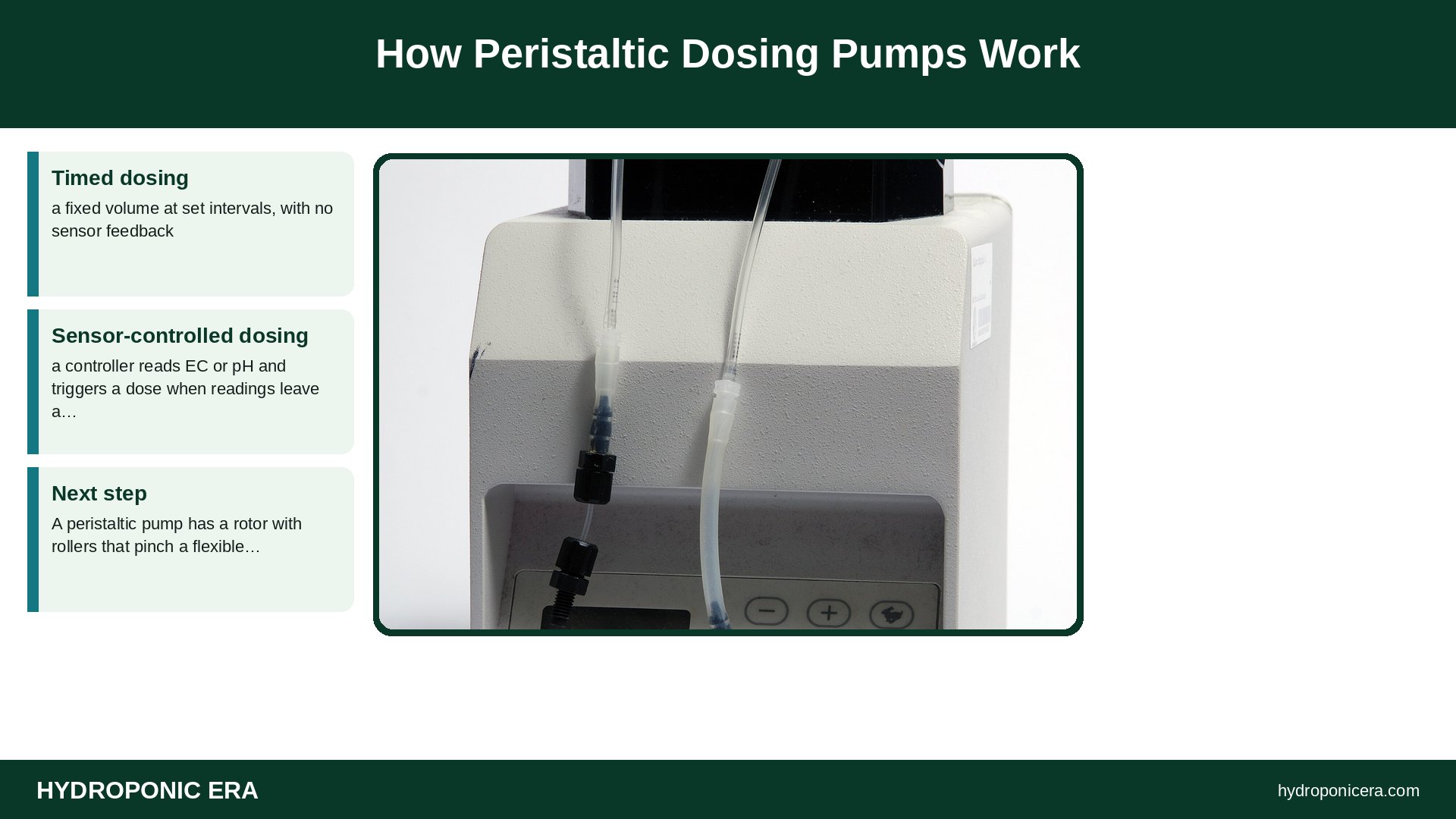
A peristaltic pump has a rotor with rollers that pinch a flexible tube against a curved housing. As the rotor turns, a pocket of liquid moves forward. Each rotation moves a fairly consistent volume, so the pump can deliver measured doses in milliliters. Because the liquid only touches the tube, concentrated acids and nutrients don’t corrode the pump mechanism.
In hydroponics, dosing pumps usually run one of two ways:
- Timed dosing: a fixed volume at set intervals, with no sensor feedback.
- Sensor-controlled dosing: a controller reads EC or pH and triggers a dose when readings leave a set range.
Do You Need Dosing Pumps?
| Situation | Recommendation |
|---|---|
| One 5–20 gallon home reservoir | Hand dosing is usually enough |
| Fast-drinking fruiting crops in large reservoirs | Dosing pumps can help stabilize EC and pH |
| Multiple reservoirs or a micro-farm | Strong case for automation |
| Frequent travel | Helpful, but only with remote alerts and limits |
| Learning hydroponics | Dose by hand first to understand your system |
Our timers and automation guide and Wi-Fi controllers guide cover simpler automation steps to take first.
Setting Up Dosing Pumps Safely

- Start with good sensors. Calibrate pH and EC probes regularly. See our probe care guide.
- Calibrate each pump. Run it for a set time into a measuring cylinder and record milliliters per second.
- Use separate pumps for Part A, Part B, pH down, and pH up. Never let concentrates mix in tubing. Our mixing order guide explains why.
- Dose small, wait, measure. Allow the reservoir to circulate for several minutes before the controller reads again.
- Set maximum daily dose limits so a failed sensor can’t empty a bottle into the tank.
- Add alarms for out-of-range readings and low concentrate levels.
- Check weekly by hand with a separate meter.
Tubing, Placement, and Maintenance
- Replace pump tubing on the maker’s schedule; it wears and changes dose volume.
- Keep concentrates below the pump or use check valves to prevent siphoning. See our check valves guide.
- Deliver doses near circulation, such as by the pump intake or air stone, for fast mixing.
- Label every line and bottle clearly.
- Store acids safely and wear gloves and eye protection when refilling.
Dosing Pump Problems and Fixes

| Problem | Likely cause | Fix |
|---|---|---|
| pH swings up and down | Doses too large or no mixing delay | Smaller doses, longer wait |
| EC keeps climbing | Sensor drift or setpoint too high | Recalibrate, verify by hand |
| Bottle empties overnight | Failed sensor, no max limit | Add daily limits and alarms |
| Doses smaller than expected | Worn tubing | Replace tubing, recalibrate |
| White precipitate in tank | A and B dosed at the same spot | Separate injection points, add delay |
Common Mistakes
- Trusting automation blindly.
- Skipping probe calibration.
- Dosing pH up and pH down in quick succession.
- No physical spill containment under concentrates. See our leak alarm and tray guide.
Variables That Change Results
| Variable | Effect | Adjustment |
|---|---|---|
| Reservoir volume | Small tanks swing fast | Smaller doses, longer waits |
| Crop stage | Fruiting crops drink and feed more | Adjust setpoints by stage |
| Water temperature | Affects EC readings | Use temperature-compensated meters |
| Concentrate strength | Strong stocks magnify errors | Dilute stock for finer control |
Quick Decision Guide
- Checking your system daily anyway? Skip dosing pumps for now.
- Running several reservoirs? Start with one controller on your biggest system.
- Traveling often? Add remote alerts before adding dosing.
Whatever you choose, keep a manual backup plan: a calibrated handheld meter, measured concentrates, and a written dosing chart.
A Simple Starter Setup
For a first automated system, keep it small. Use two dosing pumps for pH down and a single-part nutrient, a reliable pH probe, and a controller that lets you set a maximum dose per day. Place the dosing lines where they drip into a well-mixed area of the reservoir, such as near an air stone or pump outlet, so readings settle quickly. Run the system for a week while still checking by hand, and compare the controller’s readings with a separate calibrated meter. Only when the two agree consistently should you rely on automation for longer stretches. Keep a manual test kit on hand as a backup.
Keeping a Dosing Log
Record how much each pump adds per day. A sudden increase in pH down use can signal a drifting probe, a change in source water, or a problem with the plants. Logging dose volumes alongside pH and EC readings turns the system into an early-warning tool. See record keeping and probe care and calibration.
FAQs: Dosing Pumps for Hydroponics
Are dosing pumps worth it for home hydroponics?
For a single small system, usually not. For larger or multiple reservoirs, dosing pumps can save time and stabilize EC and pH.
Can I use dosing pumps without sensors?
Yes, with timed dosing, but you lose feedback. You’ll still need to check readings by hand.
How often should I calibrate dosing pumps?
After installation, after tubing changes, and periodically. Calibrate probes more often.
Can one pump dose all my nutrients?
No. Use separate pumps for each concentrate to avoid precipitation.
Related HydroponicEra Guides
Sources
- USDA National Agricultural Library — Hydroponics resources
- Penn State Extension — Hydroponics Systems and Principles of Plant Nutrition
- Photo credits (Wikimedia Commons, edited with titles): Laboratory peristaltic pump Gilson-01 by Lilly_M (CC BY-SA 3.0); PH- und Leitfähigkeitsmessgeräte by Rotkaeppchen68 (CC0); Arduino UNO compatible board, CNC shield stepper motor controller, and a NEMA 17 stepper motor by DotEagle (CC BY-SA 4.0)