
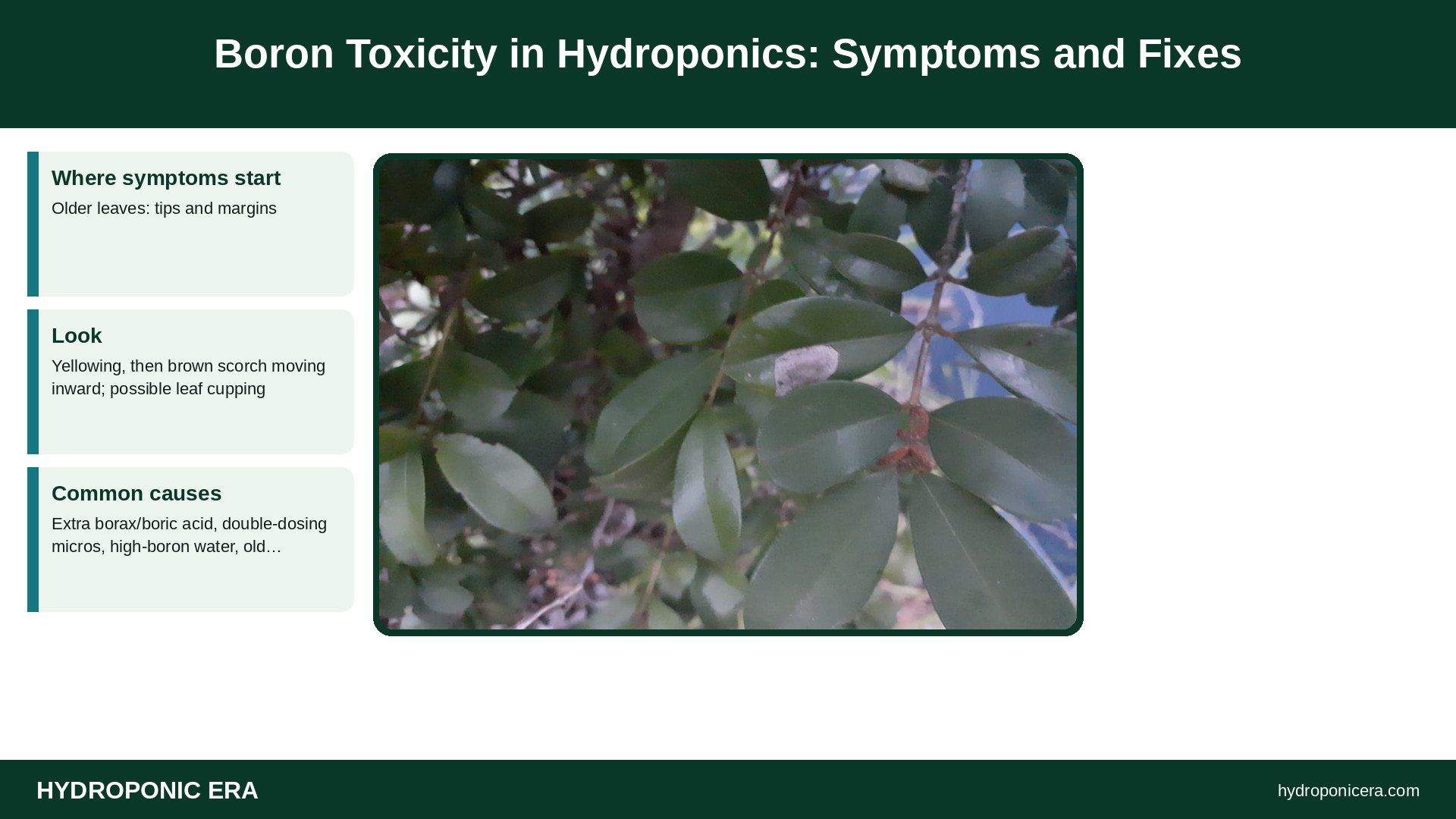
Boron toxicity in hydroponics shows up first on older, lower leaves as yellowing and then brown, scorched tips and margins that spread inward, sometimes with small dark spots. It happens when boron in the nutrient solution builds too high, usually from overdosing micronutrients, adding borax or boric acid by hand, recirculating solution for too long, or using source water that’s naturally high in boron. The fix is to stop any extra boron, replace the solution with fresh mix, test your source water, and keep boron in the low range typical of hydroponic recipes.
Key takeaway: Boron has a narrow safe range. A little prevents deficiency; a bit too much burns leaves. Never add boron “just in case.”
| Question | Short answer |
|---|---|
| Where symptoms start | Older leaves: tips and margins |
| Look | Yellowing, then brown scorch moving inward; possible leaf cupping |
| Common causes | Extra borax/boric acid, double-dosing micros, high-boron water, old solution |
| Typical recipe level | Hydroponic recipes commonly use well under 1 ppm boron |
| High in irrigation water | Above about 0.5 ppm is considered high by UC IPM |
| Fix | Fresh solution, test water, remove extra boron sources |
What Boron Does and Why the Range Is Narrow
Boron is a micronutrient involved in cell wall formation, cell division, and flower and fruit development. Plants need only tiny amounts. Michigan State University Extension describes boron in vegetables as a “not too little, not too much” nutrient, because the gap between deficiency and toxicity is smaller than for most nutrients. In hydroponics, where everything is in solution, that narrow window is easy to overshoot.
Unlike calcium, boron moves with the transpiration stream and accumulates where water exits leaves: at tips and margins. That’s why boron toxicity appears as edge burn on older leaves.
Symptoms of Boron Toxicity
- Yellowing at the tips and edges of older leaves
- Brown or black scorched margins spreading inward
- Small brown spots near leaf edges in some crops
- Leaf cupping and premature drop in severe cases
- Slowed growth overall
Compare with our nutrient deficiency chart, since several problems look similar.
Boron Toxicity vs Look-Alikes
| Problem | Where it starts | Key difference |
|---|---|---|
| Boron toxicity | Older leaf tips and margins | Recent boron addition or high-boron water |
| Nutrient burn | Leaf tips, often all leaves | High overall EC |
| Potassium deficiency | Older leaf margins | Low K; EC often low or imbalanced |
| Tip burn | Young inner leaves | Calcium transport issue, not older leaves |
| Boron deficiency | Growing tips, new leaves | Distorted new growth, brittle stems |
Common Causes in Home Hydroponics
- Adding borax or boric acid to “fix” a suspected deficiency without testing.
- Doubling up micronutrient products, such as a complete nutrient plus a separate micronutrient blend.
- Mixing errors with DIY salts, where a small weighing mistake in boric acid has a big effect. See nutrient calculator.
- High-boron source water. Some wells and regions, particularly in parts of the western US, have naturally elevated boron. See well water decision tree.
- Long recirculation. Topping off old solution without full changes can concentrate some elements.
How to Fix Boron Toxicity
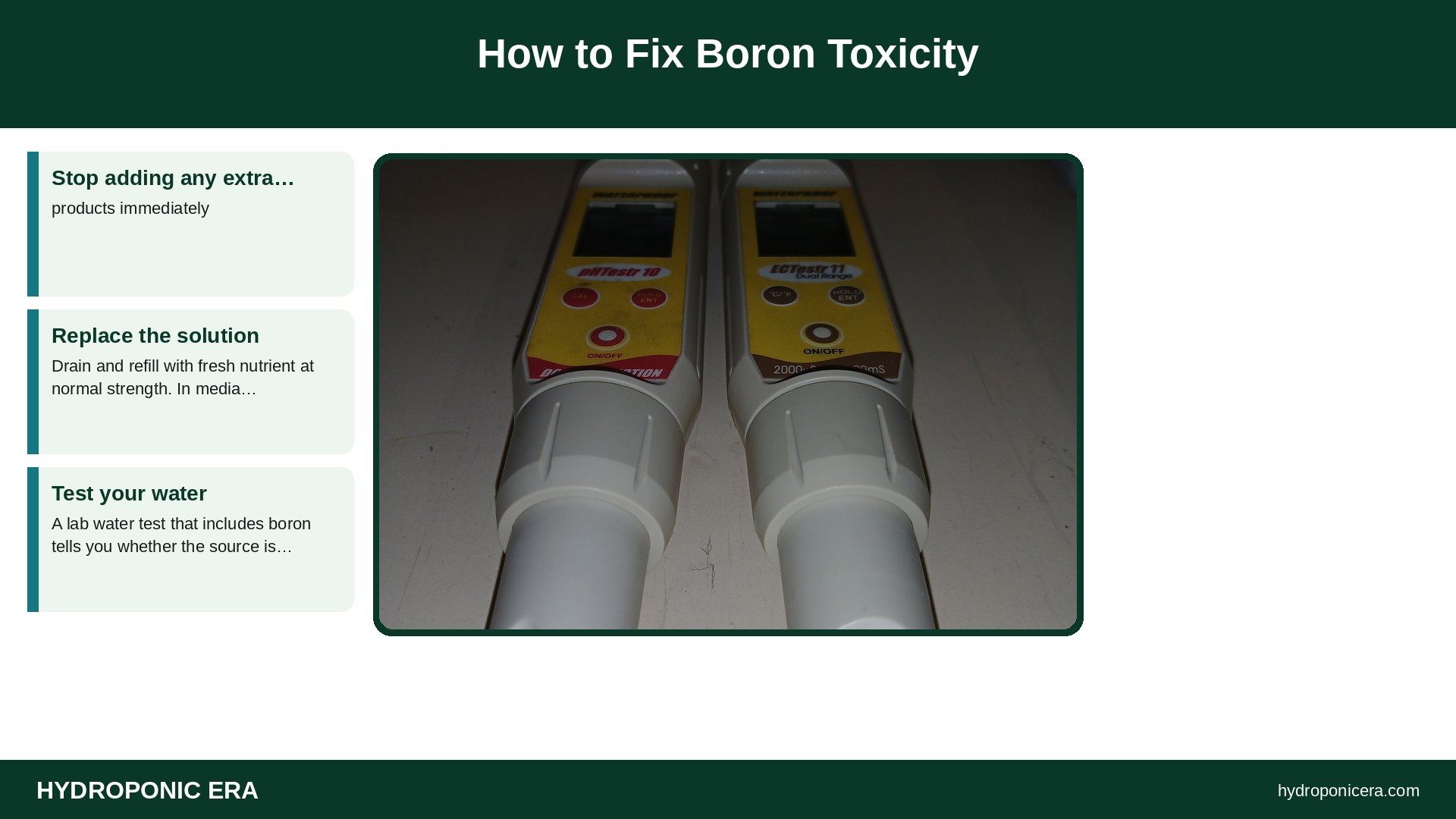
- Stop adding any extra boron products immediately.
- Replace the solution. Drain and refill with fresh nutrient at normal strength. In media systems, flush with plain or low-EC water first. See when to flush.
- Test your water. A lab water test that includes boron tells you whether the source is the issue.
- Switch water if needed. Reverse osmosis removes much of the boron, though removal varies with pH and membrane. See RO systems.
- Remove badly damaged leaves that won’t recover, and watch new growth.
Damaged leaves won’t turn green again. Judge recovery by new leaves over the next one to two weeks.
How Much Boron Is Normal?
Standard hydroponic recipes include boron at low concentrations, generally well below 1 ppm. Penn State Extension’s hydroponic nutrient recipes list boron among micronutrients at small amounts. UC IPM notes that irrigation water above about 0.5 ppm boron can be high for sensitive plants, especially when fertilizers add more. If you use a commercial complete nutrient at label rates with typical tap water, boron is rarely a problem.
Sensitive Crops
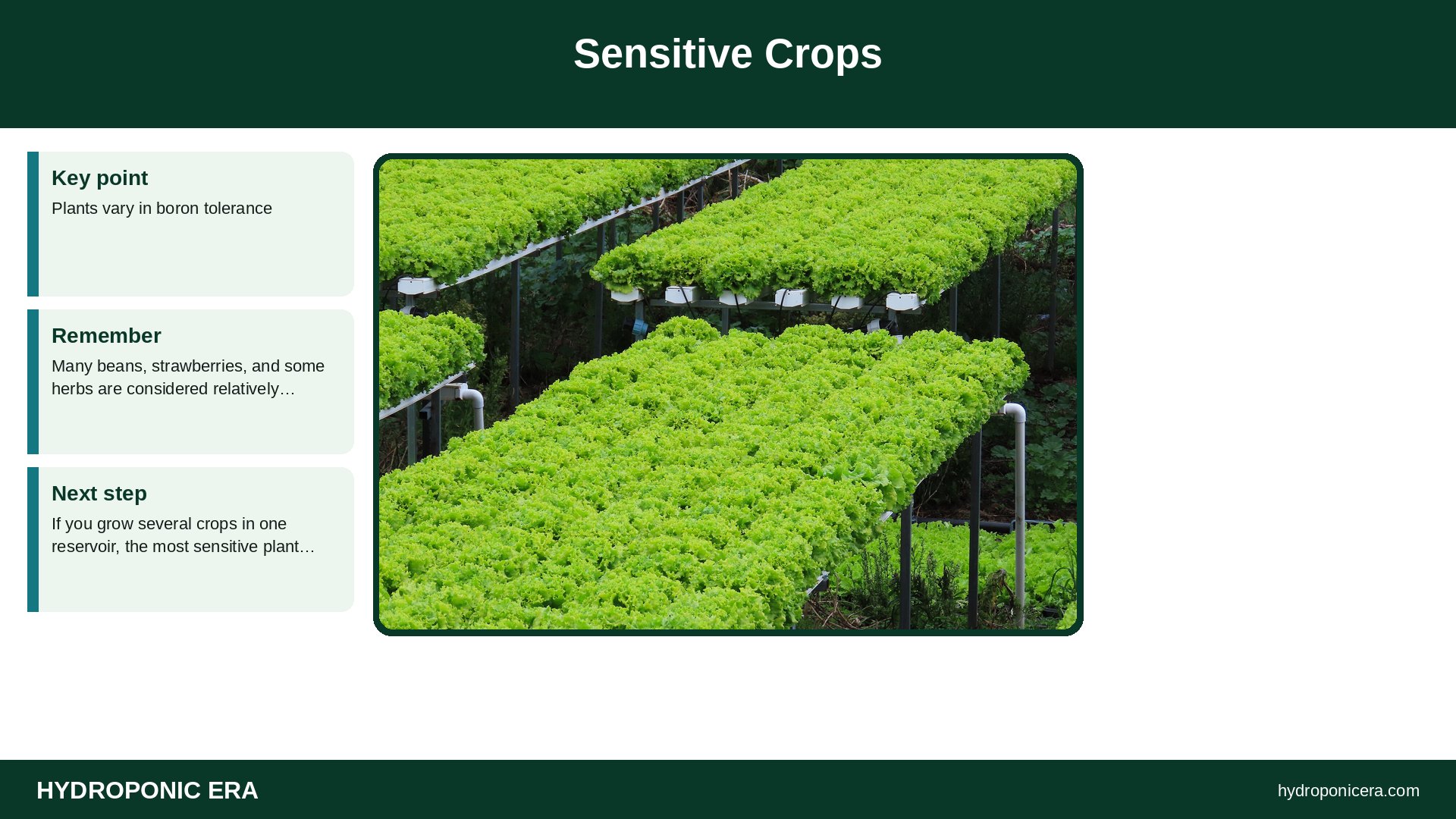
Plants vary in boron tolerance. Many beans, strawberries, and some herbs are considered relatively sensitive, while crops like tomatoes and some brassicas tolerate more. If you grow several crops in one reservoir, the most sensitive plant sets the limit. See multi-crop reservoir compatibility.
Prevention Checklist
- Use one complete nutrient at label rates instead of stacking products.
- Don’t add borax or boric acid unless a test confirms deficiency.
- Test new water sources, especially wells.
- Change solution fully every 1–3 weeks.
- Keep a log of everything added to the reservoir. See record keeping.
Testing Options
Home EC meters can’t measure boron specifically. For an accurate answer, send a water sample to a certified lab or your state’s extension soil and water testing lab. Some labs also test nutrient solutions or plant tissue, which shows whether leaves contain excessive boron.
Recovering Plants After Boron Toxicity
Damaged leaves won’t turn green again, so judge recovery by new growth. After lowering boron in the solution, many crops put out clean leaves within a week or two. Remove badly burned older leaves to tidy the plant, but don’t strip so many that it can’t photosynthesize. Keep pH in range and avoid sudden EC changes while the plant recovers. If boron toxicity keeps coming back after fresh solution, the source is likely your water or a nutrient that’s being overdosed, so test those before your next mix.
FAQs: Boron Toxicity in Hydroponics
What does boron toxicity look like?
Yellowing and brown scorch at the tips and edges of older leaves, spreading inward over time.
Can boron toxicity be reversed?
Damaged leaves won’t recover, but new growth will be healthy once boron levels return to normal.
Does RO water remove boron?
Reverse osmosis removes much of it, though efficiency varies. Test after treatment if boron is a known problem.
Should I add borax to my hydroponic system?
Only if a test confirms deficiency, and in very small, carefully measured amounts. Overdosing is easy.
Is boron toxicity the same as nutrient burn?
Both scorch leaf edges, but nutrient burn comes from high overall EC, while boron toxicity comes from excess boron specifically.
Sources
- UC IPM — Boron Toxicity or Other Specific Ions in Excess
- Michigan State University Extension — Boron in vegetables: Not too little, not too much
- Penn State Extension — Hydroponics Systems: Nutrient Solution Programs and Recipes
- Photo credits (Wikimedia Commons, edited with titles): Leaf spot grey necrosis by Savina Jo (CC BY-SA 4.0); Water droplets on a late cotoneaster (Cotoneaster coriaceus) leaf, Jardim da Fundação Calouste Gulbenkian, Lisbon, Portugal julesvernex2 by Jules Verne Times Two (CC BY-SA 4.0); Several green unripe and red ripe tomatoes growing on the vine. (086c449c-117b-44f6-a7c4-e2acbf284092) by NPS (Public domain); PH- und Leitfähigkeitsmessgeräte by Rotkaeppchen68 (CC0); Hydroponic lettuce @ Plaine des Cafres 03 by Rémih (CC BY-SA 4.0)