
Quick Answer
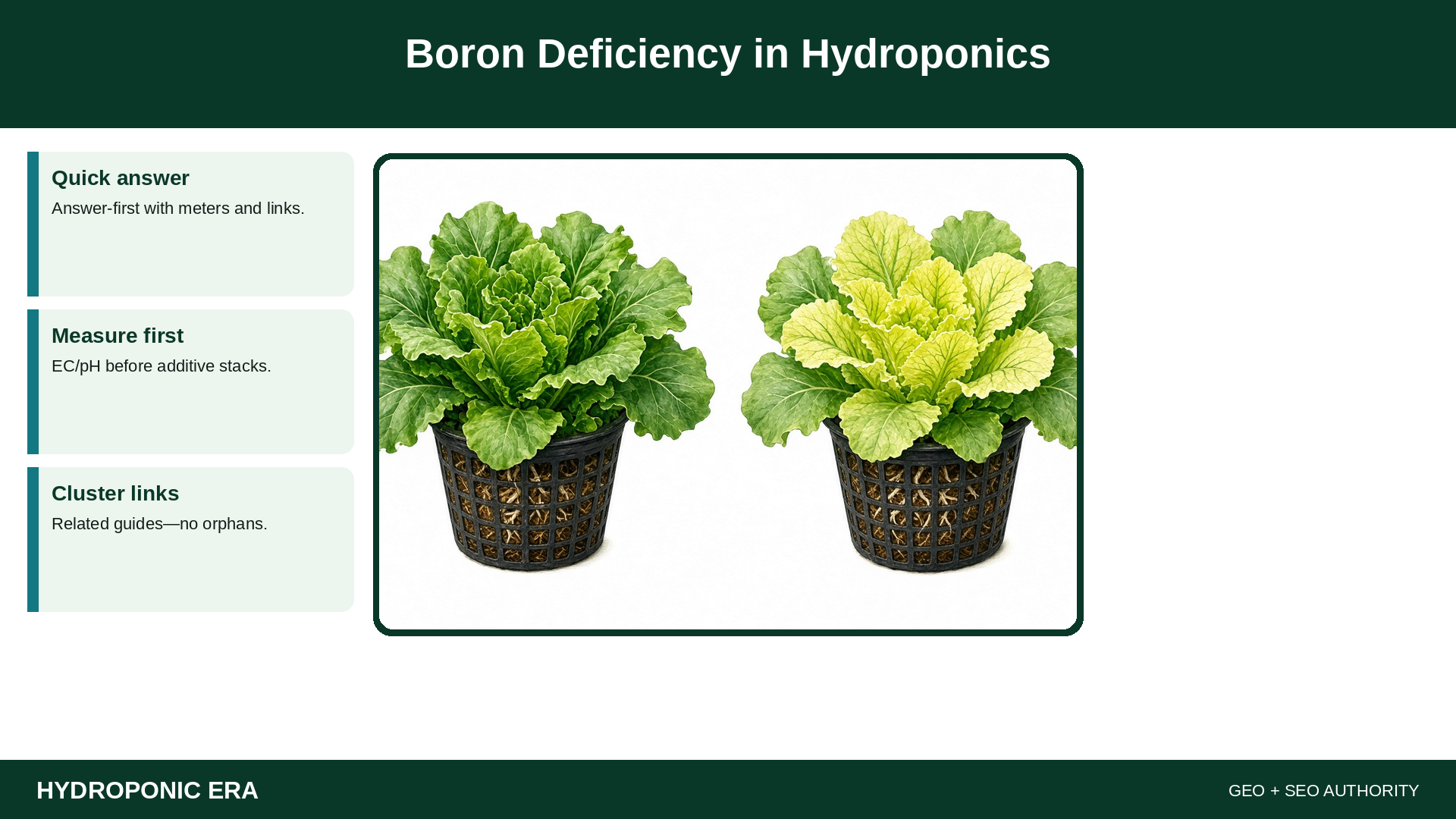
Boron deficiency in hydroponics often hits growing points and new tissue: death of tips, brittle or distorted new leaves, hollow stems in some crops, and poor flowering/fruiting structures.
Before you buy a single-element bottle, measure EC and pH, inspect roots, and compare old-vs-new leaf patterns using the deficiency chart, lockout, and yellow leaves.
Key Takeaways
- Boron is immobile—watch growing points.
- Do not hammer-dose boron; excess is harmful.
- Boron Deficiency patterns should be confirmed with EC/pH and leaf-position logic—not vibes.
- Penn State hydroponic nutrition materials explain essential-element functions—use them for literacy, not invented home ppm guarantees.
- Oklahoma State EC/pH guidance keeps soilless chemistry in a workable band while you troubleshoot.
- Many ‘deficiencies’ are lockout, low overall EC, roots, or light problems in disguise.
- Prefer complete nutrient resets over stacking random single-element bottles when you are unsure.
- Immobile/poorly mobile: watch whether symptoms start on old or new leaves.
- Log changes so you do not oscillate between deficiency and toxicity.
Related HydroponicEra guides
- Tip burn
- Ca/Mg
- Tomatoes
- Nutrient deficiency chart
- Yellow leaves
- Nutrient lockout
- EC and TDS
- pH control
- Nutrients
How to Recognize Boron Deficiency
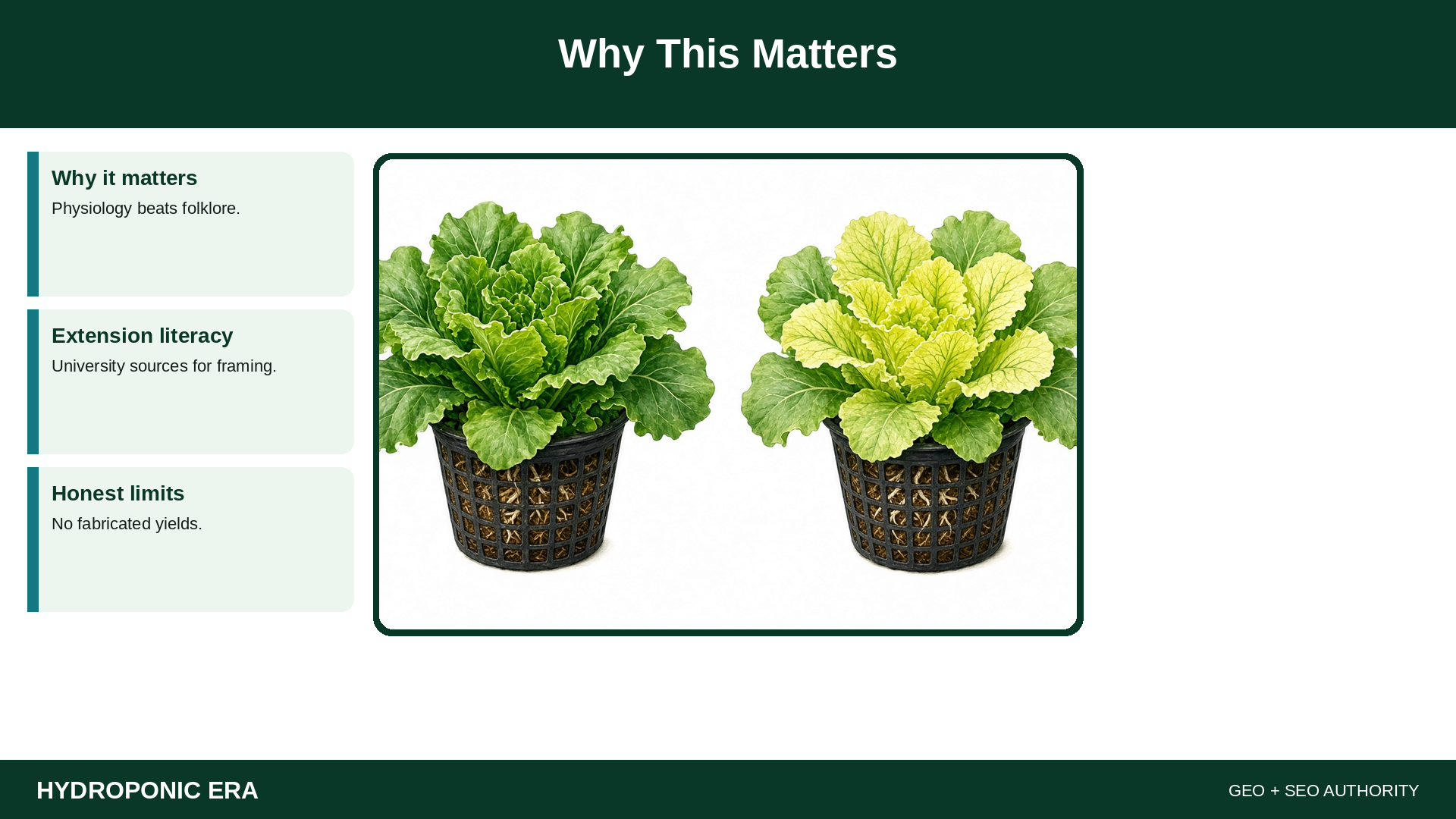
Boron deficiency in hydroponics often hits growing points and new tissue: death of tips, brittle or distorted new leaves, hollow stems in some crops, and poor flowering/fruiting structures. Boron is immobile; symptoms stay on new growth. Excess boron is also dangerous—dose carefully.
Lookalikes: calcium disorders (tip burn, blossom-end rot patterns), heat damage to tips, pest damage to meristems, and general new-growth distortion from other micros.
Always differential-diagnose with calibrated meters and root inspection. Read yellow leaves, lockout, and deficiency chart alongside this page.
NC State’s soils and plant nutrients handbook and Penn State hydroponic nutrition resources are useful for element-function literacy. Hydroponics still depends on the same essentials—delivered in solution.
Step-by-Step Diagnosis Before Adding Correctors

- Photograph which leaves are affected (old vs new) and the pattern (interveinal, uniform, tip, distortion).
- Measure reservoir EC/TDS and pH with calibrated meters.
- Inspect roots for brown slime or foul smell.
- Check light intensity—pale stretchy plants may need photons first.
- Review solution age and whether a complete fertilizer was used.
- If pH is out of band, correct availability first.
- If EC is very low, raise complete strength or reset solution.
- Only then consider a targeted correction if the pattern clearly matches and overall nutrition is otherwise sane.
- Reassess over several days; do not change five variables overnight.
- Log results for the next cycle.
- Never correct boron aggressively—narrow adequacy window.
Boron Deficiency vs Lookalike Problems
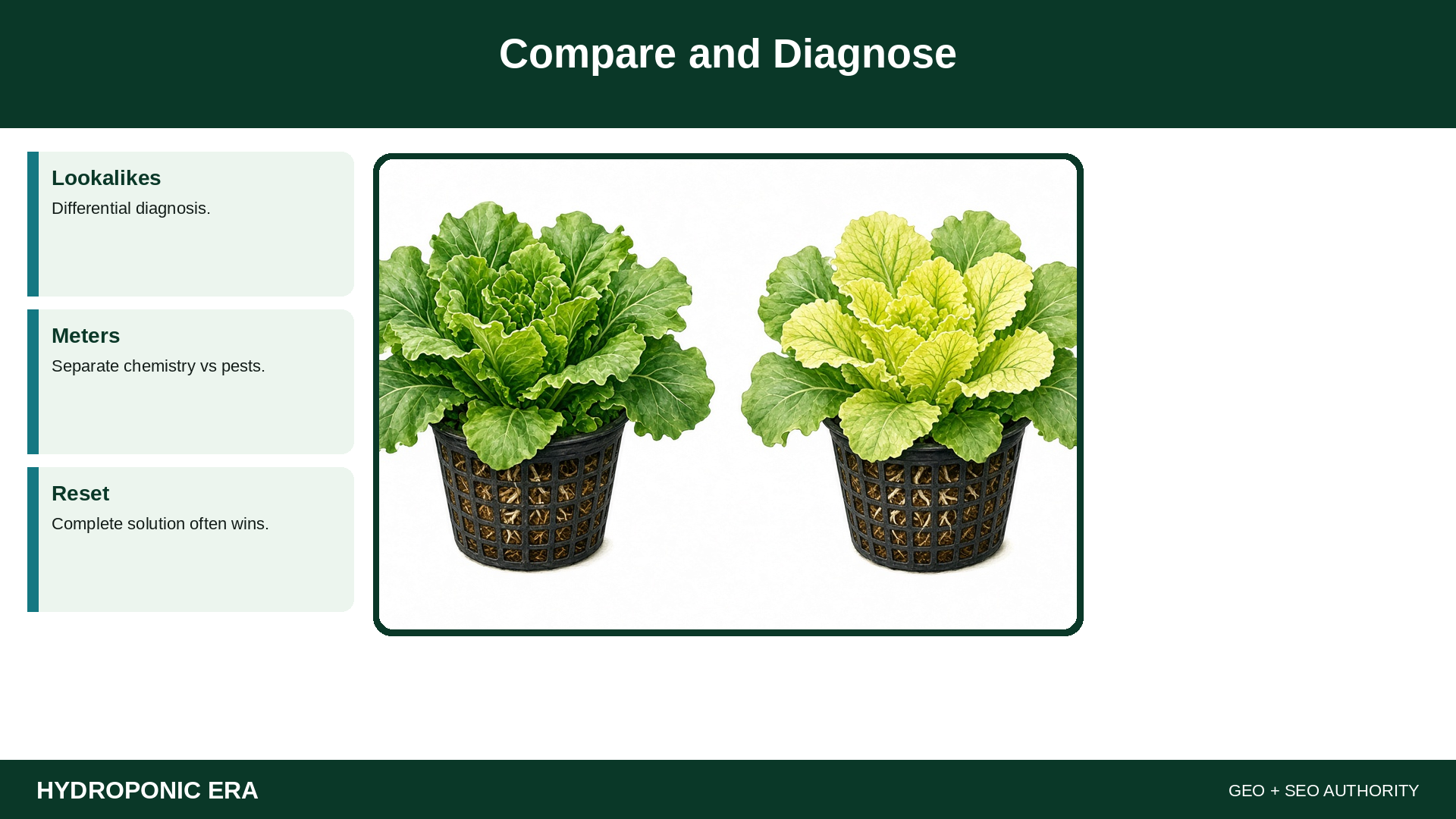
| Observation | More likely | First check |
|---|---|---|
| Dead growing points + brittle new growth | Possible B short | Review B in formula; careful correction |
| Tip burn on leaf margins | Ca / RH / EC more often | Tip burn + Ca/Mg guides |
| BER on tomatoes | Ca transport classic | Blossom-end rot guide |
| Distorted new leaves + high pH | Multiple micros | pH + complete micros |
| Only after heavy RO water DIY | Possible missing B in salts | Check recipe |
Iron deficiency preferentially hits new leaves with interveinal chlorosis—see iron deficiency. Nitrogen often pales older leaves first—see nitrogen.
Common Mistakes

- Hammer-dosing boron
- Confusing tip burn with boron every time
- Ignoring calcium and humidity
- Using soil boron folklore rates in hydro
Troubleshooting After You Act
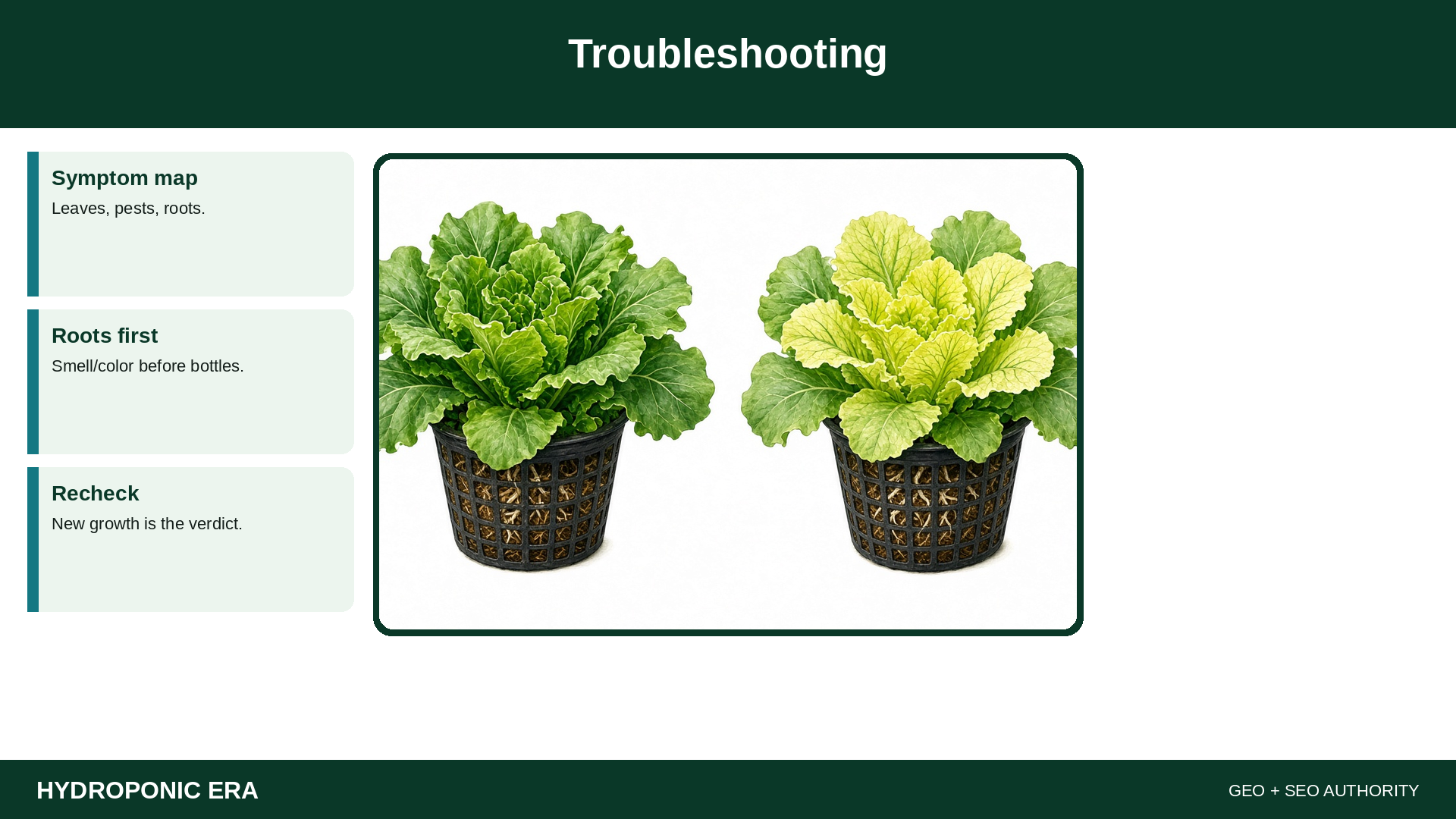
| After you act | If you see | Next |
|---|---|---|
| Tiny careful B adjust | Tips resume | Stop; monitor |
| Heavy B add | Leaf edge burn / toxicity | Flush/reset immediately |
| No change | Likely Ca/climate | Tip burn + Ca guides |
| Reset complete | Stable new growth | Maintain logs |
Related: nutrient burn, slow growth, Ca/Mg, fix pH.
Practical Framework: Completeness, Then Precision
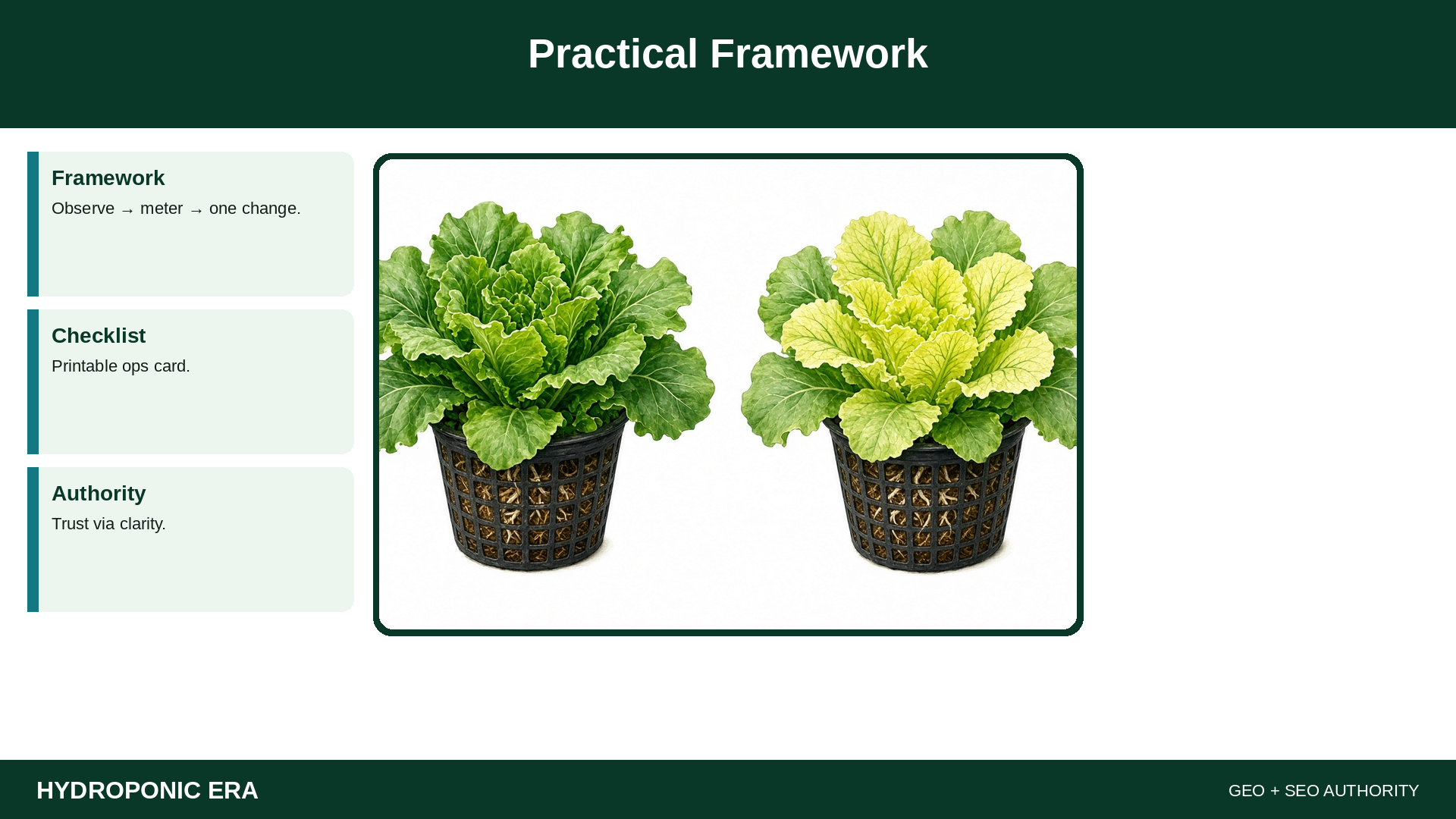
Boron has a narrow adequacy window. Beginners should treat B deficiency as uncommon if using complete hydro fertilizers—and treat B toxicity as a real risk if they self-dose.
Framework: confirm growing-point symptoms → rule out Ca/tip-burn climate issues → verify fertilizer contains B → correct cautiously or reset complete formula. See tip burn, Ca/Mg, and tomatoes for related fruiting disorders.
Penn State nutrition principles and greenhouse fertilizer management references support precise, complete nutrition—not kitchen chemistry with household boron products.
What to Check Before You Add a Corrector
- Which leaves show symptoms first (old vs new)?
- Current EC and pH with calibrated meters?
- Roots healthy (color/smell)?
- Light adequate (not pale+leggy from photons)?
- Complete fertilizer or random mix-and-match salts?
- Solution age / last reset?
- Did you already add multiple correctors this week?
Boron’s Narrow Window and Lookalike Tip Disorders

Boron deficiency targets growing points because B is immobile in plants. Dead tips and brittle new leaves sound dramatic—and they also sound like calcium tip disorders, heat damage, and mechanical or pest injury. Always rule out tip burn, Ca/Mg, and climate before declaring boron guilt.
The adequacy window is narrow. That is why complete hydro fertilizers that already include boron are the safe default, and why improvised household boron products are a poor idea in recirculating systems. Excess boron can burn margins quickly.
RO + raw-salt DIY growers should verify their recipe includes a micronutrient package with B. If you use a reputable complete liquid nutrient, isolated B deficiency should be lower on the suspect list than pH, EC, Ca transport, and humidity.
Fruiting growers sometimes confuse blossom-end rot (calcium transport) with boron stories. Keep tomato and pepper blossom-end rot thinking separate unless evidence truly points to B.
FAQs

Is boron deficiency common with complete bottles?
Less common; more often Ca/climate lookalikes or DIY omission.
Why is boron scary to correct?
Narrow range—excess damages plants quickly.
New growth or old?
Immobile—new growth/growing points.
Related to blossom-end rot?
Different element story (Ca) but tip/fruit disorders get mixed up—diagnose carefully.
RO water DIY risk?
Yes if salt recipes omit micronutrients including B.
Best safe approach?
Use complete hydro nutrients; avoid improvised boron sources.
Measurement discipline beats memory. Calibrate pH/EC meters on a schedule, write down readings when symptoms appear, and change one major variable at a time. If you already added multiple correctors this week, pause and reset to a complete nutrient solution at a known EC rather than stacking further. For overlapping pale-leaf cases, keep yellow leaves, deficiency chart, and lockout open beside this article so readers can cross-check patterns without orphan pages.
Original troubleshooting loop: observe → meter → roots → light → complete recipe → wait → log. That loop is the expertise signal HydroponicEra wants—not fabricated farm diaries or invented cure percentages.
If growing points die after a heat spike, cool the room and review irrigation uniformity before boron dosing. Heat-damaged meristems are not fixed by micronutrient panic.
Sources
- Penn State Extension — Hydroponics Systems and Principles of Plant Nutrition
- NC State Extension — Soils and Plant Nutrients (Extension Gardener Handbook)
- Oklahoma State University Extension — Electrical Conductivity and pH Guide for Hydroponics
- Oklahoma State University Extension — Hydroponics
- University of Florida IFAS — CV265: Fertilizer Management for Greenhouse Vegetables
- Michigan State University Extension — Hydroponics as an agricultural production system
- Ohio State University Extension — HYG-1263
- University of Kentucky Greenhouse Horticulture — Root disease management in hydroponic systems (PDF)